Balancing projects is frequently like walking on a tightrope; you wish to deliver within the right time, the question of what is slack in project management from wanting to overcommit the resources, but at the same time, you do not want to leave a safety margin that may lead to a disaster. It is where slack time (also known as “float”) is an insider advantage.
Through this informative blog, we will unveil the mystery behind the meaning of Slack in project management, why Slack is very important to any serious project manager, and how you (particularly when using tools such as Tivazo) can use Slack time to your advantage and ensure your projects run smoothly, accurately, and with little stress. At the conclusion, not only will you learn what slack is and what float is, but you will be in a position to compute and apply slack time correctly.
What is Slack in Project Management?
In project management, slack time is described as the duration of time that a task or an activity can be postponed without bringing about a postponement to:
- The last date of the project completion, or
2. The beginning of another task (when the delayed task is connected with another one).
In more basic words: Slack = breathing room. Its inherent buffer time protects your project schedule in case of unexpected delays – delays in other project participants to give feedback, or the unavailability of resources.
Slack may take the form of hours, days, or weeks, depending on the size of a project. A two-day Slack task may be postponed to a maximum of two days and still have the project on track.
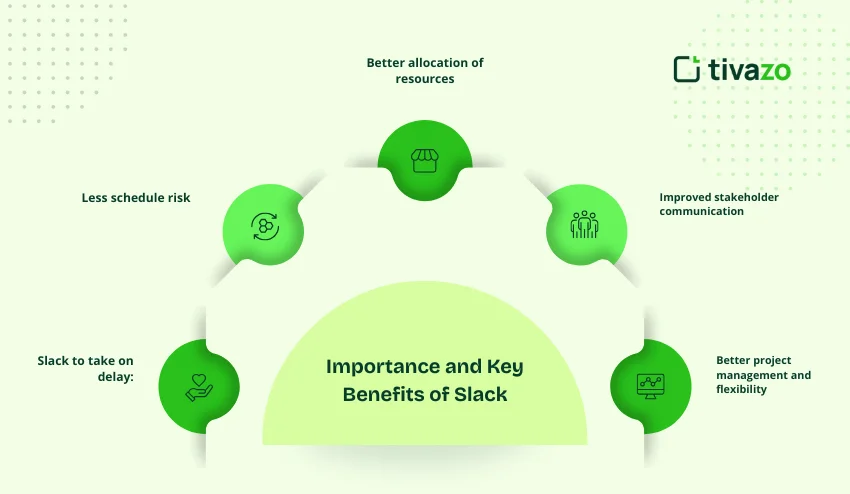
The Importance and Key Benefits of Slack: Why Slack Matters
Slack is not merely a convenience for scheduling, but it is a strategic tool. Here’s why slack time is vital:
- Slack to take on delay: Timelines can be derailed by unforeseen problems (e.g., a supplier slipping, a team falling ill). Slack provides a buffer which is internalized such that little hiccups do not grow to become giant issues.
- Less schedule risk: It is not very often that projects run flawlessly. Slack is like an insurance cover, whereby it mitigates the chances of failure to meet deadlines.
- Better allocation of resources: With an understanding of the tasks with slack, you can dynamically reassign resources to high-priority tasks or those that are time-sensitive.
- Improved stakeholder communication: Slack enables you to be realistic about the timelines – explain to your stakeholders that some activities have some buffer time, which results in credibility should things go wrong.
- Better project management and flexibility: Slack gives project managers room to reprioritize, reschedule, or re-adjust without throwing the project off track.
It is useful to think of Slack as a shock absorber in your schedule to make use of it as a strategic resource, not as dead time.
Slack vs Float: Are They Equivalent?
| Name | ✔️Is it possible to delay a task without affecting the project end date? | ✔️Is it possible to postpone the task without impacting the following tasks? | Notes |
| Slack | ✔️Yes (by slack amount) | ✔️Often yes (when there is a free slack/float) | General buffer – often is total slack. |
| Float | ✔️Depends (free vs total float) | ✔️Yes (when free float) | Used particularly in the Critical Path Method (CPM). |
| Total Float | ✔️Yes, | ❌A delay in interconnected activities or the completion of the project | The expanded margin of scheduling flexibility |
| Free Float | Hypothetically, but not necessarily, when there are no dependent tasks | ✔️Yes | Smaller, more conservative buffer. |
Practically: PMs interchange the terms slack and float. Clarity in your schedule is of greater importance, however, whether you are working with project-management tools or showing plans to stakeholders.
What is the role of Slack in Project Management?
Slack is not merely a theory, but it has very diverse applications in the real world that enhance the delivery of the project.
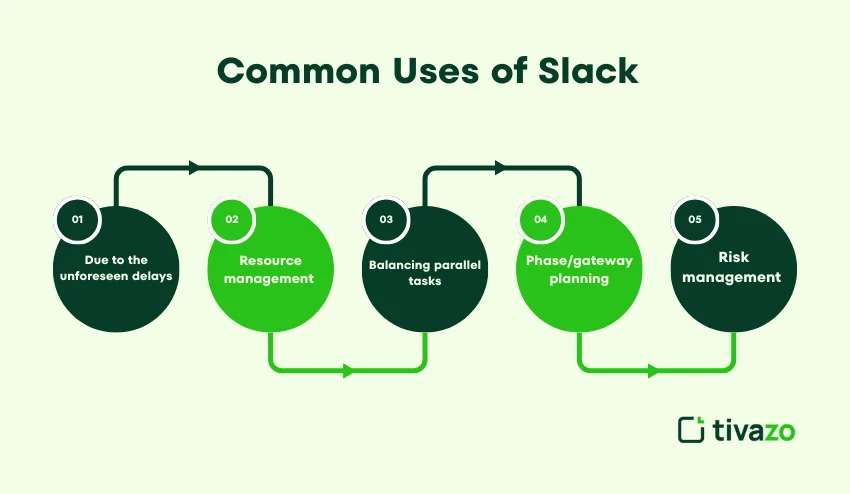
Common Uses of Slack
- Due to the unforeseen delays – such as waiting until someone approves of you, a falling ill team member, or a buffer who is there to take the place of a dependency.
- Resource management constraints– the capacity to re-allocate resources in case a task with slack can be postponed.
- Balancing parallel tasks – in multi-task projects that have numerous overlapping tasks, slack is used to balance the workload in a way that it does not introduce any bottlenecks.
- Phase/gateway planning- Phase/gateway planning employs slack around key milestones to allow testing, revisions, or review by stakeholders.
- Risk management and contingency planning – Slack is its own contingency, and it does not require a crisis response.
Example Scenario
Example of a software development project:
Task A: Requirement gathering- 5 days.
Task B: UI design – 10 days (commences on completion of Task A)
Task C: Backend configuration – time 7 days (may begin on completion of Task A)
Task D: Integration – is contingent on B and C.
With UI design (Task B) and Backend (Task C) running concurrently, however, backend usually takes less time, you could develop slack in Task C – allowing it to complete any time between 7 to 10 days without preempting Integration (Task D). The fact that Slack gives some flexibility if the backend developers have to perform urgent bug fixes in other areas.
How to Calculate Slack Time
The formal method of the Critical Path Method (CPM) lets you put values on the slack time belonging to each task.
Follow these steps:
Draw the task dependency diagram
Determine the earliest start (ES) and the earliest finish (EF) of each task (forward pass). Determine the latest start (LS) and latest finish (LF) of each task (backward pass) – do not postpone the project.
Calculate slack (Total float) at each task:
Slack = LS – ES, or Slack = LF – EF In case Slack = 0, then that task is a critical path task, and any delay will cause a direct delay on the project end date.
The Importance of Slack Time to Project Managers?

As a project manager (or will become one), slack time isn’t simply a convenience in planning, but one of the pillars of project governance.
- Buffer against reality uncertainty – Now, in the real world, things do not get completed as planned. Slack time provides the space to move about and delays gracefully.
- Improved reliability of delivery – Successful projects completed in time earn your credibility and the trust of stakeholders.
- Resource optimization and conflict avoidance – Slack enables you to balance teams, reallocate work, and eliminate burnout or bottlenecks.
- Risk mitigation – Slack provides an early alert mechanism that will inform you about possible delays early, before they become critical.
Any slight delays at the initial stages of the project may have multiplied effects without slack, endangering project deadlines, budgets, and stakeholder trust.
Best Practices in computing and implementing slack time in project management
To ensure that Slack is really effective – and not merely an arbitrary buffer – the project managers would need to adhere to the following best practices:
1. Always deploy a network-based scheduling technique.
Simple Gantt-chart time estimates are to be avoided. Calculate true slack using dependency-based techniques such as CPM or PERT based on task relationships.
2. Determine the difference between total float and free float/slack
- Total float: a buffer that safeguards the project completion date.
- Free float/slack: a buffer that ensures the following dependent tasks.
- Free float is used when you would like to ensure that downstream tasks are not influenced.
3. Write down Slack on your project plan
Include columns with labels of Slack / Float or Buffer – this will make your team aware of the flexible tasks. Transparency matters.
4. Check Slack at significant stages of the project
Slack may become less popular as time passes by, particularly when there is a change in dependencies. Regular re-evaluation keeps your buffer to the point.
5. Avoid over-allocating slack
Excess buffer may result in inefficiency – idle resources or runs in low-priority processes. Balance is key.
6. Risk management: Use Slack, not procrastination
Slack time must be used as a buffer to actual risk situations, and not as an excuse to be complacent. Use it wisely.
7. Add live tracking solutions
Use project-tracking tools that bring forward slack times, bring out critical tasks, and notify when slack is consumed. That is where it is beneficial to apply such a tool as Tivazo.
The difference between Slack Time and the Contingency of a project
Interestingly enough, slack or float is not interchangeable with project contingency (additional budget, buffer phases, or contingency reserves). Slack is created at the task level of the schedule, and contingency is more of a high-level buffer (in terms of time, money, or resources) that is held in reserve against strategic risks. Both are useful; however, Slack is accurate, quantifiable, and is linked to particular activities.
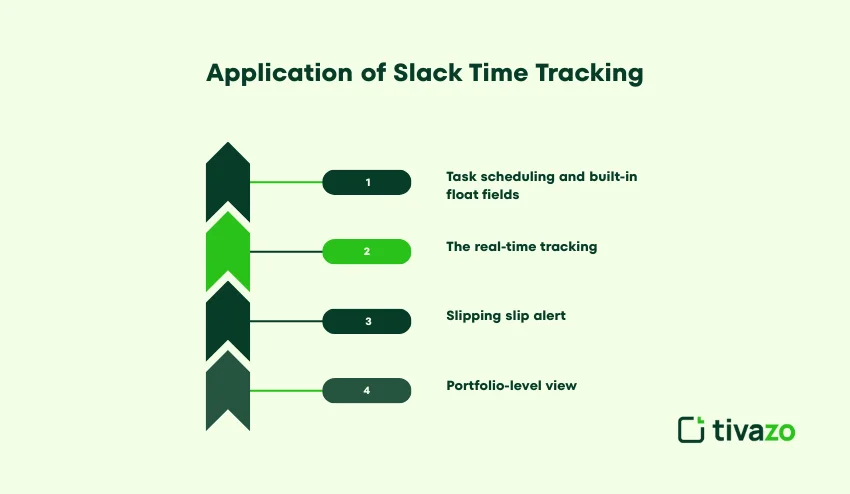
Application of Slack Time Tracking via Tivazo
Slack time can be easily integrated with Tivazo if you are using it, or if it is considered by you in your project or time-tracking needs:
- Task scheduling and built-in float fields: Tivazo has task dependencies and time. You can define the time associated with each task, and it will auto-calculate the amount of slack and the critical and non-critical tasks.
- The real-time tracking: Tivazo tracks the actual durations versus planned durations as tasks are made progressively, providing a live view of Slack being used.
- Slipping slip alert: When the task slack approaches zero or negative values, Tivazo can alert project leaders so that they can re-plan in advance before deadlines are missed.
- Portfolio-level view: Tivazo allows you to see Slack across all projects, when you have more than one project being run by the same team – it allows you to manage resources and prevent over-commitment.
The mindful use of slack time and its dynamic monitoring can significantly lessen the risk of projects, enhance the rates of deliveries, and give the project stakeholders reasonable estimates of the timeframes.
Top Ten pitfalls in Slack Time
Making slack a kind of free time, resulting in procrastination or slight-priority delays.
- Excessive use of Slack rather than schedule optimization – good planning ought not to optimize schedule buffers (should minimize them).
- Failure to update Slack on changes in the scope – project plans change; Slack needs to be recalculated to ensure that the schedule remains accurate.
- No dependencies and resource constraints – Slack can only make sense when dependencies and resources are defined correctly.
- Not communicating Slack to stakeholders – when Slack is not clear, stakeholders might misread delays or buffer consumption.
Conclusion
Slack (or float) is not just a scheduling concept, but a strategic safety net. Managed effectively, slack time can provide flexibility, reduce risk, aid in resource optimization, and ensure that projects are not derailed even at the last minute.
Combined with a powerful project management or time tracking software such as Tivazo, slack time is actually a living metric – not just a single number. It allows you to navigate projects with confidence, change, and provide reliability.