The interviewing for a position of a team lead might be stressful. Not only do you have to demonstrate confidence, but also leadership skills and address issues at a fast rate, but do so without panicking in the face of the hiring manager. It may be difficult to understand what questions will be raised and how to respond to them in a clear way.
This guide is here to help. You will get 40 actual team lead interview questions and their short sample answers, behavioral and situational question tips, and even specific to your brand, Walmart and Target. In addition, you can download a free checklist and train on it to be ready to do your interview.
Key Highlights:
- How to Answer Team Lead Interview Questions
- Team Lead Interview Questions with Strong Sample Answers
- Behavioral Team Lead Interview Questions
- Walmart and Target Team Lead Interview Questions
- Skills Companies Want in Team Leads
- Tips to Succeed in a Team Lead Interview
How to Answer Team Lead Interview Questions
All answers in the role of a team leader must demonstrate:
- You understand people.
- You take responsibility.
- You focus on results.
A quick way to do that is the STAR method:
- Situation — What happened?
- Task — What was your role?
- Action — What did you do?
- Result — What improved?
This is a simple way of beginning many answers:
“In my last role, I noticed… so I took action to… and the result was…”
Also remember:
- Give actual examples of the work or school.
- Keep answers short and clear.
- Add a positive result where possible.
40 Team Lead Interview Questions with Strong Sample Answers
This section is organized into topics in order to assist you in studying. This will allow one to concentrate on a particular area at a time and know what interviewers are after. The questions also contain a brief sample answer that you can use to modify to your experience. Examples to practice and be more confident by the time of your interview.
Quick navigation
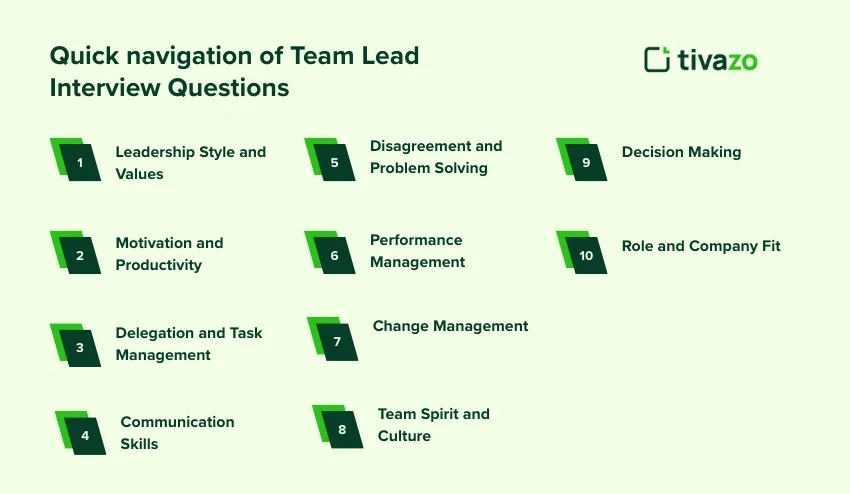
- Leadership Style and Values
- Motivation and Productivity
- Delegation and Task Management
- Communication Skills
- Disagreement and Problem Solving
- Performance Management
- Change Management
- Team Spirit and Culture
- Decision Making
- Role and Company Fit
Leadership Style and Values
1. Describe your leadership style.
ans: I lead through support. I establish clear expectations, hear issues, and keep people on track. I lead the team and do not manipulate.
2. What motivates you as a team leader?
ans: I like to see teammates develop. It motivates me when one learns a new skill or when he/she apply the solution to a problem by themselves.
3. How do you define success as a leader?
ans: Success implies that the group achieves objectives and everyone feels proud of his/her job. Provided they are liking the job and are getting better every week, I am fulfilling my job.
4. How do you build trust with your team?
ans: I am also an honest person and a promise keeper. In case I am not aware of something, I state that I do not and then seek the answer.
5. What values guide you as a leader?
ans: Justice, responsibility, and respect. I do not treat people in ways I do not want to be treated.
6. How do you lead by example?
ans: I have the same behavior I demand. When we have to work late in the day, I stay late as well. In case of a difficult job, I assist first.
Motivation and Productivity
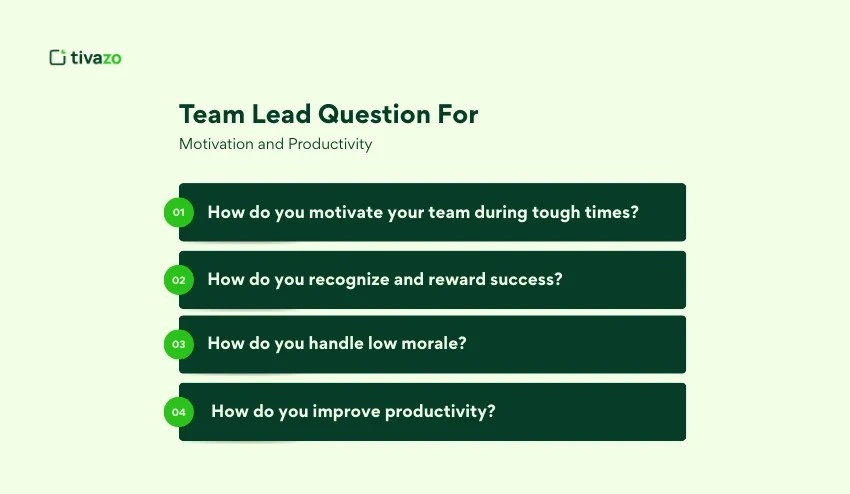
7. How do you motivate your team during tough times?
ans: I break work into smaller tasks, praise progress, and explain why the job is important.
8. How do you recognize and reward success?
ans: I congratulate people individually and in the meeting. Even the mere acknowledgment gives confidence.
9. How do you handle low morale?
ans: I enquire the cause of frustration. Then I assist in clearing the roadblock and make the work less heavy.
10. How do you improve productivity?
ans: The first thing I am going to do is determine whether the process is slowing people down. Productivity problems can be solved by using better tools or instructions.
Delegation and Task Management
11. How do you delegate tasks effectively?
ans: I assign tasks to competencies, clarify the purpose, and monitor progress without being micromanaging.
12. How do you decide who gets which task?
ans: I consider ability, volume of work, and desire to learn new things.
13. How do you manage workload differences between team members?
ans: I also put tasks on a weekly basis and request feedback to ensure that no one is overworked.
14. How do you handle many deadlines at once?
ans: I prioritize work based on urgency and impact and remind the team of the priorities on a daily basis.
Communication Skills
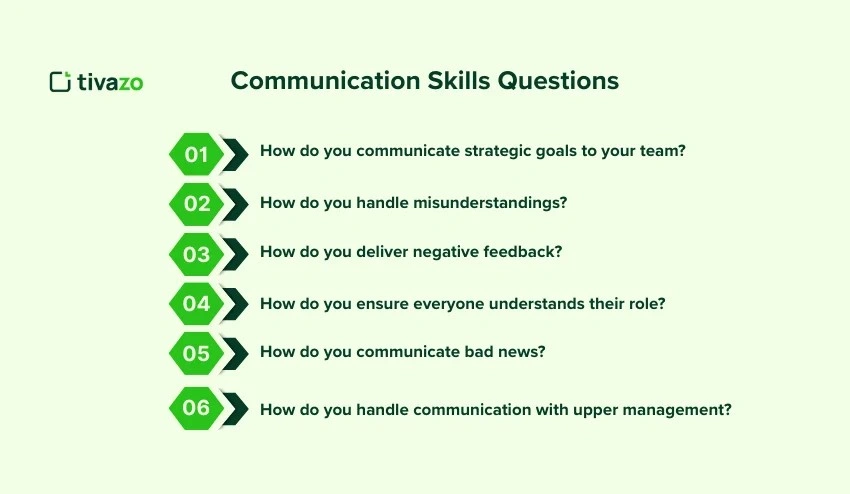
15. How do you communicate strategic goals to your team?
I will divide large goals into specific steps and remind the team about how their work contributes to the overall picture.
16. How do you handle misunderstandings?
I request the two individuals to clarify their position and paraphrase it to make everyone on the same page.
17. How do you deliver negative feedback?
Privately and with respect. I am not a personality-oriented person but a behavior-oriented one, and I have a simple plan to get better.
18. How do you ensure everyone understands their role?
After issuing instructions, I check back on them and request them to summarise important points.
19. How do you communicate bad news?
I remain truthful and explain. Then I provide clear follow-up steps so that people are aware of what they need to do.
20. How do you handle communication with upper management?
I post brief posts with facts and outcomes. I address issues at an early stage to ensure that they do not become a major issue.
Conflict and Problem Solving
21. How do you manage conflicts between teammates?
I communicate with every individual one-on-one, and then pull them together to reach a consensus.
22. Tell us about a leadership challenge you faced.
S: Two employees went on strike and slackened work.
T: I had to assist them in collaborating.
A: I heard both of them, established mutual expectations, and verified them each day.
R: They hit the deadline and were to become solid partners.
23. How do you resolve a dispute when both sides have strong opinions?
I focus on the goal. I will then ask them to contribute towards one thing that they can make concessions to meet halfway.
24. How do you handle a team member with a bad attitude?
I speak in a low tone, inquire about the situation, and offer encouragement. The majority of the attitudes can be changed upon being heard.
25. How do you identify risks early in a project?
I observe any delays, quality problems, or common errors. I read between the lines when I notice something is wrong.
Performance Management
26. How do you monitor team performance?
I monitor the developments on a weekly basis and compare the outcomes with our objectives. I post updates in order to make people aware of our progress.
27. How do you address underperformance?
I indicate the gap and inquire about what assistance is required. Next, we established a temporary uplift goal.
28. How do you prepare your team for performance reviews?
Nothing they see in the review is unexpected because I remind them of the most important gains and the aspects that should be better.
29. How do you help team members grow?
I assign learning assignments and demonstrate to them how they will benefit their career.
30. How do you identify future leaders?
I seek individuals who are responsible, helpful, as well as who remain calm when under pressure.
Change Management
31. How do you handle sudden changes from management?
I remain collected, present reasons as to why the change is important, and assist the team in adapting fast.
32. How do you get people to accept new tools or rules?
I demonstrate how the change helps them in their work or makes it easier or safer. They advocate change when they realise some gain.
33. Tell us about a time you led through a big change.
S: New software slowed down work, making it stressful.
A: I arranged training sessions of limited duration and matched skilled workers with others.
R: Two weeks later, the speed and accuracy were better.
Team Spirit and Culture
34. How do you create a positive team culture?
I believe in shared efforts, cheering in victories, and promoting the culture of seeking assistance.
35. What is your strategy for team building?
Minor operations executed at the workplace, such as the exchange of ideas in a short period, do not require additional time but create a solid connection.
36. How do you encourage new ideas?
I request recommendations every week and implement them when I can.
Decision Making
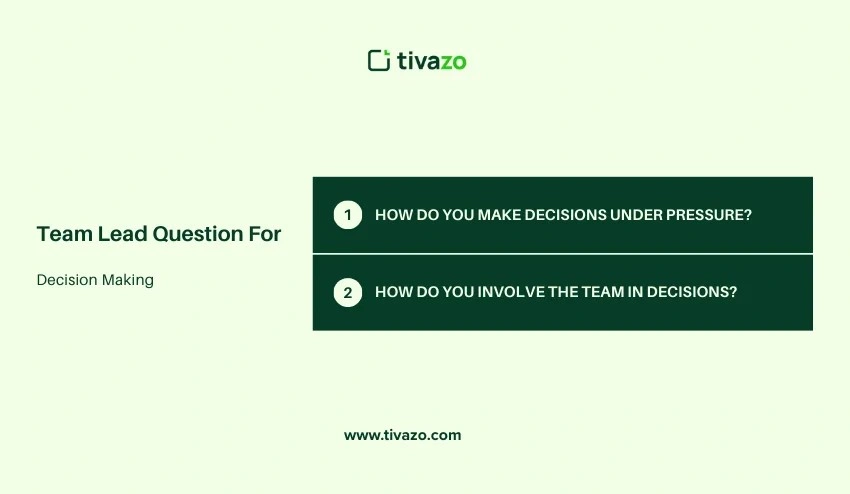
37. How do you make decisions under pressure?
I choose the least risky and quickest possible variant and enhance it later, when everything becomes quiet.
38. How do you involve the team in decisions?
I ask for input, discuss advantages/disadvantages, and make the ultimate decision.
Role and Company Fit
39. Why should we hire you as a team lead?
I remain calm under pressure, I am a communicator, and I make teams complete work on time. I will encourage what you want to achieve and assist people to perform at their best.
40. What makes you a good fit for this company?
I like working in a dynamic setting and serving customers. Your emphasis on teamwork is similar to mine.
Behavioral Team Lead Interview Questions
Behavioral questions help the employer understand how you behave in actual working conditions. They are designed to assess how you coped with challenges, managed your team, and made decisions under pressure.
To answer well:
- Share short stories
- Focus on the actions you took
- End with a positive result
Examples:
- “Tell me about a time you helped someone improve.”
- “Describe a time you handled a problem early.”
Providing behavior examples demonstrates to employers that you are proactive, trustworthy, and can utilize your leadership skills in real-life scenarios. This is usually the best indicator that you will make a successful team lead.
Walmart and Target Team Lead Interview Questions
The inclusion of this section will make you ready to undergo brand-specific leadership interviews.
Walmart
- How do you support great customer service during busy hours?
- How do you keep shelves filled and organized?
- How do you handle price or item issues from customers?
Target
- What do you do to get new employees to learn quickly?
- What do you do to accelerate the checkout lines?
- What do you consider as a strike balance between customer requests and team needs?
Trick: Demonstrate that the store’s safety, speed, and friendliness are important to you.
Skills Companies Want in Team Leads
Employers seek individuals who can lead a team, resolve issues, and ensure work is on course. Effective team leaders are clear, organized and uphold the development of their team members. Skills are the right ones that assist you in completing tasks, dealing with challenges in a calm manner and gaining the confidence of your team members and the management.
| Skill | What hiring managers look for | How to show it |
|---|---|---|
| Communication | Clear instructions | “I take responsibility.” |
| Accountability | Own results | “I track tasks daily”. |
| Organization | Meeting deadlines | “I coach teammates.” |
| People skills | Helping others succeed | “I coach teammates” |
| Calm control | Handling stress | “I stay steady during problems” |
Tips to Succeed in a Team Lead Interview
With a lot of preparation, you will come out as a lot more confident and able. The interviewer is able to make a good impression on you by concentrating on your experience, open communication, and knowledge about the company.
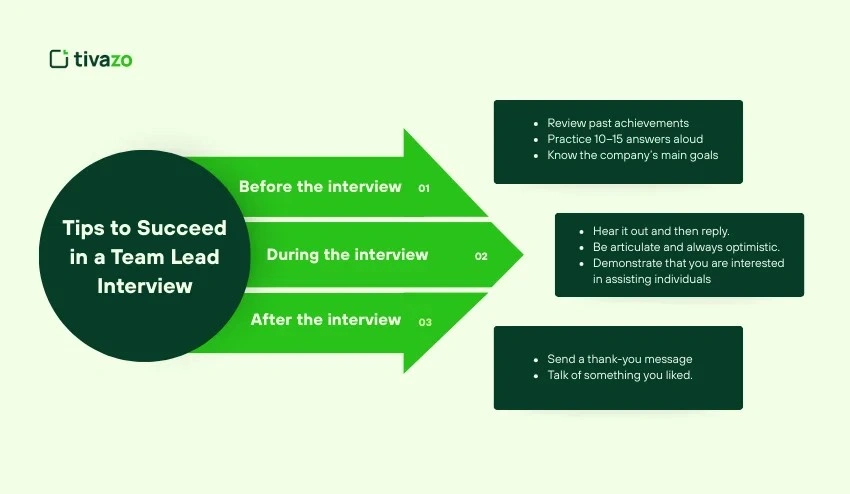
Before the interview
- Review past achievements
- Practice 10–15 answers aloud
- Know the company’s main goals
During the interview
- Hear it out and then reply.
- Be articulate and always optimistic.
- Demonstrate that you are interested in assisting individuals.
After the interview
- Send a thank-you message
- Talk about something you liked.
Such minor steps can produce a big last impression.
Conclusion
When you know what to expect and prepare in advance, team lead interviews become a lot easier. Being positive and demonstrating clearly how you support and guide your team will help a great deal. By walking into the interview calm and prepared, you automatically are going to come out as a competent leader. It is important to bear in mind that interviewers are not only seeking skills, but they would like to know that you can overcome difficulties, communicate effectively, and bring your team to success. When you exhibit these attributes, you make an impact of great magnitude.