Managing the absences of employees has risen to be a business-critical role as opposed to a routine HR activity. Since tracking employees absences where companies are embracing hybrid, remote, and flexible work structures, productivity, compliance, and cost control require control of what employees are doing in terms of attendance, sick leaves, and time off.
Under the systems in which tracking employees absences is based on spreadsheets, emails, or verbal approvals, there is always a chance of mistakes, which will also result in payroll errors, understaffing, and compliance issues. This is the reason why organizations in the present time are moving towards automated employee absence monitoring systems such as Tivazo, which consolidates all attendance, time tracking, and leave management in a single location.
This is a reference guide on all you need to know regarding monitoring the absences of employees, best practices, regulations such as the 7-minute timekeeping rule, and the way Tivazo can assist businesses in managing absences effectively.
What are employee absences?

Employee absences: This is the time when an employee is not available during the working hours that he or she is expected to work. Absences can be both intended and unintended and may directly influence productivity, staffing, and the accuracy of payroll.
Typical Forms of Employee Absences
- Paid time off (PTO): boss vacations/personal leave.
- Sick leave: sickness or doctor visits.
- Unpaid leave: authorized, yet not paid leave.
- Public holidays: holidays that the company accepts.
- Paternity or maternity leave of parents.
- Illegal absences: no-shows or unattended leaves.
Effective workforce absence management is based on the accurate tracking employees absences in these categories.
The Importance of Tracking the Absences of Employees
Monitoring the absence of employees always gives operational and financial advantages. It assists organizations in keeping the right payroll records, preventing overpayment, and ensuring that the right employee is paid a fair amount for the time he works. Businesses can also minimize unplanned absence by tracking employees absences patterns to detect common problems before they affect productivity.
- Improves payroll accuracy
- Lowers absenteeism without planning.
- Promotes compliance with labor law.
- Enhances workforce and shift planning.
- Establishes openness between the staff and the supervisors.
In addition to such advantages, efficient absence monitoring enhances responsibility and fosters a spirit of fairness. Employees are well aware of the policies regarding leaves, and the managers have real-time information on the availability of the workforce. In the absence of a trusted absence tracking system, companies will be at risk of paying more than necessary, staffing fewer employees than needed, failing to meet quality standards, and missing the chance to glean valuable data on attendance trends that influence long-term and sustainable performance and development.
What do you do to track the absences of employees?
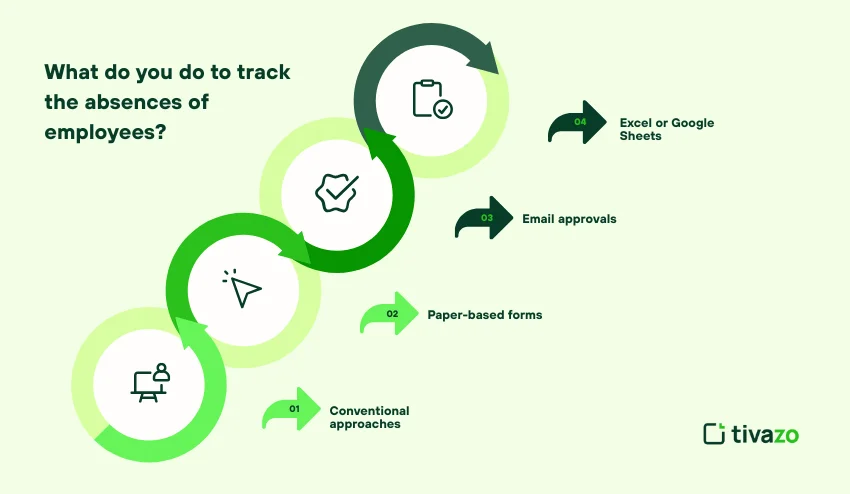
Tracking Employees Absence can be done in several ways, not all of which are effective and scalable. The selection of the appropriate approach has a direct influence on accuracy, compliance, and administrative effectiveness.
- Conventional approaches (Extreme risk)
- Paper-based forms
- Email approvals
- Excel or Google Sheets
Such approaches are not updated in real time, are hard to audit, and are most likely to have manual errors and data inconsistencies.
- Current Practices (Best Practice)
- Absence tracking software that is automated.
- Unified time and attendance applications.
- Cloud-based dashboards
Such automated tools as Tivazo simplify the whole process, including leave requests and approvals and reporting; make less work of the administration; generate real-time visibility and quality absence data; and help in a better decision-making process.
To the best of my knowledge, one can monitor the attendance of employees by using the following steps:
There is a close relationship between attendance tracking and absence tracking. The two should be captured in a reliable system.
- Best Practices in Attendance Tracking.
- Automate clock-out and clock-in programs.
- Monitor real-time attendance.
- Time-stamp attendance and absence, and leave data.
- Keep all records in an aggregated system.
Comparison of Attendance Tracking
| Method | Accuracy | Scalability | Real-Time Data |
| Manual registers | Low | Poor | ❌ |
| Spreadsheets | Medium | Limited | ❌ |
| Tivazo | High | Excellent | ✔️ |
In terms of accuracy and scalability, automated systems are much more efficient than manual tracking
Tracking the number of days off for employees
The days off of employees consist of PTO, vacation, and planned leave. The lack of tracking can easily result in overlapping absences, staff shortages, and last-minute scheduling problems that interfere with the regular running of things and team efficiency.
- What You Should Track
- Leave type (PTO, unpaid, sick)
- Approval status
- Leave balance per employee
- Duration and dates
In addition to these necessities, companies ought to monitor past leave trends as well as be able to determine trends in the historical leave trends to allow equitable policy execution and prevent a more well-planned workload. A centralized system assists the managers in a quick view of the availability and when different people are available, which limits miscommunication that arises among different teams. Time off is requested by employees using Tivazo digitally, managers grant it in real time, and leave balances automatically update, no longer necessitating back-and-forth emails. This will bring out transparency, responsibility, and a better leave-handling experience for all.
What is the best way to monitor the time and attendance of my employees?

Time tracking is very much related to attendance and absence tracking. All three should be handled by the effective system to give a complete picture of the workforce productivity and availability. What to Track
- Working hours
- Breaks
- Overtime
- Absences and leave
- Why Automation Is Essential
Manual tracking makes the payroll prone to errors, time theft, and compliance risks. Such automated software as Tivazo guarantees proper timekeeper records, lessens the workload on the administration, and delivers real-time data that might assist managers in making well-founded staffing and payroll choices without ever doubting it.
Tracking of Sick Days of Employees
Sick leave is unpredictable, and in most cases, it is the worst form of absence that is not managed well; therefore, it is hard to have teams work out the workloads and continue working. The best practices in sick leave tracking.
- Establish a clear set of sick leave policies.
- Use online sick leave applications.
- Follow frequency and trends.
- Protect employee privacy
Along with such practices, the businesses are encouraged to pay attention to the patterns of sick leaves to be able to detect burnout or work-related health problems. Tivazo allows HR departments to have accurate tracking of sick days with confidentiality, enhanced planning, and policy adherence without manual follow-ups that are unnecessary.
The 7-Minute Timekeeping Rule
Another payroll rounding technique is the 7-minute rule, which is usually applied in timekeeping to simplify clock-in and clock-out hours.
How the 7-Minute Rule Works
Clock-ins in the first 7 minutes are rounded off.
Post-7-minute clock-ins are rounded up. Actual Clock-In Rounded Time
9:02 AM 9:00 AM
9:08 AM 9:15 AM
Rounding rules can be used to create a balance between fairness and payroll efficiency when properly set. Tivazo helps to tailor the policies of rounding, where organizations can ensure that they are in compliance with labor standards, and at the same time, the payment records are accurate and transparent in their calculation.
Usual Problems in the process of monitoring the absences of employees
- Manual data entry errors
- Lack of transparency
- Poor attendance records.
- Payroll disputes
- Compliance risks
These challenges can be removed with a centralized system such as Tivazo, which automates and standardizes the process of tracking employee absences.
The way Tivazo will curb the absence of employees
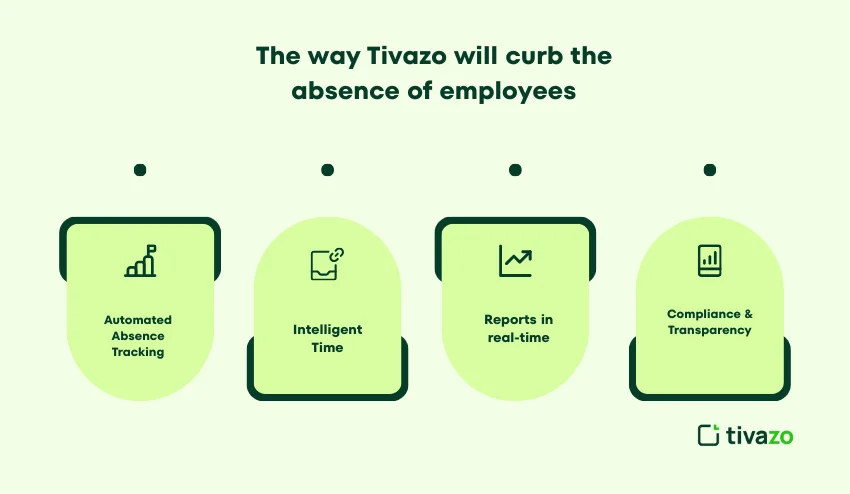
Tivazo is a time, attendance, and absence tracker that has been designed to suit contemporary teams.
Key Tivazo Features
1. Automated Absence Tracking
- Digital leave requests
- Real-time updates
- Centralized absence records.
2. Intelligent Time and Attendance Monitoring
- Correct clock-in and clock-out.
- Break and overtime tracking
- Policy-based automation
3. Dashboards and reports in real-time
- Absence trends
- Attendance summaries
- Payroll-ready exports
4. Compliance & Transparency
- Audit-ready logs
- Clear policy enforcement
- Self-service to employees.
Tivazo vs Templates vs Manual Tracking
| Features | Manual | Templates | Tivazo |
| Real-time updates | ❌ | ❌ | ✔️ |
| Payroll accuracy | ❌ | 🚫 | ✔️ |
| Sick leave tracking | 🚫 | 🚫 | ✔️ |
| Compliance-ready | ❌ | ❌ | ✔️ |
| Scalable for growth | ❌ | ❌ | ✔️ |
Tivazo provides scalability and real-time accuracy, unlike the use of static templates
Conclusion
Monitoring the absence of employees does not have to be a complex and hectic task. The appropriate system provides businesses with visibility, accuracy, and compliance, and less administration.
Tivazo is an efficient automated system that substitutes spreadsheets and templates with a potent system that assists an organization in handling attendance, leave, and time tracking with strong efficiency.
Tivazo is the wiser option in case you prefer to have fewer mistakes, higher compliance, and full visibility of the workforce.