Scheduling of jobs was simple. Workers came to work at the same time, worked the same number of hours and went home at the same time. Decades later, this model was not questioned much.
That has changed. Managers today have to make decisions on whether to use a fixed schedule or flexible schedule, with little guidance in most cases. The productivity, collaboration, accountability, and retention are now more than ever affected by this decision.
To leaders, scheduling is no longer a small operational option. It influences the way teams interact, the way work is measured and the way employees feel about their jobs. An inappropriate schedule may slow down the implementation and burn out. The right one is able to enhance concentration, confidence, and performance in the long run.
This guide simplifies the two models. It contrasts their weaknesses and strengths and assists managers in selecting the style that suits their team and business objectives.
Fixed Schedule vs Flexible Schedule?
Fixed schedule vs flexible schedule is the variation between the fixed working hours established by the employer and flexible working hours, which give the workers the option of when to work within specified boundaries.
In plain English, one of the models is structure-focused. The other lays emphasis on flexibility. The two influence the day-to-day functioning of teams.
Having a clear understanding of these two schedules helps managers not to be confused and set realistic expectations.
What Is a Fixed Schedule?
Fixed schedule implies that employees have to work the same number of hours or shifts each day or shift. The organization predetermines the start times and end times.
This model is prevalent in those roles where there is a need to have 24/7 coverage or real-time teamwork. These are customer support, operations, manufacturing and on-site services.
Managers have certain schedules that provide predictability. All the people are accessible simultaneously, and it is easier to plan meetings, shifts, and handoffs.
What Is a Flexible Schedule?
Flexible schedule enables the employees to have the flexibility of the time they work. Expectations kept within the limits will allow start and end times to vary.
Other teams have core hours, whereby all of them overlap during a section of the day. There are those who are concerned with output and not the time they spend on the internet.
Knowledge based jobs like software development, marketing, design and consulting are often flexible in terms of schedule. This model is applied by managers who are more concerned about results rather than hours worked.
Key Differences at a Glance
- Predetermined schedules are based on consistency and control.
- Flexible schedules focus on trust and autonomy.
- Fixed schedules are time-oriented presence.
- Flexible schedules are output and result-oriented.
Why Scheduling Decisions Matter for Managers and Leaders
The work schedules determine the daily functioning of teams. They determine the time of collaboration among the people, the speed with which decisions are made and the method of measuring performance.
To managers, accountability is strongly related to scheduling. Predictability and visibility of availability are achieved through fixed schedules. Flexible schedules need more definite goals and effective communication to keep track.
Employee engagement is also influenced by the scheduling choices. Over-controlled teams tend to check out. Boundless teams may be stressed, and burnout may be experienced. Leaders need to strike the right balance between structure and autonomy.
Business wise, the appropriate schedule helps in productivity and retention. The inappropriate one causes friction, handoff misses and frustration. That is why the decisions about scheduling must not be inherited or imitated by other companies.
The Case for Fixed Schedules
Fixed schedules value structure and predictability. They simplify the process of planning, monitoring and coordinating team operations by the managers.
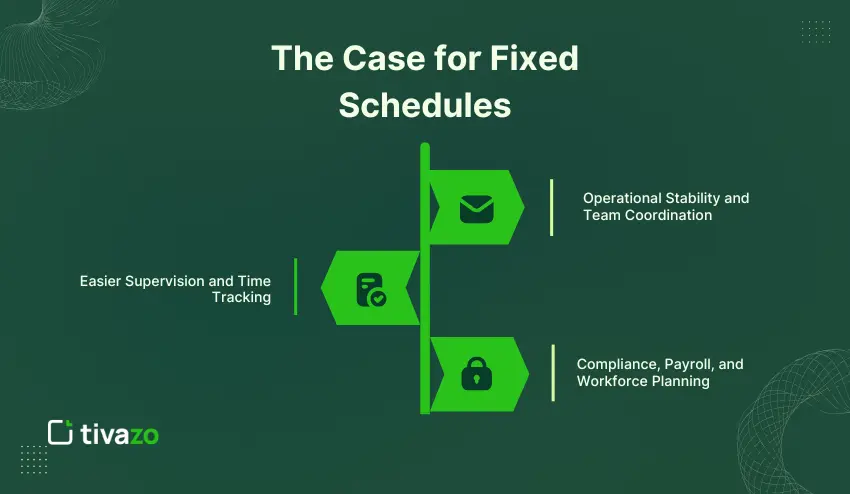
1. Operational Stability and Team Coordination
Having fixed hours, everybody is present at the same time. This eases meetings, handoffs and tracking of projects. This approach is most beneficial to teams that rely on real-time collaboration.
2. Easier Supervision and Time Tracking
Managers have a better way of monitoring attendance and performance. Fixed schedules are also very useful with junior teams or positions that need constant supervision.
3. Compliance, Payroll, and Workforce Planning
Fixed schedules make legal requirements, payroll tracking, and shift planning easier. Organizations are able to predict the staffing requirements and prevent scheduling conflicts.
Teams Where Fixed Schedules Work Best
- Customer support teams
- Manufacturing or operations personnel.
- On-site services
Fixed schedules are clear and consistent and are best used when timing and coverage is important to the team.
The Case for Flexible Schedules
Flexible schedules focus on autonomy and trust. They enable employees to decide on the time they work and achieve agreed-upon targets, and are therefore suitable in output-based teams.
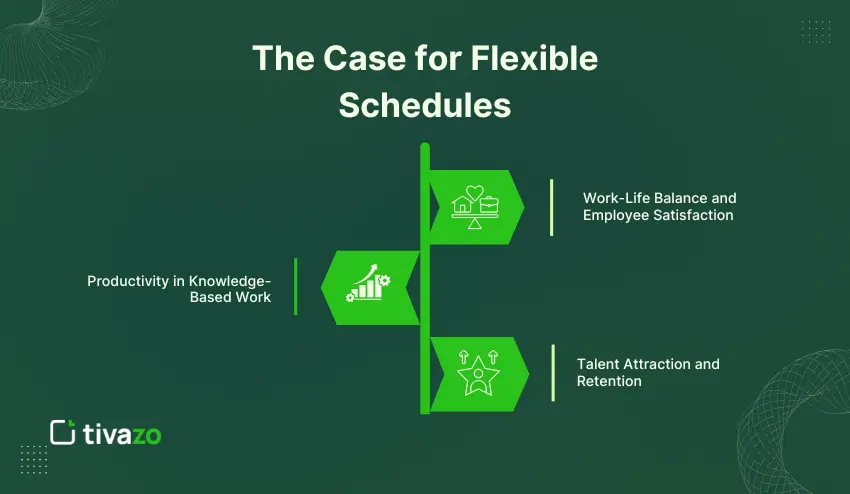
1. Work-Life Balance and Employee Satisfaction
The flexible schedules provide the employees with the control of their day. This will minimize burnout and boost morale which is particularly vital in retaining the best talent.
2. Productivity in Knowledge-Based Work
When the managers are result-oriented and not time-oriented, then the employees are able to work when they are most productive. This flexibility is usually useful in creative and knowledge-intensive tasks.
3. Talent Attraction and Retention
The provision of flexible schedules is also a competitive advantage during the recruitment process. Careerists are more demanding jobs that enable them to have autonomy and enhance work-life balance.
Common Types of Flexible Scheduling
- Flextime: The employees decide on the start and finish time within limits.
- Compressed workweeks: The same number of hours in a reduced number of days.
- Hybrid models: Remote and in-office work mixture.
Flexible schedules need clear communication and goal-setting; however, when done effectively, they will motivate engagement, productivity and loyalty.
Fixed Schedule vs Flexible Schedule (Comparison Table)
Visual comparisons help managers quickly see which schedule fits their team’s needs.
| Feature | Fixed Schedule | Flexible Schedule |
|---|---|---|
| Predictability | High – same hours every day | Medium – hours vary by employee |
| Employee Autonomy | Low – strict start/end times | High – employees control work hours |
| Collaboration | Strong – everyone available simultaneously | Variable – depends on overlap |
| Performance Measurement | Time-based tracking | Output-based tracking |
| Managerial Effort | Low – simple supervision | Medium – requires goal alignment |
| Best-Fit Teams | Operations, customer support, and manufacturing | Knowledge work, creative teams, remote/hybrid teams |
This table makes it easy for you to compare both approaches at a glance. Managers can see where structure benefits operations and where flexibility boosts engagement.
How Managers Should Decide Between Fixed and Flexible Schedules
The selection of the appropriate schedule is based on the team roles, business objectives, and the workflow demands. It depends on your situation, and it will not have a universal answer.
When a Fixed Schedule Makes More Sense
- Work is time sensitive or must be covered.
- Teamwork in real-time is essential.
- There are numerous junior members in teams who require supervision.
When a Flexible Schedule Works Better
- Work is product-oriented and not time-oriented.
- The team members are mature and self-driven.
- Jobs demand innovation, intense work, or work at a distance.
Can Teams Use a Hybrid Approach?
The hybrid model is advantageous to many modern teams. Core hours provide some flexibility to the employees, and also there is an overlap in meetings and collaboration. Customization at the departmental level enables the managers to strike the right balance between productivity, engagement, and operational needs.
Common Mistakes Managers Make With Work Schedules
Even the most perfect schedule may fail when it is applied in a bad manner. The knowledge of pitfalls to avoid will enable leaders to avoid needless friction.
Fixed Schedule Mistakes
- Monitoring employees rather than results.
- Disregard of personal employee needs and preferences.
- It is the formation of low morale through the imposition of rigidity.
Flexible Schedule Mistakes
- Lack of establishment of clear boundaries and expectations.
- Lack of communication leads to missed deadlines or misunderstandings.
- Inequality in workload results in frustration.
With early identification of these errors can enable managers to create schedules that can accommodate team performance as well as the satisfaction of employees.
Tools That Help Managers Manage Schedules Effectively
The appropriate tools ease the process of scheduling, minimize misunderstandings, and enhance the productivity of the team.
- Scheduling Software – Programs such as Sling or Deputy make it easy to plan schedules, time tracking, and attendance.
- Communication Platforms – Applications such as Slack or Microsoft Teams keep everyone informed about the availability and updates.
- Time Tracking and Performance Software Tivazo or Hubstaff are examples of software that allow managers to monitor output without micromanaging hours.
By using such tools, your schedules will be clear, manageable, and flexible to the needs of the team.
Conclusion
Scheduling is not just a logistical decision, but a strategic one that influences the performance of a team, its engagement, and retention.
It does not have a one-size-fits-all solution. Fixed schedules are structured and predictable, which is suitable in time sensitive operations. Flexible schedules provide freedom and facilitate output-based, innovative, or remote teams. The hybrid approaches strike the right balance between the two worlds for many leaders.
The only trick is to evaluate your team, set expectations, and match your schedule with your business objectives. Choose your scheduling choice purposefully, and you will establish a productive, trustful and long-term engagement work environment.