
Most managers can’t tell if their teams are productive or just pretending to be busy. That’s a problem that costs businesses serious money.
Productivity metrics fix this. They show you what’s really happening, where time goes, what’s getting done, and what needs to change. You don’t need to guess when deadlines slip.
This guide walks through measuring productivity the right way. You’ll learn which numbers matter and which tools actually help. You’ll also learn how to use data without turning into a micromanager everyone hates.
What Are Productivity Metrics?
Productivity metrics are measurable results used to evaluate the efficiency with which individuals, teams, or organizations accomplish tasks and attain objectives. To increase overall productivity, they assist in measuring performance, pinpointing areas for development, and directing decision-making.
Productivity metrics measure how well your team turns effort into results. You’re checking if what goes in matches what comes out. Are people creating value or wasting time on nonsense?
Output vs. Input Measurement
The concept is dead simple: stuff goes in, results come out. The ratio tells you everything.
Input includes hours worked, money spent, and energy invested. Output is what you get: finished projects, revenue, solved problems.
Example: Team A works 40 hours, finishes 5 projects. Team B works the same 40 hours and completes 12 projects. Same input, totally different output. Team B is killing it.
Workplace efficiency indicators show you these gaps before they blow up in your face. You’ll see where hours vanish and whether work actually matters.
The Role of Employee Engagement
Here’s something most bosses miss: engaged employees don’t need babysitting; they just perform.
When people care about their jobs, everything improves. Tasks finish quicker, quality jumps, and they help teammates without prompting. Tracking engagement, like pitching ideas or helping others, predicts performance better than timesheets. It does so better than any timesheet ever will.
Why Measuring Productivity is Important?
Not measuring productivity is like driving with your eyes closed. Might work for a bit, but you’re gonna crash eventually.
1. Better Decision-Making and Resource Allocation
Managers face constant choices. Hire more people or shift workloads? Fund this project or another? Who’s drowning and who’s bored?
Productivity metrics answer these questions. You stop guessing and start knowing. You see which teams need backup and which can handle more.
The operational efficiency improves when decisions are made from data instead of whoever yells loudest.
2. Identifying Bottlenecks and Improving Workflow
Work stalls for predictable reasons. One person approves everything. Processes have pointless steps that nobody questions. Teams wait forever for basic answers.
Good metrics expose this fast. You catch slowdowns early, remove dumb barriers, and keep things moving.
Fix workflow problems based on actual data instead of office politics, and results improve overnight.
3. Setting Realistic Productivity Benchmarks
Know what kills morale? Unrealistic targets were pulled from nowhere.
Real metrics let you set standards that make sense. Compare current performance to past results, check what competitors do, and factor in your team’s actual capacity, not fantasy numbers.
This creates goals that push growth without destroying people.
Key Types of Productivity Metrics for Teams
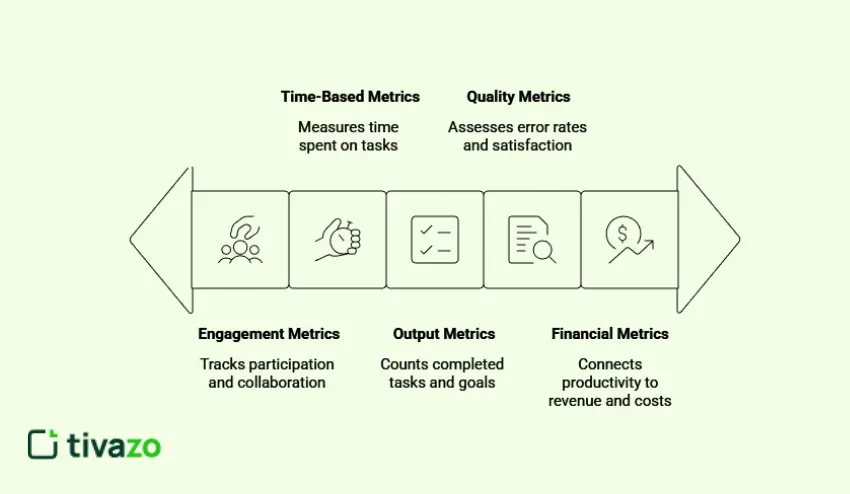
Smart measurement uses different angles. One metric type is like judging a car by its color; you’re missing critical stuff.
Time-Based Metrics
Time metrics show how long work takes and whether effort matches results.
Hours worked versus output produced is your starting point. Someone logging 50 hours finishing the same work as someone needing 35? That’s worth investigating.
Time tracking reveals where hours disappear. Maybe your calendar is 80% pointless meetings. Or vague instructions force constant rework.
Catch these patterns, and you can protect focus time, kill useless meetings, and give clearer direction.
Output Metrics
Output metrics count what actually gets done, such as finished tasks, closed deals, shipped products, and hit goals.
For team productivity, finishing activities is more important than starting them. A team that completes 20 tasks per week outperforms one that starts 50 but only finishes 10.
Everyone might focus on outcomes and not just appear busy when production is tracked.
Quality Metrics
If the work is terrible, a high output is meaningless. Quality metrics include things like error rates, customer satisfaction, and rand edo frequency.
Teams that strive for large numbers end up making costly mistakes. Mistakes need fixes, burning time, and annoying customers.
Top teams nail speed and quality. They produce volume without sacrificing value.
Engagement and Collaboration Metrics
No one works alone. Team collaboration affects everything.
These metrics track participation, response speed, and contribution to shared goals. Do people show up prepared? Help others? Actually communicate?
Higher engagement almost always means better productivity. When people care about work and teammates, performance follows.
Financial Metrics
Financial metrics connect productivity to money, which executives controlling budgets care about.
Revenue per employee, project costs, and ROI show whether efficiency improvements help the business. Your team getting 20% faster while costs jump 30% means you’re losing.
Financial metrics keep productivity honest. They prove whether changes create real value or just look good in presentations.
Tools to Measure Productivity
Tracking manually is slow, wrong, and insulting to everyone. Software handles this automatically.
Productivity Measurement Tools Overview
Different tools serve different purposes:
- Project management tools like Asana, Trello, and Jira track tasks, deadlines, and progress. You can see what is moving, stuck, and what’s about to tank.
- Time tracking software like Tivazo, Toggl, and Hubstaff shows how people spend hours. These reveal patterns, catch time drains, and create accurate records.
- Productivity dashboards combine data from many sources. Team leaders check KPIs, review output, and spot trends without juggling systems.
Automated vs. Manual Tracking
Manual tracking asks employees to log hours, update spreadsheets, and write reports. Wastes time, guarantees mistakes.
Automated tracking runs quietly. Software captures activity, generates reports, and updates dashboards without extra work.
The catch? Employees might feel watched if the implementation sucks. Clear communication about tracking can prevent suspicion.
Selecting the Right Tool
The ideal tool for you depends on team size, workflow, and learning needs.
Small teams might need simple time tracking. Big organizations benefit from comprehensive platforms.
Ask yourself:
- Does it work with current systems?
- Can the team learn it easily?
- Does it measure what matters?
- Will it grow with us?
Start with one tool, test thoroughly, and expand based on results.
Best Practices for Using Productivity Metrics
Metrics are powerful, but misuse can create resentment. So, how you use these metrics matters as much as what you measure.
Setting Key Performance Indicators (KPIs)
Tracking everything is tracking nothing. Pick KPIs that directly impact success. Sales teams track revenue and deal speed. Support teams need response times and resolution rates.
Stay focused. Three to five core KPIs beat thirty random metrics. Track consistently, patterns emerge.
Aligning Metrics with Business Goals
Productivity without purpose just makes people busy. Metrics should support actual objectives.
Launching products faster? Measure project completion speed. Keeping customers longer? Track service quality and satisfaction. Alignment ensures productivity gains push business forward instead of generating pretty charts.
Avoiding Metric Overload
Thirty data points on one dashboard overwhelm people. They get confused, not informed. Focus on meaningful stuff. What helps make decisions? What changes behavior? Delete everything else. Clean metrics drive action. Messy dashboards get ignored.
Regular Reviews and Employee Feedback
What matters in January might be useless by July. Priorities shift constantly.
Review metrics quarterly. Ask whether tracking feels fair and useful, and adjust when priorities change or feedback reveals issues. This keeps measurement relevant and prevents resentment.
How to Improve Productivity Using Metrics?
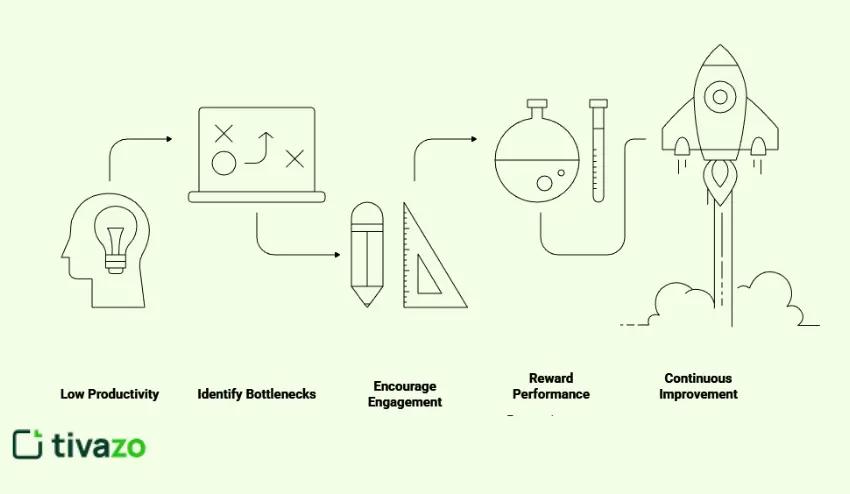
Collecting numbers accomplishes nothing alone. Value comes from action.
Identify Bottlenecks and Fix Workflow Issues
Metrics expose where work stalls. Maybe one person approves everything, creating delays. Or teams waste hours in handoff chaos.
Seeing problems clearly lets you fix them properly. Speed approvals, clarify responsibilities, automate repetitive tasks. Targeted fixes based on data often unlock huge improvements.
Encourage Employee Engagement Through Transparency
People perform better understanding expectations and see progress.
Share metrics openly. Show where teams stand, celebrate wins, and discuss obstacles honestly. Transparency builds trust, sparks motivation. Never weaponize numbers. Use them to support development.
Reward High Performance Based on Data
When someone consistently exceeds targets, recognize them. Rewards tied to clear metrics feel fairer than random praise.
Bonuses, promotions, and recognition based on performance creates culture where hard work pays. People see excellence matters.
Continuous Improvement Through Benchmarking
Compare current numbers to past performance and industry standards. Are you improving? Are competitors faster?
Benchmarking prevents settling. It reveals opportunities you’d miss. Track trends monthly. Test approaches, measure impact, keep what works.
Common Challenges in Productivity Measurement
Even great tools hit obstacles. Knowing pitfalls helps dodge them.
Overemphasis on Quantity Over Quality
Counting completed tasks is easy. Measuring quality takes thought. Teams pressured for big numbers rush and cut corners. They finish more while creating bigger problems.
Balance output with quality checks. Track speed and accuracy.
Employee Resistance to Tracking Tools
Many worry about surveillance. They fear unfair metric use.
Combat with transparent communication. Explain why you’re tracking, what you’re measuring, and how data gets used. Frame around improvement, not punishment.
Misinterpreting Data or Setting Unrealistic Benchmarks
Numbers don’t tell complete stories automatically. Lower productivity might imply challenging projects, not lazy workers.
Context matters enormously. Talk with teams before concluding. Base benchmarks on reality.
Ensuring Privacy and Ethical Tracking Practices
Measurement should respect boundaries. Don’t track personal communications or off-work activities. Be transparent about tracking. Give control when possible. Ethical treatment builds trust.
Future of Productivity Metrics
Technology keeps changing measurement and performance.
AI and Predictive Analytics
Artificial intelligence spots invisible patterns. It might warn about delays days early or suggest better task distribution. Predictive tools help leaders get ahead instead of firefighting.
Wearable Productivity Trackers
Some organizations experiment with wearables to track focus, energy, and stress. The goal is to match tasks to peak windows.
Interesting, but adoption depends on solving privacy concerns.
Metrics for Remote and Hybrid Teams
Remote work changed measurement completely. Can’t judge productivity by desk presence anymore.
New approaches focus on deliverables, communication quality, and collaboration across zones. Tools built for async work are essential. Future metrics will be flexible, personalized, and context-aware.
Comparison Table: Traditional vs. Modern Productivity Tracking
| Aspect | Traditional Approach | Modern Approach |
| Data Collection | Manual logs and reports | Automated tracking tools |
| Frequency | Weekly or monthly updates | Real-time monitoring |
| Focus | Hours worked | Output and results |
| Decision Speed | Slow, delayed | Fast, informed |
| Employee Experience | Micromanaged feeling | Transparency and trust |
| Scope | Individual performance | Team and workflow efficiency |
How Tivazo Helps Measure and Improve Productivity
Tivazo gives leaders clear team visibility without surveillance creepiness.
What managers execute with Tivazo:
- Track time accurately: See who’s working, on break, offline in real time. Catch workload imbalances before burnout or missed deadlines.
- Spot performance patterns: Heatmaps and reports reveal trends. Identify top performers and struggling areas quickly.
- Generate useful reports: Automated timesheets and dashboards deliver actionable info. Stop guessing, start knowing.
- Respect privacy: Features track work without invading personal space. Transparency builds trust.
- Manage teams smoothly: Remote, hybrid, office, Tivazo makes organizing groups, distributing tasks, and monitoring progress straightforward.
Real example: Manager notices through Tivazo that one person handles 50% of active tasks while teammates carry light loads. Quick rebalancing prevents deadline disaster and reduces stress. That’s turning metrics into action.
Conclusion
Productivity metrics have become an important factor for workplace success. They replace guesswork with facts, help leaders choose wisely, and guide teams toward better outcomes.
Success requires picking appropriate measurements, using the right tools, and applying information thoughtfully. Track time, output, quality, and engagement. Don’t bury teams under endless data or turn tracking into Big Brother.
Done properly, productivity metrics do more than measure work. They improve it. Teams get clarity, managers decide faster, and organizations stay competitive.
Remember: Metrics help you work smarter, not just harder. Start with a few key indicators, test them in practice, and refine your approach as you learn. The improvements will speak for themselves.