Most teams monitor their deadlines and production levels. However, they tend to miss one critical metric that can help them identify hidden inefficiencies in their workflow. Flow time is a metric that can help teams identify how much time their tasks take to get completed.
Most managers tend to think about their teams’ levels of busyness. They tend to think about the number of hours their teams have worked or the number of tasks completed. However, busy does not always mean productive.
The real question, therefore, is how long tasks take to get completed within the system. This is where flow time can help teams improve their productivity.
Flow time can help teams improve their productivity without necessarily adding more hours or members to their teams. This is because it can help teams work smarter, removing inefficiencies that might be slowing them down.
What is Flow Time?
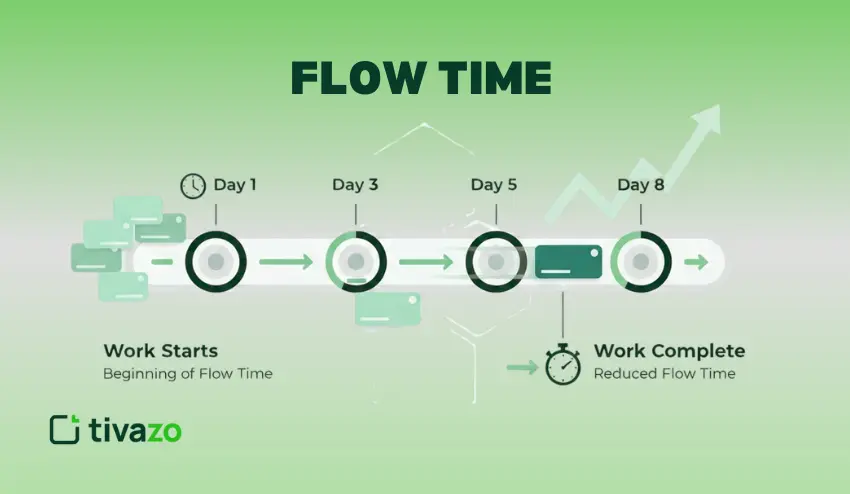
Flow time is the total time that passes from the time that the work item enters your workflow until the time that it’s finished. It’s every moment that this work item exists in your workflow, with or without anyone actually working on it.
Imagine this as the total lifecycle of a work item. From the time that the work item starts until the time that you mark it as finished, this is the flow time.
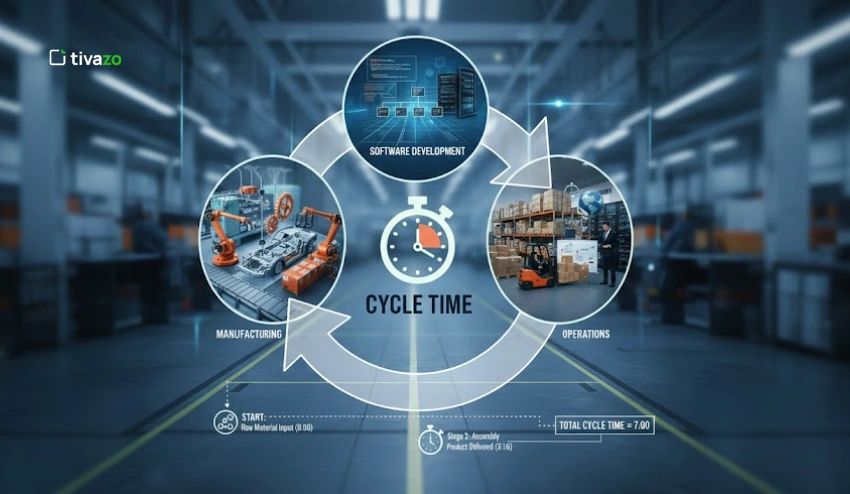
Flow time differs from cycle time because it accounts for waiting, delays, and handoffs between people.
Flow time vs. Cycle time in Process Management:
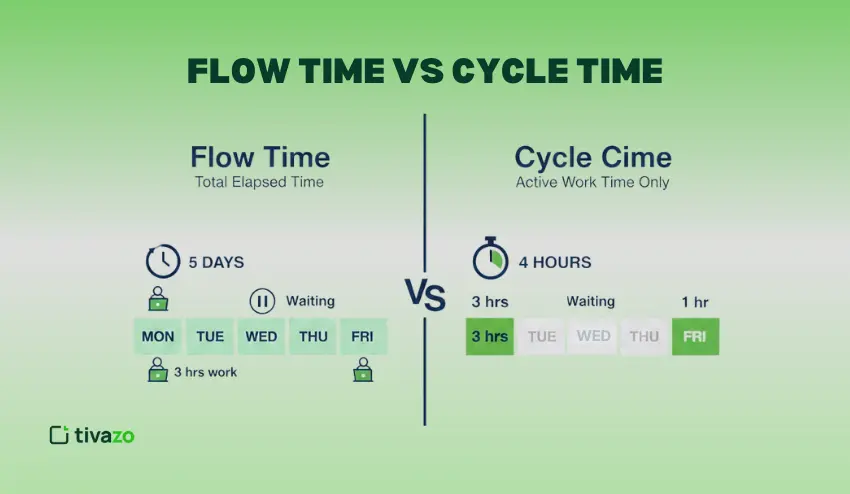
- Flow time: Total time from the start of work to the end of work.
- Cycle time: Time actually spent on work.
- Example: A task that takes 5 hours of work time but 3 days of total time.
Here is one way to think of it. A designer is told to design a logo on Monday. She works on it on Tuesday for 3 hours. Then she waits for client feedback until Friday. She works on it for another 1 hour on Friday.
The cycle time is 4 hours (actual work time). The flow time is 5 days (Monday to Friday).
The flow time naturally fits in with the Lean methodology and process optimization frameworks. The flow time helps identify waste not seen with other productivity measures.
Agile process management teams find flow time useful. It measures real delivery speed, not just how busy someone is.
Why Flow Time Matters for Teams
Flow time is an important metric that has a direct impact on the improvement of team productivity. This is because longer flow times mean longer customer wait times. This will also mean longer times before the team’s value contribution is realized.
Flow time helps teams identify areas where they are not as efficient as they think. For instance, a task may only take 2 hours to be done but may be idle for 3 days.
The following are the things that the flow time helps teams understand:
- The handoffs that are happening within the team
- The approval issues that are happening
- The context switching that is happening
- The resource issues that are happening
The improvement in task throughput will be realized through the reduction of flow time. This is because more will be done in the same period.
The improvement in operational efficiency will be realized through the reduction of flow time. This is because there will be no waiting. The improvement in team morale will be realized through the reduction of flow time.
How to Measure Flow Time Effectively
How to measure flow time in your team begins with identifying tracking points. This involves identifying the time work enters your system and the time work exits your system.
Workflow management software helps in measuring flow time. This is because these tools automatically record time stamps as work progresses through different states.
Steps To Calculate Flow Time
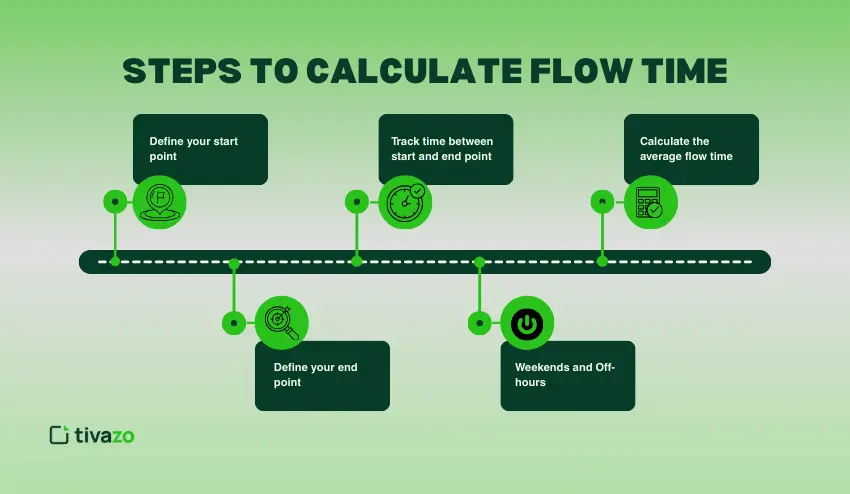
- Define your start point: when work starts
- Define your endpoint: when work is completed
- Track all the time between the start and the endpoint
- Weekends and off-hours included
- Calculate the average flow time for similar types of work
Tools for tracking processes will aid in data collection. Look for tools that can integrate with your current workflow.
Popular Measurement Approaches
- Kanban boards with date stamps on cards
- Project management tools that automatically track time spent
- Spreadsheets for manual tracking (simple and effective)
- Analytics software for more in-depth analysis
Keep it simple. Basic tracking will show you patterns that you didn’t know were there.
Calculate flow time for different types of work. A bug fix and a new feature, for example, have different expected flow times.
How Reducing Flow Time Can Help Boost Productivity
To improve productivity, flow time can be reduced by identifying and solving bottlenecks. To detect the bottleneck, flow time can be used as an indicator.
The best practices that can be implemented to reduce flow time include:
- Work in progress should be limited to reduce waiting time.
- Unnecessary approvals should be eliminated.
- Employees should be trained to eliminate single points of failure.
- Automated processes should be implemented to eliminate waiting time.
- Priorities should be set to ensure that important tasks do not wait in the queue.
A software team was able to reduce its flow time from 12 days to 6 days. The bottleneck identified was code review.
The solution was simple. They aimed for a 4-hour response time for reviews. The flow time decreased, and the throughput doubled.
Continuous improvement techniques are most effective when used on a regular basis. Review flow time data on a weekly or monthly basis.
Common bottleneck areas to check:
- Review and approval cycles
- Knowledge transfer between experts
- Testing and quality assurance phases
- Deployment and release activities
Small improvements lead to large gains. Reducing flow time by 20% makes a huge difference in team productivity.
Start with the largest bottlenecks. Eliminate the bottleneck point that impacts the largest number of work items.
Flow Time and Workflow Efficiency
Process optimization helps increase workflow efficiency by reducing the time spent on unnecessary activities. Flow time statistics indicate where you should target optimization.
You can make better decisions when you use flow time statistics. You can see which processes require more support.
Connection to Agile Process Management
Flow time is an excellent match for Agile process management. Flow time helps you achieve continuous delivery with shorter flow times.
Sprint planning becomes more accurate when you use actual flow time.
Tools and Techniques for Ongoing Improvement
- Weekly flow time review meetings to detect trends
- Visualization of where work is backing up
- Automated notifications when flow time exceeds a threshold
- Regular retrospectives to reduce delays
Improving the efficiency of the workflow involves eliminating waste. The focus is not on working hard but on removing impediments.
Compare the flow times of different types of work and different people. There are inconsistencies to explore here.
Monitor the impact of changes on flow time. Did the new process really make things better or worse?
Flow Time Metrics Comparison
| Metric | What It Measures | Best Used For |
| Flow Time | Total time from start to finish | Overall process efficiency |
| Cycle Time | Active work time only | Individual productivity |
| Lead Time | Time from request to delivery | Customer experience |
| Wait Time | Idle time between work stages | Bottleneck analysis |
Knowledge of these differences will enable a team to make the right choice depending on the situation. Flow time provides a complete picture of how a process is performing.
Conclusion
Flow time is the unknown metric that will reveal a team’s real productivity. It will reveal how long a team really takes to get a job done and where a team is losing time.
Measuring a team’s flow time will enable you to know where a team is losing time due to bottlenecks and workflow inefficiencies. The more you reduce your flow time, the more value you will be able to deliver.
Start tracking your team’s flow time this week. Just select a workflow and measure how long a particular item takes from start to finish.
The knowledge you gain will be surprising. The results will also be surprising.
To make tracking your team’s flow time easier, you could use workflow management software like Tivazo. Better data will mean better decisions and better results.