The reduction of lead time has become an important success factor in the fast-changing business environment nowadays.
Reducing the lead time, whether it is projects, operations, or product delivery, directly influences the competitiveness, customer satisfaction, and bottom line.
This ultimate guide will take you through proven strategies on how to reduce lead time.
Why Is It So Important to Reduce Lead Time in Today’s Fast-Paced Work Environment
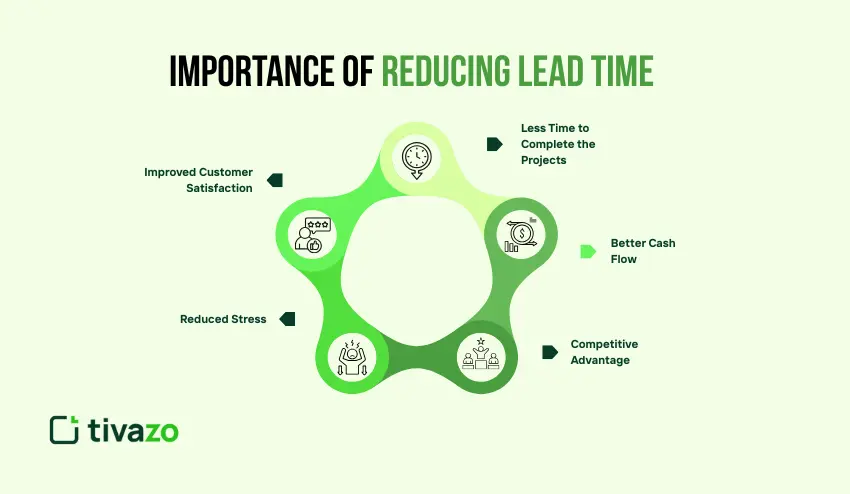
The advantages of successful reduction in lead time among organizations are huge, and they offer a competitive edge:
- Less Time to Complete Projects: You can complete more projects in less time, allowing your team to work harder and increase productivity.
- Improved Customer satisfaction: Delivering the project ahead of schedule builds trust and loyalty, leading to repeat business and referrals.
- Better Cash Flow: The ability to complete projects faster improves your cash flow by accelerating invoicing and payment receipt.
- Reduced Stress in your Team: Process efficiency translates to less firefighting and a lighter workload.
- Competitive Advantage: When organizations complete projects faster, they can capitalize on opportunities before their competitors do.
Typical Reasons for Long Lead Time (Most Businesses Ignore These)
You must figure out what is delaying you before you can cut the lead time. The most frequent offenders are the following:
- Ineffective Task Priorities: Doing non-critical tasks when there are critical tasks that need to be done is a waste of time and resources.
- Manual Processes: Human processes are monotonous, time-consuming, and prone to human error.
- Communication Delays: Waiting to get an email, vague instructions, and numerous approval stages increase the lead time considerably.
- Supplier Dependency: There is a dependence on suppliers that may not be properly coordinated with or may have alternative plans, leading to unpredictable delays.
- Lack of Real-Time Tracking: It is unaware of the progress going on in the work, and thus, the issues are not noticed until they become significant bottlenecks.
- Bottlenecks in Approval Processes: Approval processes with multiple layers of approval, where work stagnates while awaiting approvals, introduce significant lead time.
How to Calculate Lead Time the Right Way
What is not measured can never be improved. The following are the steps to be used to calculate lead time:
- Determine Clear Start and End Points: Decide accurately what constitutes the beginning and end of the lead time clock.
- Measure Every Process Step: Divide your process into specific steps and calculate the duration of each. This displays the areas of delay.
- Use Tools or Simple Formulas: Project management software can have in-built time tracking or a simple formula: Lead Time = End Date – Start Date.
- Determine Delay Patterns: Examine your data to find repeated bottlenecks or stages that repeatedly take a longer-than-predicted time.
Scenario: A software development team manages a feature request from the time it is received to the time it is deployed. They find that the average lead time is 14 days, and 8 days of waiting incurred in seeking approval of code reviews clearly shows that their biggest bottleneck is the waiting period.
For a detailed step-by-step breakdown, check out this guide on How To Calculate Lead Time:
12 Proven Strategies to Reduce Lead Time Effectively
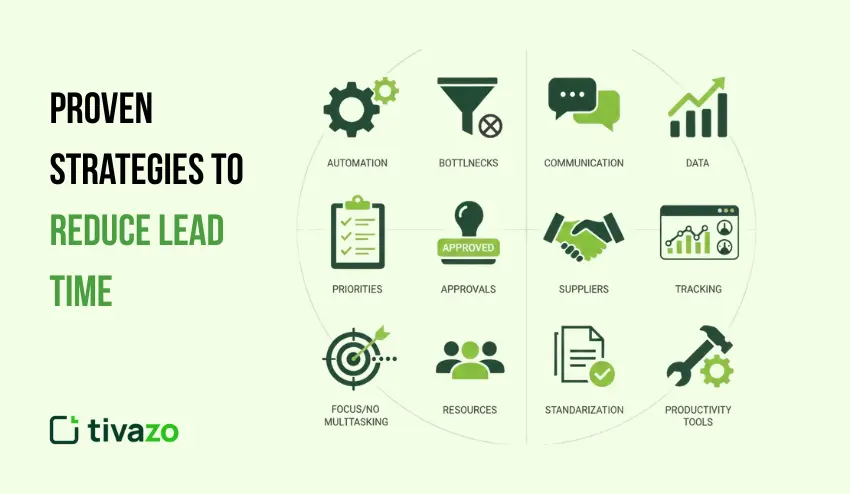
Now we are going to consider the action steps that will provide tangible benefits:
1. Discover and Eliminate Workflow Bottlenecks.
Bottlenecks refer to locations in your working process where there is a buildup of work that causes delays. Make a process map to see the whole process of your work, then pinpoint points of work accumulation.
Typical bottlenecks are points of approval, resource limitations, or reliance on a single member of a team. After you have detected the bottlenecks, redistribute the work, introduce more resources, or redesign the whole process.
2. Automate Repetitive Tasks
One of the best methods of reducing the lead time is automation. Find tasks that are routine, rules-based, and time-intensive; those are the type of tasks that are best to automate.
Some of them are data entry, report generation, email notifications, file transfers, and status updates. Even semi-automation will release large amounts of time. Begin with a few processes (one or two) and increase as you achieve results.
3. Enhance Real-Time Team communication.
Unresponsiveness in communication is a silent productivity murderer. Accommodate real-time communication devices that will allow instant messaging, fast video calls, and collaborative workspaces.
Put in place specific communication guidelines on how members of the team will understand when to adopt synchronous or asynchronous communication. Develop specialized channels for particular projects or topics to decrease noise and enhance the findability of information. Frequent stand-up or check-in keeps each person on track without protracted discussions.
4. Use Data to Predict Delays
The past is your crystal ball for future performance. Learn through historical project analysis of trends that are predictors of seasonality of delays, resource availability, complexity, or external dependency.
These insights can be used to create predictive models that will warn you of possible delays before they happen. This proactive behavior enables you to act early, redistribute resources, or adjust schedules to prevent issues before they arise.
5. Optimize Task Priorities
Not everything is a task that is created equal. Adopt a strict prioritization system like the Eisenhower Matrix (urgent/important), the MoSCoW technique (Must/Should/Could/Won’t), or the RICE scoring (Reach, Impact, Confidence, Effort).
The efforts of focus teams should be on high-impact work that can most quickly advance projects. Periodically revise priorities and adapt to a changing situation.
It is a trap to put your hand on tasks that are easy to solve before you get tired to do high value items when your energy and concentration are at their highest.
6. Streamline Approval Processes.
Nightmares of lead time are complex approval chains. Draw out your existing approval procedures and pinpoint those that are not needed. Give decision-making powers to team members depending on their positions. Introduce parallel approvals where applicable instead of sequential approvals.
Establish specific approval SLAs and reminders on outstanding approvals. Take into consideration pre-approving routine requests that fit within a specified set of criteria.
7. Enhance Supplier Co-ordination.
Dependency externalities should not pull down your schedule. Become a good relationship builder with the suppliers and ensure effective communication. Communicate your project schedules and requirements earlier.
Develop backup supplier relationships in order to reduce risk. Apply the cooperation platforms whereby suppliers can tap into requirements, deliverables, and monitor progress.
This company conducts frequent reviews of supplier performance and proactively addresses any problems that arise.
8. Monitor Progress on a Continuous Basis.
The last thing to do is measure performance when the project is due. Introduce ongoing improvement following project management tools with real-time visibility. Work with dashboards to see the current work status, completion rates, and bottlenecks.
Track leading indicators (amount of work in progress, the speed at which tasks are being finished) instead of merely lagging indicators (the final delivery date). This is because it makes corrections on the course before slight delays turn into big issues.
9. Reduce Multitasking
Multitasking is a productive experience that increases lead time by reducing switching costs. Make team members concentrate on finishing a task before beginning another one.
Introduce work-in-progress (WIP) results so that team members do not have to work on many tasks at once.
Collect similar activities together to minimize context switching. Guard deep working time during which members of the team are able to concentrate on their work without distractions.
10. Enhance Allocation of Resources.
The unmatched resources bring about delays. Make sure the right skills are put in the right people to do the right things. Visualize capacity and prevent overallocation with resource management tools.
Train other team members to minimize reliance on a few members. Make buffer capacity plans to meet the unforeseen needs without derailing the ongoing projects. Periodically consider the usage of resources and rebalance.
11. Standardize Workflows
Disorganized processes lead to mixed upness and time wastage. Standard operating procedures for documents on routine work. Standardize common deliverable templates to do away with beginning with a blank sheet. Prepare checklists, which guarantee quality and that no item is overlooked.
Standardization does not imply everything is fixed, so that when the situation demands it, some adaptation can be made, but it creates a sense of standardized floor, and everybody knows and works with it.
12. Make Visibility with Productivity Tools.
Lead time reduction is made much simpler with the right tools. You can look for tools that integrate planning, execution, and monitoring, and offer functionality such as:
- Real-time dashboards for monitoring progress in an instant
- Automation of workflows to minimize manual work
- Time management and tracking to identify where work hours are being spent
- Collaboration workspaces for smooth communication between team members
- Analytics and reporting to quickly identify bottlenecks
Some popular time management tools include Tivazo, Toggl Track, and Time Doctor.
It is essential to use tools that can be easily integrated into your existing workflow to minimize friction and prevent the creation of new silos. With the right visibility, teams can remain on track, bottlenecks can be quickly identified, and lead time can be continually reduced.
How Technology Helps Reduce Lead Time in Modern Workflows
Technology will be a force multiplier in regards to lead time reduction:
- Automation Tools: Removal of manual and repetitive tasks, automating workflows, scheduling jobs/tasks, and smart triggers and work through routine processes automatically without human input.
- Project Management Software: Organize all planning, task allocation, tracking progress, and teamwork in one platform that makes the whole organization seen.
- Time Tracking: Track time correctly where it is really being used and expose all the areas where time is not being efficiently used and prove effort worth improving it.
- Real-Time Dashboards: Get real-time data on project status, team capacity, bottlenecks, and performance metrics to make fast decisions.
- Workflow Analytics: You can understand work performance more deeply, identify areas for improvement, and evaluate the long-term effects of changes.
Contemporary productivity systems combine these features into a cohesive system that facilitates sustained improvements in lead times without requiring manual control.
Real-World Example of Lead Time Reduction
Situation: A marketing company was experiencing challenges with an average lead time of 21 days to launch campaigns on behalf of clients, leading to client frustration and reducing their ability to accept additional business.
Before Improvement:
- Unless it was done through email, campaign requests had to be lost, and their requests became unclear.
- There were four approval stages of creative assets in a series of emails.
- No insight as to which stage each campaign was in.
The time taken to manually schedule social media was 6 hours per campaign.
Changes Applied:
- Adopted uniform campaign request forms.
- Reduced approvals to two steps, where stakeholders will read in parallel.
- Implemented project management software that has real-time status dashboards.
- Workflow-based automated social media scheduling.
- Developed campaign templates of most frequent requests.
Findings: The lead time decreased by 57 per cent, from 21 days to 9 days. The agency expanded its capacity to conduct campaigns by 40% and hired no more personnel; client satisfaction scores rose by 35%, and team overtime was also halved.
Difficulties in Reducing Lead Time (And How to Overcome Them)
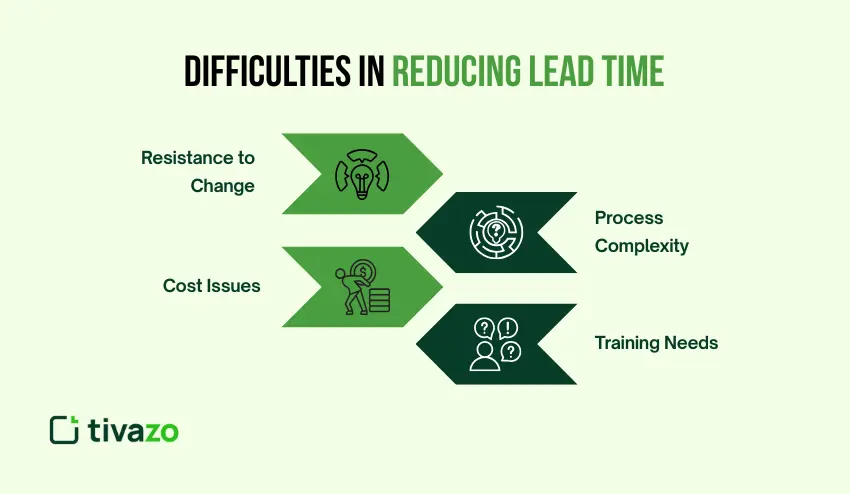
The initiatives to reduce lead time have foreseeable challenges:
Resistance to Change
Employees who feel at ease with the current processes will be resistant to change. This can be addressed by engaging them in the improvement process, clearly communicating the benefits, and providing sufficient training and support.
Cost Issues
New tools or procedure changes might involve an initial investment. Show a business case based on ROI in terms of time savings, higher capacity, and customer satisfaction.
Begin with small investments by starting with low-cost or free solutions before committing to larger investments.
Process Complexity
Workflows that are complex are more difficult to optimize. Break big processes into smaller ones and improve them in small steps.
Record existing processes to first see the instances of improvement instead of trying to redesign on a large scale.
Training Needs
Learning new tools and processes requires time. Help your team with basic training sessions, guides, and a few experts who can assist others in getting accustomed to it quickly.
Best Practices for Long-Term Lead Time Improvement
Lead time reduction has to be a sustainable process:
- Continuous Tracking: Monitor your lead time on a regular basis to track progress and identify trends. Be alert for sudden changes, ensure that the gains are sustained, and identify ways to further optimize your process.
- Team Training: Develop team capabilities regarding process improvement, time management, and other tools. Highly trained forces are able to detect and resolve issues more quickly to maintain lead times.
- Periodic Audits of your Workflows: Are you drifting off in your processes, or have you created new process inefficiencies? Have a periodical audit of your workflows. The conditions of business vary, and processes have to change accordingly.
- Data-Driven Decision: Found improvement decisions on concrete data as opposed to assumptions. Test the effectiveness of changes and modify the course of action. This disciplined strategy helps in avoiding wasted labor in non-productive enhancements.
Reduce Lead Time to Gain a Competitive Advantage
The idea of lead time reduction is not that of hurrying work, but it is rather a way of being efficient and producing better and quicker results. Companies specializing in lead time minimization enhance customer satisfaction, streamline operations, and develop more productive workforce teams.
Identify the biggest bottleneck and fix it first, monitor the progress, and make constant improvements. Even slight decreases in the lead time will make significant performance and competitiveness gains.
Implement one lead time improvement strategy per week and evaluate the results. Smarter processes will lead to faster workflows.