Team engagement ideas usually get a bad rap. People imagine awkward trust falls or “let’s share one fun fact about ourselves” that ends with 3 people staring at their shoes. Best employee engagement ideas make your team look forward to Mondays instead of counting the minutes until Friday.
This is exactly what this article is about. We will share 22 innovative employee engagement ideas that will make people laugh and maybe even brag about work for once. If your team has rolled its eyes at engagement efforts before, this is the reset.
Why Is Employee Engagement Important For Your Business: 5 Key Benefits
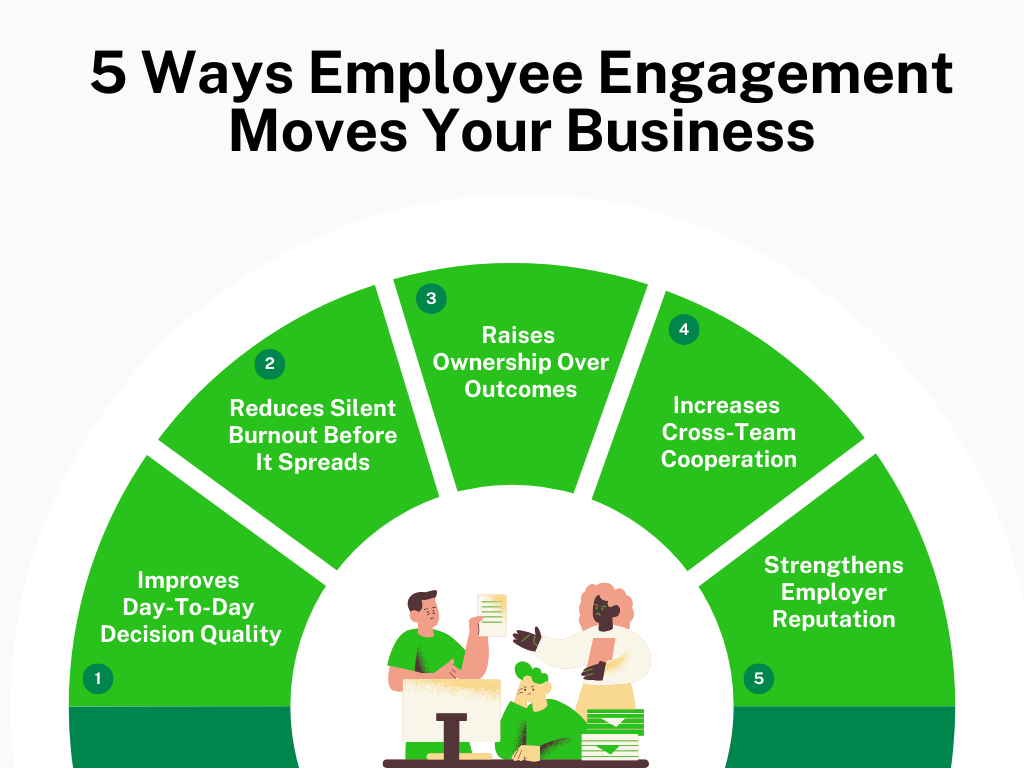
Here’s why boosting employee engagement matters more for a company’s success than most leaders realize.
1. Improves Day-To-Day Decision Quality
Engaged employees don’t default to “just do what I’m told.” They assess impact and make smarter calls in the moment.
A customer-facing employee fixes a small issue immediately rather than escalating it three levels up. A developer flags a risky shortcut before it ships. A marketer pushes back on bad data instead of blindly following a brief. Engagement encourages employees and sharpens judgment because people care about consequences, not just completion.
2. Reduces Silent Burnout Before It Spreads
Burnout rarely starts with someone saying, “I’m burned out.” It shows up as slower responses and lower employee morale. In engaged teams, those changes stand out immediately because of better work-life balance and enhanced job satisfaction.
Programs like mental and physical health support and stress management counseling access plus flexible work arrangements make things easier.
People check in early. Managers notice patterns instead of excuses. Workloads get adjusted before productivity drops or resentment leaks into group chats. Employee satisfaction increases and problems stay small because no one is pretending everything is fine.
3. Raises Ownership Over Outcomes, Not Just Tasks
Low engagement creates checkbox behavior. Do the task. Send the update. Move on. Engagement changes that instinct. Employees feel empowered and track what happens after their work leaves their hands.
They follow up. They fix downstream issues. They care if the results are poor, even if their part was “technically done.” That is ownership, and it saves time you would otherwise spend correcting avoidable mistakes.
4. Increases Cross-Team Cooperation Without Enforcement
Boosting engagement removes territorial behavior. Sales explains client constraints to the product. Product flags roadmap shifts early to support. Support loops insights back to engineering without being asked. This cooperation happens because people trust each other’s intent. No policies required. Work simply moves faster across boundaries.
5. Strengthens Employer Reputation Through Employee Behavior
Engaged employees advertise your company without trying. They post real stories online. They refer to people they respect. They speak positively about company values in industry conversations. This behavior attracts better candidates than job ads ever will. It also sets expectations early, which improves hiring quality and reduces early turnover.
22 Fun Team Engagement Ideas That Actually Work for Everyone
Here are 22 highly effective and inexpensive employee engagement ideas that fit into real workdays and actually encourage participation.
Creative Employee Engagement Ideas
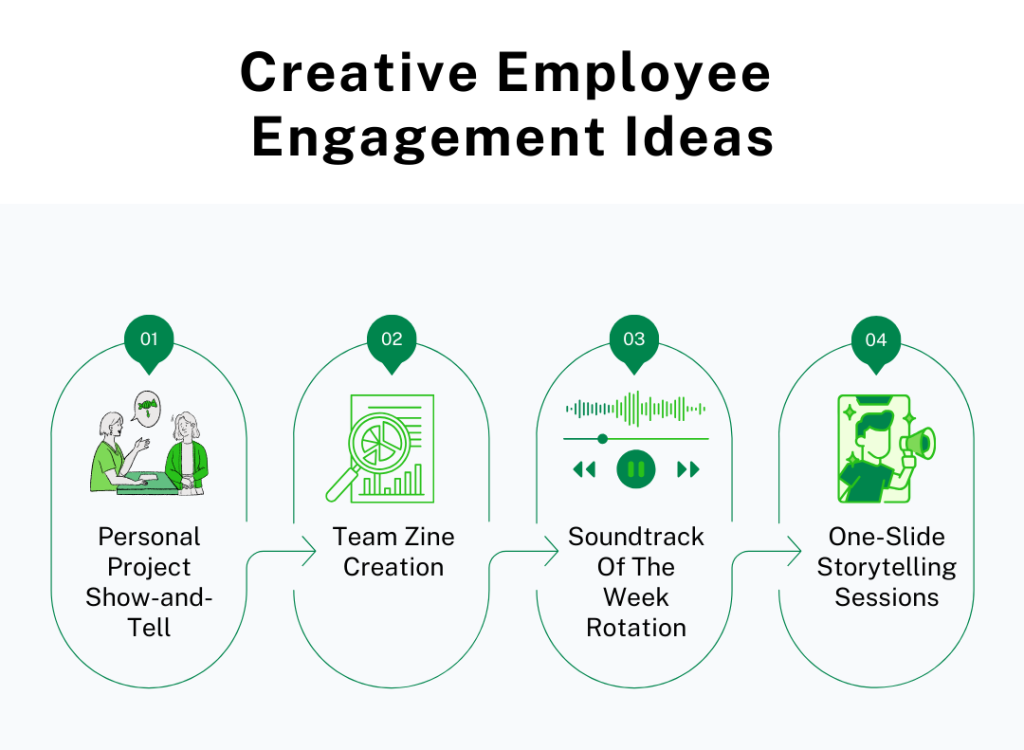
1. Personal Project Show-and-Tell
It is a great employee engagement idea that gives people space to share something they work on outside their job description – a hobby, a Notion system, a home automation setup, a long-term hobby. It creates respect fast because the focus is on teaching new skills and curiosity, not personality.
- Ease of Execution: Easy
- Group Size & Setting: 6–20 people, team meeting or lunch-and-learn
- Duration: 5 minutes per person, max 30 minutes
- What You Need: One slide per person or one photo
- Best Time to Do: Monthly team meetings or end-of-quarter wrap-ups
2. Team Zine Creation
The team collaborates on a digital mini-magazine. Each person owns one page: tips, short essays, visuals, experiments, or lessons learned. One shared deadline. One final PDF. Ownership stays individual, outcome becomes collective.
- Ease of Execution: Moderate
- Group Size & Setting: 5–15 people, async contribution + one review session
- Duration: 10–15 minutes per person to contribute, 30 minutes to review
- What You Need: Google Slides, Canva, or Notion
- Best Time to Do: Quarterly team rituals or onboarding cycles
3. Soundtrack Of The Week Rotation
One person curates a short playlist and explains the logic behind it – work energy, focus blocks, post-deadline decompression. This employee engagement game creates a light structure and a weekly rhythm without meetings.
- Ease of Execution: Easy
- Group Size & Setting: Any size, async, ideal for remote team members
- Duration: 2 minutes to submit, zero meeting time
- What You Need: Spotify, Apple Music, YouTube playlist
- Best Time to Do: Mondays or sprint kickoffs
4. One-Slide Storytelling Sessions
Each participant brings one slide explaining a recent organizational success or failure. No decks. No over-explaining. The constraint forces clarity and sharper communication.
- Ease of Execution: Moderate
- Group Size & Setting: 6–12 people, team meeting
- Duration: 3 minutes per person, max 30 minutes
- What You Need: Slide deck
- Best Time to Do: Monthly retrospectives or project wrap-ups
Learning & Skill-Building Employee Engagement Programs
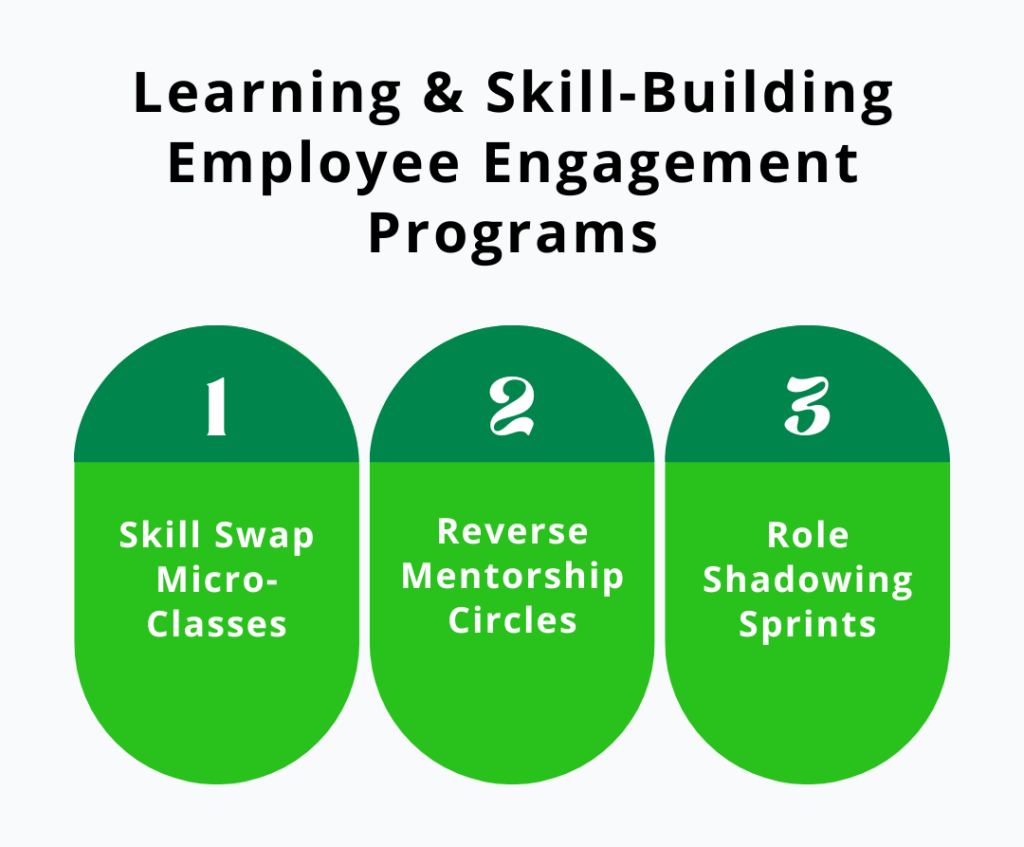
5. Skill Swap Micro-Classes
Team members teach a 15-minute micro-class on a skill they use at work – SQL basics, prompt writing, stakeholder emails, spreadsheet shortcuts. Teaching rotates, and content stays practical and immediately usable.
- Ease of Execution: Easy
- Group Size & Setting: 5–20 people, meeting room or video call
- Duration: 15 minutes per session
- What You Need: Volunteer instructors and calendar slots
- Best Time to Do: Biweekly team meetings
6. Reverse Mentorship Circles
You pair employees where junior team members lead sessions explaining tools or workflows they use daily. Senior staff listen and ask questions. It changes hierarchy and offers more professional development opportunities.
- Ease of Execution: Moderate
- Group Size & Settling: 3–5 people per circle, structured sessions
- Duration: 30–45 minutes per session
- What You Need: Topic list and facilitator
- Best Time to Do: Quarterly learning cycles
7. Role Shadowing Sprints
Employees shadow someone in a different role for half a day or one full day. One task. One walkthrough. One debrief. This removes assumptions and improves collaboration immediately.
- Ease of Execution: Hard
- Group Size & Setting: 1:1 or small groups, live work environment
- Duration: Half-day or full-day
- What You Need: Manager approval and scheduling coordination
- Best Time to Do: Post-project or during slower business periods
Fun Employee Engagement Ideas
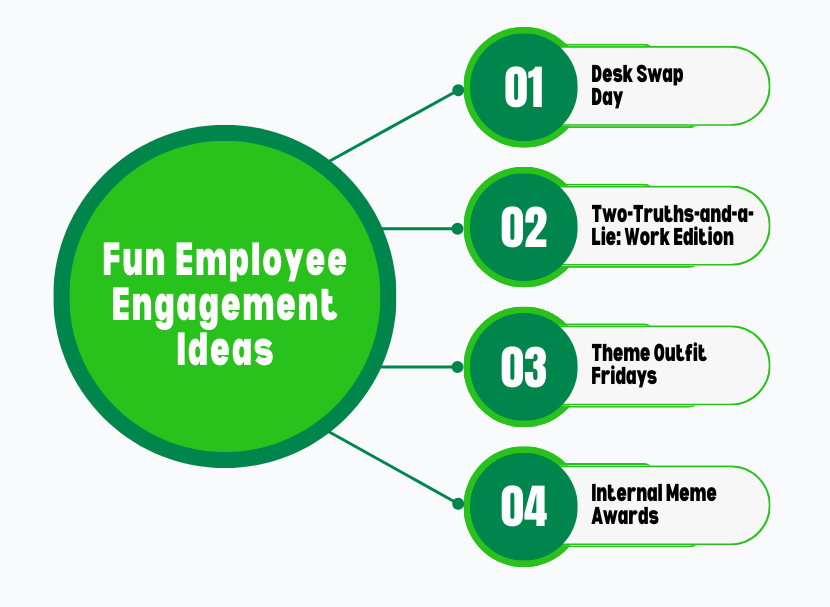
8. Desk Swap Day
Desk Swap Day is simple: two people trade workspaces for a day. Same tasks. Different setup. You quickly notice how others arrange tools and structure focus time. Someone might have a minimal desk that speeds up decision-making. Someone else might use sticky notes or shortcuts you have never tried. The value comes from copying what works, not the novelty.
- Ease of Execution: Easy
- Group Size & Setting: Any size, in-office or hybrid
- Duration: One full workday
- What You Need: Pairing list and manager approval
- Best Time to Do: During lighter workload weeks
9. Two-Truths-and-a-Lie: Work Edition
Invite employees to prepare 3 work-related statements. Two are real. One is false. These could be strange client requests or last-minute pivots. The group guesses which one is the lie. This works because it surfaces real experiences people rarely talk about, without drifting into personal trivia.
- Ease of Execution: Easy
- Group Size & Setting: 5–12 people, team meeting or lunch session
- Duration: 10–20 minutes
- What You Need: Clear prompt sent beforehand
- Best Time to Do: Team onboarding or monthly check-ins
10. Theme Outfit Fridays
In this fun employee engagement activity, the team picks a light and work-appropriate theme each Friday – “favorite color,” “sports team,” “throwback decade.” Some go all in. Some keep it subtle. Participation is optional, and no one is singled out. The shared theme creates visual energy without interrupting work.
- Ease of Execution: Easy
- Group Size & Setting: Any size, in-office or video calls
- Duration: All day, no meeting time
- What You Need: Theme calendar and Slack reminder
- Best Time to Do: Fridays or end-of-sprint days
11. Internal Meme Awards
Create a private space where employees submit memes about internal processes or recurring work moments. At the end of the month, you gather employee feedback and the team votes on categories like “Most Accurate,” “Best Project Meme,” or “Best Client Moment.” Voting shows shared frustrations and inside jokes that leadership can actually learn from.
- Ease of Execution: Moderate
- Group Size & Setting: Any size, async + short voting session
- Duration: 5–10 minutes to vote, zero meeting required
- What You Need: Slack channel or shared folder
- Best Time to Do: Month-end or sprint retrospectives
Ownership & Autonomy-Driven Team Engagement Ideas
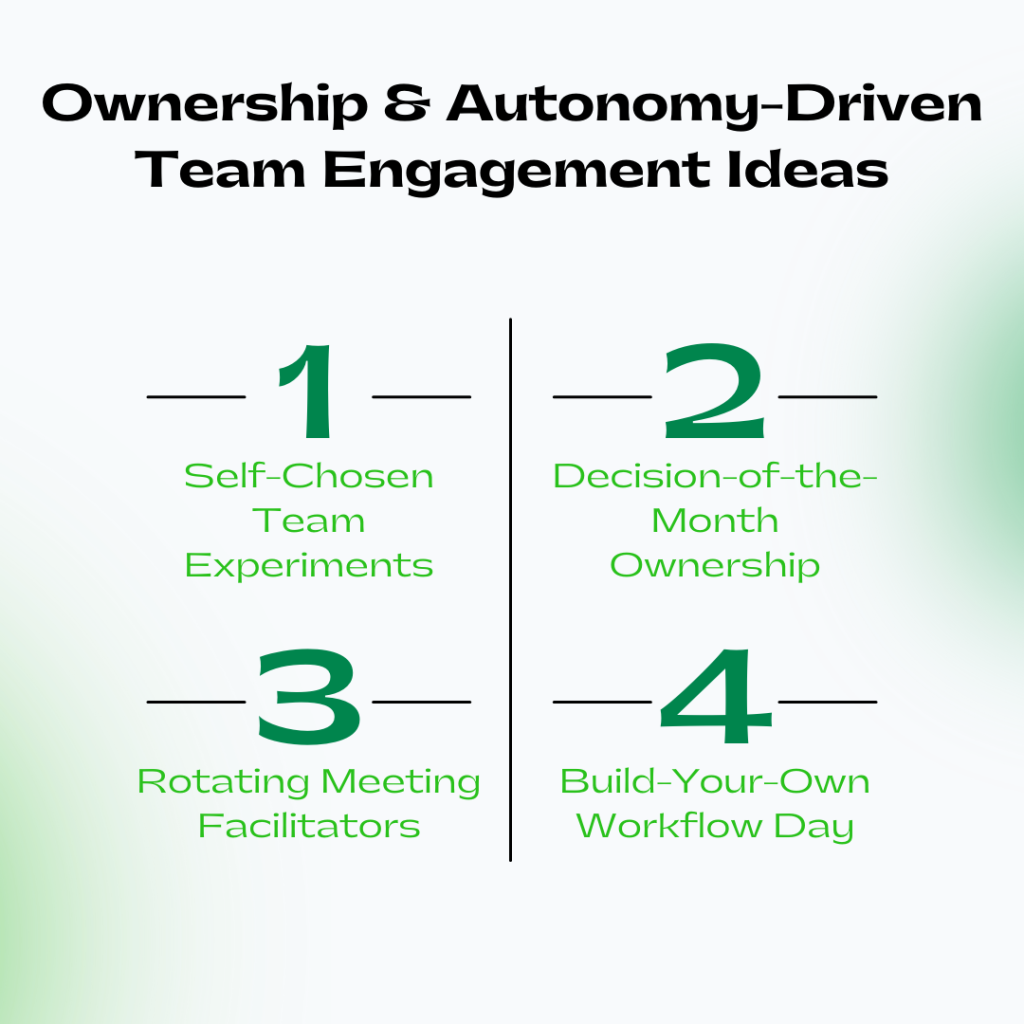
12. Self-Chosen Team Experiments
Each team member chooses one small work experiment to run for two weeks. This could involve a new task batching method or improvements to documentation. They track results and share what changed – no leadership approval cycle.
- Ease of Execution: Moderate
- Group Size & Setting: Any size, async with one share-out meeting
- Duration: Two-week experiment + 30-minute review
- What You Need: Experiment template and tracking doc
- Best Time to Do: Start of a sprint or quarter
13. Decision-of-the-Month Ownership
One person owns one recurring decision for a month. They collect input, make the call, document why, and track outcomes. Authority is clear and temporary.
- Ease of Execution: Moderate
- Group Size & Setting: 6–15 people, async + one review meeting
- Duration: Ongoing ownership for one month
- What You Need: Decision brief template
- Best Time to Do: Monthly planning cycles
14. Rotating Meeting Facilitators
Each recurring meeting has a new facilitator every time. They control the agenda and assign follow-ups. Meetings tighten quickly when responsibility rotates.
- Ease of Execution: Easy
- Group Size & Setting: Any size, recurring meetings
- Duration: Per meeting
- What You Need: Facilitation checklist and rotation schedule
- Best Time to Do: For all standing meetings
15. Build-Your-Own Workflow Day
One day every quarter, team members redesign their own workflows. Tools, steps, handoffs. At the end, they share what changed and why. Teams steal ideas that save time.
- Ease of Execution: Hard
- Group Size & Setting: Any size, independent work + group review
- Duration: One full day + 30-minute review session
- What You Need: Workflow template and manager approval
- Best Time to Do: End of quarter or post-project reset
Connection & Human-Centered Team Building Ideas
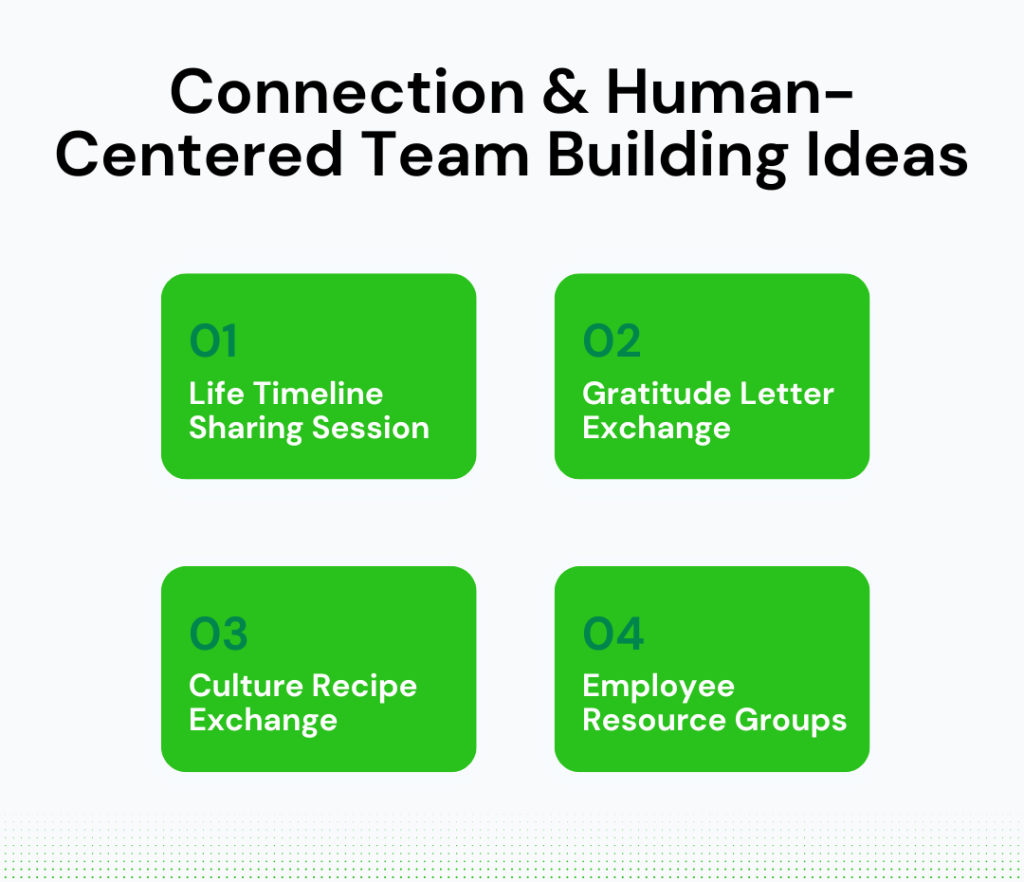
16. Life Timeline Sharing Session
Each person creates a simple timeline with 5–7 points: career shifts, major learning moments, pauses, pivots, or challenges that change perspective. No therapy talk. Just context. Teams stop assuming motives once they understand backgrounds.
- Ease of Execution: Moderate
- Group Size & Setting: 4–6 people, private meeting room or video call
- Duration: 30–45 minutes
- What You Need: Timeline template and clear participation guidelines
- Best Time to Do: Team onboarding cycles or post-reorg resets
17. Gratitude Letter Exchange
Each participant writes a short and specific note to someone on the team explaining a concrete contribution they appreciated. No vague praise – it must reference an action or decision. Letters are exchanged privately, then acknowledged briefly as a group. This works best for employee recognition.
- Ease of Execution: Easy
- Group Size & Setting: Any size, async with private delivery
- Duration: 10 minutes to write
- What You Need: Prompt guide and delivery method
- Best Time to Do: End of quarter or major project completion
18. Culture Recipe Exchange
Each person contributes one recipe tied to their background and explains when it is usually made and why. Recipes are compiled into a shared doc or PDF. Teams usually recreate them later during potlucks or remote cook-alongs.
- Ease of Execution: Easy
- Group Size & Setting: Any size, async contribution
- Duration: 5–10 minutes per person
- What You Need: Shared document or design template
- Best Time to Do: Cultural heritage months or team anniversaries
19. Employee Resource Groups (ERGs)
ERGs are employee-led groups built around shared experiences or identities. They exist to support professional growth, surface insights leadership may miss, and improve company practices. Strong ERGs have budgets and an executive sponsor.
- Ease of Execution: Hard
- Group Size & Setting: 5–50+ people, ongoing group meetings
- Duration: Ongoing with monthly or quarterly meetings
- What You Need: Charter, leadership sponsor, budget allocation
- Best Time to Do: During inclusion strategy rollouts
Purpose & Impact-Focused Ideas To Increase Employee Engagement
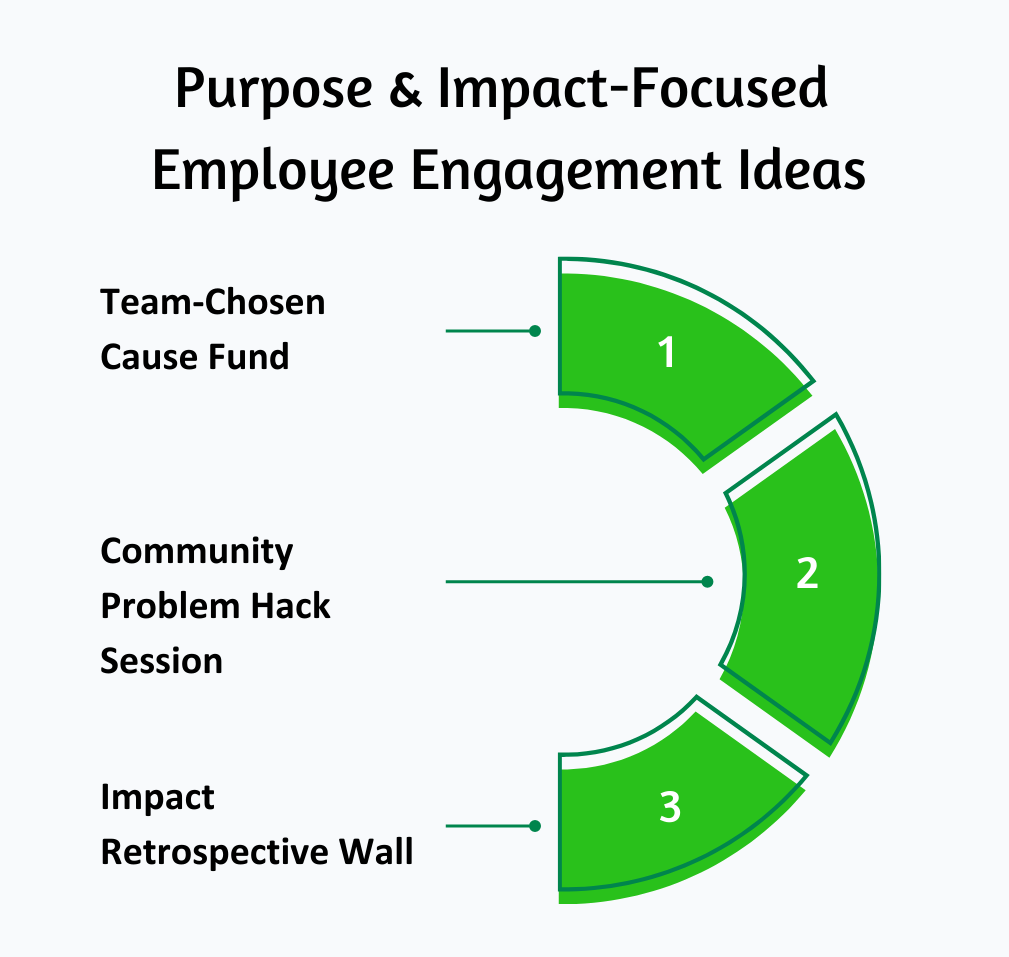
20. Team-Chosen Cause Fund
Teams receive a fixed amount and decide collectively where it goes. Discussions center on impact, not popularity. The decision process matters as much as the donation itself.
- Ease of Execution: Moderate
- Group Size & Setting: Any size, async voting + short discussion
- Duration: 15–20 minutes to decide, ongoing impact
- What You Need: Budget allocation and vetted cause list
- Best Time to Do: Quarterly planning cycles
21. Community Problem Hack Session
Teams pick a real issue faced by a nonprofit or local group and spend a half-day proposing solutions using their skills. Output gets shared with the organization. This turns engagement into practical community involvement that has real impact.
- Ease of Execution: Hard
- Group Size & Setting: 6–20 people, workshop or offsite
- Duration: 3–4 hours
- What You Need: Partner organization, problem brief, facilitation plan
- Best Time to Do: Company retreats or volunteer days
22. Impact Retrospective Wall
A physical or digital wall where teams document work that mattered beyond metrics. Customer outcomes, internal improvements, long-term effects. It becomes a living record without performance theatrics.
- Ease of Execution: Moderate
- Group Size & Setting: Any size; physical wall or digital board
- Duration: 20–30 minutes to build, ongoing reference
- What You Need: Whiteboard, mural board, digital canvas
- Best Time to Do: Project closeouts or quarterly reviews
7 Employee Engagement Mistakes That Create Pushback (With Practical Fixes)
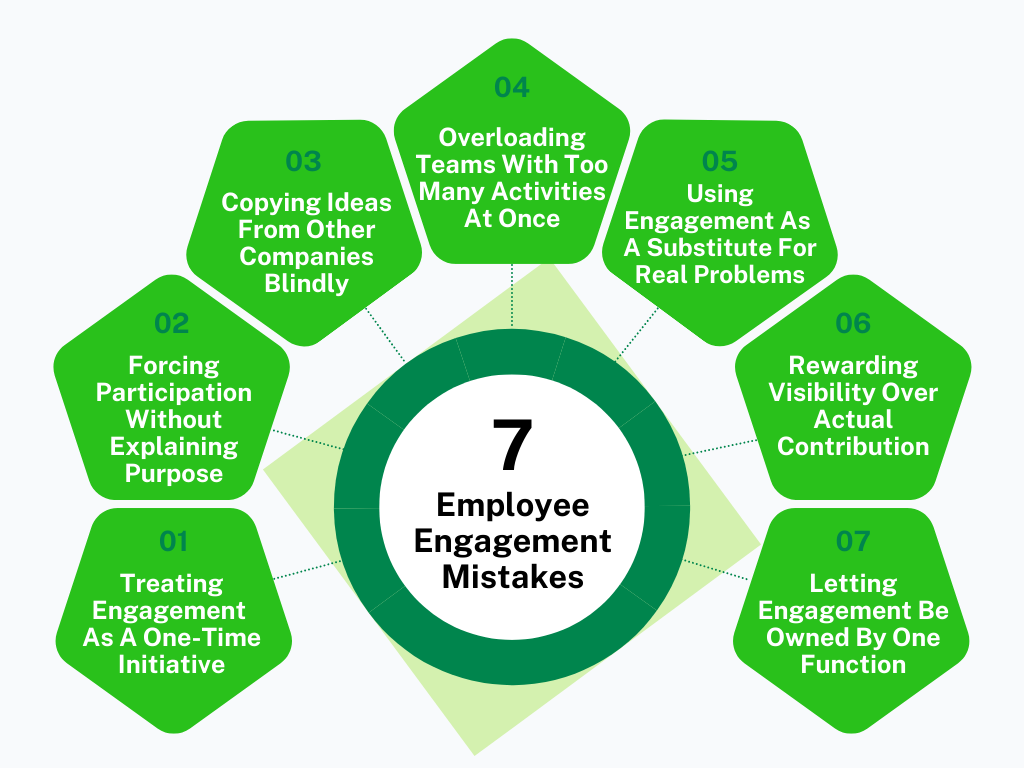
Even the best intentions can flop if engagement is done the wrong way. Here are 7 mistakes that make teams groan instead of participating.
1. Treating Engagement As A One-Time Initiative
This happens when engagement is launched like a campaign. There is a kickoff. A few activities. Some noise. Then it quietly disappears. Teams read that pattern clearly. Engagement becomes something temporary and easy to ignore because nothing about daily work actually changes.
How to Fix It
Design engagement to live inside existing routines. Tie it to weekly reviews or retrospectives so it keeps running even when no one is “promoting” it anymore.
A Practical Example From A Team That Got It Right
The team of California cost segregation experts at Re Cost Seg initially ran an annual engagement week that generated short-term excitement but no lasting impact.
They shifted to embedding engagement checkpoints into their client delivery process. Each project now includes a structured reflection on workload and decision clarity. This made engagement part of how work happens, not something that interrupts work.
2. Forcing Participation Without Explaining The Purpose
Mandatory engagement creates resistance when people don’t understand the problem it is meant to solve. Calendar invites show up. Activities get scheduled. No context follows. Teams interpret that silence as a lack of respect for their time. Participation becomes mechanical instead of thoughtful.
How to Fix It
Start with the problem, not the activity. Explain what is breaking or causing friction. Then introduce engagement as a tool, not an obligation.
A Practical Example From A Team That Got It Right
DialMyCalls school notification system rolled out mandatory engagement sessions tied to internal communication improvements, but skipped explaining the intent. Attendance dropped in quality, not quantity.
They reset by sharing internal data showing missed handoffs during peak notification periods. They framed the sessions as a fix for those breakdowns. Once teams understood the connection, discussions became tactical instead of performative.
3. Copying Engagement Ideas From Other Companies Blindly
Engagement ideas don’t work well without adjustment. What works for a 20-person startup collapses inside a 200-person operation. What works for creative teams frustrates operational ones. Blind copying creates friction because it ignores how work actually happens.
How to Fix It
Extract intent instead of format. Ask what outcome the idea supports, then rebuild it around your team’s workflows and constraints.
A Practical Example From A Team That Got It Right
MedicalAlertBuyersGuide adopted a peer recognition model used by a tech startup, but their research-heavy and compliance-driven team found it distracting. They redesigned the program to focus on recognizing risk mitigation and data accuracy instead of public praise. Engagement improved because recognition matched the work that mattered most.
4. Overloading Teams With Too Many Activities At Once
Engagement fatigue comes from good intentions stacked too closely together. Wellness initiatives, fitness challenges, feedback sessions, learning blocks, and social events pile up until engagement itself becomes work.
How to Fix It
Limit active engagement efforts to one or two at a time. Pause or retire anything that stops producing insight or behavior change.
A Practical Example From A Team That Got It Right
CodaPet on-demand pet euthanasia services launched learning sessions, wellness challenges, and social check-ins within one quarter. None of them failed individually. Together, they overwhelmed teams already handling emotionally demanding work. Participation dropped across the board.
Leadership paused everything except one weekly decompression session linked directly to case reviews. Teams re-engaged because attention wasn’t split across competing initiatives.
5. Using Engagement As A Substitute For Real Problems
Engagement collapses fast when it is used to distract from operational issues. Mental health support programs don’t offset unclear priorities. Social activities don’t fix workload imbalance. Teams notice when basic engagement runs alongside unresolved problems.
How to Fix It
Fix structural issues first. Once work is stable and expectations are clear, engagement can reinforce progress instead of masking gaps.
A Practical Example From A Team That Got It Right
Golf Cart Tire Supply introduced recognition boards and morale contests, while fulfillment teams struggled with inconsistent inventory updates. Employees saw praise being handed out while the same operational issues caused daily rework. Engagement initiatives felt disconnected from reality.
Once leadership fixed inventory visibility and delivery scheduling, engagement efforts regained credibility. Teams participated again because daily frustrations were finally addressed.
6. Rewarding Visibility Over Actual Contribution
When recognition favors who speaks the most or appears busiest, engagement turns performative. Quiet contributors disengage. Teams learn to optimize for attention rather than outcomes.
How to Fix It
Linkrewards to results and impact. Make contribution visible through outcomes, not who talks the most or shows up the loudest.
A Practical Example From A Team That Got It Right
At GetSafe, recognition initially favored employees who spoke often in meetings or stayed visible in Slack. Quiet contributors handling complex escalations went unnoticed. Over time, those employees disengaged.
Leadership shifted recognition toward measurable outcomes like incident resolution time and customer recovery success. Contribution patterns changed quickly because rewards matched actual impact.
7. Letting Engagement Be Owned By Only One Function
Engagement loses relevance when it is entirely with HR or leadership. Teams see it as something done to them, not with them. Ownership gaps form between intent and execution.
How to Fix It
Distribute ownership across managers and teams. Let engagement decisions happen where work actually gets done.
A Practical Example From A Team That Got It Right
Brain Ritual natural migraine prevention supplements originally centralized engagement under People Ops. Activities were well-intentioned but disconnected from formulation and marketing workflows. Teams participated politely, then disengaged.
The shift happened when engagement planning moved into team retrospectives. Managers and teams decided what engagement looked like for their work. HR supported instead of directing. Participation increased because engagement was no longer external to daily operations.
Conclusion
If there is one takeaway from this list, it is this – engagement is something you design quietly and run consistently. Pick fewer engagement initiatives. Run them well. Let teams refine them instead of rolling out polished team-building activities from the top. Measure employee engagement through employee surveys. When people have control and clarity, engagement blends into everyday work.
That same thinking is exactly why we built Tivazo. It is a time tracking tool for in-office and remote employees that offers real-time dashboards, timesheets, live screenshots, and performance insights.
This lets you see who is working on what, how long tasks take, and where time gets spent – not to point fingers, but to give employees the context they need for better routines and sharper decisions.
See how it works with a Tivazo demo or try it for free on your own remote and hybrid employees.