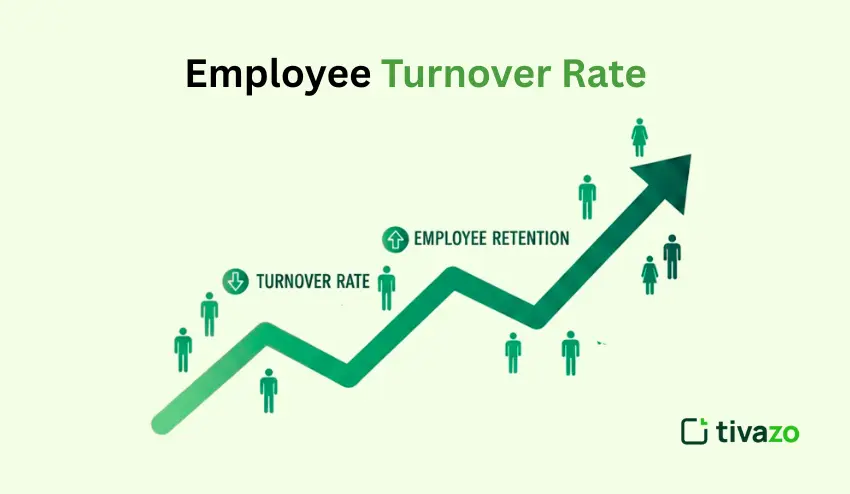
Retaining your best employees is no longer just important to boost morale; it has become crucial to the success of a business. Organizational life today has presented leaders and managers with unprecedented challenges related to employee retention, burnout, and a changing work environment.
In 2026, workforce stability is no longer a futuristic ideal but a pressing need within every business, across every industry. Unprecedented challenges in employee retention, employee exhaustion, and changing expectations at work.
But it’s not about having a stable workforce; it’s about building a foundation for continued performance and ultimate success.
What Is Workforce Stability?
Workforce stability refers to the capacity of maintaining a steady and steady workforce in an organization. This means maintaining a steady workforce through employee engagement, productivity, and commitment to their work without frequently turning them over.
There is a great deal of confusion between workforce stability and employee retention. Although they overlap, they are not identical.
Retention focuses on preventing employee turnover, whereas workload stability is a more holistic concept that aims to create an environment where a workforce is productive, enthusiastic, and committed.
The Difference Between Stability and Retention
Employee retention is also a metric. It shows you how many employees stay compared to how many leave.
Workforce stability in an organization is a condition that stands for the general well-being of your workforce. You can have a decent retention strategy, but still fail to have a stable workforce because of a disengaged workforce or flaky productivity.
Why Workforce Stability Matters for Business Performance
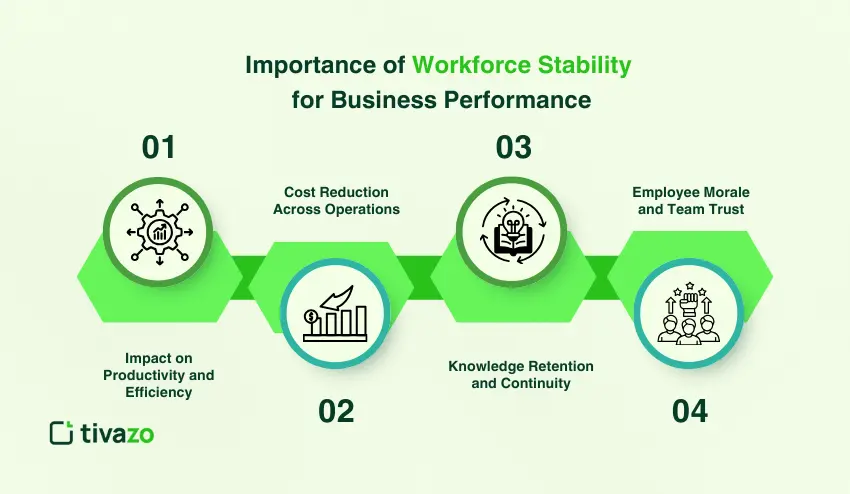
The importance of employee stability goes far beyond traditional HR metrics. Your bottom line, employee satisfaction, and competitive positioning in the market all depend on it.
Yet, organizations that maintain a constant work environment have benefited substantially over others whose staff changes frequently. The advantages permeate every facet of operating a business, from day-to-day productivity to long-term strategic planning.
1. Impact on Productivity and Efficiency
Stable teams work faster, more innovatively, and smarter. They know their roles, understand the processes, and can work together.
When your workforce is consistent, you don’t have the dips in productivity that occur every time you do onboarding. New hires take some time to learn. While doing so, productivity for both them and their trainers decreases.
A stable team has momentum. Projects move along. Deadlines are met. Quality is maintained high level.
2. Cost Reduction Across Operations
Employee turnover is expensive-very expensive. Depending on how you calculate the costs of recruitment, induction, and lost productivity, replacing one employee can cost anywhere from 50-200% of a worker’s annual salary.
You see, workforce stability and productivity go hand in hand to reduce such costs. You spend less on hiring, and the budget for training shrinks. Operational efficiency improves.
Stability, aside from direct costs, is reduced through such invisible costs as overtime to make up for gaps and mistakes of inexperienced personnel and management time dealing with recruitment.
3. Knowledge Retention and Continuity
Every person who leaves the organization takes their knowledge with them. This includes clients, processes, and problem-solving expertise.
In a stable environment, this knowledge remains and continually increases. Veteran staff members guide younger staff members. Best practices are codified and shared with others. Your company gets smarter.
Continuity can be very important, especially in professional roles or industries where experience can take a lifetime to gain.
4. Employee Morale and Team Trust
Stability leads to a certain level of confidence. Teams are stable, so the members are able to form working relationships and trust each other.
It causes anxiety for those remaining to wonder if they should also leave. It puts an extra burden of extra workload on those remaining to help compensate for those leaving. It lowers employee morale.
A stable environment sends a different kind of message: “This is a good place to work.” This is a place where people want to stay. That sends a message to attract good talent and to ensure your very best performers are staying.
Key Factors That Affect Workforce Stability
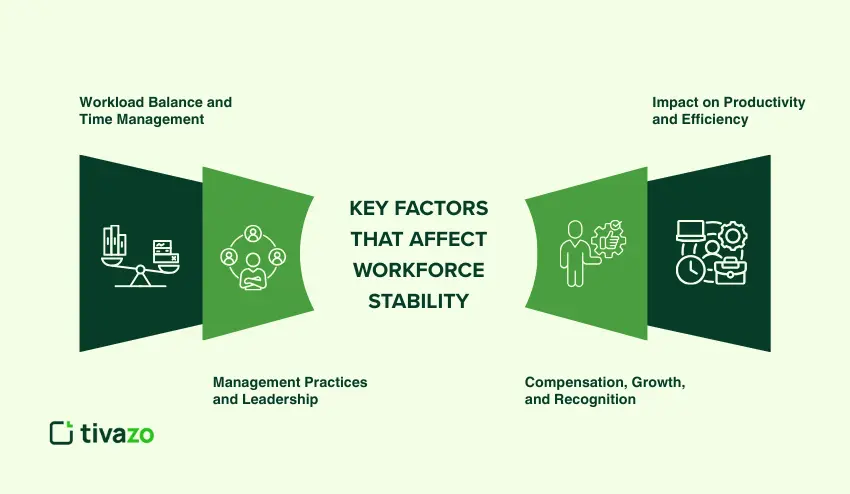
There are numerous variables that affect employees’ commitment and productivity; understanding them is key to becoming aware of risks before they turn into issues.
Workload Balance and Time Management
Overwork is one of the main reasons for turnover. When people are overworked, they get exhausted and quit their jobs. Ineffective distribution of tasks only worsens an already bad problem. Some members have too much work, and then some have too little.
Effective time management at work requires knowledge of who is doing what. Without clear data on who is doing what, management cannot make informed decisions on allocations.
Overtime, a chronic issue is a sign of future instability, as it means the business is either understaffed or has inefficient processes, and these issues need
Management Practices and Leadership
The way you manage people has a major effect on workforce stability/retention. Proper communication avoids confusion, which harbors trust. Employees have a need to be told what is expected of them. Employees have a need for feedback. Employees have a need for accountability.
Management forces people away from organizations faster than anything else. Great managers hold on to people even in tough times.
Compensation, Growth, and Recognition
Money matters; however, money is also not everything for people. Employees need to be compensated properly; however, they also need opportunities for growth and recognition.
Career progression is one way to continue engaging someone long-term. If there is no way forward, people will seek opportunities elsewhere.
Performance evaluation should also be transparent in nature and linked to considerable rewards. Employees are more willing to commit to an organization if they see their contribution being recognized.
Flexibility and Predictability in Work Arrangements
Flexibility is greatly appreciated in today’s employees. Remote work, hybrid schedules, and flexible options are no longer considered perks; they are now the norm.
However, flexibility doesn’t mean chaos. Employees also need predictability, knowing their schedules, understanding expectations, and having consistent processes.
The difficulty here is how to find a balance between both. There is no need for rigidity, but there certainly is a need for frameworks.
Workforce Stability vs Workforce Flexibility: Can They Coexist?
Stability and flexibility are conceived by many in power as opposites. They are not.
Organisations can definitely exist with both. The problem is realising that stability is found in clearness, rather than stiffness.
Flexible work schedules can work well if there is a clear understanding in place. It doesn’t interfere with stability if there is a system of accountability in place for remote work arrangements. Hybrid work arrangements can work as long as work visibility is high.
If one were asked to define stability as a foundation and flexibility as the point on which one builds, they would realize that without stability, flexibility equals chaos.
How Workforce Instability Hurts Organizations
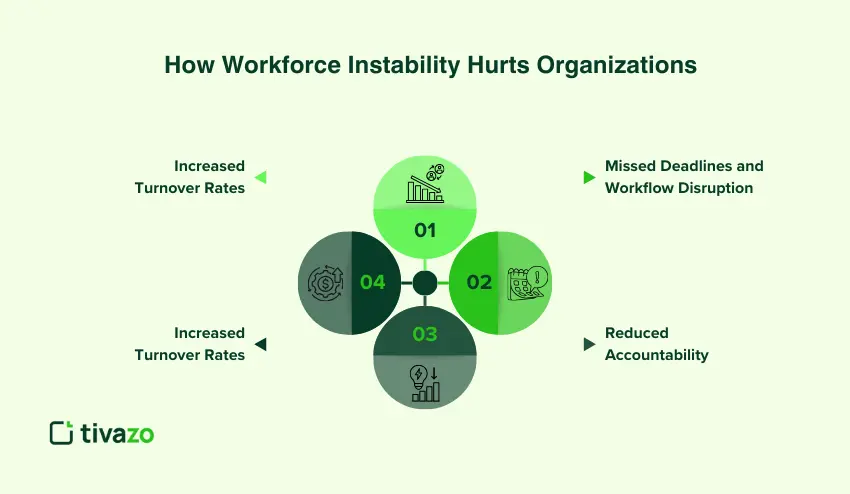
The costs of instability, however, are not merely the direct costs of turnover. This ripples through every aspect of your business.
Increased Turnover Rates
Instability breeds instability. If good employees depart, those remaining will become apprehensive and begin to look elsewhere, too.
High turnover rates create a downward spiral. In other words, each turnover breeds a second turnover, and a second turnover breeds a third, and so on. Breaking this spiral is a labor-intensive process.
Missed Deadlines and Workflow Disruption
In unstable teams, there are issues of consistency. When projects are involved, teams falter due to the departure of members. There are also knowledge gaps that result in mistakes.
However, employees must be given time to make full contributions to the team. Therefore, when they are new to an organization, teams are working at less than full potential, and deadlines are missed.
Reduced Accountability
In unstable situations, there is a lack of accountability. People don’t know who is accountable for what. Instead of ownership, there is finger-pointing.
On a team that changes constantly, institutional memory ceases to exist. No one remembers the reasons for doing things the way they’re done or how they are done.
Higher Operational Costs
In addition to replacement costs, instability adds to direct costs everywhere. Training budgets grow. Overtime, error rates escalate.
Managers become distracted with recruitment activities rather than improving operations. Strategic initiatives are delayed. Growth stalls.
Practical Approaches to Workforce Stabilization
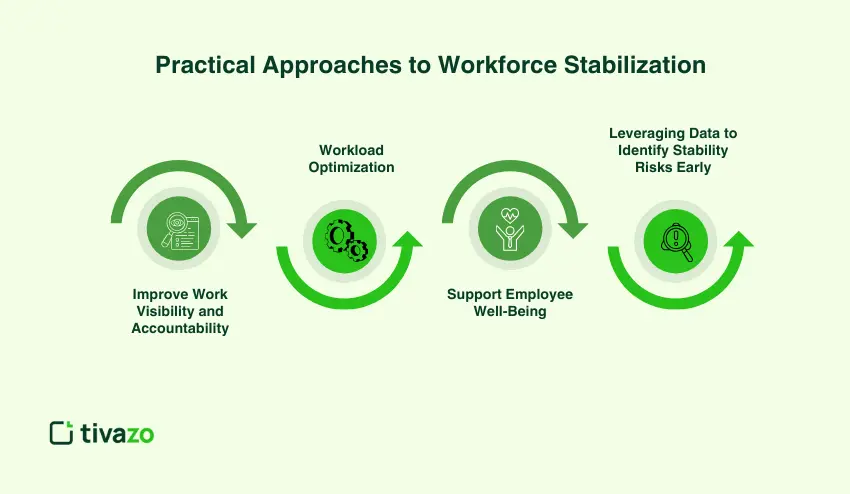
Workforce stability is built with purpose in many different areas. These workforce stability strategies yield quantifiable results.
Improve Work Visibility and Accountability
You can’t manage what you can’t see. Clear visibility into who’s working on what prevents confusion and overload.
Ownership of tasks needs to be clear. Each person needs to be aware of the tasks with which they will be dealing and the deadlines for each. Transparency in performance tracking keeps teams aligned.
When work is visible, managers are able to see problems sooner. They are able to rebalance the workload before anyone burns out. They are able to give credit where due.
Workload Optimization
Data-backed scheduling prevents the feast-or-famine cycles that stress teams. Some employees shouldn’t be drowning while others have spare capacity.
The regular analysis of the workload helps balance assignments. It finds patterns leading to burnout. It uncovers opportunities for more efficiency.
It’s avoiding chronic overtime. You’re always going to have some crunch times, but sustained overwork absolutely guarantees turnover.
Support Employee Well-Being
Employee burnout dissipates any sense of a stable workforce. The only way to prevent this is through active interventions, not solely through wellness seminars.
Monitor work patterns for signs of burnout. Promote healthy boundaries. Demonstrate work-life balance from the top.
Employee engagement thrives in a culture where employees feel cared for. This includes flexible arrangements, recognition schemes, or clear avenues for growth.
Leveraging Data to Identify Stability Risks Early
Workforce analytics detects these patterns before they turn into crises. Trends in attendance disclose disengagement. Changes in productivity reveal issues.
The time allocation insights indicate where there are bottlenecks. It indicates when individual roles or departments are being overwhelmed.
Early intervention also prevents people from leaving. When you identify early warning signs, you can often address the underlying issues before your people begin to look outside for new opportunities.
Measuring Workforce Stability: What to Monitor
For effective workforce management, it is essential to monitor suitable workforce management indicators. The indicators will let you know your stability.
- Employee Turnover Rate: Measure monthly and/or annually. Compare to industry standards. Analyzing trends.
- Absenteeism Rate: Frequent absences are usually a sign of impending resignation, so increased rates might be an indicator of
- Average Tenure: Long average tenures may indicate more stability. Comparison of different departments may be useful here.
- Productivity Consistency: Monitor the quality and quantity of output produced. Extreme fluctuations signal instability.
- Overtime Trend: If overtime is consistently high, it may signal burnout or turnover in the future
The Future of Workforce Stability
Changes in the management of workforce stability are happening fast, especially due to technological advancements.
AI and workforce analytics offer unprecedented visibility. Stability risks can be predicted using data, not gut feelings.
The evolution from hours worked toward work quality is an ongoing process. This process is beneficial for stability and flexibility.
Organizations that want to leverage the data-based approach to employee management will reap many rewards. Some of these rewards include earlier identification and resolution of issues and improved employee retention.
Conclusion: Building a Stable Workforce
Workforce stability doesn’t mean no change. It means developing an environment where good people want to stay and contribute.
Stability of Workforce: This term now goes beyond retention; it also refers to engagement, productivity, and well-being.
Organizations that focus on stability reap benefits, including gaining competitive advantages. They are more efficient. They are better at serving their clients. They are able to attract stronger talent.
For stability within an organization, commitment needs to be found across various domains such as workload, communication, remuneration, and growth, among others.
First, there is the issue of visibility. Be aware of your current state. Know the key metrics. Intervene as soon as you note a risk.
Stability is a business advantage, not an HR requirement. If you think of it that way, you’ll construct an organization that succeeds over time.