Staying productive can be challenging, especially with distractions constantly vying for your attention. This is where time-blocking steps in as a highly effective technique that allows you to take control of your schedule, enhance efficiency, and achieve your goals without feeling overwhelmed. Let’s explore how this method can elevate your productivity.
What is the meaning of Time Blocking

Time blocking is a powerful productivity technique that helps you manage your day effectively by prioritizing and scheduling your most important tasks first. This method encourages you to focus on what truly matters, allocating specific time slots for high-priority activities.
By creating a structured schedule with distinct blocks dedicated to specific tasks, you minimize distractions and enhance concentration. This allows you to immerse yourself in each task without interruptions, significantly boosting your productivity.
Incorporating time blocking into your daily routine can transform how you approach productivity. By prioritizing your tasks, minimizing distractions, and allowing for flexibility, you can create an efficient workflow that empowers you to achieve your goals with greater ease.
Is time blocking good for ADHD?
Absolutely, time blocking works for some ADHDers, but it needs to be flexible and realistic. It is also often hard to keep distractions under control, to prioritize work, and to maintain a long attention span with ADHD. Time blocking helps by providing the structure of the day and helps to ease decision fatigue.
People work on one task instead of a long to-do list and in a specific time block. This will help focus attention and break down big projects into smaller ones.
Time blocking for ADHD has the following benefits:
- Improved concentration and less multitasking
- Improved time awareness
- Lower mental overwhelm
- Improved yields and uniformity.Greater productivity and uniformity
But rigid times can be frustrating. It’s best to keep the blocks shorter, use some breaks in between, and leave buffer time between tasks. Many individuals with ADHD use time blocking in conjunction with another technique, such as the Pomodoro method or digital reminders, to increase effectiveness.
What is the 5-time blocking method?
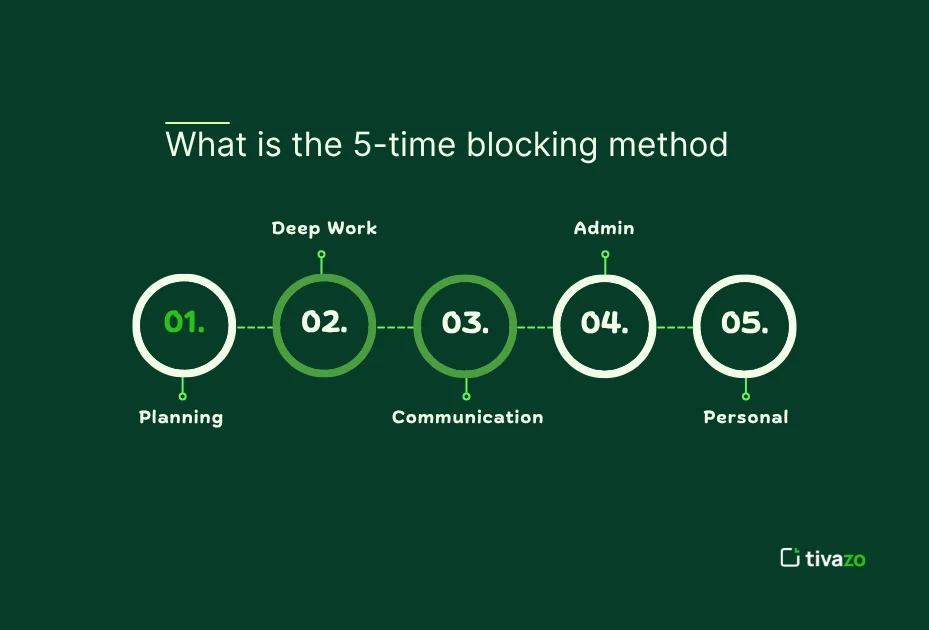
The 5-time blocking method is a productivity technique that breaks your day into five main blocks of time. Every block is meant to be used for a particular work or activity, aiding in keeping people organized and steering clear of constant changes of tactics.
A simple structure could be like this:
- Planning Block: Check priorities, emails, and daily goals.
- Deep Work Block: Concentrate on tasks of high priority.
- Communication Block: Conduct meetings, messages, and collaboration.
- Admin Block: Follow up, report, or complete routine tasks.
- Personal Reset Block: Take breaks, include exercise, time for reflection, or learning.
This is a method that works because it sets up “boundaries” around work activities rather than responding to tasks throughout the day. This boosts productivity, time management, and work-life balance for individuals and teams.
Benefits for productivity and focus

Time blocking offers numerous advantages for improving productivity and maintaining focus:
- Reduced decision fatigue
- Increased accountability
- Better time management
- Enhanced concentration
- Improved work-life balance
Comparison with other time management techniques
Here’s a comparison of time blocking with other popular time management methods:
| Technique | Main Focus | Flexibility | Best For |
| Time Blocking | Scheduling specific tasks | Moderate | Structured workdays |
| Pomodoro | Short work sprints | High | Overcoming procrastination |
| Getting Things Done (GTD) | Organizing tasks and projects | High | Managing complex workflows |
| Eisenhower Matrix | Prioritizing tasks | Moderate | Decision-making |
Time blocking stands out for its ability to provide structure while allowing for focused work on specific tasks. Unlike the Pomodoro technique, which emphasizes short work intervals, time blocking can accommodate longer periods of concentrated effort. While GTD excels at organizing tasks, time blocking takes it a step further by allocating specific time slots for execution.
Now that we understand time blocking and its benefits, let’s explore how to start using this powerful productivity technique.
Getting Started with Time Blocking
Now that we understand the concept of time blocking, let’s dive into how to get started with this powerful productivity technique.
1. Choosing the right tools (digital vs. analog)
When it comes to time blocking, you have two main options: digital or analog tools. Both have their advantages, and the best choice depends on your personal preferences and work style.
| Digital Tools | Analog Tools |
|---|---|
| Calendar apps | Paper planner |
| Task management software | Bullet Journal |
| Time tracking apps | Whiteboard |
| Productivity platforms | Sticky notes |
Digital tools offer convenience, synchronization across devices, and automated reminders. Analog tools, on the other hand, provide a tactile experience and can help minimize screen time.
2. Assessing your current time usage
Before implementing time blocking, it’s crucial to understand how you currently spend your time. Consider these steps:
- Track your activities for a week
- Identify time-wasters and productivity patterns
- Note your most productive hours
- Recognize recurring tasks and commitments
3. Setting clear goals and priorities
With a clear understanding of your current time usage, it’s time to set goals and priorities:
- Define short-term and long-term objectives
- Categorize tasks based on importance and urgency
- Align your time blocks with your most important goals
- Be realistic about what you can achieve in a given timeframe
4. Breaking tasks into manageable blocks
The final step in getting started with time blocking is to break your tasks into manageable chunks:
- Estimate the time required for each task
- Group similar tasks together
- Allow buffer time between blocks for unexpected interruptions
- Be specific about what you’ll accomplish in each block
By following these steps, you’ll be well on your way to creating an effective time-blocking schedule. In the next section, we’ll explore how to craft a schedule that maximizes your productivity and helps you achieve your goals.
Creating an Effective Time-Blocking Schedule
Now that we understand the basics of time blocking, let’s dive into creating a schedule that works for you. An effective time-blocking schedule is tailored to your unique needs and work style, maximizing productivity while maintaining balance.
1. Determining your most productive hours

To create an optimal time-blocking schedule, start by identifying your peak productivity periods. These are the times when you feel most alert, focused, and energized. Here’s a simple method to find your most productive hours:
- Track your energy levels for a week
- Note when you feel most focused and productive
- Identify patterns in your peak performance times
| Time of Day | Energy Level | Focus Level |
|---|---|---|
| Morning | High | High |
| Afternoon | Medium | Medium |
| Evening | Low | Low |
2. Allocating time for different types of tasks
Once you’ve identified your most productive hours, assign your most important or challenging tasks to these periods. Categorize your tasks based on their nature and required focus:
- High-priority, complex tasks
- Routine, administrative tasks
- Creative work
- Meetings and collaborations
3. Building in flexibility and buffer time
While structure is essential, rigidity can lead to stress and reduced productivity. Include buffer time between blocks to account for unexpected interruptions or tasks that take longer than anticipated. This flexibility ensures your schedule remains realistic and achievable.
4. Incorporating breaks and self-care
Don’t forget to schedule regular breaks and time for self-care. These are crucial for maintaining focus and preventing burnout. Consider including:
- Short breaks between work blocks (5-10 minutes)
- Longer breaks for meals and relaxation
- Time for exercise or meditation
- Personal development activities
By following these guidelines, you’ll create a time-blocking schedule that not only boosts your productivity but also supports your overall well-being. Next, we’ll explore how to implement this schedule effectively in your daily life.
Implementing Time Blocking in Daily Life.
Now that you have a solid understanding of time blocking and have created your schedule, it’s time to put it into practice. Implementing time blocking in your daily life can be challenging, but with the right strategies, you can overcome common obstacles and make the most of this productivity technique.
Overcoming common challenges and obstacles
When implementing time blocking, you may encounter several challenges:
- Overestimating task duration
- Underestimating breaks and transitions
- Feeling restricted by a rigid schedule
- Difficulty sticking to the plan
To address these challenges, consider the following solutions:
- Start by overestimating task durations and gradually refine your estimates
- Include buffer time between tasks for breaks and transitions
- Allow for flexibility in your schedule by creating “flex blocks.”
- Use reminders and notifications to stay on track
| Challenge | Solution |
|---|---|
| Overestimating task duration | Start with longer time blocks and adjust as you go |
| Underestimating breaks | Schedule dedicated break time between tasks |
| Feeling restricted | Include flex blocks for unexpected tasks or activities |
| Difficulty sticking to the plan | Use reminders and track your progress regularly |
Dealing with unexpected interruptions
Interruptions are inevitable, but they don’t have to derail your entire day. Here are some strategies to handle unexpected disruptions:
- Create a “buffer zone” in your schedule for handling urgent matters
- Use the “two-minute rule” for quick tasks that arise
- Learn to politely decline or postpone non-urgent requests
- Implement a system for capturing ideas or tasks that come up during focused work
Adjusting your schedule as needed
Flexibility is key to successful time blocking. Don’t be afraid to adjust your schedule when necessary:
- Regularly review and refine your time blocks based on actual time spent
- Shift tasks around if priorities change or unexpected events occur
- Experiment with different block durations to find what works best for you
- Be willing to adapt your schedule to accommodate your energy levels throughout the day
Remember, the goal of time blocking is to increase productivity and reduce stress, not to create a rigid, inflexible routine. With practice and persistence, you’ll find the right balance that works for you.
Advanced Time Blocking Strategies

Now that you’ve mastered the basics of time blocking, let’s explore some advanced strategies to supercharge your productivity.
1. Combining time blocking with other productivity methods
Time blocking can be even more powerful when combined with other productivity techniques. Here’s a table showcasing some effective combinations:
| Productivity Method | How to Combine with Time Blocking |
|---|---|
| Pomodoro Technique | Schedule 25-minute focused blocks followed by 5-minute breaks |
| Eisenhower Matrix | Prioritize tasks in your time blocks based on urgency and importance |
| Getting Things Done | Use time blocks for processing the inbox, organizing tasks, and weekly reviews |
2. Using time blocking for long-term projects
For complex, long-term projects, try these strategies:
- Break the project into smaller, manageable tasks
- Allocate regular time blocks for project work (e.g., 2 hours every Tuesday and Thursday)
- Use “milestone” blocks to review progress and adjust plans
3. Customizing time blocks for different work styles
Tailor your time blocks to suit your personal work style:
- Early birds: Schedule high-priority tasks in morning blocks
- Night owls: Reserve creative work for evening blocks
- Multitaskers: Create “batch” blocks for similar tasks (e.g., email, phone calls)
4. Leveraging technology for enhanced time-blocking
Embrace digital tools to streamline your time-blocking practice:
- Use calendar apps with color-coding features
- Set up automatic reminders for block transitions
- Experiment with AI-powered scheduling assistants
By implementing these advanced strategies, you’ll take your time-blocking skills to the next level, ensuring maximum productivity and efficiency in both your personal and professional life.
Measuring and Improving Your Time-Blocking Results
Tracking progress and productivity gains
To maximize the benefits of time blocking, it’s crucial to track your progress and measure productivity gains. Start by maintaining a daily log of completed tasks and the time spent on each block. This data will help you identify patterns and areas for improvement.
Here’s a simple table to track your daily progress:
| Time Block | Planned Task | Completed? | Actual Time Spent | Notes |
|---|---|---|---|---|
| 9:00-10:30 | Write report | Yes | 1h 45min | Took longer than expected |
| 10:45-12:00 | Client calls | Yes | 1h 15min | Finished early |
| 13:00-14:30 | Research | Partial | 1h 30min | Interrupted by an urgent email |
Analyzing and optimizing your time blocks
Once you’ve collected data over a few weeks, analyze your time blocks to identify:
- Most productive times of day
- Tasks that consistently take longer than planned
- Frequent interruptions or distractions
- Blocks that are too long or too short
Use these insights to optimize your schedule. For example, if you find that you’re most focused in the morning, schedule your most challenging tasks during that time.
Experimenting with different time-blocking approaches
To further improve your results, try experimenting with various time-blocking techniques:
- Pomodoro Technique: 25-minute focused work sessions followed by 5-minute breaks
- 90-minute blocks: Aligning with your body’s natural ultradian rhythm
- Theme days: Dedicating entire days to specific types of tasks or projects
Keep track of which methods work best for different types of tasks and adjust your approach accordingly. Remember, the key to successful time blocking is flexibility and continuous improvement based on your personal data and experiences.

“Time blocking: because even procrastination needs a schedule!”
Conclusion
Time blocking is a powerful productivity technique that can truly transform your daily routine and help you achieve your goals more efficiently. By dedicating specific time slots to tasks and activities, you can maintain focus, reduce distractions, and make significant progress on your most important work. This structured approach enables you to prioritize effectively, ensuring that your energy is channeled toward what matters most.
Additionally, consider incorporating breaks into your blocks. Short breaks can recharge your mind and prevent burnout, allowing you to return to your tasks with renewed focus. With practice and persistence, you’ll find that time blocking not only boosts your productivity but also enhances your overall sense of control and accomplishment in both your personal and professional life.
Embrace this powerful technique, and watch as it transforms the way you manage your time and achieve your goals!