
Data is king in any forward-thinking organization today. Gut feelings alone are no longer enough; high-performing teams are now moving towards data-driven insights in an attempt to outperform competitors and boost their overall productivity.
Be it in professional sports leagues such as the NBA and EPL, where data analytics are revolutionizing player performances, or web development services where businesses can create custom-made APIs, we are now seeing more teams implementing performance analytics strategies to gain a competitive edge. It’s no surprise that the global data monetization market is expected to hit $4.74 billion in 2026.
How Data-Driven Insights Strengthen Team Effectiveness
Today’s AI methodologies help turn your team’s raw data into objective insights that reveal patterns, indicate friction points, and identify market gaps within your team’s strategy.
Here’s how these insights can strengthen team effectiveness:
Improving Decision-Making With Clear Evidence
With data analytics, a team can easily identify why something happened and how they can make it happen again. Being a corrective mechanism, the data insight counteracts the cognitive biases associated with going with your gut feeling. This means transforming processes formed through intuition into strategies backed by verifiable metrics.
Better yet, a team that builds a data-first culture is able to democratize data insight to all team members. This allows for evidence-based decision-making with all team members aligned to a single purpose.
Netflix typifies this best with its deep-learning data-driven approach. The streaming site replaced the traditional Hollywood style for approving shows with a data-driven strategy based on what people watched, how often they paused, and when they abandoned shows. This insight helped the launch of House of Cards, which was quite a success.
Identifying Bottlenecks in Team Workflows
Operational inefficiencies are a common reality for most teams. Even worse, these inefficiencies are often invisible to the naked eye. Data insights highlight these invisible bottlenecks by, for instance, identifying how often your team’s work remains waiting rather than being in an active state.
Analyzing data on the latency and idle time helps identify the approval bottlenecks within the team’s workflow. Besides, in a world where cross-team dependencies are unavoidable, being able to expose external dependency bottlenecks can play a huge role in preventing project delays.
Better yet, team leaders can easily quantify which team needs what resources at a specific time to clear the bottleneck. With workflow visibility, your team shifts to being fluid since all bottlenecks are easily identifiable and manageable. Uber’s marketplace data insight helped them solve a dispatch latency in their rider-driver workflow caused by driver hesitation. The company was able to reduce rider wait times by 15% in major cities.
Aligning Teams Around Shared Goals and Metrics
Any high-performing team leader will attest that the key to their success lies in aligning the team around shared metrics. This means fostering a culture where the results are driven by a shared visibility on the hows and whys of performance. Data insight helps create transparent metrics for team members, reducing uncertainty and subjectivity in their workflow.
For instance, a software company looking to improve its customer retention can easily set its top-level objective before breaking it down to department-specific targets that contribute to the main goal. The different teams within the company can then have real-time tracking on shared dashboards such as Jira or Asana, allowing for improved team dynamics and fairness in evaluations.
Enhancing Collaboration Through Performance Visibility
Even better, the shared dashboards ensure that everyone can see the score. This transparency in performance visibility means that all departments see the same data. With the performance shared openly, there is no need for any top-down policing. Members within the team can adjust their behavior automatically to align with the set goals.
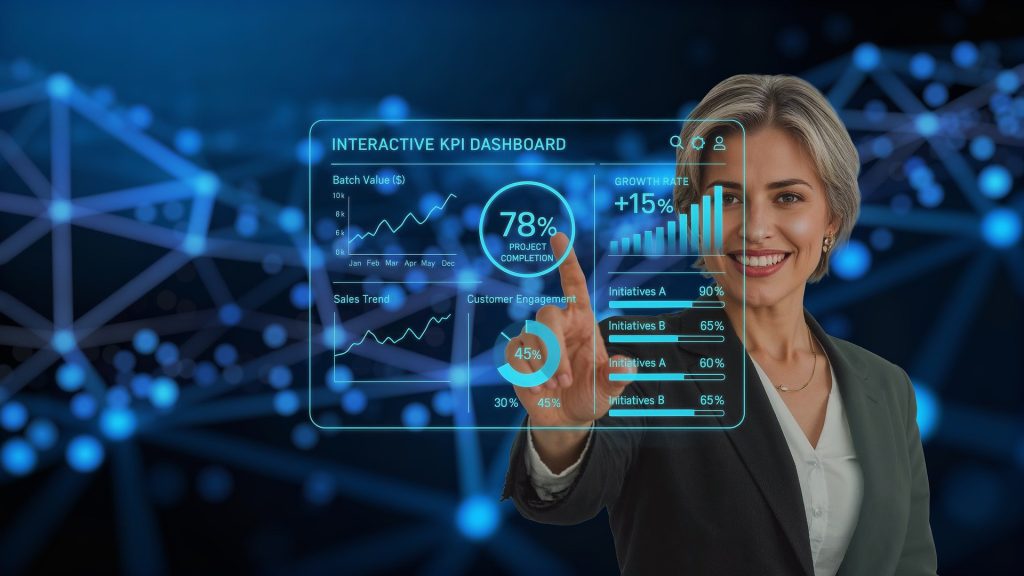
Besides, since every stakeholder has access to the same live data, there is reduced finger-pointing. The performance data easily identifies where there are bottlenecks, immediately enhancing accountability. The cross-functional synergy that comes with performance visibility, especially in large organizations, can’t be overstated.
For instance, if the sales team is struggling with lead conversion, real-time visibility allows other departments, such as marketing, to proactively adjust their messaging to fix the problem. You not only get faster response times but also interactive problem-solving across multiple teams.
Supporting Continuous Learning and Improvement
Continuous feedback loops based on real-time data ensure that a team’s performance is no longer tethered to leadership’s intuition or opinion. Instead of waiting for monthly and quarterly reviews, team members can use their real-time dashboards to check the impact of their work.
Besides, since the feedback loops are automated and instantaneous, teams can easily demystify failure. Data analysis provides a blame-free autopsy since the metrics can easily highlight where the bottlenecks are within the workflow. The data also allows teams to validate hypotheses through experimentation. Such hypotheses can empower junior team members carry out A/B testing for innovations while also highlighting their skill gaps.
Measuring Impact and Driving Accountability
Performance visibility always drives accountability. More so if it’s data-driven, accountability is no longer a “he-said, she-said” affair, which favors personal relationships within top-down hierarchies. Rather, team members can view live dashboards on their project status, eliminating bias and favoritism associated with traditional accountability.
When an individual’s progress is transparent, there is no need for micromanagement of daily tasks. Visible metrics ensure team members manage their own performances, hence empowering autonomy. After all, no one wants to be the bottleneck on their team’s Asana or Monay’s live dashboard. On the other hand, high-performing members are easily highlighted based on their impact on the team’s goals.
Besides, if a team misses their target, data can easily highlight the point of failure and carryout corrective action without pointing fingers.
Data-Driven Teams Perform With Clarity and Confidence
Data insights are now considered a primary driver for team success. Recent research shows that 65% of business leaders are expected to move fully into data-driven decisions, while more than 84% of data and analytics leaders consider data as a top priority for the success of their AI environments.
High-performing teams understand that well-analyzed data ensures faster decision-making while allowing teams to take bolder risks since strategies are no longer based on gut feeling but are rather grounded in a verifiable reality. Data-driven teams move from reactive firefighting into proactive strategic decision-making, leading to a performance-based culture.