
If you’re thinking of moving to Thailand for work or are just curious about how much Thai people earn, it’s essential to have some knowledge of the average salary in Thailand. Thailand is a unique mix of affordability, comfort, and culture. But just how much money do you need to live well?
This blog will explore what the average income in Thailand looks like in 2026, what a good salary is, whether or not you can live on $1500 per month, what the minimum wage is, and what kind of money foreigners earn within the country.
What is the Average Salary in Thailand?
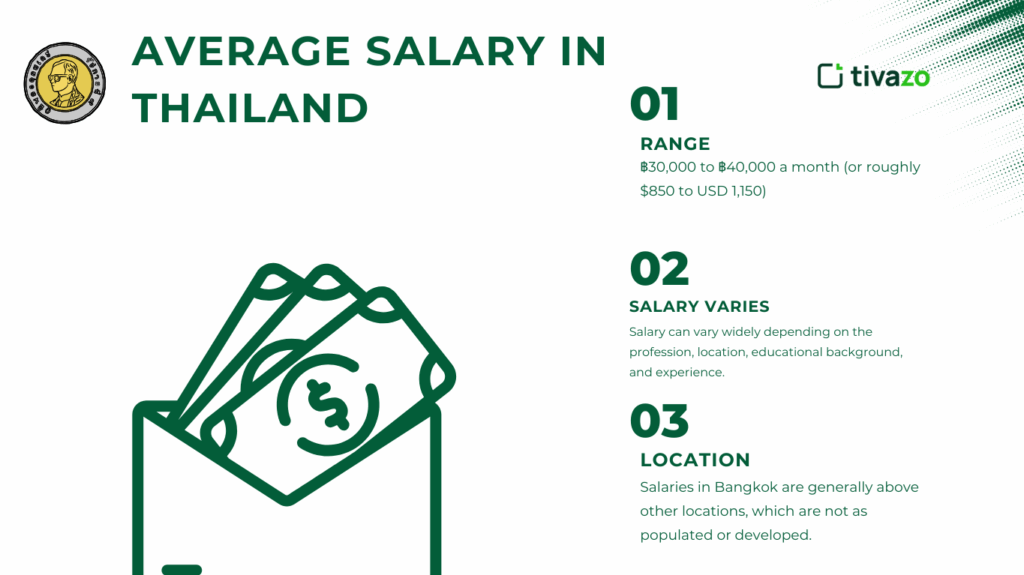
In Thailand in 2026, the average salary is likely to be in the range of:
- ฿30,000 to ฿40,000 a month (or roughly $850 to USD 1,150)
- Salary can vary widely depending on the profession, location, educational background, and experience.
- Salaries in Bangkok are generally above those in other locations, which are not as populated or developed.
Although the national average salary of Thailand sounds alarming, some professions offer a salary multiple times the average (think: doctors, lawyers). Any educated person realizes that many Thai citizens who work in the retail or hospitality sector are lucky to earn the minimum wage or more.
👉You May Also Like: What is the Average Salary in China in 2026?
Average Wage in Thailand per Month
Minimum wage in Thailand is not set across the country. Minimum wage is an amount set by the province (or region); however, the general daily range in 2026 is expected to be:
- ฿330 to ฿370 per day
- This is approximately ฿10,000 to ฿11,500 a month (if working full-time)
Below are some highlights:
- Bangkok and the surrounding area pay the highest minimum wage (฿370 daily)
- The northern region or rural areas of the country pay closer to ฿330/day
- And while immediately shocking, in urban areas, this barely gets you above basic living conditions.
Even though the minimum wage is well below the average salary in Thailand, it is a legal protection for employees throughout the country.
What Is a “Good Salary” In Thailand?
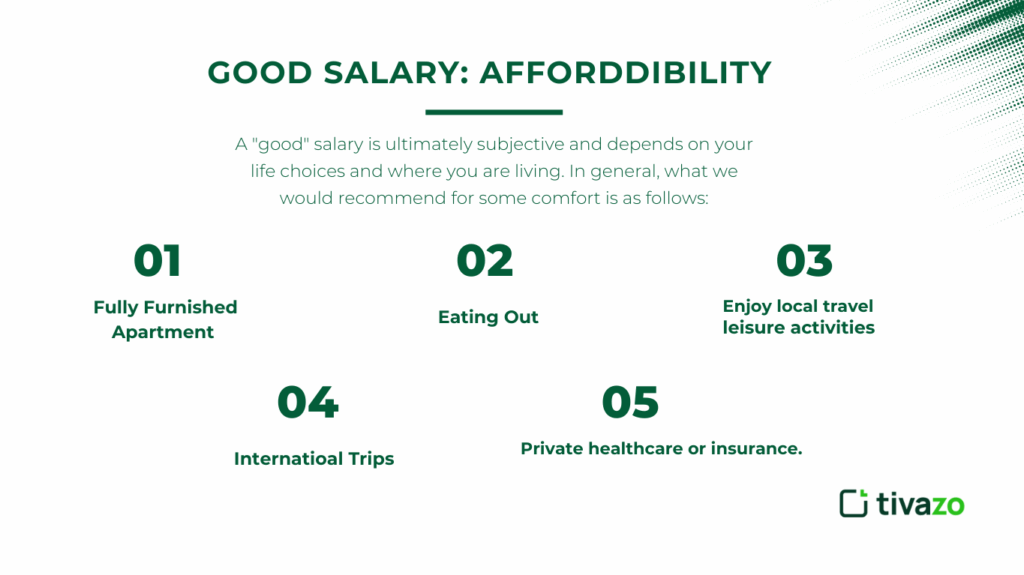
A “good” salary is ultimately subjective and depends on your lifestyle choices and where you are living. In general, what we would recommend for some comfort is as follows:
- ฿50,000 to ฿70,000 per month in Bangkok
- ฿40,000 to ฿60,000 per month in Chiang Mai, Phuket, and other areas.
If you can bring in anything more than ฿60,000/month, you’ll be able to save, travel, and enjoy a typically higher standard of living.
Able to afford comfortably:
- A modern one-bedroom apartment in nice premises.
- Eating out several times a week.
- Enjoying local travel/leisure activities.
- Occasional international travel.
- Private healthcare or insurance.
So whilst the average salary in Thailand may seem low by Western standards, a “good salary” goes a long way!
👉You May Also Like: Average Salary in Vietnam in 2026
Can I Live in Thailand for $1500 a Month?
Yes, it is feasible to live in Thailand for $1,500 a month, and it’s quite comfortable for a single person. In Thai Baht, it’s about ฿54,000 a month, which is well above the average salary in Thailand.
Here’s what you can comfortably cover for $1,500/month:
- Rent for a modern apartment: ฿12,000 to ฿18,000
- Food (groceries): ฿8,000 to ฿12,000+
- Utilities and high-speed internet: ฿2,000 to ฿3,500
- Transportation (public and private): ฿1,500 to ฿3,000
- Entertainment and leisure: ฿3,000 to ฿6,000
- Gym membership, shopping, personal expenses: ฿5,000+
The possibilities for your lifestyle may leave you with a little left over for savings and emergencies. Many expats and digital nomads create an income stream from Thailand and live on this budget with luxuries that were otherwise unattainable back home. With low rent, cheap transportation, and plenty of affordable yet delicious food, there’s simply no reason to live life financially stressed while still living well. With an average salary in Thailand as mentioned above, it is feasible, but for a comfortable life, it may be difficult.
A lot of foreigners find that they can travel regularly around Thailand and visit neighbouring countries like Vietnam, Malaysia, or Cambodia, and it does not always create financial pressure. While making a moderate amount of money, life in Thailand encourages weekend getaways, wellness, and a well-balanced lifestyle that outsiders may view as impossible.
Is Thailand a Competitive Destination for Outsourcing?
Thailand has steadily emerged as a competitive outsourcing destination, especially for companies seeking a balance between cost savings and workforce quality. One of the strongest factors driving this trend is the average salary in Thailand, which remains significantly lower than in Western countries while still supporting a skilled and reliable labor force.
Cost Advantage Driven by Average Salary in Thailand
The average salary in Thailand is a major attraction for outsourcing companies. Compared to the United States, Europe, or Australia, labor costs in Thailand are substantially lower across multiple sectors:
- IT & tech professionals typically earn ฿40,000–฿80,000 per month
- Customer support, BPO, and back-office roles often fall between ฿18,000–฿45,000 per month
- Finance, accounting, and banking professionals average ฿45,000–฿90,000 per month
These salary ranges allow companies to reduce operational expenses while maintaining service quality. Lower employment costs also enable businesses to scale teams more efficiently, making Thailand attractive for long-term outsourcing strategies.
👉You May Also Like: Average Salary in Finland in 2026: What You Can Expect
Skilled Workforce and Talent Availability
Thailand produces a large number of graduates every year, particularly in business administration, IT, engineering, healthcare, and digital marketing. This creates a steady pipeline of talent suitable for outsourcing services such as:
- Software development and IT support
- Business process outsourcing (BPO)
- Accounting and finance operations
- Digital marketing and remote services
While the average salary in Thailand remains competitive, skill levels continue to improve due to private sector training, international exposure, and government-backed digital initiatives.
Infrastructure and Technology Readiness
Thailand has invested heavily in digital infrastructure, including high-speed broadband, data centers, and nationwide 4G/5G coverage. This supports remote work, cloud-based operations, and international collaboration, all essential for modern outsourcing.
Major cities like Bangkok, Chiang Mai, and Phuket have become outsourcing and remote-work hubs due to reliable connectivity and access to skilled professionals at competitive wage levels.
Business Environment and Government Support
Thailand offers a relatively business-friendly environment for foreign companies. Government initiatives focused on digital transformation and economic modernization support outsourcing growth, especially in technology, innovation, and service industries.
Lower labor costs, combined with tax incentives and simplified company setup processes, strengthen Thailand’s appeal as an outsourcing destination when evaluating the average salary in Thailand against productivity and output.
Cultural Compatibility and Work Ethic
Thai professionals are widely known for their strong work ethic, adaptability, and service-oriented mindset, which is particularly valuable for customer support, hospitality-related services, and BPO operations. While English proficiency varies, it is generally stronger in outsourcing-focused roles and international companies.
Cultural compatibility with global business practices further reduces friction for companies outsourcing to Thailand.
Average Wage in Thailand by Sector
There is a natural variance in wages across different jobs, and even more variance depending on the industry. Here is how the average salary in Thailand breaks out by sector:
- IT & Tech: ฿40,000 – ฿80,000 per month
- Education (including English teachers): ฿25,000 – ฿60,000 per month
- Healthcare: ฿35,000 – ฿70,000 per month
- Tourism & hospitality: ฿18,000 – ฿45,000 per month
- Finance & banking: ฿45,000 – ฿90,000 per month
- Construction & manufacturing: ฿20,000 – ฿40,000 per month
- Freelancers or remote workers: Highly variable; can be greater than ฿100,000 depending on existing clientele. Many digital marketers also earn extra income by managing campaigns through tools like an smm panel, which helps them serve multiple clients efficiently
| Sector | Average Monthly Salary (THB) |
|---|---|
| IT & Tech | ฿40,000 – ฿80,000 |
| Education (incl. English teachers) | ฿25,000 – ฿60,000 |
| Healthcare | ฿35,000 – ฿70,000 |
| Tourism & Hospitality | ฿18,000 – ฿45,000 |
| Finance & Banking | ฿45,000 – ฿90,000 |
| Construction & Manufacturing | ฿20,000 – ฿40,000 |
| Freelancers / Remote Workers | Highly variable; can exceed ฿100,000 |
This knowledge helps you gain better insight into how your choice of career affects the average salary in Thailand. The many industries you can go into open the door to different earnings levels.
Advantages of Outsourcing to Thailand
Thailand has emerged as a very appealing destination for outsourcing by companies around the world in terms of efficiency and value. One of the major factors that has contributed to this trend is the average salary in Thailand, which saves a lot of cost and has the capacity to sustain a competent and expanding labor force.
1. Competitive Labor Costs
The average salary in Thailand is one of the greatest benefits of outsourcing to Thailand, as it is much lower than the same in the Western world and most of the developed Asian economies. Companies are able to lower operating costs in the areas of IT outsourcing, BPO services, customer support, and back-office operations without compromising reliability.
The reduction of labor costs enables businesses to scale faster and reinvest the cost savings in growth, technology, or service enhancement. Such cost effectiveness renders Thailand particularly attractive to long-term outsourcing relationships.
2. Skilled and Expanding Workforce
Hundreds of thousands of graduates are produced annually in Thailand in information technology, business management, finance, engineering, and digital marketing. This stable source of talent can help in numerous forms of outsourcing.
Although the average salary in Thailand is relatively low, the skills are on the rise because of the training in the private sector, exposure to the world, as well as demand that must be made on international service standards.
3. Strong Infrastructure and Digital Connectivity
Thailand has invested in highly modern infrastructure, such as high-speed internet, cloud-ready data centers, and 4G/5G networks across the country. These innovations favor telecommuting, online teamwork, and smooth outsourcing processes.
Key outsourcing centers such as Bangkok and Chiang Mai have good connectivity with low wages, which supports the idea that Thailand is a good outsourcing destination.
4. Business-Friendly Environment
Thailand has a friendly atmosphere for foreign investors, and the process of registering a company is easy; there are incentives for industries that focus on technology. The government programs aimed at digital transformation also increase the opportunities for outsourcing.
This business environment, coupled with the positive average salary in Thailand, can assist companies in attaining reduced total operating costs without compromising compliance and stability.
5. Cultural Compatibility and Work Ethic
The Thai employees have a culture of hard work, flexibility, and a service-oriented culture, and these factors are essential in outsourcing jobs like customer care and BPO services. These characteristics lead to the satisfaction of the clients and their long-term cooperation.
Also, the knowledge of doing business in other parts of the world, as well as enhancing English communication skills, facilitates easier communication between companies that outsource to Thailand.
Thailand has a good balance of cheapness, skills, and infrastructure when it comes to outsourcing. When these benefits are compared with the average wage in Thailand, the country can be seen as a good and cheap outsourcing destination for international companies.
👉You May Also Like: What Is the Average Salary in Mexico?
Legal Provisions Regarding Outsourcing to Thailand
Learning the legal structure will be necessary prior to outsourcing to Thailand since it influences the cost, operations, and feasibility in the long run. Although the mean wage in Thailand is economically viable to implement outsourcing, companies should consider labour policies, data protection policies, and foreign restrictions on businesses.
Labor Laws and Employment Regulations
The labor system in Thailand is regulated by the Labor Protection Act, which provides a minimum standard in wages, working hours, overtime, leave, and termination. The legal minimum wage depends on the province, although the wages paid to an outsourced worker are usually higher than the legal minimum wage and are comparable to the average salary in Thailand that is paid to skilled and semi-skilled professionals.
The employers are also obliged to observe the rules regarding social security payments, severance benefits, and provisions for the employees. Such requirements are foreseeable and clear, and as such, outsourcing companies can estimate the cost of employment correctly and still be within the bounds of the law.
Foreign Business Act (FBA) Considerations
The Foreign Business Act (FBA) governs foreign involvement in some business activities in Thailand. Certain service industries, such as certain outsourcing and consulting services, might need special rights or majority Thai ownership where there are no exemptions.
Lots of outsourcing companies are legally established through the settlement of local subsidiaries, collaboration with Thai organizations, or acquisition of promotional rights. Thailand is a good place, notwithstanding these limitations, because of the low compliance costs and positive average salary in Thailand, as compared to productivity.
Board of Investment (BOI) Incentives
The Board of Investment (BOI) in Thailand provides incentives to foreign business companies dealing with technology, software development, digital provision, and advanced business activities. The companies promoted by BOI can enjoy foreign ownership allowances, tax benefits, and easy work permit applications.
Such incentives are useful in counterbalancing the setup and compliance expenses, and the cost advantage that the average salary in Thailand establishes is further increased, which makes outsourcing more feasible to international companies.
Data Protection and Confidentiality Laws
The Personal Data Protection Act (PDPA) is the data protection law in Thailand; it is quite similar to the international privacy regulations, including the GDPR. The outsourcing firms dealing with customer information, financial data, or any information about individuals should have appropriate data protection and consent systems.
Adherence to PDPA will provide an additional level of confidence to international customers and a way of assurance that the outsourcing activities in Thailand can address the international data privacy requirements without any serious impact on the cost of doing business.
Visas, Work Permits, and Remote Outsourcing
Foreign managers and experts who are in charge of outsourcing in Thailand need to acquire the relevant business visa and work permit. It is a clear process, especially in the case of technology-driven or BOI-supported firms.
In the case of remote outsourcing models, the businesses utilize the Thai natives or locally recruited teams, and they have a direct advantage of the competitive average wage in Thailand without complicated immigration procedures.
On balance, the legal environment of Thailand regarding outsourcing is well-organized, transparent, and more oriented to international standards. These legal provisions, when combined with the cost benefits in terms of the average salary in Thailand, give a stable base on which compliant and scalable outsourcing operations can be made.
Does Thailand Have a Gender Pay Gap?
Yes, Thailand does experience a gender pay gap, although it is smaller compared to some other countries in the region. While the average salary in Thailand varies significantly across sectors, research shows that women, on average, earn less than men for similar roles, particularly in higher-level positions and industries like finance, IT, and manufacturing.
Current Status of Gender Pay in Thailand
According to recent labor statistics and surveys:
- Women in Thailand earn approximately 75–85% of what men earn on average, depending on the sector.
- The gap is narrower in education, healthcare, and public service sectors, where female participation is higher and pay scales are more standardized.
- In contrast, fields such as finance, technology, and construction show a larger disparity, partly due to fewer women in senior positions.
Factors Contributing to the Pay Gap
Several factors contribute to Thailand’s gender pay gap:
- Occupational Segregation – Women are more concentrated in lower-paying or service-oriented roles, while men dominate higher-paying technical and executive positions.
- Career Progression – Cultural expectations and family responsibilities can limit women’s opportunities for promotion or participation in higher-paying jobs.
- Negotiation and Representation – Women are less likely to negotiate salaries aggressively, and there is limited female representation in corporate leadership roles.
Government and Corporate Efforts
Thailand has implemented policies to promote gender equality and workplace fairness, including labor laws that prevent discrimination based on gender. Many multinational companies in Thailand also adopt internal pay equity audits and flexible work policies to reduce disparities.
While the average salary in Thailand offers a useful benchmark, it is important to consider gender-based differences when evaluating pay scales and workforce planning, especially in outsourcing, corporate staffing, or recruitment decisions.If you want, I can create a detailed table showing average salaries by sector for men and women in Thailand, which would give a clear picture of the gender pay gap. Do you want me to do that?
Average Salary In Thailand for Foreigners
Usually, as per the data, foreigners tend to earn more than the local people. If work permits and visas are not required. Although foreign employees are, of course, subject to work permit and visa regulations, restrictions even the categories of jobs.
Common earnings for foreigners are:
- Language school English teachers: 30,000 Baht to 50,000 Baht
- International school teachers: 70,000 Baht to 150,000 Baht
- Professionals in business and finance (Marketing, banking, etc.): 70,000 Baht to 200,000 Baht
- Technology workers and developers: 60,000 Baht to 120,000 Baht
- Managers in the hospitality sector: 50,000 Baht to 90,000 Baht
- Digital nomads or freelancers: Highly variable – could be over 150,000 Baht in some cases
While the average salaries for foreigners in Thailand are above the local average, jobs of this nature are also dictated by your qualification level, type of visa, and limitations of Thai labor law.
Regional Salary Variations
There is a lot of variation in Thailand, by way of income and costs, but location matters! The average salary in Thailand can vary greatly between cities, depending on local job markets that have differences in living costs, and is usually correlated with where the economy chooses to focus.
Bangkok
- Largest earning potential in the country.
- Won’t find too much variation with salaries that average in the ฿40,000 – ฿60,000 range.
- Best chance for those in finance, IT, international business, and education.
Salaries in Bangkok tend to be high, but it also has the highest costs, too, which is something to consider. Rent, transport costs, and dining expenses are often noticeably higher. However, while housing is certainly more expensive, overall living conditions are more favorable, with better services for infrastructure, access to good-paying multinationals (which are rarely found in Chiang Mai), and far better access to healthcare.
Chiang Mai
- Salaries rarely exceed the ฿25,000 – 35,000 bracket.
- A popular destination for digital nomads and remote workers.
- Lower cost of living offsets lower salaries.
Considering the average salary in Thailand, Chiang Mai offers a relaxed lifestyle, scenic beauty, and a very solid expat community in the city. While salaries are higher in Bangkok, Chiang Mai offers a much better cost of rent and food, which makes the place a perfect place to live for remote workers and freelancers, who earn a foreign income while being able to have local costs.
Phuket
- Wages can run from ฿30,000 to ฿50,000 in Phuket
- The tourism-based economy can affect the availability of work.
- Seasonal nature can affect income and job availability.
Considering the average salary in Thailand, Phuket is mostly a tourism-based economy; hence, income can be erratic. Jobs can be found in hospitality, diving, and other recreational activities. These jobs tend to be transient and unassociated with long-term job security. Foreigners may work in resort management or villas where they may make good money, although they may not be busy during the off-peak season.
Typically, the average pay in Thailand differs across regions, but your potential to afford a typical lifestyle usually adjusts with similar prices. The better question has more to do with the actual job you do, how you are paid (as an employee or not).
How the Cost of Living Compares to Wages
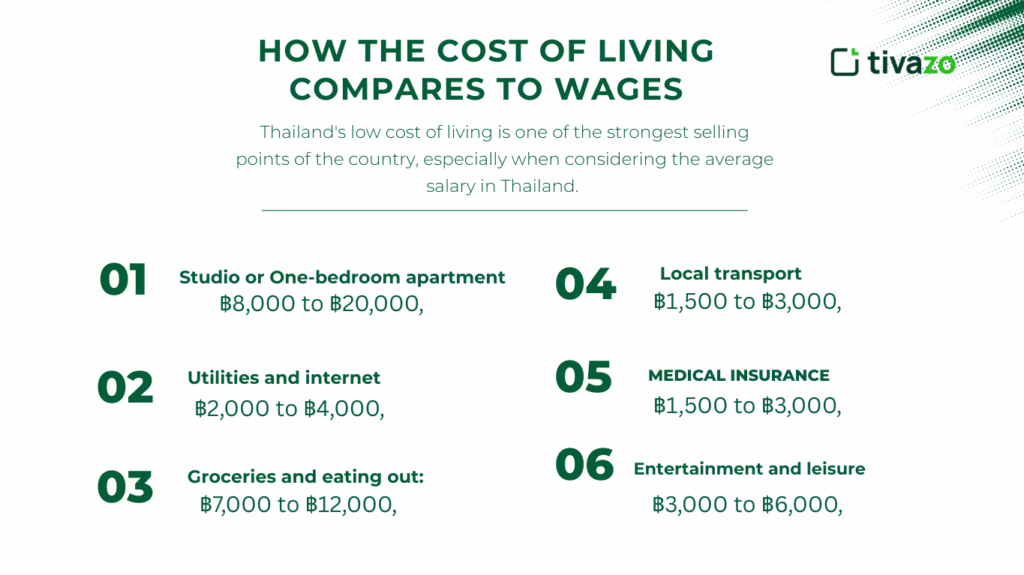
Thailand’s low cost of living is one of the strongest selling points of the country, especially when considering the average salary in Thailand. Even those with average earnings can expect a decent standard of living compared to many Western countries.
Let us review what you can expect to spend in one month:
- Studio or One-bedroom apartment:฿8,000 to ฿20,000, depending on the area.
- Utilities and internet: ฿2,000 to ฿4,000.
- Groceries and eating out: ฿7,000 to ฿12,000.
- Local transport: ฿1,500 to ฿3,000.
- Medical Insurance: ฿1,500 to ฿3,000.
- Entertainment and leisure: ฿3,000 to ฿6,000.
If you are earning around ฿30,000 (the average salary in Thailand you will need to live frugally, most likely sharing an apartment, living in cheaper areas of town, and cooking most meals. Public transport will be required to stretch your money a bit farther.
If you earn over ฿50,000 a month, you will afford to live in a modern condo by yourself, eat out often, and save some money each month. Many people making foreign salaries or who work remotely find that their money goes a lot further in Thailand, allowing them a higher standard of living in Thailand than they could finance in their own countries.
When combined with its lifestyle benefits, Thailand can be a pretty affordable place to live for everyone.
How to Make More than the Average Salary in Thailand
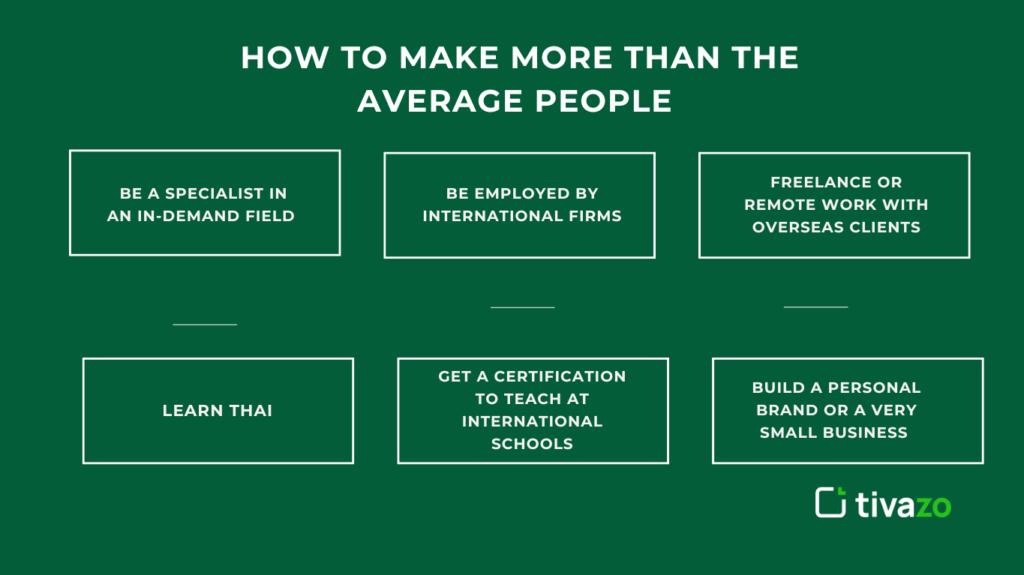
If you’re going to be working or moving to Thailand and want to make more money, consider the following tips to get you above the average salary in Thailand:
- Be a specialist in an in-demand field – IT, finance, engineering, healthcare, etc.
- Be employed by international firms with offices in Thailand – usually,y they pay expats or skilled professionals more.
- Get a certification to teach at international schools rather than just language centres; the pay is much better, and you get benefits.
- Freelance or remote work with overseas clients receiving USD, EUR, or stronger currencies.
- Learn Thai – this will give you an advantage to find better employment, build a connection with local employers, and negotiate higher wages.
- Build a personal brand or a very small business servicing expats, tourists, or remote workers – there are many opportunities for services like consulting, coaching, design, or tourism.
If your main goal is to have a luxurious life in Thailand and you want to earn more than the average salary in Thailand, you will have to build up skills and knowledge in your field via online certification or classes, as per the market demand. Learn basic Thai for the least of making conversation with local people. Last, build the network and communicate with as many people as possible. Opening doors to hidden communities and opportunities.
Many expats who came to Thailand initially working at a low average salary of (for example) 30-50,000 baht per month eventually more than doubled or tripled their earnings, in part by moving into roles or freelance work that held higher value, or creating businesses and becoming more entrepreneurial. With the right mindset, you can usually earn more than the average or typical salary in Thailand while enjoying affordable living.
Conclusion
The average salary in Thailand may look low on paper, especially if you are migrating from the West. However, when compared with the cost of living in Thailand, it is possible to lead a healthy lifestyle, even an enjoyable lifestyle.
Whether you are a backpacker who wants to stay longer, a digital nomad looking for a base, or a skilled professional making a move for work, there are going to be lots of income options in Thailand. Planning is important, but it is possible to live comfortably, even on a shoestring budget.
With a delicious and affordable street food scene, beautiful beaches, and incredible history and culture, the lifestyle benefits would outweigh the perceived “low” pay in most situations, making Thailand an enticing foray into a sustainable long-term lifestyle.