The modern work world is so busy, time-sensitive, and balancing urgency that you can get an email with the ASAP tag or be Slacked every hour, or have a surprise urgent project, or feel the need to produce something perfect. But this is the fact: not all that is urgent is important, and not all that is important must be addressed at this moment.
It is in this process that a sense of balancing urgency in the workplace becomes a major skill. Learning teams do not work harder but rather smarter. They prevent burnout, increase the speed of decision-making, and produce better results. And using such tools as Tivazo that enable to introduction of clarity to time tracking and task visibility, prioritizing becomes even simpler.
This is a complete guide that breaks down the true meaning of balancing urgency, managing false urgency, the 3-3-3 rule, and how a team can be urgent without being chaotic.
What Does Balancing Urgency at Work Mean?

What needs to be done urgently?
- What requires careful planning?
- What does not have to be done at all
- Working is not about working faster-it is about working deliberately.
The reasons why urgency is misconceived
Urgency is mistaken by most teams for speed. But it is not about rushing: it is about getting work in time, in the right place with the right impact, and using the right resources. Urgency addressed properly will result in smart decisions, acceleration, and improved results. When managed inadequately, it becomes sound, stress, and anarchy.
The largest error that teams exhibit? Considering any task that arrives as an emergency, based only on the sudden appearance or conveyed with emotions. It is a fact that there is hardly anything urgent. Several are merely urgent because of a lack of planning, effective communication, or because the stress of another individual was moved down the hierarchy.
Emotional urgency must underline rather than ruin concentration. Having this difference, teams will not fall into panic-induced actions but will be able to develop a systematic approach that will maintain performance consistent and predictable.
The Sweet Spot
A moderately active working process is between the poles of manic and inactive:
| Too Much Urgency (Bad) | Balanced Urgency (Ideal) |
| Stress, panic, burnout | Composure, focus. |
| Ineffective decision-making | Evidence-based decisions. |
| Hurried subpar work | Quality, quantity production. |
| Interuptions all the time | Purposeful processes. |
Urgent balance teams are confident in their work. They understand when to speed up and when to slow down. They do not react but make informed decisions, communicate more, and minimise surprises at the last moment. This proportion produces healthier working conditions, effective cooperation, and sustained output-far superior to that which can be provided by continuous velocity.
Tracking the Origins of Spurious Urgency
"Can you send this now?"
"This needs to go ASAP."
Speaking of which, in 5 minutes, we should get on a call.
These are, in most instances, fake pressures, stress that are not produced by necessity, culture, or poor or unclear communication.
The Main Causes of False Urgency
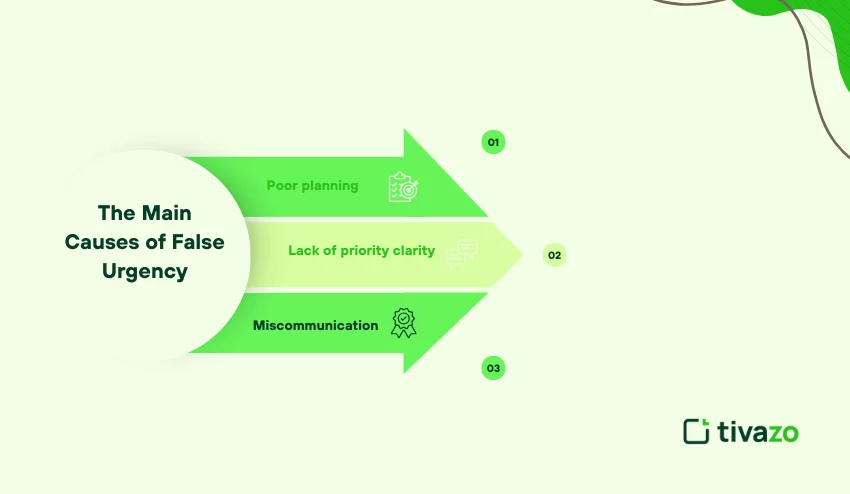
False urgency usually creeps into the workplace under the guise of urgent work, but it is usually because of underlying structural problems.
1. Poor planning
Tasks not planned or mapped properly will eventually accumulate and turn into last-minute urgent ones- causing stress that is not necessary.
2. Lack of priority clarity
Groups that lack a prioritization structure find themselves prioritizing all things as being of equal importance, and make seemingly ordinary tasks seem to be emergencies.
3. Miscommunication
It happens that sometimes an activity seems urgent merely because it was presented (emotional, abrasive, or out of context) and received. Tone generates artificial stress.
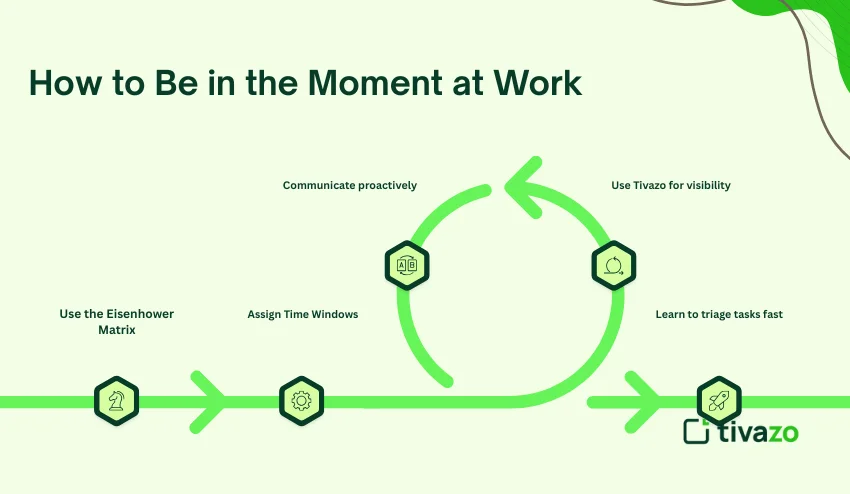
How to Be in the Moment at Work
Being urgent implies taking immediate action and being effective- but not rushing blindly. Here’s how:
1. Use the Eisenhower Matrix
Rank tasks in four categories:
| Priority | Level Definition | Description |
| Urgent + Important | Important needs | Do First |
| Significant + Immediate | Planning required | Set up a schedule. |
| Not Important + Urgent | Interruptions | Delegate |
| Not Important, Not Urgent | Low-value tasks | Eliminate |
Applications such as Tivazo assist in monitoring the majority of your time in order to reposition to high-impact work.
2. Assign Time Windows
The urgency is magnified as time is imprecise. Instead of using such vague deadline terms as soon or ASAP, use:
“End of today”
“Before our 3 PM meeting.”
“By Thursday, 10 AM”
Well-defined deadlines eliminate panic and enhance delivery.
3. Communicate proactively
It is not necessary to wait until things become urgent. Instead:
- Give early updates
- Ask clarifying questions
- Delays should be notified in advance.
An emergency reduces when they are aware of what is happening.
4. Use Tivazo for visibility
Tivazo simplifies the balancing of urgency by providing teams:
- Accurate time tracking
- Clear work patterns
- Productivity insights
- Improved allocation of work.
Having this visibility, you can expect to have bottlenecks and avert last-minute madness.
5. Learn to triage tasks fast
Ask these questions
- Is it a critical task to outcome?
- Are there bad effects of postponing it?
- Do you think someone would be more fit to address it?
- What will be the result when we fail to do it today?
When time runs out to make decisions, you make ’em and make them in a hurry, it is all right-but decide wisely.
Speed-based workplace culture
Organizational cultures that reward inertia, even unproductive inertia, encourage urgency as a default position instead of a strategic decision by default.
1. Speed-based workplace culture
Organizational cultures that reward inertia, even unproductive inertia, encourage urgency as a default position instead of a strategic decision by default.
2. Micromanagement
Managers visit the office often and thus may end up building pressure on employees who may feel that everything has to be done at once.
3. Fear-based behavior
Unnecessary urgency can be caused by employees who are afraid to make mistakes and get criticized, as well as disappoint the leadership.
Such manners build up over time, and false urgency becomes normal, although it is energy-consuming, diminishes focus, and diminishes work quality.
What Is the 3-3-3 Rule for Working?
The 3-3-3 rule is useful in time and urgency management as it allows you to divide your day into focus blocks that are easy to manage.
The Rule Explained
You allocate:
- 3 hours on your highest priority tasks.
- 3 smaller tasks that favor daily development.
- 3 fast wins that increase pace and decrease backlog.
Why It Works
- Reduces overwhelm
- Stops congesting your brain.
- Assist you in an actual urgency.
- Helps you remember your schedule even when you are in a hurry.
Combined with time insights of Tivazo, you can track the daily performance of your application of the 3-3-3 rule.
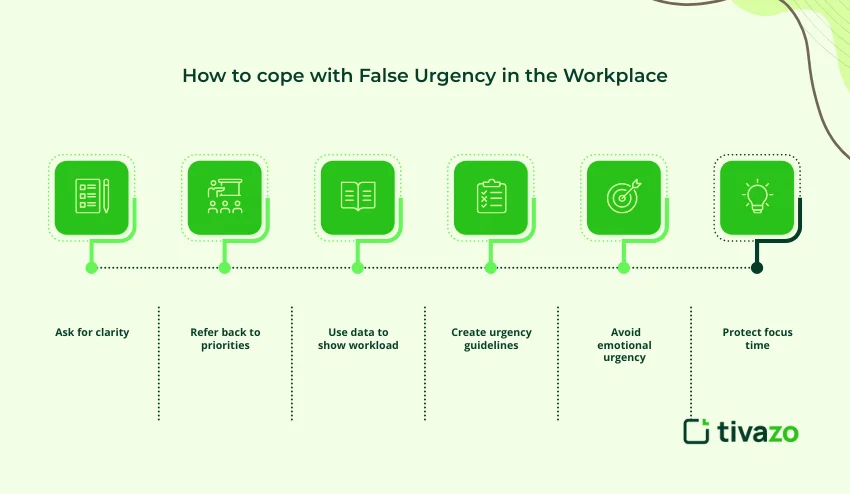
How to cope with False Urgency in the Workplace
False urgency is dangerous. It results in stress, burnout, and permanent loss of productivity. Here’s how to deal with it:
1. Ask for clarity
Before plunging into a task that you have defined as urgent, ask:
- What is the real deadline?
- What is the impact?
- What dependencies exist?
- How urgent is it in comparison to the present assignment?
The greater part of false urgency is removed by a mere question.
2. Refer back to priorities
Apply the Eisenhower Matrix and plan tasks according to the strategic value.
3. Use data to show workload
Tivazo comes in here very handy.
Using time tracking and productivity analytics, you can demonstrate:
- Your current workload
- What you’re already handling
- What are the really urgent tasks according to the data?
- This assists in getting rid of unwarranted pressure.
4. Create urgency guidelines
The teams are supposed to establish rules, including:
- Not everything can be “urgent.”
- Demanding wants should have e time constraint.
- One should have fewer urgent tasks every day.
- Emergencies have to be documented.
This establishes an order to which we all pay attention.
5. Avoid emotional urgency
Religious individuals tend to use the word urgent due to self-stress.
React with facts, not emotions.
6. Protect focus time
Block deep work schedules when you do not reply to messages ASAP.
When teams appreciate focus time, there is a minimization of urgency.
Paperwork is eliminated before it gets urgent.
Real-Life Strategies to Strike a Balance at Work.
Step 1- Prioritize Effectively
Use a mix of:
- Eisenhower Matrix
- 3-3-3 rule
- Daily planning
Step 2 – Enhance Team Communication
Elaborate expectations by:
- Reducing the pace of messaging.
- Scheduled check-ins
- Clear deadlines and scope
Step 3 – Adopt a Time Tracking Tool
Using Tivazo gives:
- Transparency
- Accountability
- Better team planning
- Immediate detection of overload.
Step 4 – Reduce Interruptions
Minimize pings, calls, meetings, and impromptu.
Step 5- Train Teams on False Urgency
Educate them to identify
- Emotional urgency
- Unnecessary escalations
- Reactive behaviors
Step 6 – Develop an Organizational Culture of Cool Emergency
- Work with a sense of urgency but not with a sense of haste.
- Birth with haste, but not with stress.
Conclusion
Urgent and balancing at work is not about doing more. It is also about being smarter, more focused, and organized. The teams can be more productive when they realize the distinction between real and false urgency, and the stress levels are reduced.
By having such tools as Tivazo, businesses can see the work patterns, and thus it is easier to prioritize the work, manage the workloads, and prevent unnecessary rush.
The aim is not to go urgency-free.
This is aimed at controlling it deliberately.