What if your team could be happier, healthier, and more productive with just a little adjustment to the clock? Modern workplaces are expanding, and organizations are searching for smarter ways to boost productivity while concurrently doing well by ensuring their employees are well supported. One recent trend that is beginning to gain traction is summer hours at work.
Summer hours, or flexible summer schedules, can include shorter workdays, compressed workweeks, or more time off altogether during summer months. From large corporations to small businesses, more organizations are embracing summer hours as a way to reward their teams, allow for recovery time, and ultimately employ the healthiest working conditions for their employees.
This blog will supply you with 7 proven benefits of summer hours at work, actual examples, and practical steps on how to offer this to your organization. If you are an HR Leader, Manager, or employee advocate, you will find some simple takeaways that will allow you to explore a summer hours approach for your organization.
Key Takeaways:
- What Are Summer Hours at Work?
- Why Summer Hours Matter in Today’s Workplace
- 7 Proven Benefits of Summer Hours at Work
- How to Successfully Implement Summer Hours in Your Company
What Are Summer Hours at Work?

Summer hours are a modification to typical shift schedules during the warm summer months to provide staff more personal time. Flexible summer work schedules mean changes in many ways, such as:
- Shortened workdays, such as leaving early on Fridays
- Compressed workweeks, such as 4, 10-hour days instead of 5, 8-hour days
- Optional remote workdays, to offer additional flexibility, without the commute
- Adjusted start and end times to help employees work in their most productive periods
Initiated and championed by industries with slower summer periods, summer hours at work have become a popular platform across all industries to implement better programs for work/life balance and to help staff productivity. As organizations seek to improve workplace culture and better match employee expectations in the modern workplace, Flexible summer work hours are a progressive answer.
These changes don’t only involve working less, but also working smarter. Facilitating a certain amount of autonomy over when an employee works during the summer months lessens the burden of stressors, increases motivation, and allows for a better working relationship. As a result, employers will witness their employees feeling better, more enlivened, and performing better.
Common Examples of Summer Hours:

- Summer Fridays: Employees can leave work at noon or 1:00 on Friday
- 4-Day Workweek: Employees work four days and receive one day off weekly.
- Flexible hours: Employees will start and finish sometime over the course of a day, working the hours required.
These are examples of policies demonstrating a commitment to work-life balance and organizational wellness.
Why Summer Hours Matter in Today’s Workplace
The workforce has changed considerably in recent years. Today, employees want more than just their paycheck; they want flexibility with their work, well-being at work, and a sense of purpose every day. These expectations are changing how organizations operate and are leading to new workplace strategies like summer hours at work.
Key Trends That Make Summer Hours Relevant:
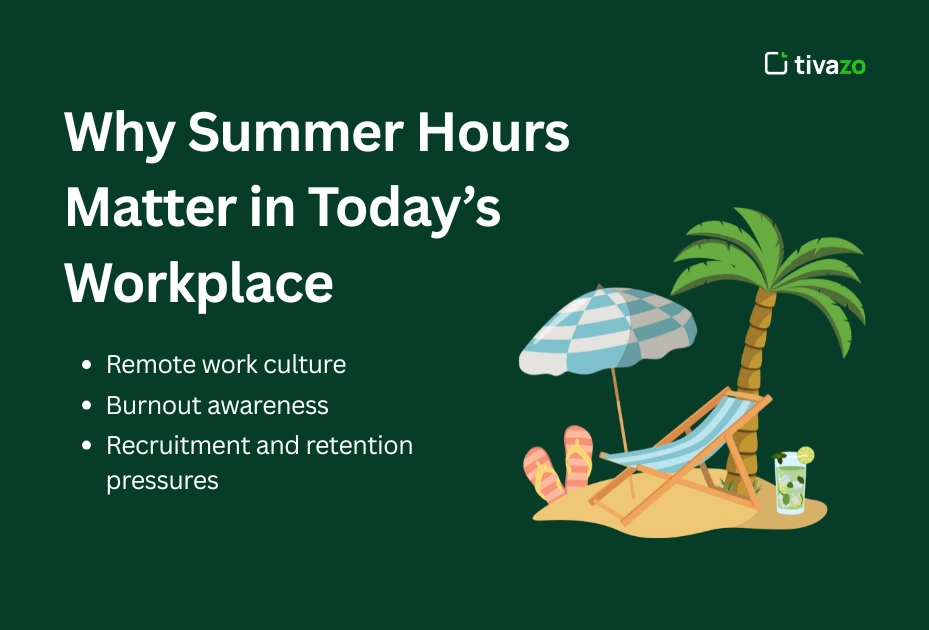
- Remote work culture: Flexibility has become an expectation in the workforce. Summer hours complement remote or hybrid working arrangements and provide self-regulated autonomy within the structure of the organization. They introduce some form of work-life balance with consideration for the person as a whole.
- Burnout awareness: Companies are realizing the state of mental health in the workplace and its implications for becoming identified with issues of burnout. Summer hours allow for built-in time to rest and recover from burnout.
- Recruitment and retention pressures: Recently, the workplace has seen increased recruitment and retention being addressed by employers. Incorporating summer hours at work can position a company as a more attractive option for potential candidates.
Incorporating summer hours at work shows that your company values both productivity and people. It enhances your brand as an employee-focused organization and helps build a happier, more loyal workforce – a key factor in both attracting and retaining top talent.
7 Proven Benefits of Summer Hours at Work
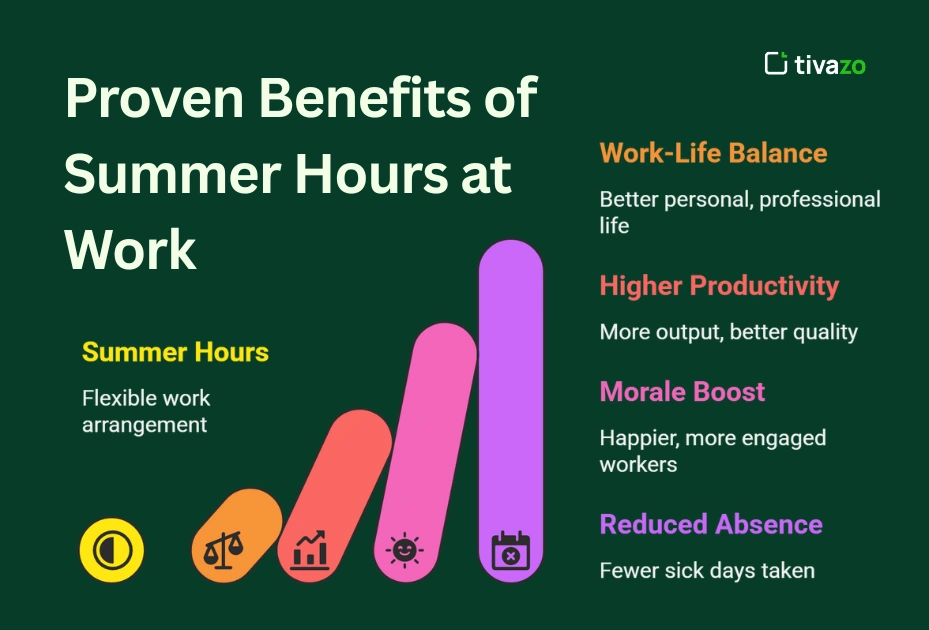
Implementing summer hours does more than provide your team with some seasonal perks: they may change the way your team operates and thinks. When implemented effectively, summer hours can dramatically indicate improvements in workplace culture and performance. In the below, we examine the top reasons (backed by research) to clearly illustrate why summer hours or some flexibility over the summer months could be beneficial—seven reasons in total, including improved work-life balance and employee productivity. From very small changes to working hours, the collective impact might surprise you.
1. Improved Work-Life Balance
One of the most profoundly positive consequences of summer hours at work is the impact to employees’ personal lives. Summer hours generally shorten workdays, such as getting off early on Fridays or introducing longer weekends, enabling your employees to use that time with family, on hobbies or for simple relaxation. This time off enables employees to disengage from work-related stresses and enjoy their time away from the office.
Better work-life balance also equates to better mental health. When employees are given sufficient time to recharge, the chance of burnout is significantly reduced. When employees feel good mentally, they will come back to work rejuvenated, motivated, and ready to engage. Over time, having employees who feel mentally good will foster ongoing productivity with reduced absenteeism rates for stress-related sicknesses.
Key Takeaway: Having more control over their schedule through summer hours at work will end in greater happiness, better focus, and better long-term satisfaction at work.
2. Increased Employee Productivity
Allowing employees to use summer schedules gives them the opportunity to work when they are most personally productive, rather than rigidly working 9-5 without any flexibility. The flexibility of being able to work when that employee is most focused typically leads to a higher quality of focus and faster finish of work. For example, some employees may be more productive early in the morning when they are mentally sharper, while others prefer performing in the afternoon or even evening hours.
Additionally, the flexibility of a compressed work week or the shorter work day also pushes employees to use their time wisely by minimizing downtime and fewer distractions. It’s easy to see how this approach models efficiency and effectiveness at work. There is research backing this. For example, Gartner revealed that organizations that allowed summer hours saw an increase in employee productivity by 20%! This supports that productivity is not necessarily about working longer hours (or time) but rather making use of every hour on the job.
Pro tip: Focus more on the quality vs quantity; allow your team the freedom to find their own best pace with summer hours at work.
3. Enhanced Employee Satisfaction and Morale
Flexible work arrangements, such as summer hours at work, encourage trust and appreciation between employees and their employer. When employees are given the authority and discretion to manage their own pace and time, they are much more satisfied with their jobs. Summer hours are often viewed as a preferred perk or reward and can help improve morale across a team.
High satisfaction results in lower turnover. Employees who have the option for flexibility are also more engaged and more loyal to their employer, which has a positive impact on the organization. According to a Glassdoor survey, 8 out of 10 employees would prefer flexible hours to a raise, ranking work-life balance as one of the most important deciding factors for employees in 2023.
The bottom line is that summer hours at work increase employee engagement and create a more motivated, dedicated workforce.
4. Reduced Absenteeism and Tardiness
Having regular time off through summer hours also eliminates employees’ need to take unexpected days off or call in sick. Employees who have guaranteed time off, can plan more effectively and make personal appointments, run errands, and get rest without feeling that their work obligations have been disrupted.
When employees feel respected and valued, they tend to arrive at work on time and be present at work. The anticipation of summer hours keeps motivation up and can lead to fewer instances of tardiness and absenteeism. That means better performance and flow for the overall team.
Takeaway: Employees feel empowered when they have control over their schedule through summer hours at work, allowing for reduced interruptions and increased attendance.
5. Cost Savings for Employers and Employees
From a cost point of view, summer hours at work can result in significant savings. Fewer employees in the office for a shorter period of time results in less utility expenses, less wear and tear on office equipment, and less cleaning and maintenance expenses.
For employees, commuting less often means they can do so during off-peak hours, which affords them some savings even if only for a modest meal or parking expense. This could mean some fuel expense savings for the ones that drive, transit fare savings for the ones that don’t, and overall more satisfaction with their financial situation and well-being.
Win-win: Lower operational costs combined with happier, financially healthier employees make summer hours at work an attractive policy for businesses.
6. Improved Team Collaboration and Flexibility
It’s not uncommon for you to have concerns regarding teamwork and communication when implementing flexible schedules. Generally, the issue of collaboration can be managed by determining “core hours” when your team is available for meetings and real-time interaction, and it is a reasonable balance between providing your employees’ flexibility, while also providing some necessary collaboration time.
Fortunately, with digital collaboration tools like Slack, Zoom, Trello, or Asana, collaboration is a lot easier in every respect. Your employees must stay connected through these tools, communicate with each other, and ensure they are on the same page regardless of their individual schedules.
Pro Tip: Strictly define when overlapping working hours will happen while also using the tools for collaboration, to provide scope for work time while in flexible summer hours.
7. Better Employee Recruitment and Employer Branding
Providing your employees with summer hours at work makes your company look good, and it is especially a clear assurance to job seekers that you are a modern, employee-friendly company. There is no metric for determining what employees want, because they feel good or they feel lousy when they are at work. As an illustration, if you stave you potential job seekers, particularly Millennials and Gen Z, you can ensure your summer hours do not detract from their proposals to get jobs or further their careers.
If your company’s summer hours promote employee wellness in the employer brand, this is attractive to potential clients in your industry, which matters in the recruitment process because it is competitive out there; your business will benefit from its competitive advantage while also rewarding its current employees to simply feel proud.
Result: A reputation as an innovative, caring employer that values both productivity and employee well-being—crucial for recruitment and retention success.
Which Companies Offer Summer Hours?
The creative agencies or startups do not have the summer hours anymore, as some of the most well-known companies in the world have adopted flexible summer hours. Below are vindicated instances on the forefront:
Basecamp
Basecamp has a formal 32-hour, 4-day workweek annually between May 1 and August 31 with no pay cut. Co-founder Jason Fried has publicly observed that the staff can accomplish equally as much, and workers will come back in September feeling refreshed.
Buffer
Buffer conducted a pilot of a 4-day summer workweek in 2020, and the results were so promising that 91% of the employees said that increased happiness did not have any measurable impact on output, making the shorter week a long-term policy. They have provided an open dialogue of productivity data, which has contributed to them being a well-sourced case study on flexible work.
CARFAX
CARFAX also officially changes to a 32-hour schedule during the Memorial Day-Labor Day period, with employees firing on Fridays every week. This policy is included in their annual calendar, and it is one of the most discussed examples of a mid-size company that makes the operation of summer hours operational.
Nike
Nike provides a specific program of employee well-being with Summer Fridays and a Well-Being Week in August. Although it is not a 4-day workweek in all positions, the policy offers substantial flexibility and is an observable aspect of how Nike promotes work-life balance.
BigLaw Firms
BigLaw firms have not been left behind in terms of traditionally demanding industries. In 2023, Davis Polk & Wardwell, Skadden Arps, and Weil Gotshal and Manges all had 4-day summer workweeks, Fridays off still fully paid, which signals that summer hours are finally made available to sectors traditionally viewed as too high-stress areas to offer flexible hours.
Regional Summer Hours Trends in the U.S.
The hours in summer will vary based on the location of the business. The pattern of adopting flexible summer schedules by companies in a given region is influenced by geography, industry mix, local culture of the workplace, etc.
| Region | Adoption Level | Most Common Format | Key Industries | Cultural Driver |
|---|---|---|---|---|
| Northeast | High | Half-day Fridays (noon-1 PM finish) | Finance, advertising, PR, media, law | Long winters make summer highly valued; flexibility is expected |
| West Coast | High | Year-round flexibility + informal summer perks | Tech, entertainment, creative services | Manufacturing, hospitality, logistics, and emerging tech |
| Midwest | Growing | 4-day workweeks or early Fridays | Manufacturing, healthcare, professional services | Short summers drive enthusiasm; post-pandemic flexibility gains |
| South | Emerging | Varies by company; gaining traction in tech hubs | Manufacturing, hospitality, logistics, emerging tech | Traditional structures shifting as tech ecosystems grow |
The Northeast: Summer Hours Worried Over.
There is a long-held consensus that the Northeast was the home of the summer hour in the U.S. Business Summer half-day Fridays have been long offered by the professional service firms of New York, Boston, and Philadelphia, and the business culture of the region embraces the tradition of half-day Fridays in advertising, finance, PR, media, and law. When companies in this market do not have a form of summer flexibility, it is becoming the outlier stance.
The West Coast: Relaxation All Year Round, Summer Spin.
Tech and creative firms on the West Coast are more likely to have a flexible timetable throughout the year, and summertime hours are not a specific seasonal policy but an extrapolation of the current culture. These summer perks usually appear as no-meeting Fridays, group outing activities, or unofficial early work ends woven into a more general assumption of autonomy as opposed to a program.
The Midwest: High Enthusiasm, Short Summers.
It is exactly in the case of the warm season being short that Midwestern workers tend to take summer hours especially energetically. Cities such as Chicago, Minneapolis, and Columbus have experienced an increase in the use of summer flexibility, particularly after the pandemic, as employers attempt to reconcile historically traditional workplace patterns against the rise in employee demands for work-life balance.
The South: An Emerging and yet to grow Trend.
Summer hours have been slowest to be applied inthe South, where manufacturing, hospitality, and logistics are still the leading industries and cannot be conducted online. This is, however, changing fast with the emergence of tech ecosystems in Austin, Nashville, Atlanta, and Raleigh-Durham. Summer hours have become a significant point of difference to Southern employers who need to compete with the coastal markets on talent.
What the Data Shows
Office occupancy measurements show quite a local divide: the East Coast operates at about 50 percent on an average work day, the West Coast at about 30 percent, indicating a long-held cultural tendency towards flexibility.
On the national level, a 4-day workweek is ranked among the most desired benefits by 68% of workers, and flexible hours are ranked over many other traditional benefits by 65 percent, so regional adoption gaps become a more significant consideration in talent management.
How to Successfully Implement Summer Hours in Your Company
Implementing summer hours at work can result in wonderful outcomes if it is done correctly. It is not just about giving employees extra time off; it is about developing a framework that allows that flexibility while maintaining accountability and employee productivity. Summer hours have the potential, when properly implemented, to become a tool that can boost morale, alleviate burnout, and positively impact your business.
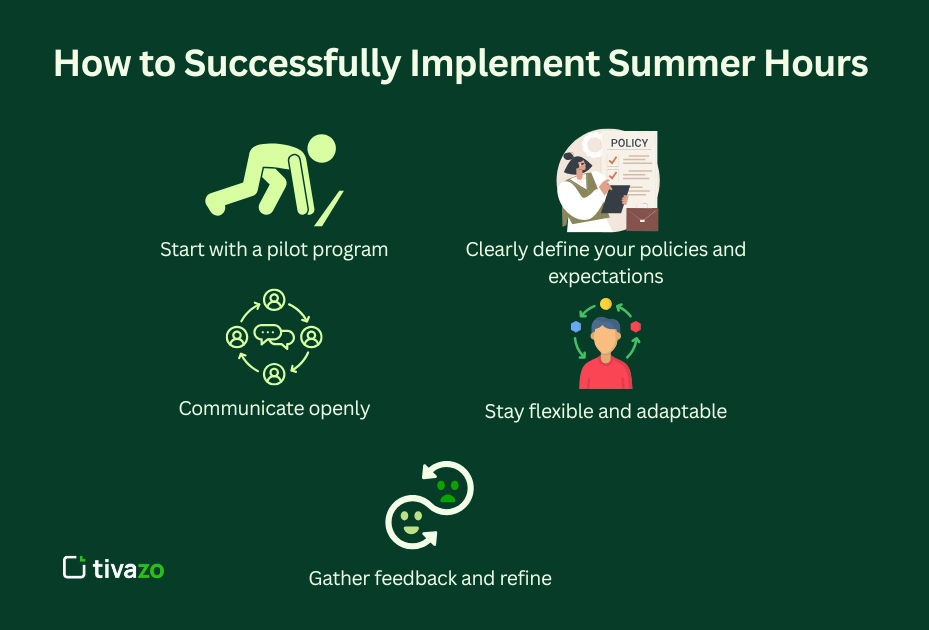
Here is how to successfully implement summer hours at work:
1. Start with a pilot program
Start with a pilot and only allow summer hours in one department, or for a short period of time. This will allow you to see how the new summer hours will affect productivity, communication, and team dynamics. This will also allow you to fine-tune your policy for a company-wide roll-out.
2. Clearly define your policies and expectations
Defining your summer hours policy should begin with a clear structure. You will need to define eligibility, working hours, deadlines, and expectations of accountability. When everyone knows and understands the rules, the system works much more smoothly and retains employee productivity.
3. Communicate openly
Open communication is critical. Take time to clearly communicate the intention of summer hours, whether it is to reduce stress, acquire an employee morale boost, or align with company values. Your communication tools should include team meetings, email updates, and manager-led support, which will allow employees to embrace summer hours.
4. Stay flexible and adaptable
Not all roles or departments will reap the same benefits from the same schedule. Allow teams to adapt their summer hours based on the unique needs of their people, clients, or project cycles. Being flexible in execution will create fairness and functionality.
5. Gather feedback and refine
If you’ve put a program in place, you should gather feedback from your team in regular check-ins. Ask what is working and where it might make sense to change things. This ongoing feedback loop not only allows you to improve the program but also serves to reinforce that you are supporting workplace productivity and folks’ happiness.
Conclusion
Providing summer hours at work isn’t simply a seasonal benefit; it’s an intelligent, people-first initiative that employees and organizations will value mutually. Giving your team more flexibility during those summer months can drive employee productivity, decrease employee burnout, and improve employee job satisfaction.
When thoughtfully implemented, summer hours can facilitate healthier work-life balances and help to position your organization as a modern, employee-directed workplace. The outcome? A more satisfied and engaged team and stronger community recognition as an employer of choice.
To sum it up–summer hours at work are not only empowering for the morale of your workforce, but they are also very good for business!