The reason is that most managers have no idea they are hemorrhaging money every single day. It’s not because of a bad product or a weak sales team; it’s something much quieter and far more expensive: context switching.
Every time employees jump between tasks, they lose more than just a few seconds of time. They lose focus, time, and money-after all, time is money. But the real question most organizations haven’t answered is: how much is this actually costing us?
The cost of context switching is usually well hidden, but it siphons off dollars and hours of productivity every single day in teams, yet most firms have never counted it.
Each task switch fires off a 15-25 minute recovery period where your brain reloads the mental framework needed for the new task. Multiply that across dozens of daily interruptions, and you’re looking at hours of lost productivity per employee.
Why Context Switching Costs Real Money
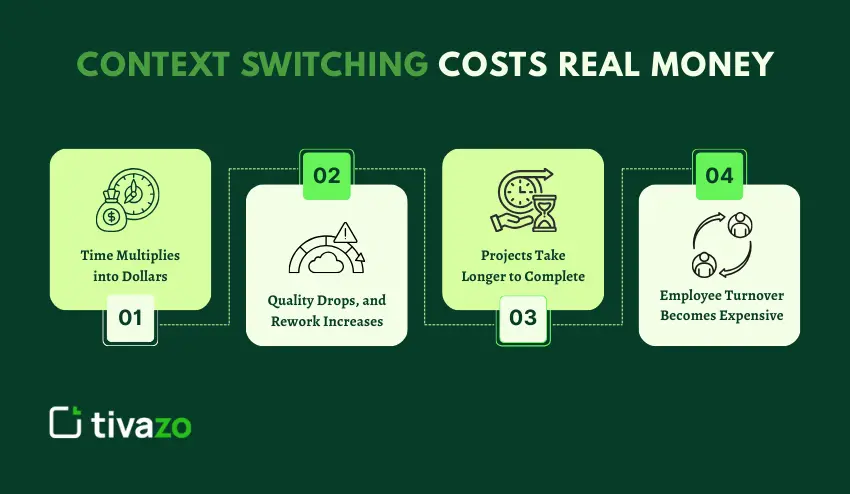
The cost of context switching is felt much beyond the cost of the wasted minutes. For hybrid teams, these costs accrue even more due to digital technologies of communication, which generate considerable interruption points.
1. Time Multiplies into Dollars
This means that every minute spent on recovering from a context switch is essentially a minute in which the person is being paid to do nothing. For an employee making $60,000 every year, that is effectively $30 an hour, and two hours wasted each day on context switching is essentially $60 being wasted every day.
Multiply this by your staff over the course of one year, and it equates to $14,400 annually for every employee. You’re talking about a team of 20 employees here, and the cost to you to
Remote workers, however, face even higher costs. Without physical office boundaries, they are exposed to 50% more digital interruptions than their office-bound counterparts.
2. Quality Drops, and Rework Increases
Fragmented attention causes mistakes. A programmer wrote a buggy program. A designer forgot something that the client needed. All these mistakes take time.
Not only does rework waste the time spent correcting mistakes, but it also wastes the original time spent on producing flawed work. You’re paying not just once for the error, and then again for the correction, but twice for the same thing.
3. Projects Take Longer to Complete
Three-hour tasks can now take five or six hours when constantly interrupted, which not only adds to the project deadline but can also shift revenue opportunities further out.
And if the product launches two weeks late due to the inability of your team to concentrate, you just lost two weeks of sales. Money is disappearing from your pockets.
4. Employee Turnover Becomes Expensive
People get mentally drained from the unending interruptions. This causes frustration, and before long, gifted workers will go elsewhere, causing high turnover.
Losing a person means you spend anywhere between 50% and 200% of their salary due to recruitment, onboarding, etc. If context switching makes one person per year decide to leave, you’re paying a huge hidden bill.
How to Calculate the Cost of Context Switching Per Employee
Now, let’s do the math with a real example. Suppose you have an employee who makes $45,000 a year. That comes out to about $20 an hour based on 2,250 working hours annually (9 hours × 5 days × 50 weeks).
Studies demonstrate that the average knowledge worker is interrupted every 12 minutes. If it takes 15 minutes to fully refocus after each interruption, then that’s 25 minutes lost per switch. With 13 interruptions daily, that’s 16.7 hours lost weekly.
At $20 an hour, losing 16.7 hours a week costs $334 a week. Over 50 working weeks, that’s $16,700 in lost productivity per employee annually. More than one-third of their salary evaporates into mental transition time.
| Employee Salary | Hourly Rate | Interruptions/Day | Recovery Time | Daily Lost Hours | Weekly Cost | Annual Cost |
|---|---|---|---|---|---|---|
| $45,000 | $20.00 | 13 | 15 min | 3.34 hours | $334 | $16,700 |
| $60,000 | $26.67 | 18 | 15 min | 4.5 hours | $600 | $30,000 |
Example: Calculating Context Switching Cost of an Employee earning $60,000:
- Hourly rate: $26.67 (2,250 hrs/yr)
- Number of interruptions per day: 18
- Recovery time per switch: 15 minutes
- Time wasted daily: 18 × 15 = 270 minutes ≈ 4.5 hours/day
- Cost per day: US$120
- Weekly cost: $600 4.5 hours × 5 days × $26.67
- Annual cost: $30,000
The numbers worsen when it comes to remote teams. Data has proven that distributed employees switch applications 1,200 times per day. Such interruptions accumulate throughout the day.
The Financial Impact Across Teams and Companies
Scale this problem to a department or whole company, and the numbers get shocking. A small team of 15 people losing 40% productivity to context switching represents $270,000 in annual waste at average salaries.
For a mid-sized company with 200 employees, you look at $3.6 million in lost productivity yearly. That is the equivalent of the full salaries of 80 other employees that could drive growth instead of compensating for inefficiency.
For example, organizations that have mixed groups of permanent employees, contractors, and freelancers as part of their workforce will always have unique challenges because each group uses different tools and has different communication needs.
What Creates Expensive Context Switching
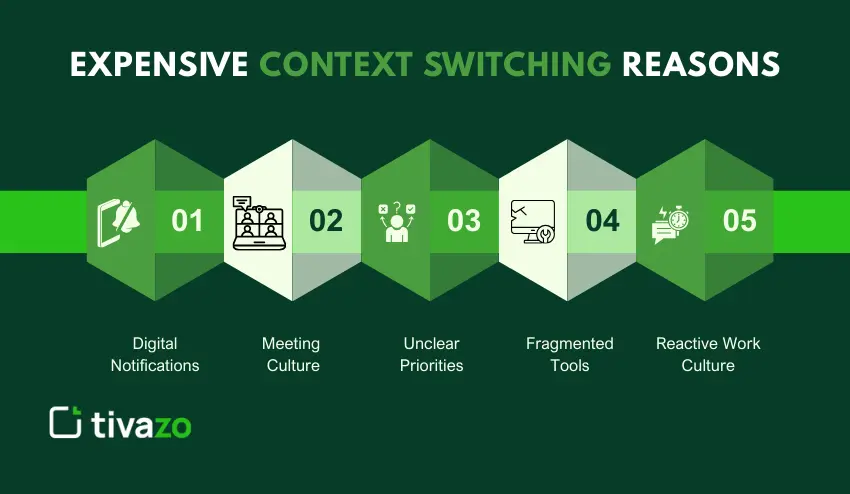
Most cases of workplace context switching are a result of identifiable and solvable factors, such as
Digital Notifications: Every notification, whether via email, chat applications, or project management tools, requires a context shift. Every day, an average worker gets more than 100 notifications. Working from home allows employees to monitor more channels concurrently.
Meeting Culture: Meetings are spread throughout the day. They fragment the overall work time. Meeting different time zones can become challenging for distributed teams. Focus sessions get interrupted at odd hours of the day.
Unclear Priorities: Without a clear understanding of the true priority, everything is urgent. There can be mixed messages sent to a contractor in an organization.
Fragmented Tools: The need to switch between different platforms is created by using 15 applications. It can get complicated when using different tools, particularly for hybrid teams, where employees may use official application versions while contractors may prefer their own versions.
Reactive Work Culture: Companies that pay employees for quick reactions teach people to interrupt themselves regularly. People working remotely feel compelled to reply straight away to demonstrate they’re actively working.
How to Measure Your Context Switching Costs
You cannot reduce what you haven’t quantified. Today’s workforce analytics techniques ensure this is done accurately.
Key Metrics to Track
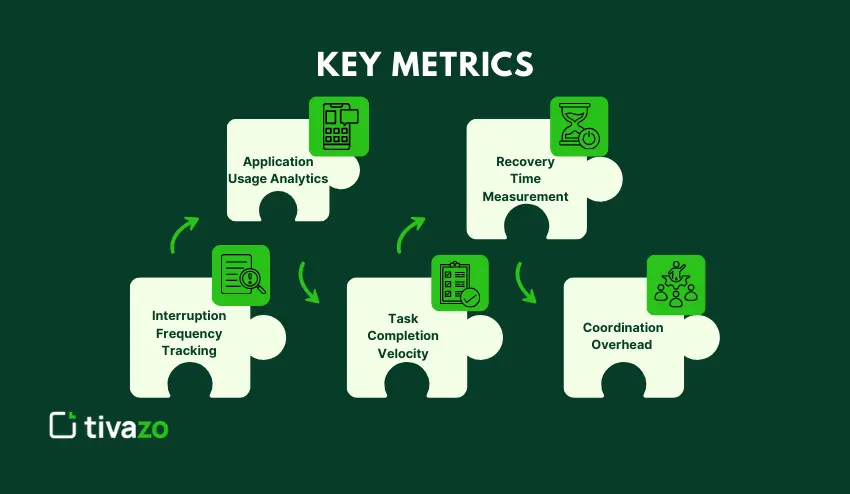
Interruption Frequency Tracking: Track the level of interruption occurrences for workers while they switch between tasks or applications. Time tracking helps in detecting when people switch between different tasks or activities.
Application Usage Analytics: Track the number of employees who switch between various software applications every hour. The number of switching patterns between applications cannot be known by simply observing employees.
Task completion velocity: Calculate the speed of various task groups when carried out with the fewest interruptions vs. a context-switching approach. The data will indicate the real productivity tax.
Measuring the Time Required to Recover: Ask your employees how long it takes to refocus on their work completely after interruptions. Studies have shown it can take between 15 to 25 minutes on average.
Coordination Overhead for Distributed Teams: Monitor time spent on handoffs, status reporting, and synchronization for distributed teams.
Using Workforce Analytics Platforms
Workforce analytics platforms can help automate these measurements to ensure comprehensive measurement. The applications track application usage patterns, task switching frequency, and time distribution, providing absolute data to take guesswork out of cost calculations.
What to measure:
- Application switching frequency per hour
- Seconds counted for each application.
- Task start and completion times
- Meeting density throughout the day
- Deep work blocks versus fragmented time
- Deep work blocks vs fragmented
To compare these metrics across different teams, departments, and different kinds of workers, whether they are full-time workers, contractors, etc. There may be different patterns for contractors, and there may also be different patterns for people who work remotely as opposed to hybrid workers.
Establish baseline measurements prior to putting any changes in place. The same measurements should be tracked month over month to measure the improvement. Quantified improvement is what builds organizational support behind focus-protecting strategies.
Strategies to Reduce the Cost of Context Switching
Thus, cutting the cost of context switching demands changes to the structure within which people operate:
Protected Focus Time: Schedule calendar time when meetings are not allowed, and notifications are off. For distributed teams, it is also important to align these periods to avoid conflicts in focus times.
Batch Communication: Allocate specific times of the day to check and process messages, not individually but in batches of 30 minutes three times a day. Set a team expectation to respond to non-urgent messages within specific timeframes.
Ruthless Meeting Reduction: Remove meetings that could have been done as an email. Try to stick to 25-minute or 50-minute meetings. Consider recording meetings for global teams.
Single Tasking Culture: Ensure that people handle no more than three projects simultaneously. They should track all their undertakings using visual boards to help them know when to decline certain responsibilities.
Async-First Communication: Prioritize asynchronous communication. In the case of blended teams, establish specific communication protocols with regards to which communications need timely or delayed action.
Tool Consolidation: Reduce the number of tools your team uses regularly. Standardize tools between full-time and contingent workers when feasible.
Data-Driven Adjustments: Workforce analytics can also identify certain switching catalysts specific to your organization. You can regularly assess switching metrics with team leads to address specific needs.
The Extra Cost of Context Switching for Remote Teams
Remote and hybrid teams pay this extra context-switching tax that office-based teams avoid:
- Digital communication creates unlimited potential for interruption, as there are no physical barriers.
- It helps workers to keep track of several channels at the same time to never miss any important information.
- Asynchronous collaboration across time zones creates handoff switching costs.
- Home environment distractions interrupt work in ways that do not happen in offices.
Yet remote work also affords singular switching reduction opportunities: without commutes and office distractions, remote workers have much more control over their focus environments. What’s necessary is to introduce a structure that will protect this possibility.
The Real Returns of Reducing Context Switching
An organization that has successfully reduced context switching activities sees productivity and financial improvements within weeks. For instance, reductions of 30% in interruptible activities can recover 10% to 15% of total productivity.
For a company of 50 employees, a mere 10 percent increase in productivity is like gaining five full-time equivalents without hiring anyone. Suddenly, we’re talking about $250,000 to $400,000 just from that added workforce.
Other benefits include:
- Fewer errors, less rework
- Improved quality of work leading to happy customers
- Higher Employee Satisfaction and Retention
- Faster project completion times
The quickest results can always be achieved in protecting your focus time. Having as little as one block of uninterrupted time at three hours a day can be transformational. You can get more done in three focused hours than you can in an entire day of interrupted work.
Organizations that monitor progress using workforce analytics see faster results. If teams perceive visualizations of switching reduction using data dashboards, they are more motivated to keep new habits.
Final Thoughts: Small Changes, Massive Savings
Additionally, the cost of context switching does not appear anywhere in the budget or financial statements, yet it drains more money than many of the line items that we are carefully tracking.
In other words, it is not about making people work more hours or being more demanding. Rather, it is about changing the obstacles that prevent existing employees from using their current time most effectively.
Do the math yourself. Count interruptions over the course of a week. Then multiply that by recovery time and salary. The results will likely astound you. The shock motivates you to correct the problem that can no longer be ignored.
Each minute you save from context switching goes directly to your bottom line. Organizations that excel at focus gain a significant competitive advantage over those still struggling to maintain focus amid constant interruptions.