On paper, it sounds easy to manage a remote team. As a matter of fact, it may be difficult and frustrating to maintain people without meeting them on a daily basis.
As a manager or a team leader, you may find that there are fewer meetings, slower responses, or that team members are performing the bare minimum. The job is accomplished, but the energy is out.
Here is where employee engagement in remote teams is important. Participation does not concern the number of hours or regular check-ins. It relates to making remote employees feel part of their work and objectives, motivated, and aligned.
The positive aspect is that remote engagement is not some kind of mystery. When the appropriate strategies are used, managers can create highly engaged remote teams that are performing well and remain committed.
What Is Employee Engagement in Remote Teams?
The commitment, motivation, and emotional attachment of remote employees to their work and the company are the degree of employee engagement in remote teams.
In plain words, employees who are engaged are concerned. They appear, present their ideas, and own their work even when nobody is looking.
The disengaged employees, however, do the bare minimum. They are present at meetings, complete tasks, and leave without participating much.
To managers, engagement is not a matter of control. It is concerning making a work environment where face-to-face interaction is minimal, clearer, trusting, and connected.
Why Employee Engagement in Remote Teams Matters More
Retention of employees is always a concern, and in remote teams, it is mission-critical. In the absence of face-to-face interaction, minor problems will easily escalate into a lack of engagement.
1. Productivity and Performance
Involved remote workers are dynamic. They deliver on time, give ideas, and provide quality work. Disengagement may cause delays, errors, or lost opportunities.
2. Retention and Reduced Turnover
The high engagement will keep employees attached to the team and company. Remote employees who feel disconnected will find other places to work, which will cost time and money to recruit and train new personnel.
3. Team Morale and Collaboration
Remote workers will work together more freely when they feel appreciated and important. There are more productive meetings, more knowledge sharing, and the team culture becomes stronger even when it is not together.
To managers, engagement is not a luxury; it is the difference between a team that succeeds and one that only lives.
Common Employee Engagement Challenges in Remote Teams
The most effective managers encounter challenges in ensuring that the remote teams are engaged. The initial step to winning over these challenges is to recognize them.
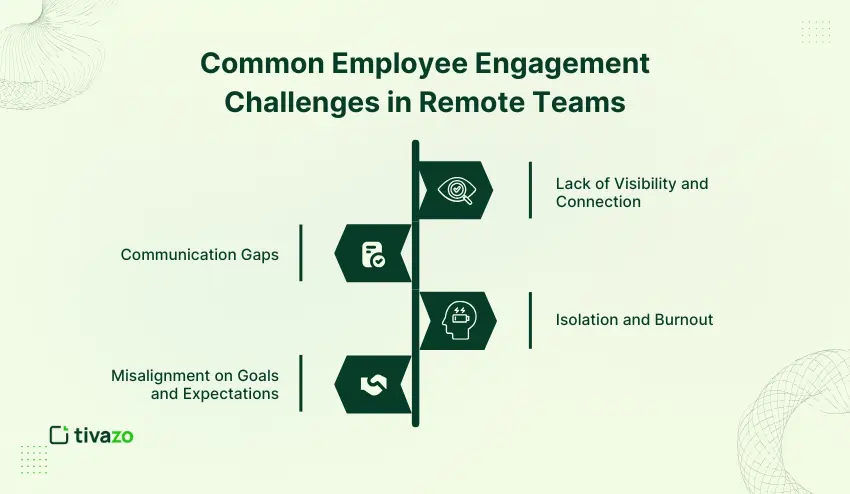
1. Lack of Visibility and Connection
Employees are able to feel invisible without the daily face-to-face interactions. It is possible that managers do not see the signs of disengagement early enough until the performance declines.
2. Communication Gaps
Asynchronous communication is an element of remote work. Employees may feel left out because of misunderstandings, delays, or a lack of context.
3. Isolation and Burnout
Working alone can be lonely. Isolation makes burnout more likely, and it has a direct effect on motivation, focus, and creativity.
4. Misalignment on Goals and Expectations
In case of unclear expectations, employees find it difficult to prioritize. Uncertainty generates frustration and disengagement even in the high performers.
7 Practical Strategies to Improve Employee Engagement in Remote Teams
Maintaining remote workers is not an effortless task. The following are seven strategies that can be implemented by managers today.
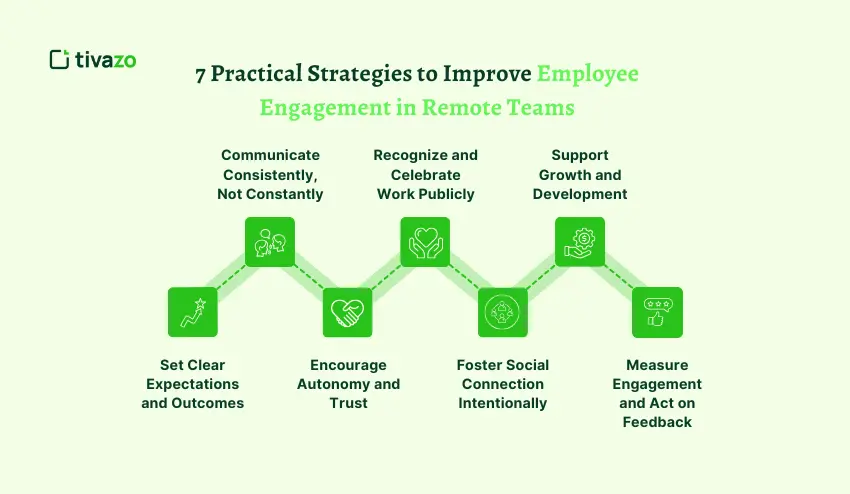
1. Set Clear Expectations and Outcomes
The employees perform optimally when they are aware of what is expected. Establish objectives, timeline and performance indicators. Transparency eliminates misunderstandings and fosters trust.
Examples: Share weekly priorities and measurable deliverables so that the team knows where to concentrate.
2. Communicate Consistently, Not Constantly
Lack of communication will result in isolation; excess will result in overload. Locate a pace that does not micromanage but keeps everyone in the know.
Hint: Weekly team check-ins and short daily updates should be used instead of constant messages.
3. Encourage Autonomy and Trust
Engagement is killed by micromanaging. Give power to the employees and make them own their work. Credibility is a source of motivation and responsibility.
Example: Have team members schedule their projects or select their workflow on specific projects.
4. Recognize and Celebrate Work Publicly
Rewards strengthen work and create a favorable team ethos. Commemorate team victories in team meetings, chat rooms or company newsletters.
Hint: Not only results, but improvement and work.
5. Foster Social Connection Intentionally
Workers at a distance are deprived of watercooler. Conduct informal meetings, online coffee sessions or team building activities to sustain relationships.
Example: Have 15-minute weekly social time when you are not putting any pressure on each other.
6. Support Growth and Development
Workers remain active when they perceive the possibility of learning and developing. Provide training, mentoring or stretch assignments to maintain high levels of motivation.
Hint: Inquire each team member on skills he or she wants to acquire and synchronize projects.
7. Measure Engagement and Act on Feedback
Nothing you cannot measure can be improved. Conduct surveys, one-on-ones or pulse tools to understand engagement and act on feedback.
Examples: Hold monthly anonymous surveys and talk about the main insights in the team meetings.
Tools Managers Can Use to Boost Engagement in Remote Teams
The appropriate team management tools facilitate the sustenance of connection, performance tracking, and engagement facilitation. These are three major categories that managers need to take into account.
Collaboration and Communication Tools
Effective communication keeps the remote teams on track and in touch.
Examples:
- Slack / Microsoft Teams: Rapid messaging, teams, or project channels.
- Zoom / Google Meet: Video-based check-ins and meetings.
- Miro / MURAL: Brainstorming and planning visual collaboration.
Feedback and Performance Tools
Monitoring the progress and providing feedback will make sure that employees are aware of where they are.
Examples:
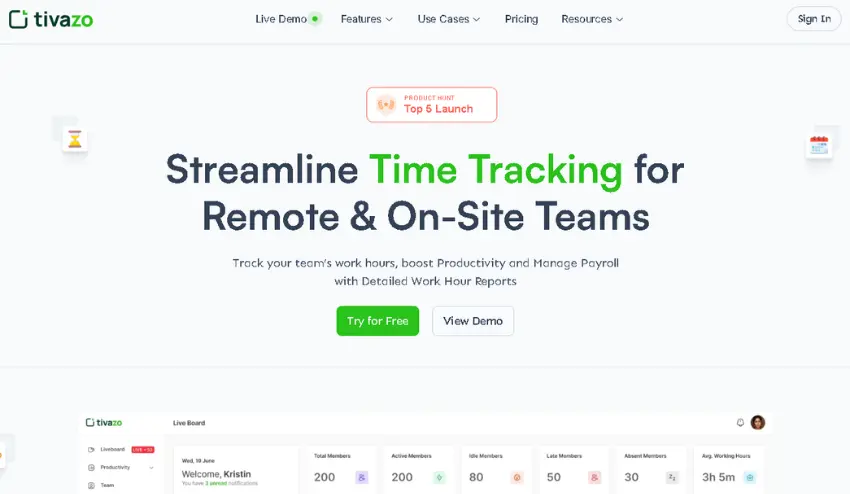
- Tivazo: Performance measurement with practical suggestions.
- Lattice / 15Five: Continuous feedback, performance reviews, and OKRs.
- Trello / Asana: Track the project status and tasks.
Pulse Survey Tools and Engagement
Frequent feedback assists the managers in noticing disengagement in time and take proactive measures.
Examples:
- Officevibe / Culture Amp: Pulse survey and engagement analytics.
- Peakon: Employee satisfaction and team sentiment.
Common Mistakes Managers Make With Remote Engagement
The engagement in remote teams can be decreased unintentionally, even by experienced managers. These are some of the most common mistakes to avoid in team performance and morale:
- Micromanaging over trusting- It can be irritating to employees when the manager inspects them at all times. Micromanagement is an indication of distrust and may demoralize.
Rather, encourage team members to have clarity of expectations and give them the freedom to get things done their own way. - Handling all remote workers in a similar way – Each team worker possesses different working styles, communication preferences, and personal situations.
One size fits all may make some employees feel neglected or unassisted. Customize your interaction strategy. - Overlooking the first indicators of disengagement– Small behavioral changes, missed check-ins, or lack of involvement in meetings are all possible signs of disengagement.
It becomes even more difficult to re-engage employees when the performance declines. Early detection of problems enables early assistance and mentoring. - Focusing only on tasks, not people – Remote managers tend to concentrate on the deadlines and deliverables rather than personal contact.
It is important to remember that you are not only task-oriented but also engage with others, which is achieved by means of trust, recognition, and connection. Frequent individual check-ins and informal discussions can make the employees feel appreciated. - Failing to recognize achievements publicly– Recognition encourages and strengthens positive behaviours.
Working remotely, an employee may feel unrecognized, and his or her efforts are not publicly recognized. Praise victories, milestones, and contributions during team meetings, chat rooms or newsletters.
Tip: By noting these patterns, modifying strategies to fit certain team members, and solving minor problems before they arise, one forms a more active and productive remote team.
Conclusion
Employee engagement in remote teams is not an accident, but a leadership behavior. Managers can do this by establishing the tone through establishing clarity, trust, and connection even at a distance.
Even little, regular things, such as rewarding effort, talking in a straightforward way, and making calls, can make a huge difference in motivating and making the team work.
Begin with a single strategy now. Perhaps it is the booking of regular one-on-ones, a team win, or a tool such as Tivazo to monitor engagement. It is easy to gain momentum once you have made the first step.