In the modern, hectic workplace, work productivity no longer involves counting hours or screen-watching. Remote and hybrid teams in modern times require more intelligent ways to understand how work is done without causing pressure, stress, or distrust by creating a different formula. Short-term visibility might be provided by micromanagement, but in the long term, it destroys morale, creativity, and performance.
Why Traditional Employee Productivity Tracking No Longer Works
Have we, over the years, quantified productivity by visible effort as to who remained late, who appeared busy, and who answered immediately? The signals are not available in remote and digital workplaces, and in an attempt to replicate these signals by continuously monitoring individuals only causes friction.
Efforts made by old methods fail because they:
- Concentrate on time and not results.
- Promote acting as work and not the actual effect.
- Enhance burnout and disengagement.
- Shatter the trust between the staff and the management.
Contemporary teams realize that productivity is a pattern, consistency, and delivery as opposed to surveillance. In the modern world, productivity can only be measured within a context and not through control.
Reframe Productivity to Modern Teams
The contemporary workplaces are multidimensional in their productivity. It covers specialization, teamwork, work-life ratio, and long-term performance. Good performing teams do not always work longer; they work smarter.
This change is parallel to professional development in the modern world. Indicatively, individuals tend to develop their practical experience with a digital marketing course, not by learning theories but by understanding how the strategies work in the real world. Similarly, the measurement of productivity should be realistic, objective, and applicable to actual work trends.
How Smart Tools make Visibility Pressure-Free
The secret of non-intimidating visibility is the key to non-invasive productivity measurement. Managers require a response to such key questions:
- Do you have a balanced distribution of work?
- Are deadlines realistic?
- Who is at risk of being hit by burnout?
- Where are there delays in processes?
These answers are delivered by modern productivity tools, but not by invasive tracking, through aggregated data, trends, and insights. They assist leaders to take action early, work well with teams, and plan effectively.
How Tivazo Can Be Used to Measure and Improve Productivity
Smarter Productivity Insights Micromanagement Free
It is here that Tivazo is very vital in contemporary team management. Tivazo prioritizes trust, balance, and clarity as opposed to being a surveillance mechanism.
With Tivazo, managers can:
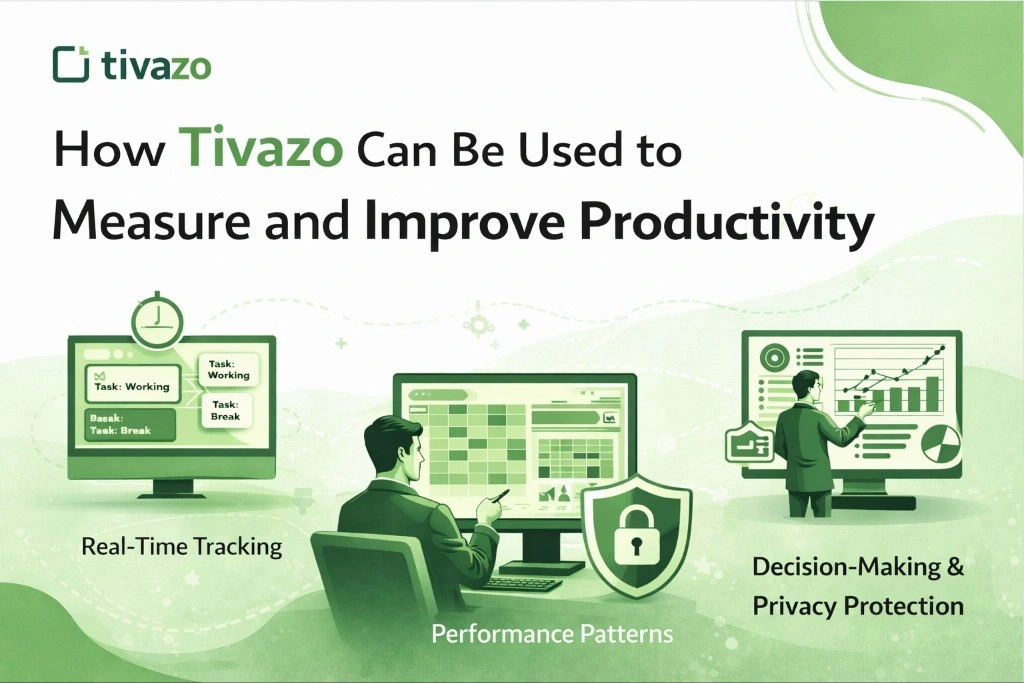
- Measure actual real-time track time
Know who is working, taking a break, or offline without intrusion in personal space. This makes it possible to detect the workload imbalances before they develop into issues. - Understand performance patterns
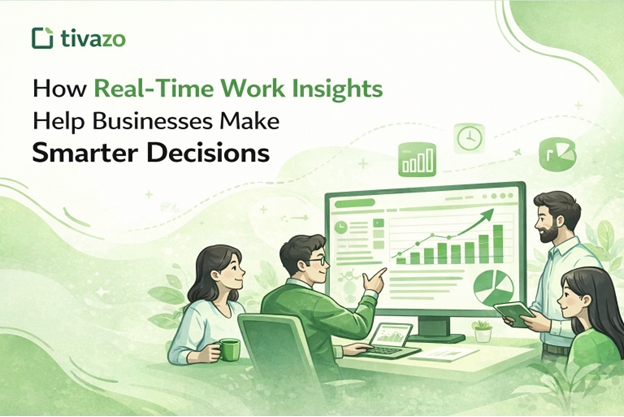
Actual spending of time is shown in heatmaps and analytical reports. In the long run, these trends assist leaders in identifying high performance and identifying areas to improve. - Decision-making with better data
Guesswork is out of automated reports and dashboards. Planning is more accurate since it is not made out of assumptions; it is made out of actual insights. - Protect employee privacy
Tivazo is meant to track the work activity, rather than personal behavior. Such transparency leads to trust and decreases the opposition to productivity monitoring. - Lead different teams easily.
In all types of teams, remote, hybrid, or office-based teams, Tivazo will help to organize, delegate tasks, and track progress in a single system.
Establishing Trust By Open-ended Productivity Monitoring
High-performing teams are based on trust. Resistance disappears when the employees know the purpose of measuring productivity and how the data will be utilized.
- Employees get to understand what is expected of them.
- Managers become confident in making decisions.
- Teams align better on goals and deadlines.
Just like professionals who explore a free digital marketing course to understand how tools and platforms work before using them, teams perform better when they understand the purpose behind productivity systems.
Reducing Physician Burnout Using Workload Optimization
Burnout prevention is one of the greatest advantages of the modern method of measuring productivity that should not be disregarded. In the absence of data, burnout is usually realized only when it is too late.
Time-tracking insights assist the leaders:
- Detect overworked team members early
- Redistribute tasks fairly
- Set realistic deadlines
- Encourage healthy breaks
Instead of pushing teams harder, data helps organizations work smarter and protect long-term performance.
Productivity Is About Insight, Not Control
Employee Productivity tracking is not about people control it is about understanding work. By concentrating on insight, they open the doors to superior planning, efficiency in teamwork, and excellence.
Learning works the same way. Lots of individuals use organized materials, such as a free course online on the Internet, to acquire clarity and orientation without feeling stressed. The same should happen with the productivity tool; they should guide teams and not police them.
What Modern Teams Should Measure Instead of Hours
In the contemporary workplace, productivity monitoring must go beyond the number of hours worked and monitor. Time is not an indicator of impact, creativity, or sustainable performance, particularly of remote and hybrid teams.
Proper productivity monitoring is not about the duration of time one spends on the computer, but the flow of work.
Modern teams do not measure presence and instead focus on workload balance. Burnout usually comes in the wake of uneven distribution of tasks. Early detection of such patterns can assist managers in rectifying the problems before the performance declines.
It is more about consistency than intensity. Healthy employee productivity tracking is a trend-following approach that does not focus on spikes of activity. Consistency between days and weeks is more of a performance indicator compared to temporary overworking.
Focus time is another important indicator. Continuous moving between contexts decreases productivity, despite the number of hours appearing large. Knowledge of the amount of continuous time employees possess enables teams to work on deep work without stress.
Recovery is also appreciated in modern employee productivity tracking. The trends in breaks tell whether the teams are operating in a sustainable manner or they are operating beyond healthy boundaries. Once these signs become visible, organizations will be able to safeguard long-term performance rather than addressing burnout too late.
By transforming employee productivity tracking to control to insight, teams can have a clear picture without causing stress and mistrust.
Why Transparency Matters in Employee Productivity Tracking
Monitoring of productivity cannot work when it seems like spying. It works well when it is open, meaningful and well articulated.
When employees are aware of the data being gathered, the purpose of this data, and its intended use, then they are much more open to Employee productivity tracking. Transparency eliminates the fear and substitutes it with alignment.
Easy-to-understand Employee productivity tracking systems assist in setting expectations. Teams are less energy consuming in guessing and more in producing meaningful results when success is quantifiable and observable.
Psychological safety is also enhanced by transparency. Employees are not judged but feel supported when the tracking is based on work patterns as opposed to personal behavior. This gives room to learning, growth and candid discussions.
To managers, open productivity monitoring eliminates friction. Assumptions are substituted with data-driven discussions, feedback is more constructive, and decisions are more fair.
With transparency, accountability does not fade away. It becomes stronger. Trust is a natural development when all the individuals have the same perception of work and results.
Contemporary employee productivity tracking is not the observation of people working. It concerns the construction of systems that enable individuals to perform their best work comfortably.
The Future of Productivity Measurement
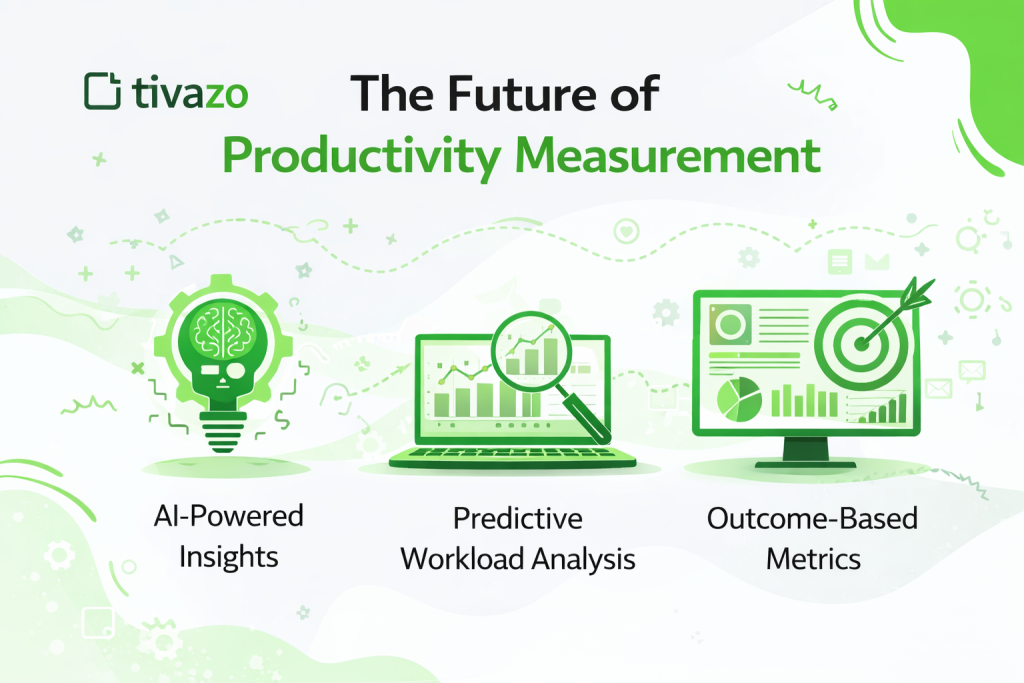
With the constantly changing workplaces, the measurement of productivity will be even smarter and more human. The future lies in:
- AI-powered insights
- Predictive workload analysis
- Outcome-based performance metrics
- Employee-first transparency
Conclusion:
Innovative teams are effective because of purposeful productivity measures. Micromanagement can be seen as a short-term visibility; however, it destroys trust and future outcomes. Smarter measurement is concerned with trends, balance, and results.
Responsible data usage and tools, such as Tivazo, help organizations be clear without stress, perform better without exhaustion, and create work environments where individuals flourish.