
The recruitment of the right talent is no longer about placing an advertisement and waiting. Full cycle recruiting is a long-term, top-to-bottom methodology that assists companies in recruiting, hiring, and retaining the most qualified employees. In the current competitive world, organizations require more intelligent ways of hiring, which makes recruiters more business-oriented.
This guide will explain what full-cycle recruiting is, how it has developed, and why it is essential to business development in modern times. We will discuss the work of a full-cycle recruiter, its major benefits and difficulties, and the way it is different than the traditional recruiting. You will also learn the six stages of full cycle recruiting, tips to make it successful, what onboarding is, what onboarding involves, and how Tivazo can help your recruiting plan. Let’s get started.
What is Full Cycle Recruiting?
Full cycle recruiting, or full life-cycle recruiting or end-to-end recruitment process, is a holistic process, where a recruiter oversees all the processes involved in the hiring process. Contrary to the traditional recruiting that might involve only sourcing or screening resumes, full cycle recruiting encompasses the whole cycle of recruitment, that is, sourcing candidates and screening resumes to interviewing, offer negotiation, and even onboarding of new employees.
The full-cycle recruiter is a strategic partner who makes sure that all the steps are in line with the recruitment strategy and the general business objectives of the company. This will help in the efficiency of hiring, lowering the rate of turnover, and improving the experience of the candidates.
👉You May Also Like: Modern Hiring Truths About Unconscious Bias in Recruitment
The Evolution of Recruiting: From Post-and-Pray to Partnership
Recruiting was like dart throwing in the dark. You would place an advertisement in the job market and wish. However, that created waiting and bad fits. Full cycle recruiting today makes the recruiter the leader of the entire recruiting process. They possess all the goods, including talking to managers and following up on offers.
This change was due to constrained job markets and turnover. Companies were aware that they required partners, not order-takers. Full cycle recruiter develops authentic relationships with teams. They identify talent requirements on time and make things run smoothly. It has to do with making the process of hiring a team effort.
Why Full Cycle Is Critical for Modern Business Growth
Full cycle recruiting is directly related to a company’s success. It reduces time spent in hiring staff, usually by 30% or more, according to recent HR reports. Rapid recruitments translate into rapid team increases and reduced wasted time. In addition, it increases the quality of hires. The recruiters who do the entire process select individuals who remain longer.
Another victory is high employer branding. Advertising candidates have a great experience, spread it. That attracts the best talent in the future. Companies that employ full-cycle approaches experience improved growth. They embrace changes such as the remote work boom without having to deal with headaches.
What does a Full-cycle Recruiter do?
A full cycle recruiter will be in charge of the full cycle recruiting process, where he or she is involved in managing all the phases of the recruitment life cycle. They have the roles of sourcing candidates, screening resumes, interviewing and selection, offer negotiation, and onboarding new employees. They make sure that the talent acquisition process is in line with the recruitment strategy of the firm and the business objectives.
A full-cycle recruiter provides greater efficiency and elevates the candidate experience through the management of every single step of the hiring process and employer branding. They also monitor recruitment metrics so as to streamline hiring behaviors so that they can have a seamless end-to-end recruitment process.
📖Related: Recruitment Plan for 2026: 7 Powerful Hiring Steps
Pros of Full Cycle Recruiting
Full cycle recruiting is a strategic method that is beneficial both to the companies and candidates. The businesses can also improve the efficiency of the hiring process by controlling the recruitment lifecycle as a whole.
1. Improved Hiring Efficiency
A full-cycle recruiter takes care of all the talent acquisition activities, including recruitment and the recruitment of new employees. This minimizes delays and provides a smooth end-to-end recruitment process.
Through management of each phase of the hiring process, full-cycle recruiting will eliminate the involvement of multiple recruiters and save time and resources at the cost of maintaining a consistent recruitment strategy.
2. Better Candidate Experience
The applicants have the advantage of a personalized and consistent experience during the entire life cycle recruiting process. They are provided with clear communication and direction, even starting with the first contact, through the interviews and selection.
An improved experience enhances employer branding of your company and the likelihood of selecting the best talent, and thus, full-cycle recruiting proves to be a great idea in competitive markets.
3. Stronger Alignment with Business Goals
Full cycle recruiting is one that makes sure that the responsibilities of the recruiter are closely aligned with the company’s objectives. Each of the steps, such as offer negotiation and onboarding, facilitates larger goals of recruitment strategies.
This active engagement enables companies to recruit talent who do not just fit the position but also bring about long-term growth, and therefore, the process of recruiting talent becomes more efficient and objective.
4. Data-Driven Decision Making
All-cycle recruiters monitor recruitment data at each phase of the hiring process procedures, including candidate sourcing through the applicant tracking system (ATS) data.
Such insights, supported by data, enable the companies to know the bottlenecks, optimize the talent acquisition process, and optimize the overall recruitment process to achieve better hiring results.
Full-cycle recruiting is known to bring distinct benefits to contemporary business, enhancing efficiency, candidate experience, and strategic alignment. Through this, businesses can use this strategy to make more informed hiring choices.
Cons of Full Cycle Recruiting
Although full cycle recruiting has numerous advantages, there are also a few problems with it. These disadvantages can be better understood to enable companies to plan efficiently and to avoid the pitfalls in the recruitment lifecycle.
1. High Workload for Recruiters
A single recruiter may find it challenging to manage the full cycle recruiting process. The tasks may add up too fast, including sourcing candidates and bringing new employees on board.
Such a workload can either cause burnout or neglect of some steps in the hiring process procedure, and therefore, companies should ensure that they offer sufficient support or think about team-based practices in the talent acquisition process.
2. Requires Advanced Skills
A full-cycle recruiter should be exceptional in various fields, and these include background checks, interviewing, selection, and negotiation of the offers. Not all recruiters are experienced enough to deal with all the facets of the recruitment lifecycle.
In the absence of training or skill, the quality of recruits could be compromised, which might affect the recruitment plan and the general business development.
📖Read More: How Hiring for Potential Transforms Your Workforce in 2026
3. Longer Recruitment Time Initially
Though full cycle recruiting may enhance efficiency in the long term, the process may require a long time to be implemented in the first place. The management of all the activities involved in the hiring process, including the applicant tracking system (ATS) installation, as well as the formal onboarding process, can be time-consuming.
New companies in full life cycle recruiting can have a slower hiring process at the beginning, and it is important to plan this and adapt to prevent delays.
4. Resource Intensive
Full cycle recruiting may involve the availability of tools, technology, and training to work with the end-to-end recruiting process. Systems such as ATS, recruitment analytics, and candidate management systems are vital.
Such additional resources may raise the cost, and the businesses may need to balance the advantages of full cycle recruiting strategy and the budget and team capacity.
The challenges notwithstanding, full-cycle recruiting is a strategic method that can deliver improved hiring results through planning, support, and resources. Companies that take these cons upstream are in a position to reap the benefits of an end-to-end recruitment process optimally.
What is the difference between recruiting and full cycle recruiting?
| Traditional Recruiting | Full Cycle Recruiting |
|---|---|
| Focuses on specific stages like sourcing candidates or interviewing. | Covers the entire recruitment lifecycle, from sourcing to onboarding new hires. |
| May involve multiple recruiters handling different stages. | A full-cycle recruiter manages all hiring process steps independently. |
| Candidate experience can be inconsistent due to hand-offs between recruiters. | Provides a consistent, guided experience throughout the talent acquisition process. |
| Can be faster initially but may lack alignment with recruitment strategy. | Improves long-term efficiency by streamlining the end-to-end recruitment process. |
| Can be faster initially, but may lack alignment with recruitment strategy. | Easier to monitor performance and optimize the full life cycle recruiting process. |
| Often less connected to overall business goals. | Strong alignment with company objectives and hiring strategy. |
How to do full cycle recruiting? 6 phases of full cycle recruiting
Full cycle recruiting involves proper maintenance of each phase within the recruitment lifecycle. The six major steps assist in ensuring that the end-to-end process of recruitment by the business is simplified, that the process becomes more efficient, and the experience of the candidate is enhanced.
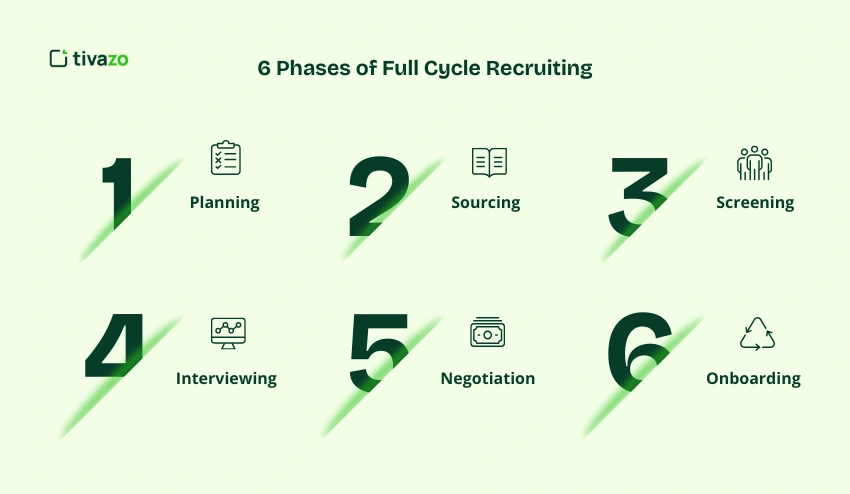
1. Workforce Planning
Workforce planning is the first step in full cycle recruiting, where companies evaluate hiring requirements depending on business goals. This will entail assigning roles, skills, and the number of heads to match the recruitment plan with the long-term objectives.
The proper workforce planning will make sure that full-cycle recruiters are aware of what jobs are a priority and how they can allocate resources without any gaps or overstaffing. It is a necessary measure to ensure the talent acquisition is a smooth process.
With an early strategy on hiring, companies can incorporate workforce planning into the larger recruitment lifecycle, and the process of sourcing, screening, and onboarding becomes more efficient and focused.
2. Sourcing Candidates
The second phase involves active recruiting on the part of full-cycle recruiters who search job boards, social media, networking, and employee referrals in order to find potential candidates. This is a very important step in ensuring a robust pipeline in the entire process of recruitment.
Applicant tracking systems (ATS) and similar tools can be used to manage applications and track candidates’ interactions throughout the hiring process. It’s seen with modern platforms that offer smart recruiter integrations. It also ensures recruiters do not lose top talent during the talent acquisition process.
An effective sourcing strategy enhances the quality of candidates and shortens the time-to-hire, which contributes to the overall efficiency of the end-to-end recruitment process and helps increase employer branding.
3. Screening and Shortlisting
After receipt of applications, full-cycle recruiters are used to screen resumes and shortlist candidates on the basis of skills, experience, and cultural fit. This will only allow the most qualified candidates to proceed in the recruitment lifecycle.
Formal tests, telephone interviews, and reference checks are used to make the entire life cycle recruiting process faster, consistent, and fair. The talent acquisition process also provides recruiters with measures to filter screening.
Efficiency in shortlisting candidates eases pressure on the hiring managers and enhances the general experience of the candidates, and the entire recruitment process is more organized and professional.
📖Related: Recruitment Funnel Guide: 7 Powerful Stages
4. Interviewing and Selection
In this stage, the recruiters interview, test the applicants, and hire the most suitable one. Full cycle recruiting represents a method that makes sure that every process of hiring is done in a systematic way, and it offers transparency on the part of the candidates and managers.
Interview methods, grading, and regular communication enhance decision-making and reduce the chances of employing a mismatch. Recruiters make the process consistent with the recruitment strategy of the company to achieve the best outcomes.
This cautious practice can assist companies in finding the best talent, enhance the branding of employers, and ensure a positive job seeker experience across the recruitment cycle.
5. Offer and Negotiation
Once selected, recruiters negotiate the offer and generate terms of employment. This step is very important to ensure that the candidate is secured without compromising on goodwill and positive candidate experience.
Effective communication in negotiations is also a positive reflection of the company and helps to facilitate the entire recruiting process, as the company will not face as many refusals to the offer and successful transitions. At this point, recruitment measures can be used to monitor success rates to improve upon them.
When managed well, the offers are used to retain the best talent, match the hires with the talent acquisition process, and ensure the end-to-end recruitment process is efficient.
6. Onboarding
The last stage incorporates new employees into the company. Onboarding the new hires means they are aware of their role, duties, and the organization culture, and the entire process of recruiting is closed.
Proper onboarding enhances employee engagement, retention, and productivity, as well as the objective of the recruitment lifecycle to recruit the right talent for the business.
Full cycle recruiting that incorporates onboarding makes the sourcing and integration process seamless, which enhances the talent acquisition process and the overall organizational success.
Tips for Successful Recruitment
Full cycle recruiting is more than a mere process of filling vacant positions but it is also about recruiting the right talent at the right time and it is also about having a good candidate experience. Application of the best practices in the recruitment lifecycle can be a great way of enhancing the results.
📖Read More: Powerful Recruitment Campaign Tactics That Work in 2025
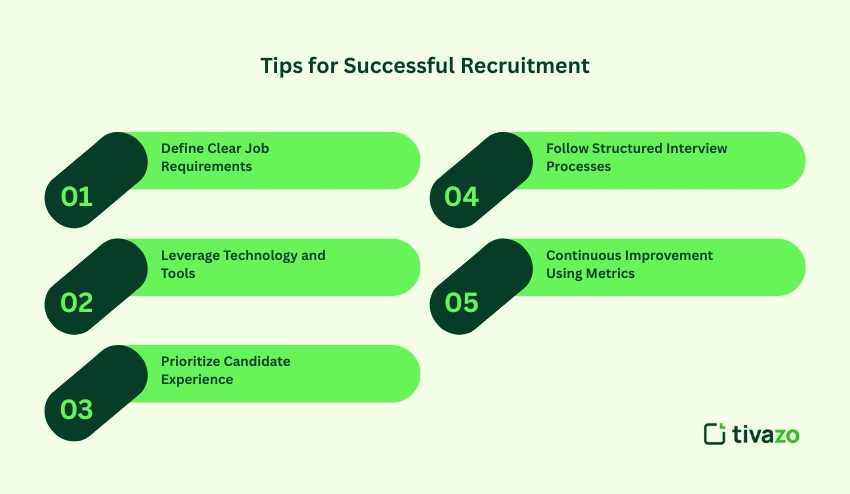
1. Define Clear Job Requirements
Begin with an elaborate job description, which includes the skills, responsibilities, and qualifications. This transparency assists full-cycle recruiters in finding the appropriate candidates in the sourcing and screening stages, thereby saving time on unqualified candidates.
2. Leverage Technology and Tools
The talent acquisition process can be facilitated with the help of applicant tracking systems (ATS) and recruitment analytics. The tools enable the management of applications, interactions with the candidates, and enhance the efficiency of every step involved in the hiring process.
3. Prioritize Candidate Experience
Ensure effective communication, delivery of feedback, and a smooth interview process. A good experience enhances the employer branding and higher chances of attracting the best talent.
4. Follow Structured Interview Processes
There is a standardization of interviews and assessment criteria, which leads to fair evaluation and uniform results. This enhances the decision-making process of full life cycle recruiting and conforms to the recruitment strategy of the company.
5. Continuous Improvement Using Metrics
Measure recruitment data, including time-to-hire, source performance, and candidate satisfaction. Empirical information enables full-cycle recruiters to optimize the recruitment process end-to-end to achieve improved results.
With such tips in mind, companies will be able to conduct full cycle recruiting effectively, recruit efficiently, and provide a smooth experience to both candidates and hiring teams.
Does full cycle recruiting include onboarding?
Yes, onboarding of new hires is usually the last step in the recruitment lifecycle under full cycle recruiting. Full life cycle recruiting is aimed at controlling all the processes of the end-to-end recruitment process that includes sourcing to the successful integration of the recruits into the company.
Onboarding is also included to make sure that new workers are familiar with their positions, the culture of the company, and its expectations. It enhances talent acquisition through better workforce retention, engagement, and long-term productivity.
Conclusion
Full cycle recruiting refers to a strategic, complete cycle that changes the manner in which business organisations deal with the recruitment life cycle. The benefit of managing the entire process of hiring, including sourcing, screening, and sifting resumes, interviewing, negotiation of offers, and onboarding new employees, is that companies can become more efficient and provide a better candidate experience and align their recruitment strategies with the overall business objectives.
By relying on the best practices, utilizing such tools as an applicant tracking system (ATS), and leveraging data in the talent acquisition process, smarter hiring decisions, enhanced employer brand, and retention of employees in the long term are guaranteed. A full life cycle recruiting strategy enables organizations to remain competitive and recruit the best talent, as well as streamline the overall end-to-end recruiting process.