Want to get enhanced teamwork, morale, and engagement? You’ve come to the right place! In this guide, you will find the best team-building games and activities that are fun, easy to implement, and specifically designed to encourage teamwork. Regardless of whether you have an in-office team or manage a remote team, this guide will provide you with options for your particular needs, sorted by team size, reason, and purpose.
Additionally, you’ll find out the difference between team-building games and team-building activities (because picking the right style is important). This guide will help you engage your team and encourage collaboration, as well as help inspire a more positive workplace culture today and in the future.
Key Highlights:
- What are Team Building Games?
- How Do I Conduct Team Building Games?
- Fun Game Ideas
- Games by Group Size & Setting
- Fun Activities and the “Big Five Teamwork Activities”
- Matching Game to Intent & Size
- Team Building Activities vs Team Building Games
What are Team Building Games?
Team building games can be described as short and concise, fun, and often competitive activities that energize teams and break the ordinary routine of work. They are a great way to facilitate a quick morale boost in engagement and team collaboration in a short time frame.
Importance of Team Building Games?
Team building games are essential for creating stronger, more connected teams and fostering a positive workplace culture. These activities help improve communication, collaboration, trust, and problem-solving skills among employees, making everyday teamwork more effective and enjoyable. By incorporating fun and engaging team bonding activities, organizations can boost morale, reduce stress, and encourage meaningful relationships across all departments. In short, it:
- Enhance trust, have communication and problem-solving capabilities, and learn about each other
- Stimulate creativity, derail siloing
- Use during unproductive times or virtual teams
Types of Team Building Games
- Icebreaker games: Just quick and easy intro exercises
- Problem-solving games: puzzles, challenges requiring teams to work together.
- Creative games: games focused on drawing materials or storytelling with constraints
- Virtual team building – scavenger hunts, quiz-type apps
How Do I Conduct Team Building Games?
These users want to use team building games with their teams as soon as possible and whenever possible. The trick is to be prepared, organized, and aware of the dynamics of your team.
Preparing to Lead a Team Building Game
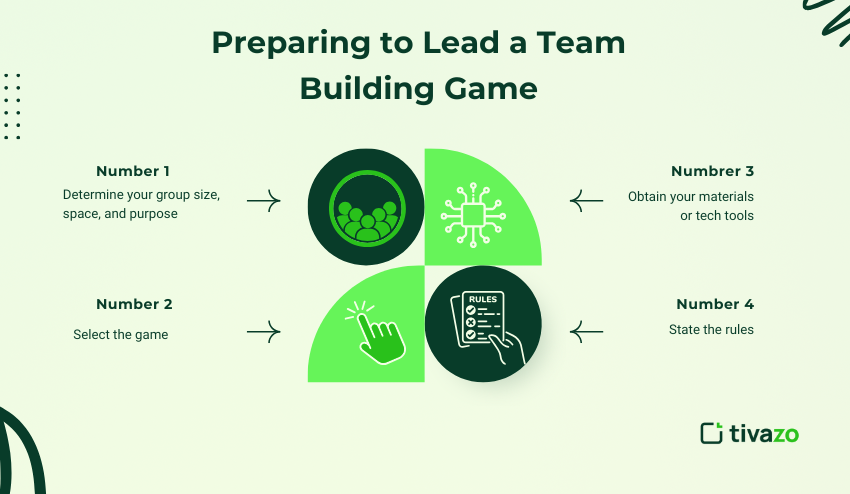
No. 1- Determine your group size, space, and purpose – Are you dealing with a small in-person team, or a larger remote group? What is your purpose, fun, creativity, trust, or problem-solving?
No. 2- Select the game- Match the complications and energy level of the game to your team’s mood and the time frame allowed.
No. 3- Obtain your materials or tech tools- For in-person sessions, make and prepare props or printed material. For remote teams, choose to host the session on Zoom, MS Teams, or Google Meet. Use either digital whiteboards, such as Miro, MURAL for drawing exercises, or Kahoot, Slido for quiz apps.
No. 4- State the rules- Be clear with the expectations, time allocation, and “win conditions.” Ask for participants to join in, but don’t force them to. Comfort leads to engagement.
21 Fun Team Building Games to Energize Your Team
1. Two Truths and a Lie
- Number of Participants: 4–20
- Rules: Each person shares two true facts and one lie; teammates guess which statement is false.
- Objective: Improve communication and personal connection through fun storytelling.
- Time: 10–15 minutes
- Required Tools: None
One of the most popular team building games is Two Truths and a Lie, as it assists employees to open up and share personal stories and get to know each other in a way beyond the work capacities. It is a great icebreaker exercise when introducing new teams or during the onboarding process, and it helps to build a comfortable and friendly atmosphere and bond the team members by laughing and asking questions. Such a game stimulates active listening and gives employees an opportunity to learn something about their colleagues that is unusual, unexpected, and enhances their interest and strengthens their relationships in the workplace.
Make everyone sit or stand in a circle. There is a turn where each participant is expected to give three statements about himself or herself, two of them true and the other one false. The group deliberates and decides on what statement they think is false. The correct answer is then given by the speaker, which tends to result in laughter and after questions. Rotate until everyone has taken their turn. It is a fast, rejuvenating exercise that can be facilitated in in-office as well as virtual meetings.
2. Blind Drawing
- Number of Participants: 4–30
- Rules: One person describes a picture while the partner draws without seeing it.
- Objective: Strengthen listening skills, clarity, and collaboration.
- Time: 15–20 minutes
- Required Tools: Paper and pens
Blind Drawing is among the team building games that have a communication-based emphasis and demonstrate the significance of precise instructions and listening. It is particularly applicable to the teams that are more dependent on verbal communication, i.e., hybrid or remote teams. This exercise shows how messages may be misconstrued very easily and teaches employees to become more precise, patient, and trusting of each other.
Split subjects into groups of two. Assign one of them a randomly chosen image (object, symbol, or shape) that is not visible to their partner. The one with the picture should explain the picture clearly without directly stating what the picture is, whereas the other player draws without any idea of what they are supposed to draw. In several minutes, compare drawings to the original picture to discuss learnings and difficulties. Switch roles and repeat to achieve maximum learning.
3. Scavenger Hunt
- Number of Participants: 6–50
- Rules: Teams compete to find items or complete challenges on a list.
- Objective: Improve teamwork, strategy, and problem-solving.
- Time: 30–60 minutes
- Required Tools: Printed list, items to find, optional phones
A Scavenger Hunt is a team building activity that is highly energetic and encourages cooperation, ingenuity, and good competition. It is perfect in motivating and shaking teams out of their usual work habits. The game can be used in company retreats or office events, or even during virtual meetings, and is a combination of physical activity, mental, and teamwork. Participants are to be strategic thinkers, distributors of roles, and efficient time workers.
Prepare a list of things, pictures, or activities that the participants are expected to find or do in a given time. Split the group into small groups and divide the list. Groups compete to identify as many items as they can and record them (physically or by photograph). The group with the most completed tasks or the highest points is the winner. To make the game more fun and interesting, add creative tasks such as a 10-second group cheer or something that looks like a heart.
4. Minefield
- Number of Participants: 6–16
- Rules: Objects are scattered; blindfolded participants navigate with teammates’ verbal instructions.
- Objective: Build trust and improve communication under pressure.
- Time: 20–30 minutes
- Required Tools: Blindfolds and random objects
Minefield is among the most effective team building games in terms of building trust and clarity of communication. It puts the team members in a scenario where they have to be fully dependent on verbal instructions and teamwork. These team building games shows the importance of being precise, patient, and communicating supportively when overcoming obstacles as a team. It comes in particularly handy when building leadership skills and relationship fortification within new or cross-functional teams.
Prepare a course with the help of chairs, cones, boxes, or any other objects in a place. Tie one of the members of the team blind and have the other give them direction on where to move without physical contact as a spectator. The player should get through the minefield without violating the rules or objects. Switch positions till all the people have been involved. This is an indoor or outdoor game that can be modified to play virtually with desk objects and remote guidelines.
5. Marshmallow Challenge
- Number of Participants: 8–30
- Rules: Teams build the tallest standing structure using limited materials, with a marshmallow on top.
- Objective: Encourage creativity, teamwork, and design thinking.
- Time: 20–25 minutes
- Required Tools: Spaghetti sticks, tape, string, marshmallows
The Marshmallow Challenge is a well-known among many team building games that is teamwork-centered and is common in a team building workshop, team retreat, or a classroom activity. It promotes creativity, experimentation, and promptness to solve problems. This practical exercise illustrates the role of planning, prototyping, and open exchange of ideas in leading to successful collaboration. It also teaches teams to learn to accept failure as a growth process.
Break the participants into small groups and allocate equal materials to each group. Prepare a timer and propose to teams to construct the highest free-standing structure that can sustain a marshmallow on top. Time runs out, the time structures are measured, and the winning team is announced. Promote a post-game reflection on the topic of leadership roles and strategies, as well as learning points.
6. Helium Stick
- Number of Participants: 6–14
- Rules: Groups lower a lightweight stick to the ground using only fingertips—without losing contact.
- Objective: Strengthen coordination and group focus.
- Time: 10–15 minutes
- Required Tools: Lightweight rod or stick
Helium Stick is a relatively easy and at the same time quite difficult among other different team building games based on coordinating, communicating, and being patient as a group. An activity that seems simple initially turns out to expose the challenges of synchronization when a group of people has to work on a common objective. It fosters comedy and a lot of energy, and thus is a potent icebreaker and morale booster.
Ask the participants to form two facing rows holding a long, lightweight rod with index fingers only. The aim is to bring the stick down to the ground without falling or losing fingers. In case of a loss of contact by anyone in the team, the team has to re-initiate. Get players to plan as a team. Reflect back on the process at the end of the day on what was useful or not.
7. Human Knot
- Number of Participants: 6–20
- Rules: Participants form a circle, grab random hands, and untangle without letting go.
- Objective: Encourage problem-solving, collaboration, and patience.
- Time: 10–20 minutes
- Required Tools: None
Human Knot is a standard game of high energy, team bonding, which involves cooperation, communication, and creative thinking to address a common physical problem. It assists in breaking social barriers, and a strong feeling of unity is developed within the group. Teamwork and laughter are the natural results when the participants are trying to unscramble the knot without losing contact.
Ask the participants to form a circle, cross hands with two different persons, and reach across. The group does not loosen its grip, but pulls itself apart into a circle. It takes strategy, flexibility, and patience to overcome the challenge. Ask the teams to change the problem-solving methods, e.g., lifting arms, stepping over, or turning positions.
8. Reverse Charades
- Number of Participants: 6–30
- Rules: Entire team acts out a word while one person guesses.
- Objective: Promote teamwork and creative communication.
- Time: 15–25 minutes
- Required Tools: Word cards or app
Reverse Charades is a variation of the guessing game in which the team building aspect is changed to be a collaborative and energetic game involving groups communicating through nonverbal and visual communication. It promotes creativity and collaboration as there is a great number of people involved and not a single person. This enhances inclusion and eliminates pressure on the introverted employees.
Divide into teams. During every round, one individual will be facing the back of the screen or cards while the remainder of the team will be performing the word without saying. The guesser is allowed to identify as many words as possible correctly in 60-90 seconds. Rotate guessers each round. Include additional theme categories such as movies, office habits, or industries to make it fun.
9. Puzzle Swap
- Number of Participants: 9–25
- Rules: Teams compete to complete puzzles, but pieces are mixed and must be traded.
- Objective: Strengthen negotiation and resource-sharing.
- Time: 30–40 minutes
- Required Tools: Puzzles
One of the most appropriate team building games in the strategies and negotiation sphere is Puzzle Swap. It emphasizes the value of resource distribution and cross-group interaction. The participants soon understand that competition is not enough; they need to collaborate in order to win. This game resembles the real-life situations in the workplace when teams have to share the available resources to achieve the objectives.
Split the group into teams and assign each team a puzzle, and mix pieces so that none of the teams has all they need. Pieces have to be traded, bartered, or negotiated to be completed by the team first. Promote pre-strategy discussion in teams. Conclusion: collaboration, compromise, and communication styles discussion questions.
10. Office Trivia
- Number of Participants: 6–40
- Rules: Host reads trivia questions about the workplace or employees.
- Objective: Improve bonding and shared knowledge.
- Time: 15–20 minutes
- Required Tools: Trivia questions
Among different team building games, Office Trivia is a light and fun game that glorifies the culture of the workplace and promotes camaraderie. It enables employees to get to know more about the company, projects, and each other in a more relaxed setting. This game improves memory, increases morale, and makes the employees feel more connected and valued.
Write trivia questions on company history, company members, team accomplishments, or facts in the industry. Divide into small groups and alternate. Correct answers are given points, and the team having the most points wins. Adding small prizes or themed question rounds is a way to make it even more fun.
11. Paper Tower
- Number of Participants: 6–30
- Rules: Build the tallest tower using only paper.
- Objective: Encourage creativity and engineering thinking.
- Time: 15–20 minutes
- Required Tools: Sheets of paper, tape (optional)
Paper Tower is a fast-paced game among many team building games that challenges teams to think creatively, think structurally, and work together with time constraints. It is ideal to stimulate the employees when they have a long meeting or training, as it creates enthusiasm, laughter, and healthy competition. This game supports the notion that the best outcomes are sometimes achieved through audacious thoughts and experimentation, and not perfection.
Split participants into small groups and distribute equal amounts of paper sheets (and tape in case permitted) to each of them. Prepare a timer and ask them to create the highest free-standing structure. At the end of time, measure all the towers to decide who is the winner. Get teams to talk about what succeeded, what failed, and how they would do it better with more time- and make fun a valuable learning experience.
Team Building Games for Work
12. Personality Map
- Number of Participants: 8–40
- Rules: Participants take a personality test and post results on a wall map.
- Objective: Understand strengths, working styles, and collaboration preferences.
- Time: 30–45 minutes
- Required Tools: Printed tests or online quiz
Personality Map is a brilliant game among many team building games that assists employees in identifying their inherent strengths, communication patterns, and motivation aspects. This understanding works to minimize conflict and leads to empathy at the workplace. It suits managers who aim at creating balanced teams and promoting psychological safety.
Get everyone to do a short personality test (such as DISC or True Colors or MBTI, or Ennegram). Request the participants to put their results on a wall or board by categories or strengths. Create a discussion on how work styles can complement each other and how the group can work together more efficiently. Apply the findings to enhance delegation and leadership development of projects.
13. Show and Tell
- Number of Participants: 4–25
- Rules: Each person brings an item and explains why it matters.
- Objective: Build empathy and human connection.
- Time: 10–15 minutes
- Required Tools: Personal items
Show and Tell is a team building game that is simple yet effective in forming emotional bonds and trust at the workplace. It also makes employees share their passions and their experiences, and allows their colleagues to view them as more than just a job title. The activity can be particularly useful with hybrid teams or new employees becoming part of the company culture.
Instruct the participants to come with an object that is meaningful to them (a picture, a souvenir, an award, or something that symbolizes a hobby). Each individual tells the story of his/her item one after another. A friendly environment should be facilitated by asking questions and receiving positive responses. This is a quick, positive exercise that elevates mood and enhances human relationships in a short period.
14. Group Storytelling
- Number of Participants: 6–20
- Rules: Participants take turns adding sentences to a story.
- Objective: Enhance creativity and active listening.
- Time: 10–15 minutes
- Required Tools: None
Among many team building games, Group Storytelling is a funny, unpredictable game that ignites imagination and develops listening and teamworking abilities. It also makes the employees think fast, adapt to new ideas, and build on the contributions of other employees, as in the real workplace, problem-solving. This game will add vigor and fun to any meeting, retreat, or morning stand-up.
Create a circle and start a story using one sentence. Every participant contributes one sentence, and the plot of the story develops. Promote unpredictability, humor, and creativity. Conclude with a retrospective on the way the group collaborated and how the communication process influences the story. In remote teams, virtual popcorn-style turn passing is used.
15. Balloon Relay
- Number of Participants: 8–30
- Rules: Teams race while balancing balloons without using hands.
- Objective: Improve teamwork, coordination, and energy.
- Time: 10–15 minutes
- Required Tools: Balloons
Balloon Relay is a team building game that is fast and very energizing, and is ideal for enhancing focus, teamwork, and healthy competition. It helps to push people out of their comfort zones, build trust, and collaborate to accomplish a collective physical task. It is perfect during outdoor activities, team building trips, or mid-day pick-me-ups when the drive is dwindling.
Split the participants into relay teams and provide each team with a balloon. The players are required to run between one point to another with a balloon in the bodies of two team members- without using their hands. They restart in case the balloon falls. Play until everybody has had a turn. Praise hard work and shout in order to boost energy and excitement.
16. Build a Bridge
- Number of Participants: 8–20
- Rules: Teams construct bridges from limited materials to support weight.
- Objective: Strengthen engineering skills, leadership, and collaboration.
- Time: 30–45 minutes
- Required Tools: Straws, cardboard, tape, coins
Build a Bridge is a strategic team building game that stimulates planning, careful implementation, and resource utilization. It recreates the real-life pressures in the workplace that include a lack of resources, time limits, and role assignments. The teams should be able to integrate creativity and engineering concepts to create a stable structure that achieves a difficult goal.
Split the group into teams and distribute the materials equally. Test them by asking them to construct a bridge that can support a weighted item, such as coins or a stapler. Finally, have a test of strength, design, and teamwork on bridges and reward points. Discuss leadership, communication, and innovation strategies employed.
Team Building Ice Breaker Games
17. Egg Drop Challenge
- Number of Participants: 6–30
- Rules: Build protective packaging to prevent an egg from breaking when dropped from height.
- Objective: Inspire problem-solving, engineering thinking, and teamwork.
- Time: 30–45 minutes
- Required Tools: Raw eggs, tape, cardboard, straws, paper, bubble wrap (optional)
The egg drop challenge is one of the most popular team building games due to its combination of creativity and science, as well as funny incidents when eggs are bound to break. This difficulty stimulates creative thinking, risk assessment, and free teamwork in a crisis. It reflects the real-life scenarios of the workplace where teams have to operate on a tight budget, test their ideas, and have to trust each other.
Divide the group into groups and give them an equal amount of building materials. Allow a time constraint for the design and construction of a protective container for the egg. After this, drop all the egg structures of a set height. The winning team is the one whose egg lasts. Finish with a talk on strategy, leadership, and improvement, in the midst of the mess and laughter of broken eggs.
18. Speed Networking
- Number of Participants: 8–50
- Rules: Rotate partners every few minutes to answer structured questions.
- Objective: Improve communication, relationship-building, and social confidence.
- Time: 15–25 minutes
- Required Tools: Timer, discussion prompts
Speed Networking is an energetic team building event that eliminates social barriers and helps employees to create meaningful contacts within a shorter time. It works best in new groups, merged teams, or occasions where remote employees are meeting face-to-face. This game contributes to the enhancement of soft skills and the development of confidence, as well as interpersonal communication.
Have the participants pair up with each other. Set a time limit (typically 2-3 minutes) and give fun or work-related prompts. Once time runs out, one of the sides turns to new partners. Keep on until you have talked with a few of your teammates. Finish with optional share-outs or partner reflections to strengthen relationships.
19. Would You Rather
- Number of Participants: 4–50
- Rules: Participants choose between two presented options and explain reasoning.
- Objective: Encourage conversation, critical thinking, and humor.
- Time: 10–15 minutes
- Required Tools: Question list
Would You Rather is a team building game that is easy and fun to play, and also brings about laughter as it reveals the personality differences and decision-making styles. It is an ideal warming-up exercise to energize, relieve stress, and make employees feel free to talk to a crowd and feel less stressed in a less pressurized situation.
Read a list of Would You Rather questions, both work-related and funny and absurd. The participants respond individually or relocate to respective areas of the room according to their preference. Ask volunteers to justify their choice. It is an easy, quick, and interactive method of establishing team chemistry.
20. Guess the Desk
- Number of Participants: 6–25
- Rules: Match anonymous desk photos to the correct team members.
- Objective: Improve familiarity, connection, and team bonding.
- Time: 10–15 minutes
- Required Tools: Photos of workspaces (submitted in advance)
Guess the Desk is a thought-provoking and funny team building activity that enables employees to express their personality in workspace style, including neat, messy, colorful, minimalistic, and pet-friendly. This game allows being curious, understanding, and discussing the habits and work preferences without being formal and pressured.
Request the participants to provide a photo of their workspace. Show pictures on a slide show and ask the group to guess whose desk belongs to whom. Give points for right matches and post funny or interesting background stories on the arrangements. This is a great virtual engagement exercise, especially when using remote teams.
21. Virtual Bingo
- Number of Participants: 6–100
- Rules: Complete bingo squares based on shared experiences or facts.
- Objective: Celebrate commonalities, spark conversations, and boost morale.
- Time: 15–20 minutes
- Required Tools: Bingo cards (digital or printed)
Virtual Bingo is an interesting and unifying team building activity that is ideal with hybrid or remote teams. It enhances engagement, uncovers fun personal details, and generates supercharged moments that build up the feeling of community despite the screens. The game honors similarity and diversity, hence it is best suited for company-wide activities.
Give out bingo cards with prompts such as Has a pet, Speaks more than one language or Loves coffee. Participants indicate their similar teammates within the breakout room or free discussion by checking off squares. The individual who has a complete row in the first place receives a minor reward. Promote festivals, narration, and much applause.
Why Use Expert Lists?
They are tried-and-true with workplace experts
They have:
- Good instructions
- Include estimated time
- Variety (in-person, remote, large groups)
There are so many examples of lists created by experts to save you time and help cut through the guesswork. Instead of trial and error with hit or miss team building activities, you are using activities that have already proven to work in real time with real teams. They will also help you stay on top of trends and current tools to use, so that your activities are new, inclusive, and effective!
Games by Group Size & Setting
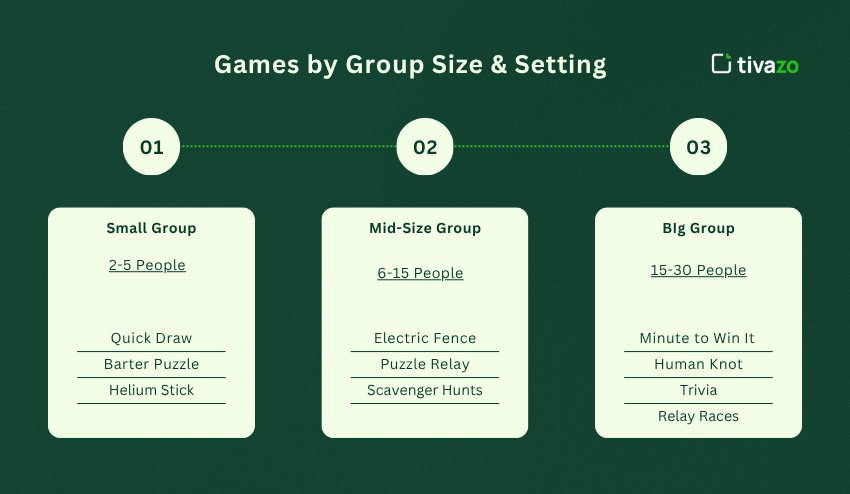
1. Games for Small Groups (2–5 people)
What are some indoor games for 4 people or adults? Consider Quick Draw, Barter Puzzle, or Helium Stick. All of these are low-material and high-fun team-building games which can work very well for small teams, small departments, or break-out sessions during larger meetings. They allow for deeper collaboration and enable each person in the team to be more involved, allowing for a better shared team-building experience.
2. Games for Mid-Size Groups (6–15 people)
These are great for departments or hybrid teams. Mid-size groups, like small groups, can actively participate in more interactive team building games like Electric Fence, Puzzle Relay, or Scavenger Hunts. For outdoor sessions, incorporating activities with larger equipment, such as a 15ft trampoline, can add a fun physical challenge that encourages teamwork and trust. You can also encourage some physical and mental challenge with a puzzle relay. This kind of activity will keep people engaged and will help foster and build communication and problem-solving abilities. Mid-size games have enough people to promote group interaction. They are small enough, with people, to still allow everyone to participate.
3. Games for Big Groups (15–30+ people)
What games can you play with people? When working as a team with larger groups, you will need to be more conscientious of energy levels and organizational aspects. Some fun ideas are:
- Minute to Win It games – use simple items found at home or from your office
- Team-building games, such as Human Knot, allow the team to work together to tangle everyone up, then untangle!
- Team large Trivia or Quiz games, while creating competitive and yet inclusive fun
- Team Relay Races or Team composite Puzzle challenges
These scalable team building games break large teams into smaller sub-groups, create friendly competition, and help keep everyone engaged and energized during the team building games or session. They are also fun for quarterly team events, all hands meetings, and team socials.
Fun Activities and the “Big Five Teamwork Activities”
Fun team-building activities?
Fun team building activities include Helium Stick (Magic Cane), Barter Puzzle, Virtual Scavenger Hunt, Parade of Homes, Quick Draw, Trivia Quiz, Human Knot, and Minute to Win It Games.
Fun team-building game to play with a group?
Teams cite Helium Stick (Magic Cane) as the most fun team building game because it has a simple setup but the most hilarious teamwork!
What are the big five teamwork activities?
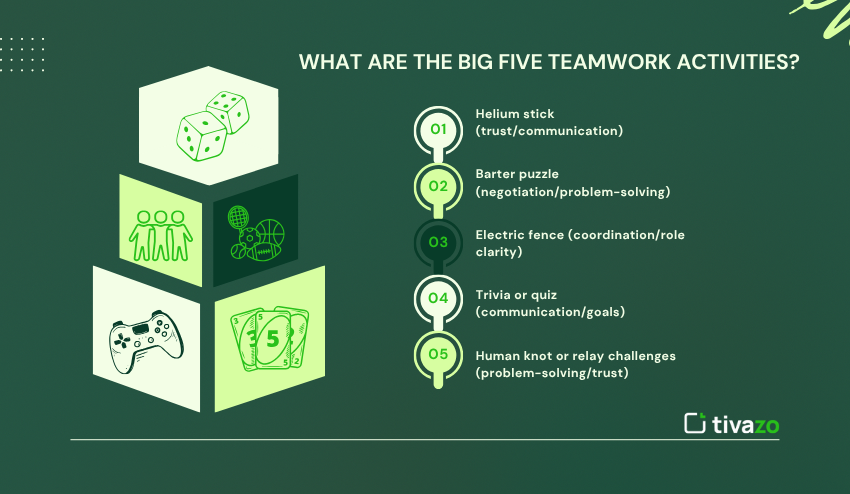
The big five are usually the core competencies in management literature and include trust, communication, role clarity, goal alignment, and problem-solving. The following are the team building games that correspond:
- Helium stick (trust/communication)
- Barter puzzle (negotiation/problem-solving)
- Electric fence (coordination/role clarity)
- Trivia or quiz (communication/goals)
- Human knot or relay challenges (problem-solving/trust)
Matching Game to Intent & Size
| Game | Ideal Size | Delivery | Focus Area | Intent Type |
| Magic Cane (Helium Stick) | 5–15 | In-person | Trust, communication | Informational / Transactional |
| Barter Puzzle | 6–12 (pairs) | In-person Negotiation | Planning Transactional | Transactional |
| Electric Fence | 5–10 | In-person | Coordination, trust | Informational |
| Human Knot | 10–30 | In-person | Problem-solving, trust | Informational |
| Minute to Win It | 10–20+ (teams) | In-person | Competitive, quick fun | Transactional |
| Trivia / Quiz | Any | Both | Communication and fun | Informational |
| Quick Draw / Pictionary | 4–10 | Both | Creativity and speed lock-in | Informational |
| Virtual Scavenger Hunt | Any (virtual) | Remote | Energy and engagement | Transactional |
| Parade of Homes | Any (virtual) | Remote | Connection and storytelling | Informational |
Team Building Activities vs Team Building Games
Although often used interchangeably, team building activities and team building games are not synonymous and have different purposes. Let’s talk about the difference:
What Are Team Building Activities?
Team building activities are structured, broader exercises to develop team collaboration, trust, and communication. They are either formal activities or informal activities, and they do not always involve a competitive aspect.
Examples of Team Building Activities:
- Workshops about conflict resolution or leadership
- A team lunch or retreat
- Brainstorming session for creative problem solving
- Volunteer program
- Job rotation or job shadowing for empathy across roles
What Are Team Building Games?
Team Building Games are often short, fun, competitive activities that can get teams excited and energized while breaking their routine. Team Building Games are a great way to improve morale, engagement, and collaboration all in just a few hours.
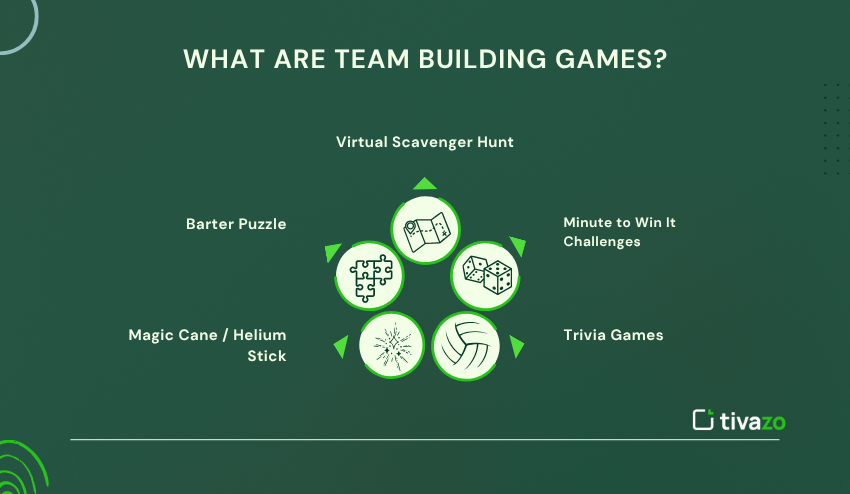
Some Examples of Team Building Games:
- Magic Cane / Helium Stick
- Barter Puzzle
- Virtual Scavenger Hunt
- Minute to Win It Challenges
- Trivia Games
Summary Table
| Category | Function | Duration | Ideal For |
| Team Building Activities | Long-term development & bonding | 30 min – full day | Retreats, training, culture |
| Team Building Games | Quick fun & engagement | 5 – 30 min | Meets, remote teams |
How Productivity Monitoring Tools Like Tivazo Support a Healthier Work Environment
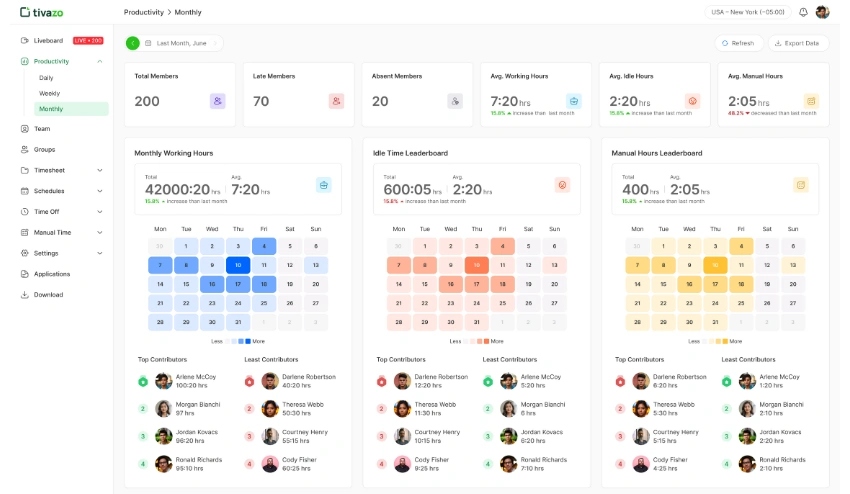
Productivity monitoring tools like Tivazo play a crucial role in creating a healthier work environment by providing managers and employees with actionable insights into work patterns, task completion, and team performance. By tracking productivity metrics without being intrusive, these tools help identify bottlenecks, workload imbalances, and areas where employees may need support. This transparency encourages accountability while promoting a culture of trust, ensuring team members feel guided rather than micromanaged. Leveraging employee productivity software, organizations can make informed decisions that reduce stress, prevent burnout, and improve overall job satisfaction.
Conclusion
Team-building games are so much more than a fun pastime; they are a strategic opportunity to improve collaboration, trust, and communication within a team. Whether you’re leading a small group, a remote team, or a large-scale company activity, games can help reduce barriers and increase proximity among people. No matter the kind of activity you are leading, once the people involved have gone through some team building games, they will be closer, especially when they are working towards the same goal.
Start using these team-building games to energise your team, make connections stronger, and build a thriving workplace culture today!
Whether you are looking for remote team building games, activities for people in the office, or a full team retreat, there are plenty of team building games here to help meet your team’s needs. We have team-building games that include everything from creative ice breakers to structured problem-solving activities to help better communication, trust, engagement, and productivity.
While team building games are fun, team building games are also a strategic avenue to build collaboration and innovative capacity towards developing a more connected, engaged, and high-performing workforce. Be sure to bookmark this guide, experiment with different team-building games based on size, and use it to help your team flourish through play.
Let’s play!