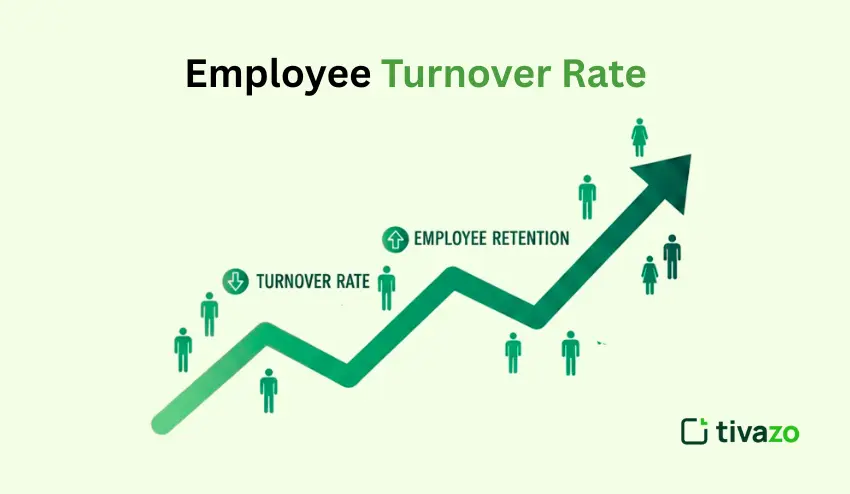
It is frustrating to watch employees go one after another from your company. High turnover affects a business in many aspects: daily operations to long-term success.
It means very little to most business leaders as to what the actual problem is for their organization.
This guide helps you recognize the big picture of employee turnover and its consequences.
What Is a High Turnover Rate?
A high rate of turnover reveals that a large number of your employees have left within a specified time period. A high turnover rate exhibits critical trends about your business. A high rate of turnover beyond normal standards is a danger sign that requires attention.
How to calculate your turnover rate.
The calculation process is simple and vital in tracking workforce stability. Simply, divide the number of employees who departed by your average number of employees. You then multiply by 100 to obtain a percentage.
For instance, if 10 workers have left and you have 100 workers, the turnover rate will be 10%.
This can be calculated monthly, quarterly, or annually, depending upon requirement. Generally, companies prefer to do annual calculations to maintain benchmarks.
What Percentage Is Considered High?
Average turnover for most industries is between 10% and 20%. If turnover rises beyond 20%, there is likely something that needs attention. At the same time, context is of significant importance here.
In the retail/hospitality industries, rates are often above 60%, especially due to seasonal employment. In tech industries, 13% average is common. In manufacturing industries, 20-25% annually can be expected.
You should compare your numbers with similar companies within your particular industry. National averages may not always apply to your particular situation.
Voluntary vs. Involuntary Turnover
Voluntary turnover refers to the turnover or departures of workers who have left for other opportunities.
Involuntary turnover, on the other hand, involves terminating or laying off workers. The two concepts are different because they have underlying factors for each one.
Voluntaries represent issues with workplace satisfaction. Involuntaries generally portray organizational decisions or business performance issues.
Is High Turnover Always a Sign of Bad Management?
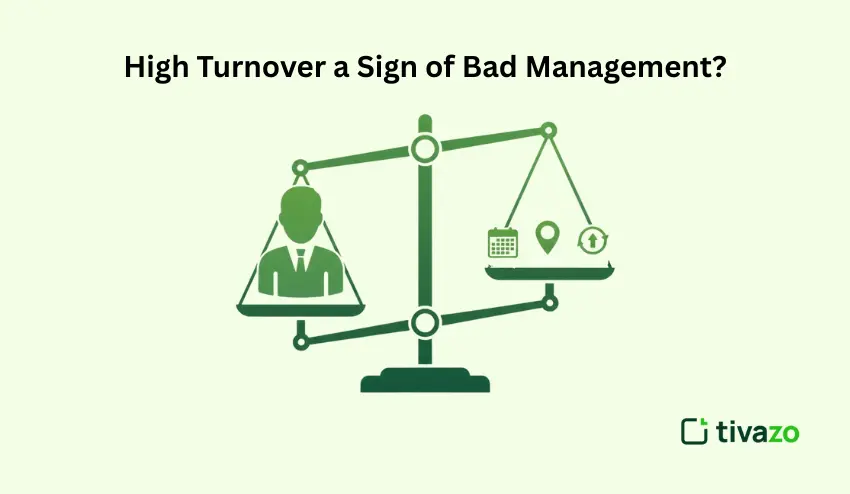
The relationship between management and turnover is complicated. While poor management is known to lead to employee turnover, others also contribute to it. This helps you better identify the problem.
Seasonal operations automatically command higher turnover rates. Internship programs also, by necessity, have a turnover rate of 100%. Some jobs are stepping stones, and higher turnover is expected.
However, if experienced people in reliable positions continue to exit, then leadership quality starts to come into question. Many employees complaining of the same issues indicate a problem related to leadership.
Moreover, geographic factors can affect turnover beyond management’s control. In areas where there is a high number of competing companies, more turnover occurs from switching between companies. Economic booms mean more job opportunities, which increases turnover naturally.
The key is to determine whether your rate is above that of industry standards. A comparison with similar organizations would be beneficial in many ways.
The Hidden Consequences of High Employee Turnover
Besides direct replacement costs, there are also rippling effects in the organization, which are usually unmeasured, as a result of having a high turnover.
Operational Disruptions
In effect, the loss of such senior employees results in an immediate step backward in terms of day-to-day operational efficiency as other workers struggle to fill in the gap that the departed employees had been covering.
Quality of customer service declines when institutional knowledge is lost. New employees are not skilled enough to deal with complex issues appropriately. Clients may lose patience with this and go elsewhere.
Team Morale and Productivity
Constant departure creates a state of anxiety among the remaining employees. This is because they are equally wondering whether they need to be looking for other jobs. This causes a decline in the level of focus, which in turn adversely affects the quality of work done.
Those who remain after the waves of turnover are forced to work harder due to unfilled positions. Resentments develop as they try to fill in the gaps left by those who have left. A rise in burnout levels may also occur, causing further resignations.
Recruitment and Training Strain
Human resource departments are constantly under pressure to fill existing vacancies. Constantly engaging in recruiting activities draws attention away from other equally important activities being performed by the departments. The quality of a product is affected if recruitment is undertaken in haste.
For instance, training new employees is a distraction from productive activities. In such a case, trained resources are diverted to help the new employees.
Financial Burden
Replacing an employee can cost between 50% and 200% of that employee’s annual income. Advertising costs, interviews, and background checks are all factored into that amount. Productivity losses on a learning curve add additional costs.
For example, in a company that employs people in a particular role that costs around $50,000 to fill, there can be a need to pay as much as $100,000 in turnover-related expenses alone. However, as the company experiences numerous departures, the costs add up.
Reputation Damage
The word gets around quickly for companies with revolving doors. Candidates research employee retention before applying for a position. High turnover rates deter top talent from even considering your company.
Current employees leave reviews about their experiences on these review sites. Patterns of negative experiences become widely known and affect the overall brand of your employer. Years of steady improvement can assist in repairing a damaged reputation.
Knowledge Loss
When leaving, employees take with them their valuable expertise. Long years of acquired wisdom regarding processes and clients are gone, and such knowledge is never documented elsewhere.
New members of the workforce would take months or even years to achieve a similar level of knowledge and understanding. Some knowledge will never be regained at all!
Warning Signs Your Organization Has a Turnover Problem
Early detection helps in prompt action to alleviate the problem before its effects worsen. Certain symptoms that could result in an increase in turnover might include:
- Resignation Clusters: This refers to a state whereby large numbers of people resign or leave at the same time, which shows something is amiss
- Less Participation in Company Activities: Employees may not want to invest in company relationships.
- More Sick Days and Absenteeism: Some people choose a job based on avoiding a place they do not like by taking too many sick days.
- Declining Performance Metrics: As a result of decreasing productivity levels within an organization, workforce instability often occurs.
- Difficulties in Attracting Qualified Workers: Difficulties in recruiting qualified workers are also related to reputation problems.
- High Internal Transfers: Requests for internal transfers point to some difficulties in particular areas.
- Negative Feedback in Surveys: Decreasing Satisfaction Scores and Repetitive Feedback Predicting an Element of Turnover
Measuring the True Cost of Turnover
Calculating actual turnover expenses shows the extent of the problem. Most organizations greatly underestimate these costs until they go into the details.
Direct Replacement Costs
Advertising open positions requires budget allocation for job boards. Recruiter fees for specialized roles can reach 15-25% of annual salary. Interview processes consume manager time that could be used elsewhere.
Background checks, drug testing, and the verification of references all bear costs. Administrative resources are required to fill out paperwork for new hires and to set up those new employees within each company’s system. Equipment must be ordered and workstations prepared, further increasing expenses.
Lost Productivity Calculations
Leaving employees are usually less productive during their notice period. The role is vacant for an average period of 42 days. New employees work at a lower capacity for 3-6 months.
Conservative estimates say 50% productivity loss during transitions. In highly specialized roles, this can be as high as 75% or more. Multiply these gaps across multiple positions for total impact.
Waste of Investment in Training
Every dollar invested in training for separated employees is money lost. Onboarding programs, certifications, and skill-building all vanish. New hires need the same investments from scratch.
This becomes a vicious cycle of wasted resources that could fund other business priorities. Companies experiencing high turnover, in essence, pay for the same training over and over again.
Customer Impact Assessment
Changing account managers regularly reduces client relationships. Trust can’t be built up overnight and will soon fade away. Some customers change to competitors rather than start over.
Customer frustration is also caused by inconsistency in service quality. It harms retention. Revenue loss associated with customer departures further adds to turnover costs. These impacts usually remain unmeasured but have a major influence on profitability.
Industry Benchmark Comparisons
Varying industries have widely dissimilar normal turnover rates. In this regard, understanding your environment helps to manage
| Industry | Average Turnover Rate | Key Factors |
| Hospitality & Food Service | 70-80% | Seasonal patterns, part-time workers, entry-level positions |
| Retail | 60-70% | Variable scheduling, weekend/holiday work, peak season competition |
| Healthcare | 15-20% | Long hours, emotional stress, burnout, specialized skills |
| Technology | 13-15% | High skill demand, competitive poaching, and remote work options |
| Manufacturing | 20-25% | Physical demands, shift work, and repetitive work, and concerns about automation |
| Professional Services | 10-15% | Career Advancement Opportunities, Client Relationships, and Competitive Compensation |
Compare your turnover rate with your industry benchmark. The national averages may not be representative of normal turnover for your specific industry. It may be more important to keep your turnover rate under or at your industry’s normal, rather than trying for universal ideal figures.
Tracking Beyond Basic Turnover Metrics
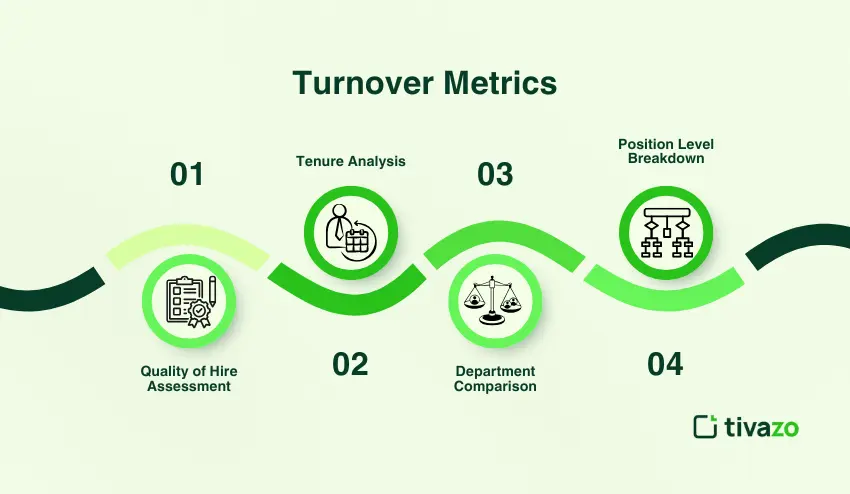
The standard measurements for turnover do not capture important subtleties of employee stability within the company. Other measurements offer additional insights into the company’s condition.
Quality of Hire Assessment
Track performance ratings of employees who stay and those who do not. An outflow of high-performance employees translates into significant issues for retention, while losing low-performance employees is actually beneficial.
This differentiation helps in better focusing of retention strategies. Invest in retaining valuable contributors, not all!
Tenure Analysis
Examine the average length of stay of employees before they leave. Employees with very short lengths of stay are either recruited incorrectly or there are problems with training. Employees who stay on longer before they actually leave have other issues.
Turnover of new hires within less than 90 days could indicate problems with hiring or employee orientation, while high turnover in 2-3 years may indicate the absence of future progression.
Department Comparison
Calculate the rate of turnover for each department and team separately: where the points of high turnover are isolated, it shows specific problem areas; while for units that continuously show a particular trend, it shows an organization-wide issue.
This granular view helps in targeting the interventions more precisely. Blanket solutions waste resources when the problems are localized.
Position Level Breakdown
Turnover is something that has to be analyzed with respect to job levels and compensation bands. High turnover at senior positions is indicative of issues different from those at the entry level. Leadership-level separations demand special attention and must be investigated.
This analysis is bound to reveal if problems are system-specific or role-specific.
Conclusion
Highly elevated turnover is an indication of a number of underlying issues within organizations that need urgent attention. Financial costs involve immediate replacement costs, productivity costs, morale costs, and reputational costs.
First, calculate your current employee turnover rate. This data should be compared with benchmark data, where applicable, for relevancy. Analysis of turnover will reveal some patterns based on which employees left or departed.
Therefore, understanding the actual cost is a driving force behind the required investment in a retention solution. Workforce stability is the key to business success and your bottom line.
Take action today: Look at the turnover statistics within your organization. Determine actual costs to better understand the scope of the issue. Next, invest in building an environment where people will want to work!