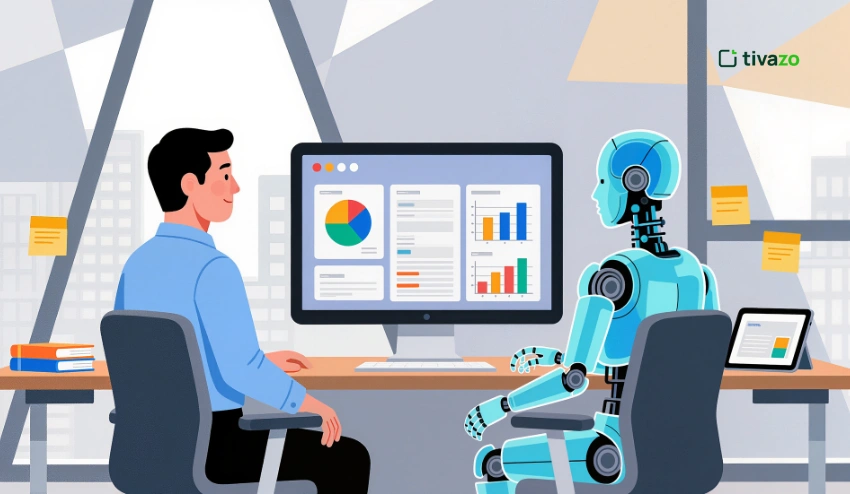
Artificial Intelligence (AI) is no longer a futuristic concept; it’s a workplace game-changer. Across industries, organizations are asking the same question: How does AI increase productivity? Companies are not merely turning to AI to be innovative; they are leveraging it to automate workflows, empower workers, and unlock efficiency that was previously deemed unimaginable.
We will explore all these practical uses, data-supported effects, and other details that most articles usually lack to provide you with a comprehensive picture of the productivity revolution that AI has brought about.
What “Productivity” Really Means in the AI Era
Before answering how AI increases productivity, we need a clear definition:
Business productivity is the efficiency with which the work is carried out; it is the achievement of maximum output with minimum wasted time and effort.
Productivity today is not just a speed thing; it is smart work. The use of AI facilitates this smarter work by automating manual efforts, enhancing decision-making by humans, and delivering insights that used to be hidden behind data.
This change is also referred to as augmented productivity, where human beings and machines work together as opposed to working against each other.
👉Related: AI Productivity Tools: Revolutionizing Work in 2025
Ways On How AI Increases Productivity in the Workplace
1. Automating Repetitive Tasks: The Foundation of AI Productivity
Automation is one of the most evident methods in which AI can be used to enhance productivity. Actions such as responding to frequently asked questions, booking appointments, and sorting mail are time-consuming and monotonous. Industry studies indicate that employees waste up to 40% of their time in the administrative field, which ought to be used in creativity and strategic orientation.
AI tools such as chatbots and robotic process automation (RPA) bots handle these tasks autonomously. When AI frees employees from repetitive work:
- Project completion speeds increase
- Errors decrease
- Staff focus shifts to strategic responsibilities
Example:
AI chatbots handle up to 80% of routine customer questions without human intervention, drastically reducing bottlenecks and delays.
This isn’t just convenient; it’s transformational.
2. Enhancing Human Decision-Making with Predictive Analytics
AI does not simply perform tasks: it is able to analyze massive amounts of data to provide insights that humans can overlook. This is a significant point of AI productivity.
When AI analyzes past behavior and performance trends, it can:
- Forecast demand
- Identify inefficiencies
- Suggest optimal resource allocation
Some analytics vendors claim that companies with AI-based forecasting have 2030% shorter decision cycles. That translates to faster reaction to market changes, less downtime, and increased cohesion among teams.
Real-world Example
Rather than employees going through spreadsheets or dashboards manually, they are presented with AI-generated insights upon which they take smarter actions. This increases productivity at the individual and organizational levels.
3. Personalizing Employee Experience and Workflow
Artificial intelligence does not necessarily mean machines will substitute work, but it means optimization of the working process of the worker.
AI-based tools can be used to sort emails, propose changes to the calendar, and even guess what activities should be addressed first depending on their urgency and context.
Workers are not left with time to determine the next thing, but instead, they are given priority tasks, usually at the right time, which increases their productivity and concentration.
AI is able to monitor the weaknesses and strengths of an employee and suggest individual training materials. This is particularly useful in industries with a rapid tempo, such as technology and design.
Studies on workplace productivity show that individualized development boosts employee engagement by up to 30% percent, and engaged employees are much more productive.
👉You May Also Like: AI Tools for Productivity: 7 Powerful Ways to Boost Teams
4. Improving Collaboration Across Teams
Modern workplaces rely on collaboration, but scattered communication and disconnected work tools often impede progress.
AI enhances collaboration by:
- Analyzing communication patterns to recommend better team structures
- Automating meeting summaries and task lists
- Streamlining document version control
AI transcription and summarization tools capture key points and action items, so no one wastes time taking notes. This not only saves time but also ensures accountability across teams.
Instead of sifting through hours of recorded meetings, employees review concise, AI-generated summaries.

5. Boosting Output Through Smart Resource Allocation
AI helps organizations allocate resources effectively, whether people, time, or tools.
AI Knows Where to Invest Effort
By analyzing performance data, AI can:
- Recommend staffing levels
- Predict peak workloads
- Suggest when additional support is needed
This reduces waste and ensures teams are neither understaffed nor overwhelmed.
Example:
In customer support centers, AI can recommend staffing changes based on predicted call volumes, smoothing workflows, and preventing burnout.
6. Reducing Human Error and Variability
Human error is a silent productivity killer. Small mistakes compound over time, leading to rework, delays, and frustration.
AI excels at:
- Consistent task execution
- Zero-fatigue performance
- Always following standard operating procedures
In environments where precision matters (data entry, financial reporting, quality control), AI reduces errors dramatically.
According to research, process automation with AI can cut error rates by up to 85%, saving both time and money.
👉You May Also Like: AI Workflow Automation for Productivity: 5 Powerful Benefits
7. Empowering Creativity and Innovation
Although a lot of individuals are afraid that AI will take the place of humans, the truth is that AI will allow human beings to do creative work.
Employees should use robots to automate the routine parts of their work, which will allow them to spend more brainpower on other areas that cannot be automated by machines, such as empathy, storytelling, and design thinking.
This is a subtle but critical part of how AI increases productivity:
Productivity isn’t just about doing more; it’s about doing better.
AI provides:
- rapid data analysis
- scalable processing
- consistent operations
- leverage for human ingenuity
Measuring Productivity Gains from AI
To understand how AI increases productivity, you have to measure it.
Key Metrics Include:
- Time saved on routine tasks
- Error reduction percentage
- Output per employee
- Customer satisfaction scores
- Response time improvements
AI tools often include dashboards that help teams track these metrics in real time.
This allows leaders to see not only if productivity increases, but also how and where it happens.
What the Future Holds
AI is evolving rapidly. Emerging trends that will further boost workplace productivity include:
- Generative AI for content and code generation
- AI-driven virtual assistants embedded in workflows
- Real-time translation and collaboration across languages
- Autonomous data analysis without human preprocessing
These developments will make productivity gains even more pronounced, especially for global teams and hybrid workforces.
AI Productivity Statistics
AI is already delivering measurable productivity gains across industries. According to PwC’s 2025 Global AI Jobs Barometer, sectors with high AI adoption experienced productivity growth of 27% between 2018 and 2024, compared to just 7% in less AI-exposed industries, showing a nearly fourfold increase. Similarly, according to McKinsey, generative AI alone could add $2.6–$4.4 trillion annually to global productivity by automating routine work and enhancing knowledge tasks. At the employee level, studies cited by Microsoft and GitHub show that workers using AI tools complete tasks up to 40–55% faster while reducing cognitive load and errors. These statistics clearly demonstrate that AI is not a future promise but a present-day driver of workplace efficiency and output.

Conclusion
AI is changing the workplace by automating repetitive duties, decision-making, collaboration, and human innovativeness. AI does not merely accelerate work when implemented intelligently in line with workflow and culture, but also assists teams to work smarter.
It is no longer a choice for businesses that would like to stay competitive to understand how AI can contribute to their productivity. Will you be prepared to achieve the maximum productivity of AI in your organization?