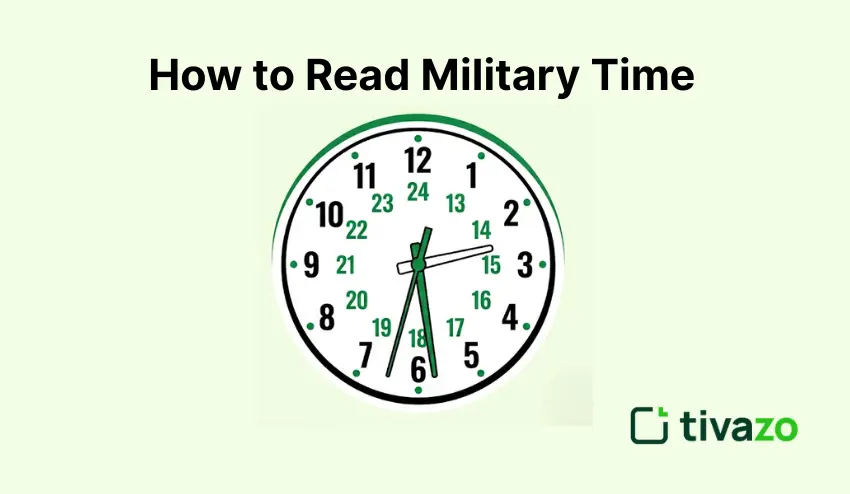
You’re looking at a flight schedule, and it says the departure time is 1830. Or a hospital form lists a procedure at 0600. Your brain pauses; is that morning or evening?
That moment of hesitation is exactly what this guide is here to fix.
Learning how to read military time and converting it are two different skills. Most guides jump straight into the math. This one doesn’t. Instead, it teaches you to look at any military time number and instantly know what part of the day it is, no formula needed.
Military time shows up everywhere: hospitals, flight schedules, the armed forces, and global scheduling tools. Once it clicks, it clicks for good.
What Is Military Time in Simple Terms?
Military time is a 24-hour clock system that runs from 0000 (midnight) to 2359 (one minute before the next midnight). That’s it. No AM. No PM. No repeated hours.
Every hour of the day gets its own unique number. 6 in the morning is 0600. 6 in the evening is 1800. There’s no overlap, no label needed, and no guessing.
A few quick examples to get a feel for it:
- 0600 → early morning, just after sunrise
- 1200 → noon, middle of the day
- 1800 → early evening
- 2300 → late at night, close to midnight
You don’t need to do any math to understand these; just recognize where in the day each number lands. That’s what reading military time is really about.
How Military Time Is Written
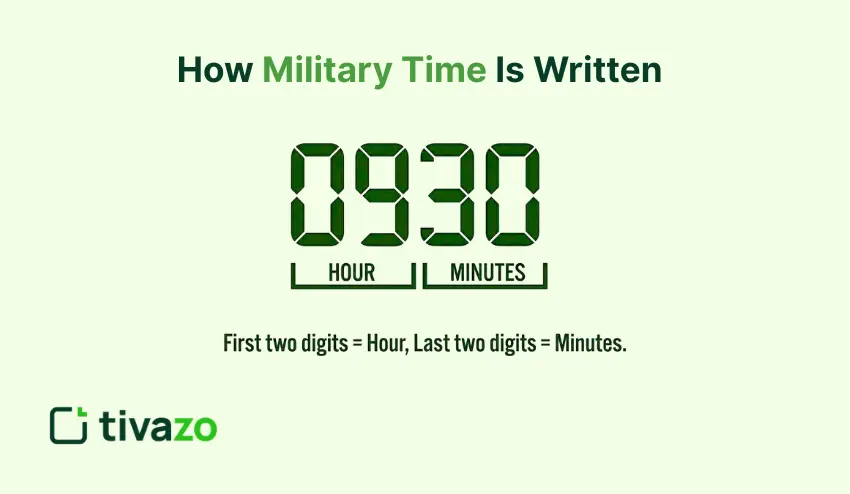
Before you can read military time, you need to recognize how it looks on paper or a screen. This is the foundation.
Military time always appears as a 4-digit number.
- The first two digits represent the hour
- The last two digits represent the minutes
So 0930 means hour 09, minutes 30. That’s 9:30 in the morning. And 2045 means hour 20, minutes 45, which is late evening.
A few formatting things to know:
| Format Detail | Example |
| Always 4 digits | 0700, not 700 |
| Leading zero for early hours | 0800, 0930, 0415 |
| Colon is optional | 1430 and 14:30 are both correct |
| Minutes read the same as always | 30 = thirty, 45 = forty-five |
The leading zero is important. 0700 looks different from 700, and in formal or professional use, that zero matters. Once you train your eye to see the first two digits as the hour and the last two as the minutes, any military time number becomes immediately readable.
How to Read Military Time (Step-by-Step)
Reading military time isn’t about doing subtraction in your head. It’s about recognizing a pattern. Follow these three steps:
Step 1: Look at the first two digits, that’s your hour
- 00 to 11 → morning hours
- 12 → noon
- 13 to 23 → afternoon and evening
Step 2: Read the last two digits as minutes exactly as you normally would
- 00 → on the hour
- 30 → thirty minutes past
- 45 → forty-five minutes past
Step 3: Say it out loud using the military spoken format
Military time has its own way of being spoken, and saying it out loud helps it stick:
| Written | Spoken |
| 0700 | “Seven hundred hours” |
| 1200 | “Twelve hundred hours” |
| 1430 | “Fourteen thirty” |
| 2100 | “Twenty-one hundred hours” |
| 0845 | “Zero eight forty-five” |
Notice that when there are no minutes (ending in 00), you say “hundred hours.” When there are minutes, you just read them after the hour number. Simple, consistent, and once you hear it a few times, it sounds completely natural.
Easy Way to Tell Morning From Evening
Here’s a beginner shortcut that skips all the math and works every single time:
- Hour number is less than 12 → it’s morning
- Hour number is exactly 12 → it’s noon
- Hour number is greater than 12 → it’s afternoon or evening
That’s the whole trick. You don’t need to subtract anything. You just look at whether the first two digits are above or below 12.
Some examples to lock it in:
| Military Time | First Two Digits | Time of Day |
| 0900 | 09 less than 12 | Morning |
| 1200 | 12 exactly 12 | Noon |
| 1700 | 17 greater than 12 | Evening |
| 2230 | 22 greater than 12 | Night |
With just a glance at the first two digits, you immediately know where in the day you are. No formula required.
Common Military Time Examples
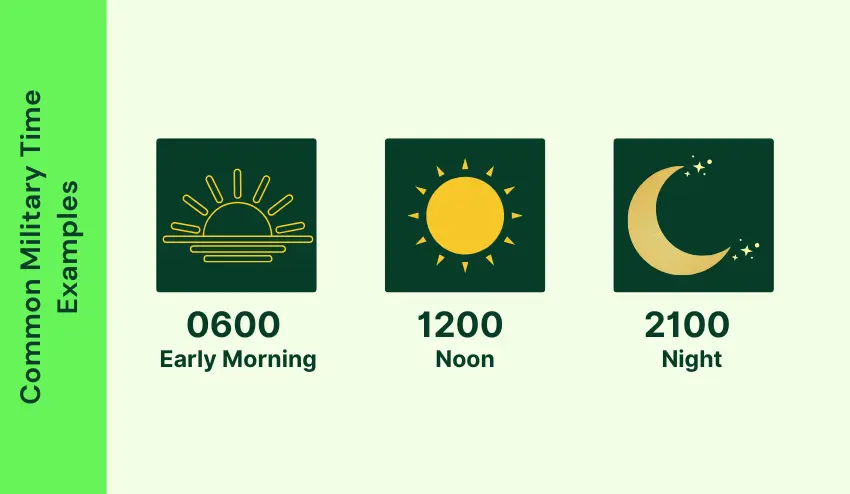
Use this table to practice reading at a glance. The goal isn’t conversion, it’s instant recognition:
| Military Time | How to Read It | Time of Day |
| 0100 | One hundred hours | Very early morning |
| 0600 | Six hundred hours | Early morning |
| 0930 | Zero nine thirty | Mid-morning |
| 1200 | Twelve hundred hours | Noon |
| 1500 | Fifteen hundred hours | Afternoon |
| 1745 | Seventeen forty-five | Late afternoon |
| 2100 | Twenty-one hundred hours | Night |
| 2359 | Twenty-three fifty-nine | Just before midnight |
Read through this table a few times, and you’ll start to recognize times by feel rather than by calculation. That’s the goal: pattern recognition, not arithmetic.
Common Mistakes Beginners Make
A few reading errors come up again and again when people are first getting started:
- Reading 1300 as “1:00”: The instinct is to drop the 13 down to 1, but in military time, you read it as “thirteen hundred,” not “one o’clock.” The number itself is the hour.
- Ignoring leading zeros: 0800 is not the same as 800. That leading zero is part of the format, especially in written and professional use.
- Thinking 2400 exists: It doesn’t. The day ends at 2359—midnight restarts at 0000, not 2400.
- Mixing spoken and written formats: Saying “fourteen hundred” but writing “2:00 PM” in the same document creates unnecessary confusion. Pick one format and stay consistent.
The key mindset shift: think in patterns, not conversions. The more you try to translate military time into 12-hour time in your head, the harder it gets. The faster you can read 1800 and just think “evening,” the more natural it becomes.
When You’ll Actually Use Military Time
You are probably wondering, is this really something that is relevant outside of the military context? Well, the answer is more often than you think:
- Flight schedules: International flight departure and arrival times are always given in military time format
- Hospitals and medical settings: All patient and medication schedules are given in military time format
- International apps and devices: Many apps and devices outside of the US use a 24-hour format
- Work settings: International business and government documentation may use a 24-hour format
Being able to read this type of time quickly will give you more confidence in all of these situations.
Quick Tips to Master Reading Military Time
A few small daily habits that speed up the learning process:
- Practice with anchor times first: 0600, 1200, and 1800 are the easiest to remember. Build from those.
- Set your phone to 24-hour format for a week: Passive exposure is one of the fastest ways to make it feel natural.
- Read it out loud: Saying “fifteen thirty” instead of just thinking “3:30” reinforces the pattern.
- Use key reference points: 12 is noon, 18 is early evening, 21 is night. Work outward from anchors you know.
Conclusion
Military time feels unfamiliar at first, but that feeling doesn’t last long. Once you understand that the first two digits are the hour and anything above 12 is afternoon or evening, the whole system starts to make sense on its own.
The real skill is not mathematics; it’s pattern recognition. The more you see it, say it, and practice it with real-world examples, the quicker it becomes second nature.
Once you get the hang of reading military time, you can take it to the next step and convert it to standard time instantly with a military time converter, especially for those times when you need to convert it in a flash and get it right.