Hackers are not the only ones who might pose cybersecurity risks. In most instances, the risk is within the organization.
Sensitive data can be accidentally or intentionally exposed by employees, contractors or partners. These risks are more difficult to locate than ever with remote work, cloud tools, and shared access becoming prevalent.
This is the reason why the tools of insider threat detection are necessary. They assist organizations in keeping track of what goes on internally, identifying suspicious activity early, and avoiding expensive security breaches prior to harm.
What Are Insider Threat Detection Tools?
Insider threat detectors are security applications that detect risky or suspicious activities of users who have already gained access to systems of an organization.
These tools track the interaction of employees and internal users with data, applications, and networks. They do not just follow rules and look for something that does not fit within the normal pattern.
To illustrate, when a user all at once downloads vast amounts of sensitive information or accesses files at odd times, the system notifies it to be reviewed.
Insider threat detection tools assist organizations in minimizing internal security threats without interfering with daily operations by applying user behavior analytics, anomaly detection, and constant activity monitoring.
Why Insider Threat Detection Tools Matter
Insider threats are special threats that are not easily detected by conventional security tools. With the help of a systematic method, we may understand the necessity of the following tools:
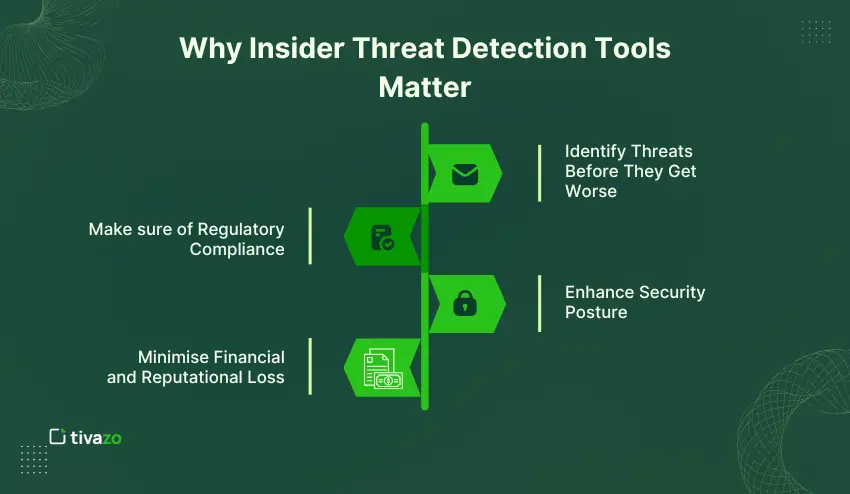
1. Identify Threats Before They Get Worse
Sensitive data are already available to internal users. Errors or malpractice can easily turn out to be expensive. Insider threat detection software detects suspicious actions at the initial stage of their occurrence to avoid data breaches and operational disruptions.
2. Make sure of Regulatory Compliance
Such industries as healthcare, finance, and retail have to follow such standards as GDPR, HIPAA, and PCI-DSS. Surveillance within an organization assists organizations in showing due diligence and prevents legal or financial fines.
3. Enhance Security Posture
These tools identify abnormal behavior by analyzing user behavior, including abnormal file access or excessive downloads. It allows uniform implementation of the policies and minimizes the threat of insiders going undetected.
4. Minimise Financial and Reputational Loss
Detecting internal threats before it even happens can prevent costly incidents, including data theft, system downtime, and damage to the company and it’s reputation.
How Insider Threat Detection Tools Work
Insider threat detection systems work by tracking user activities, evaluating deviations and notifying security personnel of the possible risks. Their procedure can be divided into definite steps:
1. Identify Users and Assets
The initial one is mapping all internal users, devices, and sensitive data. It is good to know who is allowed to access and what they can do so that nothing is left unnoticed.
2. Set Standards of Normative Behavior.
The tools track common user activity, which includes:
- File access patterns
- Login times and locations
- Data download volumes
- Application usage
This generates a reference to identify abnormal activity in the future.
3. Detect Anomalies
After baselines have been established, the system notifies of deviations which could signify risks, including:
- Use of files during non-working hours.
- Large data transfers
- Illegal connections to devices.
- Attempts of privilege escalation.
4. Generate Alerts and Reports
Red flagging causes security teams to raise an alarm. Detailed reports will give a context, severity, and recommended responses, which will enable teams to respond swiftly.
5. Respond and Mitigate
Alerts enable IT or security teams to research and implement corrective actions, which include:
- Temporarily withdrawing access.
- Being more vigilant of the user.
- Revision of policies to avoid repetition.
Insider threat detection tools can decrease risk, enhance compliance, and safeguard sensitive information by using behavioral analytics, machine learning, and real-time monitoring to detect insider threats.
Insider Threats That These Tools Identify
Insider threat detection systems are created to detect different risks within the company. Knowledge of these types assists organizations in implementing the appropriate monitoring strategies:
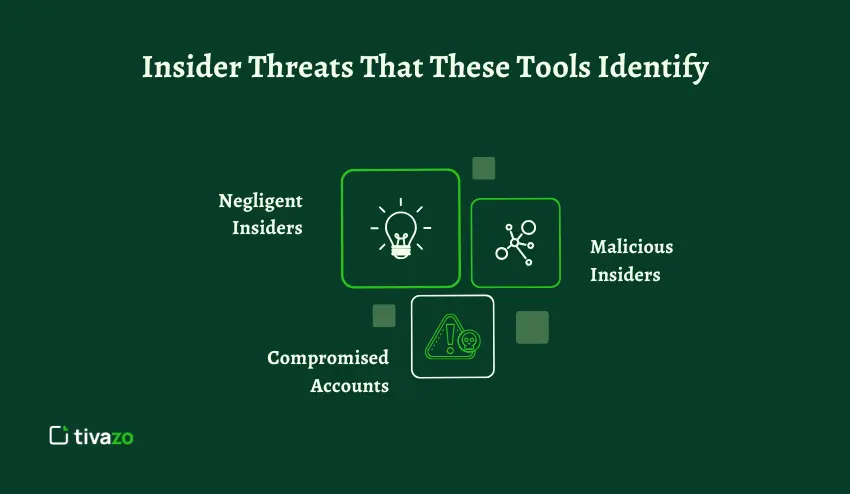
Negligent Insiders
These are those employees who do not mean to create security risks which are usually as a result of:
- Clicking on phishing links
- Misconfiguring systems
- Transfer of passwords or sensitive files accidentally.
Although their activities are not evil, they are capable of causing severe violations.
Malicious Insiders
These people willfully use access to gain personal or financial advantages. Examples include:
- Stealing confidential data
- Vending proprietary information.
- Destroying systems or processes.
Compromised Accounts
In other cases, there are insider threats that occur when an account is taken over by a third party. These can include:
- Phished credentials
- Weak password breaches
- Bills of exchange abused.
Detecting tools seek out abnormal patterns that are not in accordance with the behavior of the legitimate user.
These three categories make the insider threat detection tools address the entire range of internal threats, including human error and intentional sabotage.
Key Features To Look For In Insider Threat Detection Tools
In choosing an insider threat detection tool, some of its features guarantee its effectiveness in detecting threats and securing sensitive data:
1. User Behavior Analytics (UBA/UEBA)
The tools must monitor the activities of the users, identify the abnormal behaviors, and indicate suspicious activity in real-time.
2. Anomaly Detection
Artificial intelligence analysis can identify suspicious behaviors, like a high number of downloads, off-hours use, or an atypical place of origin.
3. Real-Time Alerts
Real-time alerts enable security teams to investigate and respond to threats in a timely manner to minimize possible damage.
4. Comprehensive Reporting
Detailed reports assist in prioritization of risks, compliance and decision-making.
5. Connection with Existing Systems.
The tool must be integrated with SIEM, endpoint monitoring, cloud platforms, among other security tools to provide a seamless protection.
6. Insider Risk Management Capabilities.
To ensure compliance within the organization, look at features that assist in policy implementation, risk scoring, and audit trails.
7. Automated Response Options
High-risk activities can be restricted automatically or escalated in warnings with some tools, which will lessen the amount of manual intervention.
With these features in mind, organizations can prevent insider threats proactively without compromising productivity and compliance.
Common Mistakes Organizations Make
Despite insider threat detection devices, businesses may err and make their systems less effective. To prevent the following pitfalls, it is better to be more secure:
1. Monitoring Too Late
It is pointless to wait until a breach has taken place. It is necessary to monitor continuously.
2. Ignoring Negligent Users
Concentrating on the malicious insiders only leaves out the accidental threats that are usually the most frequent.
3. Ignoring Alerts
Alerts can only be useful when they are checked and followed up in time. When they are ignored, they may be violated.
4. Inadequate Interoperability with Existing Systems
The tools not related to SIEM, endpoint monitoring or cloud platforms leave blind spots.
5. Not Updating Policies
The use of static policies cannot take into consideration the changing risks. Monitoring remains effective by updating rules and access controls on a regular basis.
The awareness of these errors will enable organizations to get the most out of their insider threat detection devices and stay in an active security stance.
New Insider Threat Detection Trends.
The topography of the insider threats is in a constant flux. Along with the use of remote work, cloud services, and AI-powered tools, insider threat detection solutions are gaining momentum as well.
1. AI and Machine Learning
The current technology uses AI to identify small anomalies that would otherwise go unnoticed by humans. Machine learning algorithms are able to detect trends in the long-term, and detect suspicious activity early.
2. Cloud-Based Monitoring
As more workers move to work remotely, insider threat tools based on a cloud offer real-time visibility within a variety of locations and devices and no access is monitored.
3. Behavioral Baselines
Tools have stopped using fixed rules, and instead generate customized baselines of normal activity per user. This enables greater ability to detect abnormal behavior.
4. Interaction with Wider Security Platforms.
SIEM, IAM, endpoint monitoring and DLP systems are becoming part of insider threat tools to offer a comprehensive security picture.
5. Emphasize on Employee Privacy and Compliance.
The new solutions are more consistent in balancing security and the privacy of personnel, making monitoring ethical and acceptable under the regulations such as GDPR and HIPAA.
Adhering to these trends, organizations will be able to keep pace with insider threats and minimize risk, as well as safeguard sensitive data in an ever-changing digital environment.
Conclusion
The internal threats are as harmful as the external attacks. Sensitive data may be leaked by employees, contractors, or hacked accounts that are not monitored.
Insider threat detection software gives companies insight into user activity, anomaly detection, and real-time alerts. They assist in avoiding data breaches, regulatory compliance, and overall security posture.
Organizations can get ahead of possible risks by learning the nature of insider threats, capitalizing on the essential characteristics, and mitigating the typical errors.
These tools are no longer a luxury in the digital workplace today, as they are a key component of a sound cybersecurity policy.