
Imagine sticking to the same desk job for years, doing the exact same tasks day in and day out. Such a habit can exhaust you and put your progress on hold. Job rotation gives you a shuffle, as it moves you into other roles intentionally, to allow you to acquire new skills and view the big picture.
Job rotation refers to the temporary movement of employees to a different position within the company. It tries to broaden your mind and develop a better collection of skills. It is not merely an HR gimmick, but a clever means of keeping employees excited, developing future leaders, and making the entire company resistant to market changes.
This guide describes job rotation, its key types, advantages and drawbacks, real-life examples, good practices, and a step-by-step approach to implementing a job rotation program, including how to develop an effective, clear job rotation policy.
What is the Job Rotation?
Job rotation is a structured employee development practice where employees are systematically moved between different roles, tasks, or departments within an organization over a defined period of time. The goal of job rotation is to broaden skills, enhance job knowledge, and create a more adaptable, multi-skilled workforce.
Job rotation aids cross-training, enhances on-the-job training, and increases the flexibility of the workforce by exposing employees to a wide range of responsibilities. It is also essential in career development programs, succession planning, and talent management, where employees get to learn their strengths and are equipped with future jobs.
Job rotation, in simple terms, is advantageous because it encourages lifelong learning, eliminates boredom, and makes work more interesting and essential in assisting organizations to have resilient and future-oriented teams.
👉You May Also Like: Underutilized Employee? 9 Powerful Fixes That Work
4 Types Of Job Rotation
There are various kinds of job rotation applied in organizations depending on the objectives, organizational structure, and employee development requirements. The four most popular types are listed below:
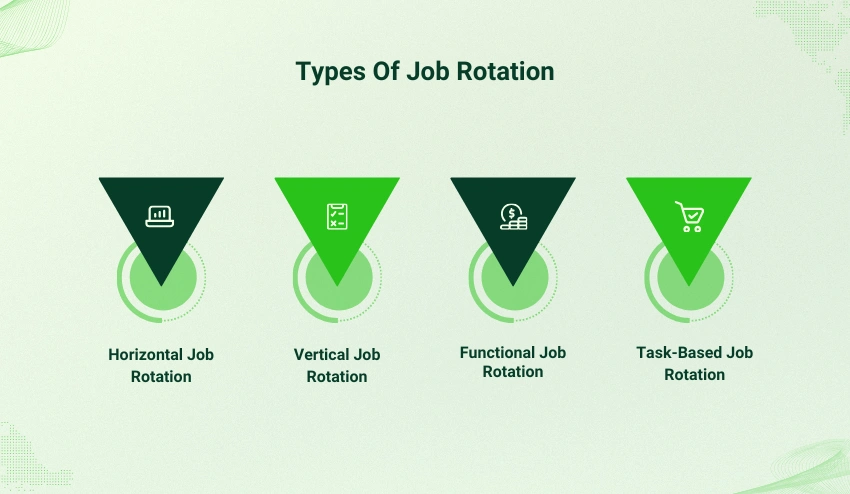
1. Horizontal Job Rotation
There is inter-departmental horizontal movement of employees. This form of job rotation enhances skills development, promotes cross-training of employees, and makes the workforce more flexible, but does not alter the job rank.
2. Vertical Job Rotation
There is an interim rotation of employees into higher-level positions. This assists in the development of leadership and succession, and equips the staff to be promoted in the future.
3. Functional Job Rotation
The staff members are moved to various functions, which may include marketing, operations, or finance. Such a type reinforces talent management, increases business knowledge, and career pathing.
4. Task-Based Job Rotation
The workers alternate in performing certain tasks in the same job. This strategy is common in the manufacturing and service industries and helps decrease fatigue, enhance efficiency, job enrichment, and employee engagement.
Every form of job rotation will lead to the creation of a diversified, flexible workforce.
📖Related: 2 2 3 Shift Schedule: A Smart 24/7 Workflow Solution
Benefits of Job Rotation to Employees
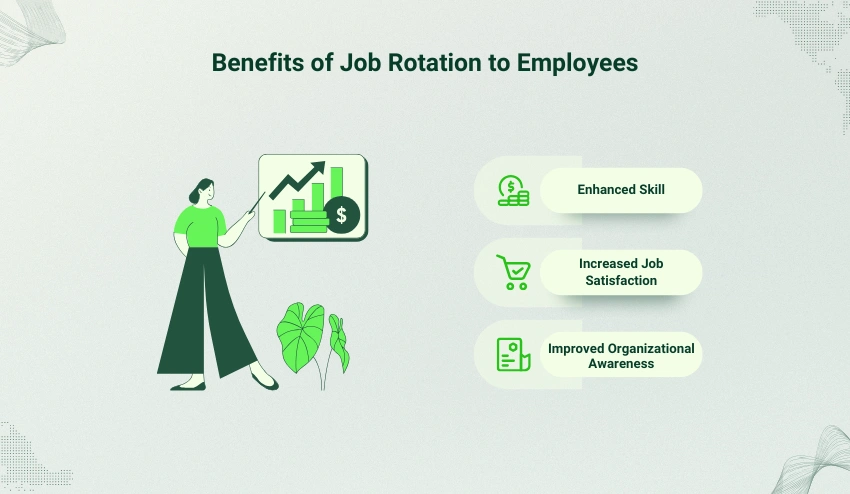
1. Enhanced Skill Versatility and Career Mobility
Job rotation introduces you to new activities, which produce T-shaped skills deep in one field and broad in others. This upskilling exposes them to new positions within the firm. You will be better placed to face the challenges that arise.
The advantages of cross-training are evident in a market that changes rapidly. You will not be stuck when your previous job is reformed. The career development is enhanced since you create a resume filled with diverse experience.
You can consider it as a toolbox: the more tools you have, the more you can repair any issue. After a stint of rotation, employees usually claim to be prepared to do bigger things.
2. Increased Job Satisfaction and Reduced Burnout
The alternation of roles is a breath of fresh air that combats boredom. You remain motivated, learning something new every day. This fire enhances greater job satisfaction in general.
Research in such destinations as Gallup demonstrates that employees who can grow remain longer, by as much as 34% percent. Rotation cuts help eliminate burnout by interrupting the monotony of the day. You come back to your primary job rejuvenated.
Have you ever found yourself in a rut? Rotation gets you out of it, and work is fun again. Low energy is an easy energy solution.
3. Improved Organizational Awareness and Empathy
The proximity to other departments creates knowledge. You understand why sales is pushing so hard or why finance is keeping the costs at bay. This sympathy enhances inter-team communications.
Improved cooperation is the solution to problems faster. Finger-pointing is out; joint fixes are all. Companies such as General Electric attribute their rotation programs to the ease of teamwork.
One example: A technology company has switched engineers to customer support. They were able to fix app glitches more quickly because they were aware of user pains themselves. The result of such changes is a networked labour force.
📖Read More: 4 Best Benefits of a Rotating Shift Schedule In 2026
How do you build a Job Rotation System?
To develop a successful job rotation system, it is necessary to have a clear objective, a systematic plan, and continuous assessment. To design a program that benefits the employees and the business, follow the following steps:
1. Define Objectives
Select either what you want to accomplish, skill building, leadership preparation, employee involvement, or succession planning. The whole job rotation program is guided by clear goals.
2. Identify Suitable Roles
Choose jobs and assignments that can permit meaningful cross-training of employees without interfering with business. Pay attention to those jobs that increase the flexibility of the workforce.
3. Assess Employee Skills and Interests
Mail rotations with strengths of the employees, career goals, and career development programs to motivate them get motivated and learn.
4. Create a Rotation Schedule
Establish timeframes, tasks, and educational outcomes of every position. On-the-job training is facilitated by well-organized timetables.
5. Provide Training and Mentorship
Provide instructions, records, and mentors to facilitate easy transitions and the development of skills among employees.
6. Track Performance and Feedback
Calculate improvement, performance, and participation. Feedback should be used to optimize the job rotation system and enhance long-term outcomes.
Disadvantages of Job Rotation
Although job rotation can significantly increase employee skills, career growth, and workforce flexibility, it does not come without problems. These are some of the possible disadvantages that organizations ought to consider keenly so that a job rotation program can be implemented in a manner that brings value, devoid of disruptions and dissatisfaction among the employees.
1. Temporary Productivity Loss
The learning curve is likely to decrease production as employees adjust to new positions. This is a time when the employees might need additional assistance and guidance, and it can influence the efficiency of the entire team.
Also, on-the-job training in various tasks or departments may slow down operations, particularly in operations that are critical. Although job rotation will improve cross-training and versatility in the long term, managers will need to address short-term productivity drops.
2. Higher Training Costs
The introduction of a job rotation system may also require more resources in the form of training, mentoring, and monitoring. The expenses may accumulate, especially in large institutions where there are more than one or two employees rotating in different positions.
Nevertheless, a proper employee development program will make sure that the workforce acquires the desired skills and knowledge, and the investment cost will be justified in the long run. These costs can be optimized with the help of talent management strategies.
3. Employee Resistance or Stress
Job rotation is not always welcomed by the employees. Others are likely to be stressed, anxious, or unwilling to assume new duties, especially when the rotation involves areas that they are not comfortable doing.
This opposition may affect the morale and involvement and negate the advantages of a job rotation program. Stress can be minimized by having good career development plans and communicating clearly on goals and objectives.
4. Disruption of Workflow
The regular transfer of employees may result in a team or departmental gap that will interrupt the workflow. In the absence of proper scheduling, job rotation can cause inefficiencies or confusion in the day-to-day operations.
To overcome it, organizations will be able to introduce some form of task rotation schedules, proper handovers, and retain the performance of teams, as well as promote internal mobility and skill development.
5. Limited Depth of Expertise
Although job rotation fosters a multi-skilled workforce, employees might fail to develop expertise in one field. This may be a drawback in jobs that demand specialised knowledge or a high level of technical expertise.
Organizations will need to strike a balance between developing employees in breadth and depth, in which they need to offer job rotation and on-the-job training to enable the employees to be well-rounded without compromising on expertise.
Examples of Task Rotation in the Workplace
Job rotation can be practiced through task rotation, where employees are given a chance to undertake various jobs within the same position or even interdepartmentally. The strategy is not just effective in enhancing the skills of the employees but also in increasing the flexibility of the workforce and their interest. Some examples in the real world are as follows:
1. Retail and Customer Service
In retail, the employees can alternate in cashier, stock replenishment, and customer service. This would allow cross-training of the employees, better customer service, and smooth operations during the peak hours.
The exposure to the various functions will lead to multi-skilled workforce capabilities among the employees, and the managers may be able to allocate staff to the area where they are most required without interfering with the workflow.
2. Manufacturing and Production
The assembly, quality control, and packaging processes are also frequently moved around in manufacturing plants. This job rotation eliminates boredom, fatigue, andensures that the employees are knowledgeable of the entire production process.
It also contributes to the career development programs as it assists the employees in attaining new technical skills, and this makes them more valuable and versatile in the organization.
3. Office and Administrative Roles
At the office, the employees can switch between positions of data entry, client support, and reporting. This improves job enrichment, promotes learning, and creates a strong team that is resilient and adaptable.
Also, the internal mobility is enhanced by rotating administrative personnel, and the employees are prepared in terms of future promotions, which will lead to succession planning and talent management objectives.
4. Healthcare and Hospitals
The healthcare professionals can be transferred among various departments such as emergency care, outpatient care, and inpatient care. Such a task rotation expands knowledge, acquires various skills, and improves the quality of patient care.
It also favors the training in the field and makes sure that the staff is ready to cope with different situations, enhancing the efficiency of the employees and organization.
These examples demonstrate how job rotation and task rotation can be tailored to different industries to foster learning, engagement, and a multi-skilled workforce.
Tips for the best practices of Job rotation
A good job rotation program needs to be planned and strategically implemented. The following are the tips needed to make sure your job rotation system works in the best interest of both the employees and the organization:
1. Set Clear Objectives
Prior to initiating a job rotation program, clarify the objectives, whether it is employee skill development, career development, or succession planning. Specific objectives assist the employees in knowing why they are under rotation and to be motivated.
Incorporation of the program with the talent management strategies would make sure that the rotations are working towards the long-term success of the organization and internal mobility.
2. Match Roles to Employee Skills and Interests
As a way of maximizing their engagement, the employees should be rotated to jobs that complement their strengths and career ambitions. The evaluation of capabilities and interests guarantees valuable learning and decreases resistance.
This practice supplements on-the-job training, job enrichment, and career development initiatives, and as such, the rotation becomes helpful to both the workers and the organization.
3. Provide Adequate Training and Support
Provide training, mentoring, and resources to the employees prior to their transition to new positions. Organized instructions eliminate errors, lessen anxiety, and accelerate acclimatization.
A multi-skilled workforce is developed through well-calculated cross-training and task rotation, so that an employee is able to cope with the diverse responsibilities.
4. Monitor Progress and Gather Feedback
Provide training, mentoring, and resources to the employees prior to their transition to new positions. Organized instructions eliminate errors, lessen anxiety, and accelerate acclimatization.
A multi-skilled workforce is developed through well-calculated cross-training and task rotation, so that an employee is able to cope with the diverse responsibilities.
5. Communicate Clearly and Transparently
Make expectations, schedule, and benefits of the job rotation program clear to every participant. Openness causes anxiety to decrease and develop trust in the system.
Community also enhances communication, which supports the relationship between skill improvement of employees, internal mobility, and long-term growth objectives of the organization.
Conclusion
Job rotation is not merely an effective HR practice; it is an effective method of developing employees in terms of skills, increasing their engagement, and producing a multi-skilled and flexible workforce. With careful use of rotation programs, training, and matching roles with employee strengths and career goals, organizations would be able to decrease burnout, enhance teamwork, and train the future executives. Although temporary productivity decreases or training expenses are a challenge, a properly designed job rotation system with clear goals, feedback systems, and effective communication channels will ensure that employees and the organization prosper. Adopting job rotation eventually creates a stable, flexible working environment that is capable of responding to the changing business needs.