Ever feel like your brain is an open browser with all those tabs glaring back at you? That’s mental clutter, a quiet fog that covers your focus, drains your energy, and makes it hard to accomplish even the simplest things.
Mental clutter has a tendency to creep into our lives without us even realizing it. To-do lists that never seem to end, racing thoughts, or always being distracted – mental clutter can be a huge productivity killer, as well as a disruptor of your sleep patterns. A cluttered mind means that your critical thinking, organizational abilities, and focus are all compromised, making you feel stuck and frustrated.
But fear not! By the end of this blog post, you will learn 8 easy yet effective ways to declutter your mind and get your focus back in an instant. Let’s get started!
Key Highlights:
- 8 powerful but easy-to-use methods to clear mental clutter in a snap
- Step-by-step, in-depth guidance for each technique (brain dumps, mindfulness, etc.)
- Boost productivity and improve decision-making
- Mental health and emotional well-being in the spotlight
- Practical advice on how to overcome mental clutter at work and in life
- Long-term benefits like better sleep, creativity, and focus
- Tips on how to make these habits second nature and build rock-solid habits
What is Mental Clutter?
Definition: Mental clutter refers to a situation where your brain is overwhelmed by too many thoughts, worries, and tasks, making it challenging for you to concentrate, prioritize, and make decisions. Mental clutter can cause stress, decreased productivity, and mental exhaustion.
Who is Most Likely to be Affected by Mental Clutter?
Of course, anyone can be affected by mental clutter, but some people are more likely to be affected by it. These include:
- Working Professionals who are constantly juggling meetings, emails, and deadlines are most likely to be affected by mental clutter.
- Parents who are juggling their household chores, work, and personal responsibilities are often carrying an invisible “mental load” that never really switches off.
- Students who are juggling their assignments, peer pressure, and future anxieties are often experiencing racing thoughts and an inability to focus, which are symptoms of mental clutter.
- People with Anxiety or ADHD are more likely to experience mental clutter. Anxiety causes people to overthink, and people with ADHD have trouble filtering out irrelevant thoughts.
Signs You Have Mental Clutter:
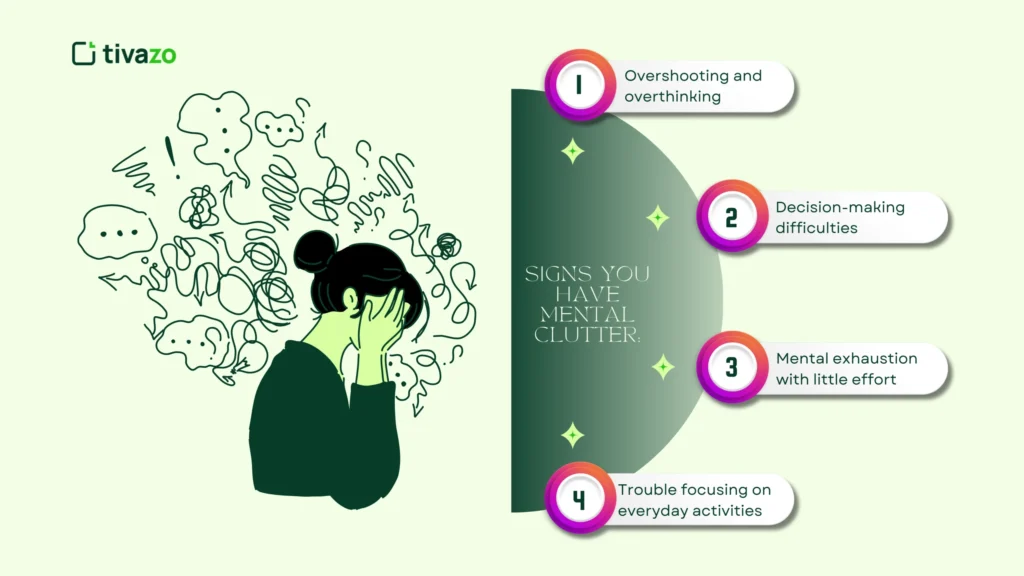
- Overshooting and overthinking: Your mind continues to run through all the possibilities, typically imagining problems that have not yet arisen.
- Decision-making challenges: The number of choices and priorities makes it hard to choose just one.
- Mental exhaustion with little effort: Although you are not doing anything, you are mentally exhausted because your mind is constantly running at full capacity.
- Trouble focusing on everyday activities: Activities that were easy to do are now challenging because your mind is focused on all the other things.
Psychological Insight: The brain is not designed to handle a constant flow of information all at once. When it becomes overwhelmed with things to do, worries, and information, it can’t effectively prioritize or store important information. This results in mental overload, when your ability to clearly think, focus, and make decisions is impaired.
Why Mental Clutter Affects Your Productivity
The Science Behind It:
Mental clutter isn’t just a sensation; it has a tangible effect on your brain. George Miller, a psychologist, discovered that your working memory can only process about 7 bits of information at a time, while another psychologist named Bluma Zeigarnik discovered that an unfinished task creates a mental loop that slowly drains your mental focus even if you’re doing something else. When you go beyond the limits of your brain, you experience cognitive overload, which affects your performance in all areas of your life:
- Memory: Your brain becomes overwhelmed and does not capture valuable information when there’s constant background noise occurring. Your forgetfulness of important tasks or deadlines may be at fault.
- Creativity: With all these competing concepts, your mind can’t even think creatively or come up with solutions. This halts innovation and makes tasks seem more stagnant or intimidating.
- Task Completion: Cognitive overload slows down your task completion power. Your mind is busy with the various streams of thought to focus on one task, making even simple tasks seem overwhelming.
Real-Life Examples
Clutter in your mind can make you constantly “busy” but not productive. For instance:
- Being Stuck: You might be just going through the motions and getting nothing done, simply because your mental resources are at full capacity, so it’s hard to make progress on anything better and more effective you could be if you emptied your mind and regained control.
- Forgetting Reminders: You can set an important reminder, but forget to do it as your mind is elsewhere.
- Procrastination: With mental confusion, procrastination is a simple option. The mind gets trapped in avoidance since it cannot put things in order or prioritize well.
8 Fast Ways to Clear Your Mind
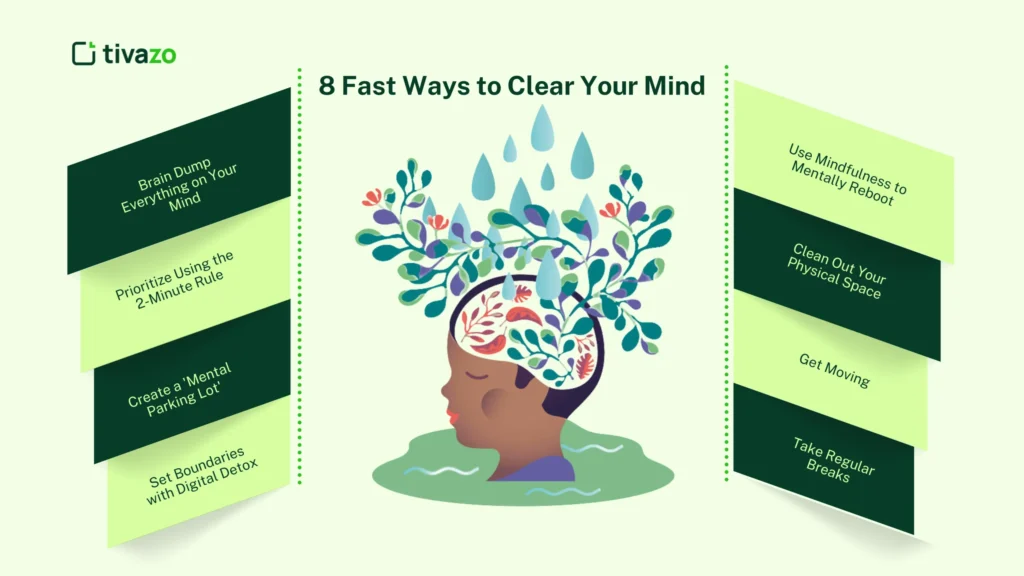
Brain Dump Everything on Your Mind
What It Is: A brain dump is a mental exercise where you get everything that is clogging your mind onto paper or an electronic device. Work, personal problems, or just random thoughts, write them down, and don’t care about structure or organization.
Why It Works: By getting it all down on paper, you clear your mind. Your working memory, which is of limited size, no longer has to hold all these thoughts, and mental tension is alleviated, allowing you to focus more on the important stuff.
Tip: Attempt to do a brain dump at the beginning of your day so that things will be cleared from your head and intentions can be set. Or, do it at night before bed in order to release nagging thoughts and gain a more restful night’s sleep.
Prioritize Using the 2-Minute Rule
What It Is: The 2-minute rule is simple but powerful: Do the action in 2 minutes or less if you’re able, instead of letting it hang on your to-do list.
Why It Works: Small tasks, left to themselves, have a way of spiraling out of hand and creating mental clutter. You don’t let them accumulate and take your attention away by performing them on the spot.
Tip: Combine the 2-minute rule with time-blocking. For example, allocate specific time blocks for larger projects and then apply smaller tasks for less than 2 minutes during your breaks to rest your mind and maintain focus.
Create a ‘Mental Parking Lot’
What It Is: A mental parking lot is where you set aside thoughts, tasks, or ideas that are important but not time-sensitive. Instead of letting them occupy mental space, you can “park” them temporarily.
Why It Works: Having placed your ideas in a safe place, you no longer need to struggle to recall them. This allows you to remain present and focused, uncluttered and unstressed.
Tip: Give your mental parking lot its own location, a physical notebook, or an electronic note-taking program. Schedule time to scan your parking lot regularly and figure out when or how to handle these thoughts so they don’t accumulate.
Set Boundaries with Digital Detox
Why It Matters: Technology is constantly generating mental noise. The flow of notifications from apps, email, and social media keeps your mind in a state of continuous stimulation, which makes it harder and harder to focus on important things.
Action Step: Allocate every day a “digital detox” session where you turn off technology. It could be as short as 30 minutes or more, depending on your needs. Disable notifications during this time, and do not check your phone or email, and do something or work that demands serious concentration.
Tip: If you can’t seem to disconnect, use apps or functionality that limit your screen time or block distracting sites. By minimizing digital distractions, you create space for focused, uninterrupted work.
Use Mindfulness to Mentally Reboot
What It Is: Mindfulness exercises such as deep breathing, guided meditation, or even just quick, 5-minute breaks where you simply exist in the present moment without distraction or judgment.
Why It Works: Mindfulness silences the noise in your head that creates clutter. By getting your brain conditioned to be present, you can get distractions and worries out of the way and usher in peace and mental clarity.
Tip: Begin slowly if you are new to mindfulness. A 5-minute guided meditation or some slow breathing is a good place to begin. You can add from there and experiment with some other mindfulness exercises, like body scans or visualization exercises.
Get Moving
What It Is: A walk, yoga, or an entire workout, whatever, exercise is an excellent way to clear your head and get rid of mental clutter. Exercise guarantees clarity of mind since it releases endorphins, the “feel-good” hormones that battle stress.
Why It Works: Exercise not only makes you feel more cheerful, but it also increases blood flow to your brain, enabling you to think more clearly and dispel the mental fogginess caused by worrying or stress.
Tip: A bit of exercise works wonders. Take a 10-minute brisk walk or do some stretching exercises, and you’re good to go, with your mind refreshed and you sharper thereafter.
Clean Out Your Physical Space
What It Is: What is surrounding you can have a big impact on what is happening inside your head. A cluttered room or dirty workspace can make it more difficult to focus and leave you feeling bogged down.
Why It Works: Cleaning up orders your space, and that cues your brain into understanding that all things have a place. Working in a tidy, clean environment encourages mental alertness and dominion.
Tip: Scrape out some time each day or week to tidy up your workspace or home space. Start with something minute, such as tidying up your desk, sorting out your computer files, or making your bed. This simple act of organization can leave you feeling instantly more focused and not so disorganized.
Take Regular Breaks
What It Is: Taking time for frequent, brief breaks throughout the day is necessary to maintain the mind’s concentration and prevent burnout. Frequent breaks allow your mind to rest and recharge.
Why It Works: When you don’t give yourself a break for so long, your mind gets exhausted, and mental disarray starts to arise. Breaks allow your brain to relax and recharge, helping to concentrate better and work in a much higher mental function during work periods.
Tip: Utilize methods such as the Pomodoro Technique: 25 minutes of work, followed by a 5-minute break. The organized nature is designed to ensure productivity and still allow your mind the relaxation needed to remain focused
The Long-Term Positive Effects of Mental Clutter Detox
- Improved Sleep:
Daily mental clutter detox improves your deep relaxation and sleeping capacity. Detoxing your mental clutter before bed helps you relax stress and anxiety, resulting in a more peaceful sleep. - Improved Creativity:
A clear mind is a creative mind. Detoxing mental clutter allows your mind to think outside the box, solve problems better, and tap into your creative potential. - Emotional Balance:
Mind detoxing reduces emotional and Mental clutter by limiting stress and anxiety. With an uncluttered mind, you can react more objectively and calmly to emotional stimuli. - Increased Focus and Productivity:
Detoxing of mental clutter regularly improves your task focus and utilization of time. You will be less distracted and more productive in life and business. - Improved Decision-Making
With mental clutter-reduced distractions in the mind, you can make wiser and bolder decisions without nagging thoughts or anxieties clouding your mind. - Consistency Is Key:
Similarly, just as physical clutter needs regular maintenance, mental clutter needs regular detox practice. Regular mental clutter detox ensures long-term clarity and also prevents future buildup of clutter. - Long-Term Habit Building
By incorporating mental clutter detox rituals into your regular or weekly lifestyle, you create it an habits that reinforce brain clarity, concentration, and mood stability in the long term.
When to Seek Professional Help
The techniques in this guide are great for dealing with mental clutter on a daily basis. However, there may be times when the clutter is more complex.
If your mind is racing, you’re unable to focus, or you’re experiencing mental fatigue and it’s having a severely negative impact on your job or personal relationships, and you’re also experiencing feelings of hopelessness or anxiety that you can’t shake, it may be time to seek the help of a mental health professional.
A therapist or psychologist can help determine if there is an underlying issue, such as anxiety, depression, or ADHD, that may be causing your mental clutter, and develop a plan to address it beyond what you can do on your own. There’s no point at which you need to reach before seeking help. It’s always the right time.
Conclusion
You now have the ability to transform your mental clutter so it does not run your life. By using the simple yet effective techniques of brain dumping, mindfulness, and digital detoxing, you can make this transformation. These three techniques will help you declutter your mind, organize your thoughts, and increase your productivity. By doing these tasks on a regularly, you will see a huge difference in your mental clarity and mood.
A clear mind is a powerful mind. By decluttering your mind, you can achieve your full potential and get through the day with more energy and drive. What map will you begin using today? It’s simple, just take the first step towards a clutter-free mind and a clearer, fuller life.
Do these tips help you? Bookmark this page and share it with someone who could use a mental clarity boost.