Recruitment today requires impartiality, precision, and evidence-based choices. But even the most expert of recruiters are all guilty of the habits of hasty opinion-not to mention that they are usually unaware of it. Such unseen power that influences hiring choices is known as unconscious bias, and it influences whom to interview, shortlist, and hire ultimately called as unconscious bias in recruitment.
In this blog, we are unloading the meaning of unconscious bias, how it influences modern-day recruitment, practical examples that you will be familiar with, and the 10 significant types of unconscious hiring bias supported by psychological and HR research.
In addition to advising HR teams to be less biased, we also point out how Tivazo- a recent workforce analytics and productivity system- can be used to guide more objective judgments with data-based information.
What Is Unconscious Bias?
Unconscious bias is a type of mental shortcut that is an unconscious decision maker. The patterns and assumptions can be used in our brains to rapidly process information; however, in the hiring process, the shortcuts may be applied in a way that is not fair in the judgment of the applicant.
All people have prejudices, and so do human resources, hiring managers, and interviewers-that is the reason why it is so important to counter them. These biases influence our perception of resumes, the ways we communicate, the level of confidence, and even the cultural signals. Unconscious bias may constrain diversity, be unfair, and may not allow organizations to attract the most talented when left unchecked.
Unconscious Bias in Recruitment – What Does It Mean?
Unconscious bias in recruitment is described as an unintentional preference or judgment that influences hiring choices, which include:
- Who gets shortlisted
- The manner in which interviews are to be carried out.
- Methods of measurement of skill levels.
- The interpretation of culture fit.
- Estimation of productivity or potential.
The influence of bias is felt in making decisions, even in processes that seem objective, such as resume review, interviews, and even in reference checks.
With such knowledge of these biases, employers will be able to establish hiring environments that are not based on stereotypes or assumptions but rather on skills, data, and potential.
Actual Cases of Unconscious Bias in Recruiting
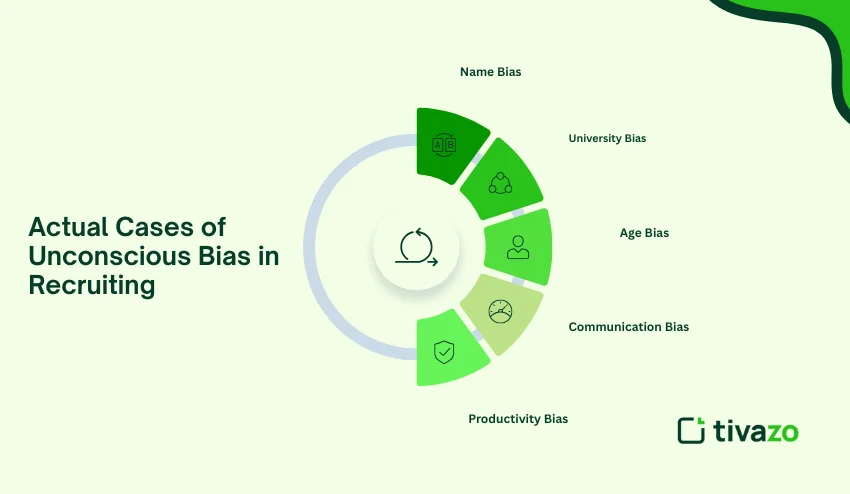
Realistic situations that are practiced daily within hiring teams are below:
1. Name Bias
A recruiter will go through resumes and subconsciously give preference to familiar-sounding names or names that are easier to pronounce.
2. University Bias
Applicants of great institutions are prioritized- even in cases where they might have equal or better skills.
3. Age Bias
A younger applicant is said to be more flexible, or an older applicant is said to be less tech-savvy.
4. Communication Bias
Even in jobs where a person does not need high-level communication, a candidate with an accent or poor English is considered inferior.
5. Productivity Bias
Managers do not consider the output but assume that the longer the working hours, the greater the productivity.
Productivity bias can be eliminated through platforms, such as Tivazo, which present companies with real-time data, insights on time, and performance that are based on facts and not assumptions.
Cases of Unconscious Bias
| Bias Type | Example in Hiring |
| Name Bias | Favoring resumes containing familiar or Western names because they appear to be a better fit in terms of cultural or other professional fit. |
| Gender Bias | Supposing that either gender is more adept at performing a specific job, like leading, technology-related, or medical care. |
| Halo Effect | Raising the value of a single flattering personality attribute, such as confidence or communication, and ignoring areas of weakness or skill deficiency. |
| Similarity Bias | Preference to applicants who seem like us, who may be of a similar background, interest, or personality, regardless of being better qualified. |
| Confirmation Bias | Finding proof that validates your original ideas and disregarding facts that should prove you wrong. |
These biases occur on the unconscious level; however, they may have a strong effect on fairness and accuracy in the recruitment process.
Is Unconscious Bias So Unconscious?
Yes.
The unconscious biases are automatic and involuntary. They are based on their own experiences, cultural messages, stereotyping, and exposure to specific environments. These trends build up over time, and we make instant judgments without even knowing it. Since the reactions are created in the subconscious mind, individuals tend to think that they are objective-even when these are in effect being biased.
That is why sensitization and appropriate hiring procedures can be used to mitigate bias. It would be easier to reduce the influence of hidden assumptions when organizations make use of standardized evaluation criteria, a variety of interview panels, and data-driven tools. Although it is impossible to completely avoid unconscious bias, it can be controlled-and this is what results in more objective and equitable hiring processes.
The 4 Big Unconscious Bias Categories
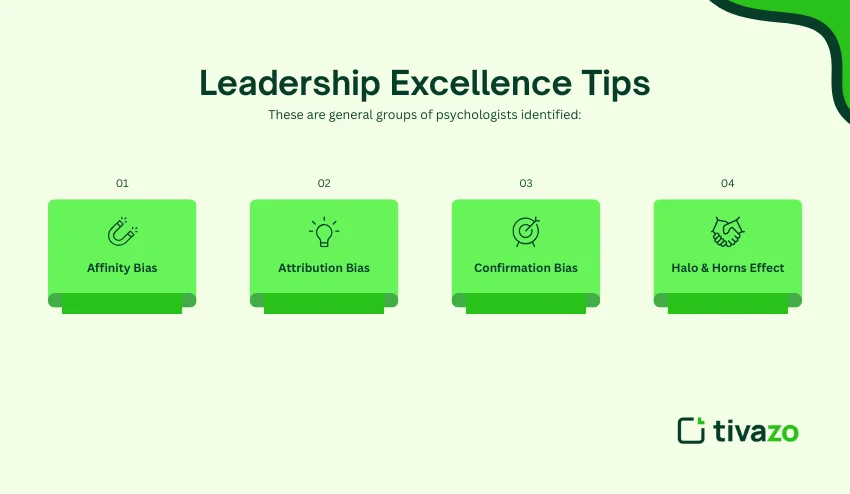
These are general groups of psychologists identified:
1. Affinity Bias
Favoring applications based on likenesses in their background, leisure activities, or personalities. This bias tends to be akin to good chemistry; however, it may lead to ignoring proper evaluation and hiring on comfort instead of strength or potential.
2. Attribution Bias
Defining behaviors in different ways depending on the already held beliefs about groups or people. Recruiters might overlook errors committed by people whom they prefer and make assumptions about the negative motives of others, resulting in unequal and unfair evaluations in the interview.
3. Confirmation Bias
In search of facts that can confirm your beliefs about an applicant. When the recruiter makes an initial impression, he or she might pose leading questions or simply pay attention to information that confirms the initial impression, but ignores information that would prove this idea wrong.
4. Halo & Horns Effect
Letting a good or bad quality cause all other qualities to fade away. One strong skill can overrate the overall rating of a candidate, whereas one weakness can undermine his/her opportunities- even when a candidate shows a high performance in most of the key areas
How Tivazo Can Be Used to Decrease Unconscious Bias in Recruitment
- Although it is impossible to get rid of unconscious bias completely, data has the ability to mitigate its effects greatly.
- To assist organizations in overcoming subjectivity and going to objective analysis, Tivazo assists by providing:
- Proper information about working practices and performance.
- Hiring and internal reviews are fairer as the performance is determined by the results and not by assumptions.
- Getting rid of visibility bias in remote teams.
- Tivazo does not reward people who seem to be busy but are not productive.
- Knowledge regarding the engagement of employees and the efficiency of the workflow.
- This assists managers in making informed decisions as opposed to their gut feeling.
- Clearly, regular assessment indicators.
- Standardized tests decrease bias and enhance inter-team fairness.
10 Unconscious Hiring Bias Types
The ten most common biases in the process of recruitment are further elaborated below in order of description and search engine optimization.
1. Affinity Bias
Affinity bias occurs when recruiters prefer candidates with whom they are familiar, such as same school, city, personality, or interests. Although it comes naturally, it negatively affects the diversity in work workplace and constrains new views. The similarity falls short of competence and is a major issue that would not allow the best talent available to be employed by the team.
2. Confirmation Bias
This prejudice causes recruiters to pay attention only to the information that confirms their pre-existing beliefs about a candidate. As an example, when they suppose that a candidate with a specific background is very competent, they do not pay attention to errors. In case of a negative assumption, they overlook strengths. It causes prejudiced and untrue judgments.
3. Halo Effect
The halo effect takes place when a single, impressive characteristic of the person is used to judge an individual. This will be a characteristic of confidence, communication, or appearance. A candidate who excels in a particular area can be rated as a competent person in all areas. Such bias exaggerates ratings and makes recruiters not see the skills realistically.
4. Horns Effect
The horns effect is the contrary of the halo effect, in which a negative character overshadows the entire impression of a candidate. Even such minor errors as nervousness or formatting can make recruiters believe that the candidate is unqualified. This results in the unrecognized talent and injustice.
5. Gender Bias
Gender bias can also affect the perceptions of competence, leadership capacity, or communication style as perceived by the recruiters in line with gender stereotyping. As an example, men could be viewed as being more aggressive, whereas women could be viewed more adversely in the case of negotiations. Such prejudice prevents gender diversity and decreases the equal chances of recruitment.
6. Age Bias
Bias based on age applies to both young and old candidates. Younger candidates can be regarded as inexperienced, whereas older candidates can be regarded as being less adaptive or less technology-oriented. These stereotypes deny the fact that there are differences in the abilities of individuals and deprive both groups of the opportunity to access equal employment opportunities.
7. Name Bias
Name bias happens when the name of a candidate provokes assumptions of ethnicity, nationality, background, or cultural identity. Resumes whose names sound familiar or whose names have a Western background are likely to get more calls. This bias occurs immediately and unconsciously, and recruiters are not always aware of its effect on equality.
8. Appearance Bias
Appearance bias is the prejudice towards the candidates on the basis of their appearance, fitness, clothing style, weight, or attractiveness. Positive assumptions are usually made about attractive applicants, whereas others are judged against. This is a competency-neutral bias that impacts much on the outcome of the interview.
9. Experience Bias
When experience bias occurs, the recruiters prefer to overrate years of experience over actual skills. An individual who has ten years of inappropriate experience can be preferred over the four applicants with up-to-date inappropriate experience. This avoids the process of recruiting genuine talent in organizations.
10. Productivity Bias
Productivity bias occurs when a recruiter or manager makes assumptions about productivity based on extraneous variables, such as working more hours, sending late-night emails, or when they seem busy. Remote teams are particularly the victims of this bias. Tivazo tools are good at getting rid of this bias as they provide precise data-driven information about real performance.
The Entry of Bias in Recruitment and the Peer of Tivazo
| Stages | Ordinary prejudice | Effects | The role of Tivazo |
| Resume Screening | Name, gender, university bias | Unfair shortlisting | Insights on data-driven evaluation. |
Interviews | Halo, similarity, communication bias | Inaccurate judgments | Objective role-fit analysis. |
| Offer Stage | Experience, age bias | Wrong hires | Performance measures to make better predictions. |
| Promotions/Evaluations | Productivity bias | Preference for visible workers | Real-time productivity analytics. |
Conclusion
Every organization is prone to the problem of unconscious bias in the recruitment process; however, it does not always have to dominate the process. It is possible to create more equitable, intelligent, and more inclusive workforces with awareness, structured processes, and information-driven tools such as Tivazo. With assumptions substituted with quantifiable knowledge, organizations reinforce decisions and establish recruitment opportunities in which all applicants are considered based on their actual merit.
Bias is human.
However, decisions can and must be informed by data.