Managed Service Providers (MSPs) work in an environment that is high-speed, where every minute matters. However, without MSP time tracking accuracy, all the productivity, profitability, and trust between the clients is lost. In this data age, companies cannot afford to make guesses but need real insights, particularly in billing clients and performance analysis by the team. Poor time tracking may translate to missed deadlines, overworking, and poor reporting to the clients, eventually affecting the revenue and growth potential. Proper tracking will enable the MSP to be more transparent, optimize its resources, make evidence-based decisions, and maintain a strong, trusting relationship with clients.
This is a comprehensive guide that will take you through all you will need to know about MSP time tracking, what it is, why most of these methods fail, how to correct them, and how Tivazo can be the solution of your dreams.
What Does MSP Stand For?
MSP is an acronym for Managed Service Provider
MSP is a third-party business that operates remotely to manage IT, networking, security, support, or cloud services of a client. They make sure that operations are run efficiently, as organizations are concerned with strategy and growth. In essence, MSPs are an outsourced IT department that offers professional assistance without the cost burden of acquiring permanent employees. They also provide proactive protection, frequent maintenance, cybersecurity, and assistance services at the help desk to avoid issues before the business process is affected.
As IT systems continue to grow in complexity and security threats continue to increase, businesses of all sizes are looking to MSPs to keep them efficient, minimize downtime, and ensure their scalability. MSPs also give organizations a competitive edge in that they offer technical expertise and allow teams to focus on the main business goals and not on the technical problem of day-to-day operations.
What Is MSP Time Tracking?
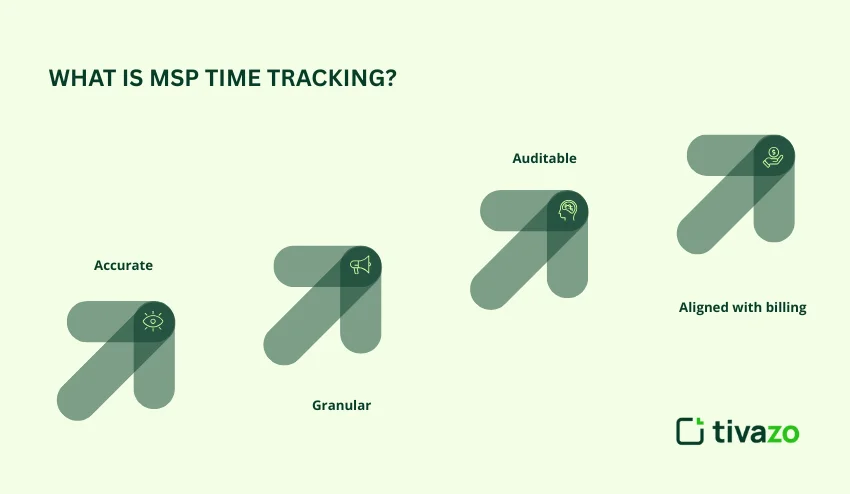
When it is most fundamental, MSP time tracking is a formalized measurement and recording of the time technicians and teams work on tasks, projects, tickets, and client work.
MSP time tracking should be unlike general time logging and should be:
- Accurate
- Granular
- Auditable
- Aligned with billing
Time is money to MSPs, and the ability to measure it properly is the difference between profitable service businesses and underperformers. High-quality MSP time tracking also gives information on the efficiency of the team, workloads, and allocation of resources. It enables managers to find the bottlenecks, streamline the processes, and make wise decisions that have a direct effect on client satisfaction and the general growth of a business. Tracking will be accurate, hence transparency, accountability, and knowing what is going on every hour.
MSP Time Tracking: Major Exempla in practice
The following are actual time-tracking scenarios of MSP:
Examples
- Ticket Resolution Tracking: Time calculation between SLA compliance of ticket opened and resolved.
- Project Work Tracking: Onboarding of clients, strategic initiatives, server deployments, network upgrades, etc.
- Service Request Management: Monitoring regular support (software installations, password resets, etc.).
- Remote Work and Monitoring: Documenting the hours that technicians have been working remotely or off-site, accessing systems.
- Billable and Non-Billable Work: Separating client and billable hours and internal work.
The above examples reflect why the use of traditional spreadsheets and manual logs is not effective, particularly when workloads increase.
Time Tracking Methods: How Common MSP Tracking Fails
We should examine typical time tracking methods first before returning to the subject to understand why these methods are ineffective with MSPs.
Method Strengths Weaknesses / Reason It Fails
| Method | Strengths | Weaknesses / Why It Fails |
| Manual Timesheets | Easy to establish | Inaccurate, forgetful, inconsistent. |
| Spreadsheet Time Logs | Simple to customise, | Difficult to audit, inefficient. |
| Ticketing System timers | Records basic activities | Not a realistic working behavior |
| Calendar Logging | Records scheduled work | Lacks reactive/interrupt-driven work. |
| Self-reporting daily | Accountability (helps) | Over-reporting/memory bias |
That is why, on time tracking, most MSPs fail:
- Manual weaknesses and guessing: Human beings overlook minutes or round hours off.
- Absence of Real Transparency: You do not know what technicians have been doing on a minute-by-minute basis.
- Client Trust Erodes: Clients tend to doubt wide or general time entries.
- Ineffective Billing Accuracy: Under-billing is lost revenue; over-billing is ruined trust.
- Unproductive Work Patterns: It is something you do not realize, where time is being squandered.
Infrastructure Problems With MSP Time Tracking
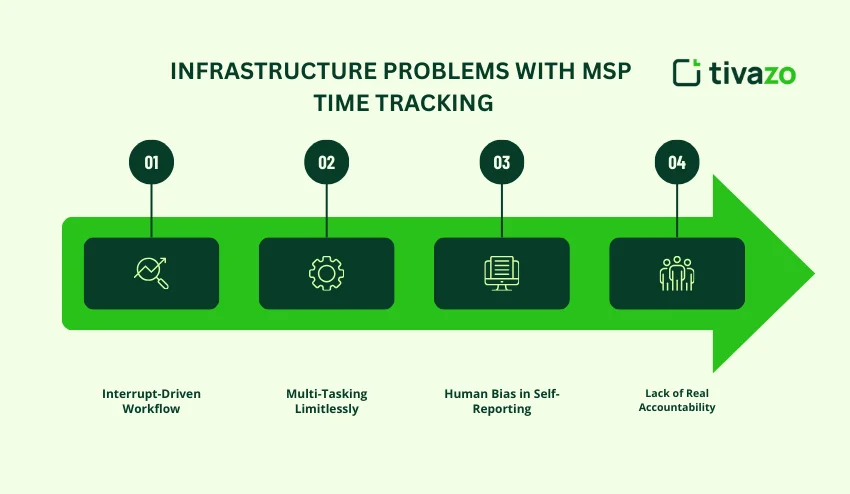
We shall explore more of the problems that MSPs encounter
1. Interrupt-Driven Workflow
MSP work is rarely linear. The time spent on a ticket can create follow-ups, escalations, monitoring checks, and parallel work; it is difficult to accurately track time in real time.
2. Multi-Tasking Limitlessly
Under no circumstances does the technician record any tasks without contextual tracking, which means that all hours are put under general categories.
3. Human Bias in Self-Reporting
When using memory, people overestimate and underestimate hours without neglecting. This causes billing disagreements, ineffective productivity analysis, and miserable client understanding.
4. Lack of Real Accountability
MSP teams do not have objective accountability in the absence of automated systems. Managers have to be in relentless pursuit of entries, wasting even more time.
The Reason MSPs Have to Organize Time Tracking Using Timesheets
In case ad hoc approaches are not effective, what is? The solution: automated time tracking of MSP in systematic and precise timesheets.
1. What Are MSP Timesheets?
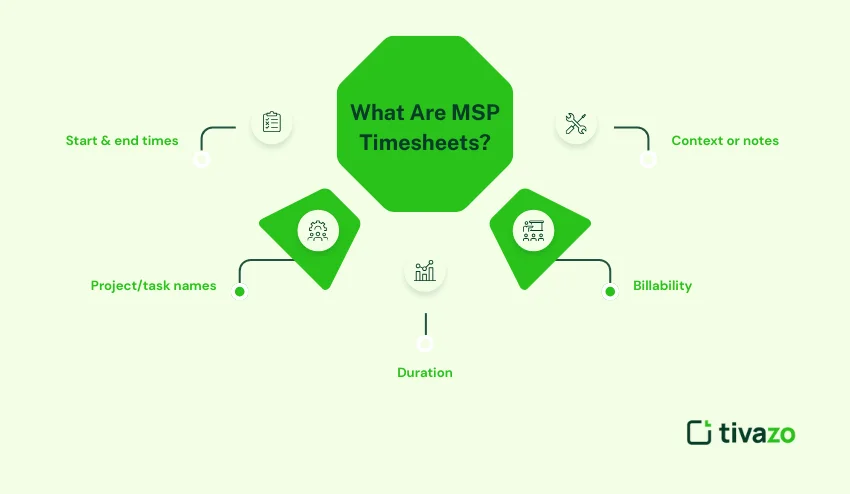
A work report is a timesheet, which contains:
- Start & end times
- Project/task names
- Duration
- Billability
- Context or notes
However, good MSP timesheets do not simply log hours; they check work behavior.
The advantages of structured time tracking.
- Accurate Billing: Clients will not pay an estimate; no guesswork.
- Improved Productivity: Teams know how their time is spent.
- Better Resource Planning: You can predict the workloads and the staffing requirements with accuracy.
- Reduced Time Theft & Guessing: Human bias is eliminated by automated tracking.
- Data-Driven Reporting: Confidently build rosters, KPIs, SLAs, and performance reports.
2. Real-Time Tracking (Not Retrospective)
The post-facto recording results in inaccuracy and possible misreporting. Real-time tracking—preferably automated—ensures that the data is intact and that the managers have a clear picture of what is going on at a specific moment in time. It also assists in the avoidance of missed hours, minimizes billing confrontation, and fosters a culture of accountability within the team.
3. Get task description and context
Time entries should answer:
- What was done?
- Why was it done?
- Who did it?
- How long did it take?
Contextualization not only guarantees comprehension among the clients but also enables in-house departments to evaluate workflow effectiveness, understand the bottlenecks, and apply the best practices. The quality of reporting also gets better and helps in strategic decision-making when detailed entries are used.
What is Different about Tivazo?
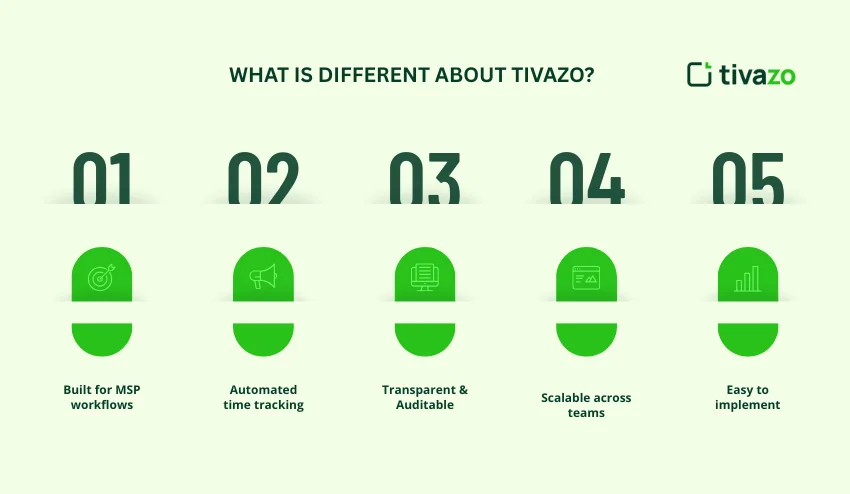
Tivazo is unlike spreadsheets, manual sheets, or simple timers, as it is
- Built for MSP workflows
- Automated time tracking
- Transparent and auditable
- Scalable across teams
- Easy to implement
This is how it assists your MSP to win
MSP Time Tracking Case Study Successes
So, how MSPs were able to gain the advantages of structured time tracking:
Case Study: MSP A
After implementing Tivazo:
- Errors in time tracking were reduced by half.
- Billable hours increased by 25%
- Conflicts with clients reduced drastically.
Case Study: MSP B
Through standardization of the task categories:
- Reporting clarity improved
- The prediction was made more precise.
- The balance in the workload of teams has been enhanced.
Such results are not isolated; they can be duplicated using the appropriate systems.
Conclusion
MSP time tracking is not an IT dream—it is a mission-critical skill of managed service providers. Unless their work is precisely tracked, MSPs will constantly underestimate it, charge clients inadequately, and not be able to maximize the performance of their teams.
It is not more spreadsheets that are the solution, but good systems. That is where Tivazo is different: automation, clarity, accountability, and insights will enable MSP leaders to make smarter decisions.
Are you willing to change your timekeeping? Accuracy and transparency, which are the two building blocks of successful MSP management, are the two characteristics of Tivazo.