The modern world of leadership is quicker than ever. Work is dispersed into teams, priorities change every week, and decisions cannot be postponed until the end-of-month reports. However, there are still a lot of leaders and managers who have a slow or partial visibility of the way work is being done.
This gap creates friction. Late delivery of work, unequal workloads, and frequent status meetings are the order of the day. Not due to poor performance of teams, but because leaders are flying using obsolete instruments.
It is there that real-time productivity visibility is a real leadership advantage. Once leaders are able to view work as it occurs, they will not be reacting late, but leading ahead. It’s not about control. It is concerning being clear, fast, and making smarter leadership choices that beat competitors.
What Is Real-Time Productivity Visibility?

Real-time productivity visibility refers to the capability of leaders and managers to monitor the progress of work in real-time, using live data rather than time-lags.
Simply put, it reveals what teams are working on, how time is being used and where progress or tension is being experienced, without having to wait days or weeks to get updates. This visibility is normally achieved through dashboards that indicate task status, workload allocation and time allocation in real time.
It should be made clear what this is not. Employee surveillance and micromanagement is not real-time productivity visibility. It does not imply observing every single click or following people every minute. Rather, it provides leaders with a high-level, precise overview of team performance to enable them to support, guide, and make changes early.
As an example, a manager can easily notice that one of the members of a team is overworked whereas the other is not. The leader is able to rebalance the work in real time and ensure that the project is on schedule as opposed to finding the problem after a deadline is missed.
Why Real-Time Productivity Visibility Matters for Leaders and Managers
To leaders and managers, the quality of decisions made is as good as the information they are made on. In cases where the productivity data is received late or incomplete, the leadership becomes reactive. Issues arise when the deadline is missed, when a group is under pressure, and when trust is lost.
Dynamic changes in productivity visibility make that dynamic. It provides the leaders with the prompt information about the way work is developing so that they can lead teams with certainty rather than guesswork. This transparency has a direct effect on the rate of execution, morale of the team, and competitiveness.
More to the point, it turns leadership into leadership of momentum as opposed to leadership of results. The leaders are able to identify trends at their initial stages, mitigate risks earlier, and keep teams focused on goals without incurring additional meetings and administrative burdens.
Reactive to Proactive Leadership.
Most leaders spend their time in firefighting without a real-time view. The problems are resolved when they are seen via delays, complaints, or missed targets.
The leaders can foresee the issues before they become a major problem with real-time productivity visibility. As an illustration, when work on a critical task stagnates unpredictably, an administrator can intervene at a young age to set priorities or eliminate inhibitors. This proactive strategy eliminates the stress of leaders and teams and keeps work flowing in the right direction.
Making Choices Worth Moving On.
Trade-offs in leadership usually come up. Who needs support? Which project to prioritize? What is the direction of resource redistribution?
Live productivity visibility takes the place of speculation with facts. Leaders will be able to make decisions based on real-time data rather than weekly reports or hunches. The manager who is planning the next week is able to have a quick view of how the workload will be distributed and make changes to the assignments to prevent overloading and underutilization.
This causes quicker and more assured decisions and generates a leadership rhythm that can hardly be matched by competitors who lack real-time insight.
The Competitive Leadership Edge of Real-Time Visibility
Speed and clarity are the two main factors in competitive leadership. The teams that are quicker in executing and adapting are always better than those that respond slowly. Real-time productivity visibility provides leaders with that benefit by reducing the gap between perception and action.
Competitors are waiting to get reports or updates, whereas real-time leaders can change priorities, redistribute workloads, and eliminate barriers in real-time. This builds a compounding advantage, which manifests itself in the speed of delivery, team resilience, and performance.
Quickly executed than the competitors
One of the least appreciated leadership strengths is the speed of execution. As soon as the leaders are able to see the progress of work in real time, they do not have to wait until issues emerge.
As an illustration, a leader can quickly reassign resources or explain expectations in the event a project is falling behind. Teams correct their course in hours instead of days of misalignment. Eventually, this capacity to move faster than the competition transforms into a decisive leadership capability.
Greater Accountability and Not Micromanaging.
Visibility is usually low when accountability fails. The leaders either micro-manage or check out, which is not effective.
Instant productivity visibility generates mutual understanding. Progress, responsibilities, and outcomes can be seen by everyone. This openness fosters proprietorship without direct supervision. The team members are aware of what is expected, and leaders are able to have constructive discussions using facts and not assumptions.
Comparison Table: Leadership With vs Without Real-Time Visibility
| Aspect | Without Real-Time Visibility | With Real-Time Visibility |
| Decision speed | Slow, delayed | Fast, informed |
| Workload balance | Uneven, reactive | Balanced, proactive |
| Accountability | Based on updates | Based on live data |
| Leadership style | Control-driven | Trust-driven |
| Competitive edge | Limited | Sustainable |
Key Productivity Metrics Leaders Should Track in Real Time
Real-Time Productivity Visibility can only be as effective as the metrics. Monitoring all that makes noise. Following the correct signals provides the leaders with clarity and control without being overwhelmed.
To the leaders and managers, monitoring is not the end but knowing the progress, capacity and results. The metrics listed below are valuable and help to ensure that the leadership remains result-oriented.
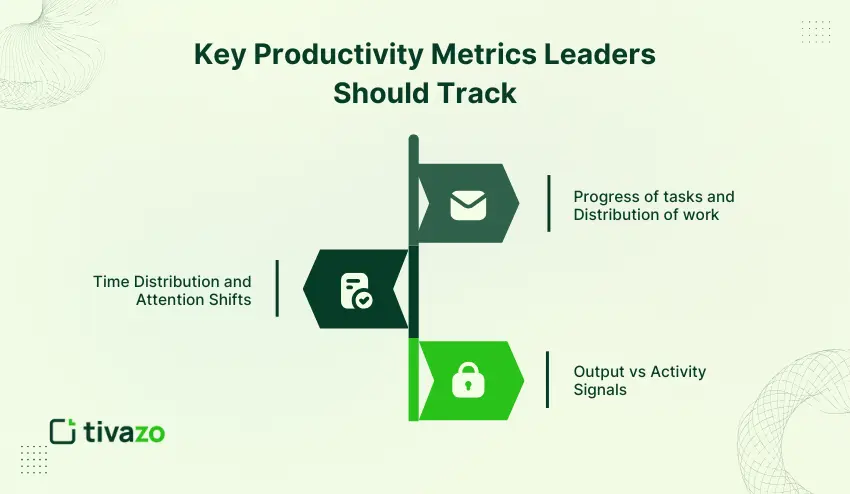
Progress of tasks and Distribution of work.
The task progress indicates the movement of work as scheduled. It is useful when the leaders view it in real time to identify slowdowns before deadlines are missed.
The allocation of work is also significant. Leaders are able to identify whether there are those team members who are overworked and there are others who are underutilized. This enables prompt rebalancing and burnout is avoided and efficiency is enhanced.
Example: When a manager observes that one of the contributors is working on 40 percent of active tasks, he or she notices it. The reallocation of work at an early stage stabilizes the delivery schedules and reduces stress levels.
Time Distribution and Attention Shifts.
Time management shows the reality of effort expenditure. Leaders tend to believe that time is spent on high-impact work, but real-time data can tell otherwise.
Leaders can notice patterns of focus to determine that they have too many meetings, engage in too much task switching, or are distracted to do deep work. This understanding can help make scheduling choices and be more realistic.
Output vs Activity Signals
Business is not productivity. The excessive movement of the mouse or the number of hours spent do not ensure any meaningful output.
Good leaders leverage on real-time visibility to bridge activity and results. They emphasize on accomplished work, achievements made, and value created as opposed to raw work. This eliminates misleading signs and makes the performance discussions fair and constructive.
Leadership Frameworks Powered by Real-Time Productivity Visibility
Real-time productivity visibility is not a tool; it changes the way leaders lead. Leaders can integrate live insights into decision-making and embrace frameworks that enhance the level of performance, accountability, and development of the team.
Data-Informed Leadership (DIL) Framework.
The DIL model is focused on a cyclical process: Observe, Decide, Act, Adjust. Live data would enable leaders to understand the exact position of the team (Observe), make sound decisions (Decide), act (Act), and adjust processes based on outcomes (Adjust).
Scenario: A manager is observing a growing backlog of tasks in real-time. They redistribute resources in real time, send updates, and track further progress, delivering the project on time.
Live Data Situational Leadership.
Situational leadership is a style that is responsive to the needs of the team. Real-time visibility enables the leaders to understand when to coach, delegate, or intervene. Evidence-based information can show gaps in performance, but also needs, which allows leaders to change their course in response to changing conditions.
Scenario: A junior member of the group with difficulty in handling complex tasks gets proactive instructions according to live workload data, whereas senior members of the same group are left on their own.
Leadership through Coaching with Visibility.
Real-Time Productivity Visibility enables leaders to engage in growth-oriented coaching dialogues as opposed to performance policing. By emphasizing trends and patterns, leaders can discuss how improvement and outcomes should be, rather than micro-managing.
How Tivazo Helps Leaders Gain the Real-Time Productivity Edge
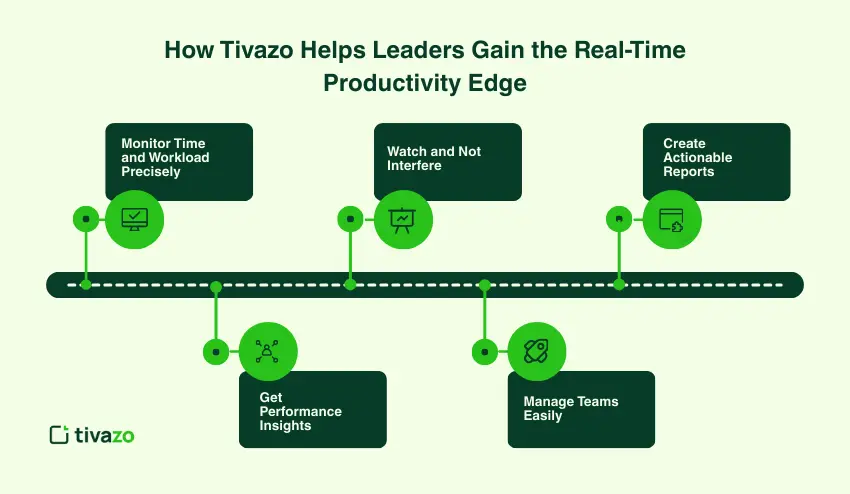
Tivazo is an all-embracing platform that allows leaders and managers to have real-time information on team performance to make smarter decisions and achieve a competitive advantage. Tivazo allows leaders to have a complete understanding of the position of their teams, but not without micromanagement; time tracking, live activity monitoring, and advanced reporting all combine to ensure that leaders are always aware of the position of their teams.
With Tivazo, leaders can:
- Monitor Time and Workload Precisely: Monitor real-time status of who is active, idle or away and balance workloads to avoid bottlenecks or burnout.
- Get Performance Insights: Heatmaps and activity trends show productivity trends, best-performers and areas that require attention.
- Watch and Not Interfere: Live screenshots and privacy-oriented features enable one to see without violating the privacy of the employees, preserving the trust and interest.
- Manage Teams Easily: Team groups and instant invites ensure that teams are managed without any hassle, regardless of whether they are remote or on-site.
- Create Actionable Reports: Automated timesheets and reports enable leaders to see trends, re-prioritize, and make strategic plans with confidence that is data-backed.
As an illustration, a manager on Tivazo can easily identify whether a project is lagging, reallocate tasks, and real-time tracking of the progress without having to wait till the end of the week to report the progress. This enables leaders to be proactive, effective coaches, and ensure high performance in their teams, and make visibility a real leadership benefit.
Common Leadership Mistakes With Real-time Productivity Visibility (and How to Avoid Them)
- Turning Visibility into Surveillance.
- Mistake: Monitoring every click, keystroke, or even minor action.
- Prevention: It is not the constant tracking of the activities but the high-level measurements which indicate progress and results.
- Tracking Too Many Metrics
- Mistake: Swamping dashboards with unnecessary data.
- Prevention: It is necessary to focus on the most important metrics connected with project goals, team work, and managerial decisions.
- Leaving Context Behind Data.
- Mistake: Working on numbers without understanding the circumstances.
- How to avoid: Visibility is a guiding tool, and then discuss with the team the challenges and roadblocks.
- Not Coaching, Control with Data.
- Mistake: Not developing but rewarding poor performance.
- Prevention: Coach, mentor, and develop employees ahead of time using the knowledge.
- Neglecting Communication
- Mistake: Implementing tools of visibility unnecessarily to the team.
- Prevention: Share the purposes, transparency policies, and the intent of data to create trust.
- Failing to Act on Insights
- Mistake: Collection of real-time information, and no prioritization and redistribution of resources.
- How to avoid: Dashboards are to be combined with leadership routines, i.e. the insights are converted to decisions instantly.
Conclusion
The modern business world is a high-speed setting that does not allow leaders and managers to lean on delayed reports and intuition. Real-time productivity Visibility gives the leaders the information that they require to make decisions that are faster and smarter, avoid bottlenecks and ensure that they support their teams.
When used wisely, visibility can make leadership less reactive and more proactive, develop accountability without micromanagement, and develop a quantifiable competitive advantage. This can be made smooth with tools such as Tivazo that transform live data into actionable insights that directly enhance performance, morale, and speed of delivery.
The leadership advantage is attached to the individuals who are visionary, decisive, and command their teams with a sense of confidence. Become visible in real-time now, and be ahead of the pack of high-performing teams.