Disengaged workers took a whopping $1.9 trillion in lost productivity from companies in 2023. That is not a small problem; this is a crisis that affects every business, from startups to Fortune 500 companies.
The thing is, most teams aren’t lazy. They’re stuck. Stuck in on-point workflows, unclear expectations, and systems that won’t support them in their success. When teams have problems with performance, their effort is rarely to blame. It’s the structure and visibility that it gets for its leadership.
This guide shows you team performance improvement strategies you can put into practice today. You’ll learn how to measure what matters, fix what’s broken, and build a team that consistently delivers results.
Understanding Team Performance in the Modern Workplace
Team performance improvement is not measured by working more hours for our employees. Performance improvement is achieving a workplace environment where good work happens naturally. The modern workplace comes with unique challenges, including working remotely, a clear lack of visibility into work patterns, and disconnected employees.
What Team Performance Really Means
Team performance refers to the performance output that your group generates as a team. Also, note that team performance is different from individual productivity since the former includes the way people within a team work together and communicate and cooperate with each other to perform their tasks effectively.
Good team performance is evident. Projects have timely completions. Quality is maintained at a high level. Team members understand how they contribute to the achievement of large goals.
Why Traditional Performance Strategies Fail
Most performance improvement plans fail due to the fact that these plans are based on guesswork. Managers are not provided with factual information, and a generalized solution is proposed without taking into account the needs of the teams.
Performance reviews, held annually, are conducted far too late to have any current value. The frequency of reviews is restricted, as feedback can’t address problems when they are first identified. Additionally, many organizations measure activity rather than accomplishment. They measure the hours worked instead of the results delivered.
The Role of Measurement in Performance
You simply cannot fix what you don’t measure, and once you know what team performance metrics to measure, patterns begin to emerge. You see where time gets wasted, and you realize that some team members are just plain over- or underutilized.
The 5 Core Elements Every High-Performing Team Needs
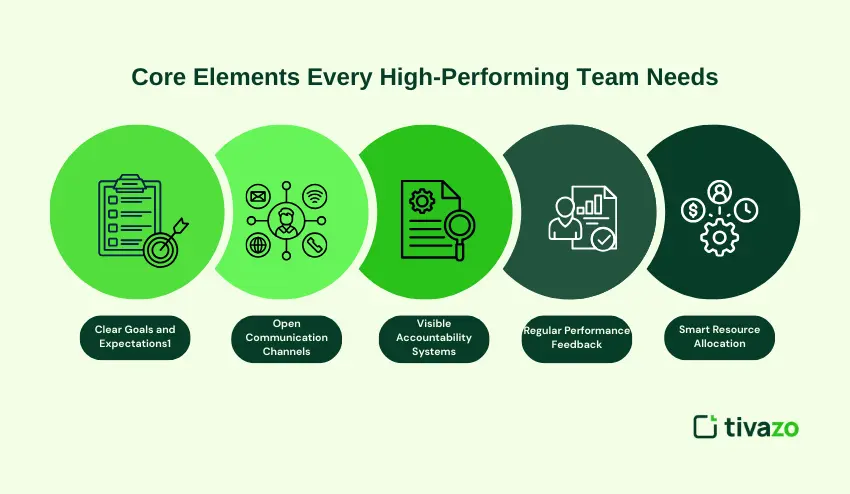
Achieving high team productivity demands focus on five key areas. These areas, when combined, provide a framework that allows high team productivity to flourish. Leave out just one, and the rest remain only a dream.
1. Crystal Clear Goals and Expectations
Every member of the team should be able to answer these questions instantaneously:
- “What am I working on?”
- “Why does it matter?”
- “How do I measure my success?”
When goals are not specific, people will waste their time working on things that do not make a significant difference. Define performance goals for teams, integrating them with business goals. Break long-term goals down to smaller goals. Use goal tracking systems.
2. Open Communication Channels
Communication breakdowns can cause a team to lose three hours of productivity per week. This translates into 156 hours a year for each person.
Establish regular touchpoints, though not to the extent of filling up calendars. The daily standup meeting ideally should not take more than 15 minutes. Async communication is key, especially when working in distributed teams.
3. Visible Accountability Systems
Real accountability is not about punishment or surveillance. Real accountability is about making commitments and keeping them.
Time tracking and productivity monitoring tools offer an objective basis for data-driven accountability talks. This approach to performance management actually turns out to be problem-solving instead of finger-pointing.
4. Regular Performance Feedback
People who get weekly feedback are 3.6 times more likely to stay motivated. Yet organizations continue to use a quarterly or yearly basis for reviewing their employees.
Good feedback is specific, it is timely, and it is based on objective, observable evidence. Performance analytics helps bring this type of feedback into play because you’re not giving opinions, you’re giving facts.
5. Smart Resource Allocation
Uneven distribution of work kills a team. It is not right for a team to have some members drowning while others cruise.
Use a time allocation analysis to detect imbalances. Look at who works overtime. The key here is to use data instead of assumptions.
12 Practical Strategies to Improve Team Performance
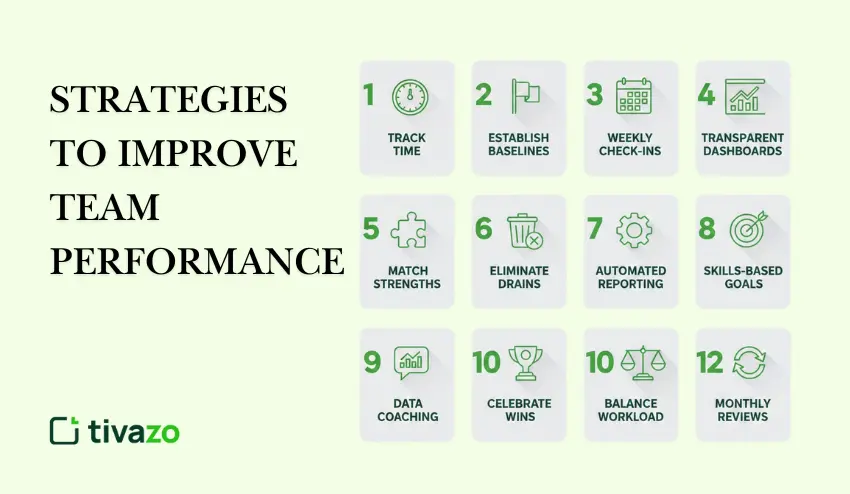
These team performance strategies have stood the test of time and work across industries. Choose three to start. Master these before adding in more.
Strategy 1: Track Time to Reveal Hidden Inefficiencies
Start using a time-tracking system today, not to police people but to understand where time really goes. It usually shocks most teams.
Meetings suck up more time than anyone realizes. Administrative tasks consume hours that could go to meaningful work. Context switching between projects destroys focus and efficiency.
Time tracking software provides the data required to deal systematically with these issues. You cannot fix what you cannot see.
Strategy 2: Create Performance Baselines
Before improving on anything, know where you stand. Measure current performance metrics of the team for a month by tracking task completion rates, project timelines, and quality scores.
These baselines become your point of reference. They let you know if changes actually work, or merely feel different.
Strategy 3: Lead Weekly Performance Check-Ins
Replace three-hour monthly meetings with a short weekly check-in. Review in 30 minutes what was done, what is blocked, and what’s next.
Use performance tracking data to inform discussions. Review the numbers together. Ask teams first what the data is telling them before you share your interpretations.
Strategy 4: Create Transparent Performance Dashboards
Create one dashboard that displays team performance in real-time. Make sure it includes all metrics that everyone agreed are important. Make it accessible to the entire team.
Transparency forges trust. The more people see the same data that leaders see, the more they will understand decisions. They will likewise realize problems.
Strategy 5: Match Tasks with Individual Strengths
Not everyone is suited to doing everything. Seek data to determine who is best at what. Some people excel in detail work, while others excel in creative problem-solving.
Task allocation based on actual performance patterns improves speed and quality. People perform better if they play to their strengths.
Strategy 6: Eliminate Productivity Drains
The average worker spends 31 hours per month sitting in meetings. None of that time adds any value! Be ruthless when auditing your meeting culture.
Cut meetings that could be emails. Shorten meetings when they drag on. Improve the usefulness and efficiency of remaining meetings.
Productivity monitoring may also identify other time wasters. Outdated technology, tedious routine tasks, and complex processes also consume productive time.
Strategy 7: Setting Up Automated Reporting
Manual reporting can take hours every week. People enter timesheets, prepare status reports, and chase down data to feed into the system.
The problem is eliminated by automated time reports. The flow of data from time tracking to reporting and then into payroll is now automated. Teams gain their hours back for actual work completed.
Strategy 8: Build Skills-Based Performance Goals
Move from measuring hours to measuring outcomes. An employee who completes quality work in four hours is more productive than an employee who takes eight hours and completes mediocre work.
Define what excellent performance looks like in each role, drawing on quality standards. Measure against quality standards, not against arbitrary time expectations.
Strategy 9: Use of Data for Coaching Conversations
When an individual’s performance has decreased, check the facts before discussing the situation with that individual. Are they overwhelmed with too many projects to deliver? Are they stuck with tasks that are not within their area of expertise? Or maybe they are continually interrupted from performing their tasks effectively?
Performance analytics changes difficult conversations to “collaborative problem-solving.” It’s not about criticizing, although what is being described does look very much like criticizing to a casual observer. It is about
Strategy 10: Celebrate Performance Wins Publicly
The key to driving motivation through recognition is to do it properly. This includes calling out specific accomplishments and relating them to team performance improvement goals that all can buy into.
Leverage your performance dashboard to celebrate your wins. When the entire team recognizes movement towards your goals, momentum is created.
Strategy 11: Address Workload Imbalances Fast
Review team capacity on a weekly basis based on workplace optimisation reports, and if a team member is always working overtime while others are idle, then work is being misallocated and should be redistributed immediately.
Burnout can destroy someone’s performance more quickly than anything else. The key is to catch the signs of overload before they become damaging to people or productivity.
Strategy 12: Run Monthly Performance Retrospectives
On a monthly basis, take a look at what you have done well and not so well up to now. Review the team efficiency metrics you are using as a team. Ask yourself the following questions: What has worked well? What has not worked well? What is next?
This formulates a cycle of constant improvement, whereby minor improvements result in tremendous overall performance improvements.
Measuring What Matters: Key Team Performance Metrics
You need some numbers to see if you are making progress or not. The team performance metrics available to you provide this clarity.
Essential Metrics to Track
- Task Completion Rate: Percentage of tasks planned and completed within the due date.
- Time Utilization Rate: The ratio of productive working hours to total working hours. Formula = Productive hours / Total working hours
- Project Timeline Adherence: Percentage of projects completed on time.
- Quality Score: Level of the work that meets the required standard.
- Team Velocity: The amount of finished work done per week or iteration.
How to Use Performance Data
Numbers without action are just numbers. Review numbers weekly with your team to discuss trends.
For instance, if performance tracking is giving you issues, dig deeper into the problem. Is it the poor planning that is still resulting in very low completion rates, or perhaps a lack of clear priorities and/or issues external to the process that have brought about the problem being tracked in the data? The data points you in
To ensure the usage of performance management tools that are capable of automatically gathering data, it is essential to consider tools that have the ability to update data in real-time and present their reports
Overcoming Common Team Performance Challenges
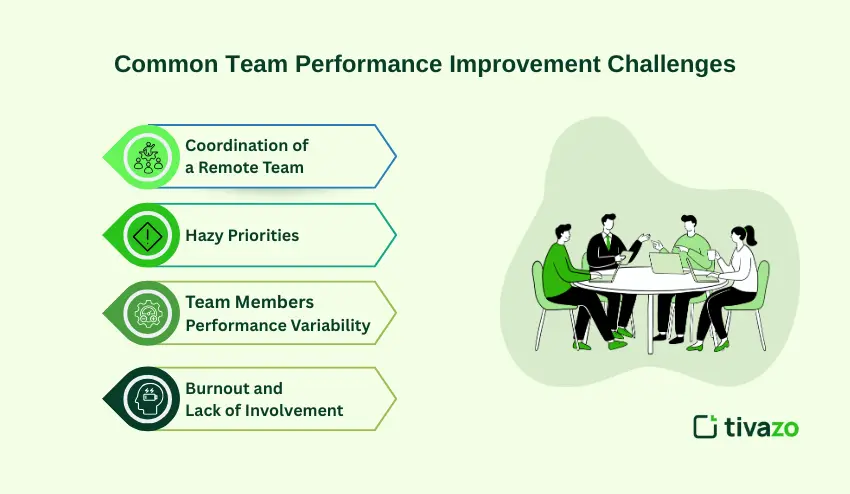
Even the best strategies have obstacles. Here are ways to overcome the most common team performance problems.
Challenge 1: Coordination of a Remote Team
Alignment is tough when working with distributed teams. Scheduling’s also much harder when multiple time zones are involved. Fix this by structuring async communication and forcing daily written updates. Time tracking becomes even more critical when working on distributed teams.
Challenge 2: Hazy Priorities
When everything is important, nothing is important. Limit focus to three to five key goals per quarter. If less than 60% of team time goes to your stated top priorities, your priorities aren’t actually prioritized.
Challenge 3: Variability in Performance within Team Members
Use the performance evaluation data to understand why some deliver while others struggle. Is it a skill issue among low performers? Are expectations unclear? Are they overloaded? Take action fast with concrete feedback based on performance analytics.
Challenge 4: Burnout and Lack of Involvement
Watch for warning signs in your time-tracking data: consistent overtime, weekend work, and minimal breaks are all bad news. Employee performance tracking needs to include well-being indicators, not just output metrics.
Making Team Performance Improvement Stick
“Gains made in the short term will not matter if performance declines over time.” Sustainability is achieved by developing new habits into your team’s “operating system.”
Make performance review a weekly ritual instead of an annual event. It should be brief and emphasize trends instead of individual data points.
Continue to measure team efficiency metrics even after you reach your goals. Performance changes when the measuring stops. Update your team performance management strategy on a quarterly basis. What works one quarter may not necessarily work the next.
Improved performance within the team is not about measurements, but about motivations. Instead, you should focus on systems to facilitate performance, not hinder, using workforce analytics as a guide for decision-making.