
Technology has become a support feature; it is the driver of how teams in the modern world work and collaborate. Technology in the workplace is transforming the productivity of all levels of workplaces, allowing employees to work smarter, faster, and more precisely with automation in collaboration software.
With the advancement in digital technology in the workplace, major changes in efficiency, communication, and decision-making are being experienced by businesses. Tech in the work environment, cloud computing, automation in the workplace, and productivity tools among employees decrease the amount of manual work and allow a workforce that is more nimble and technology-oriented.
This blog post will evaluate the ways that technology at work promotes productivity, discuss new technologies that are transforming the workplace, outline the main advantages and issues that technology may bring, provide actual statistics related to work, and provide ways to implement the technology in the workplace successfully to achieve long-term success.
👉You May Also Like: How Does AI Increase Productivity in the Workplace
How Has New Technology Affected the Modern Workplace
The nature of new technology has radically transformed the operation, communication, and competition of organisations. Use of technology in the workplace has taken the businesses out of manual and time-consuming processes into data-driven work processes. Workplace automation, business cloud computing, and workplace artificial intelligence are some of the tools that enable employees to perform their duties more effectively and with reduced mistakes and operational expenses.
Collaboration and flexibility have also been changed by the emergence of digital technology at work. The technology of remote work and tools of communication allow teams to work in real-time, no matter where they are. This has made technology and work place come together in a manner that has made them more connected, productive, and technology-driven, resulting in a workforce that is fast adapting to change.
What types of technology have recently changed the workplace?
New innovations have greatly transformed the technology in the workplace, such that organizations can now conduct their business more effectively and remain competitive. The use of digital technology in the work environment, including cloud-based systems and teamwork programs, enables staff to access information, communicate, and run projects without any inconvenience. These innovations decrease the number of delays, enhance the transparency of the workflow, and facilitate the implementation of flexible work arrangements.
Meanwhile, workplace technology has developed in the form of automation and artificial intelligence to reduce the amount of repetitive work and improve decision-making. Technology in work continues to redefine how things are done and how teams are made to perform, whether it is through cybersecurity tools that ensure the safety of company information or through employee productivity tools that help employees simplify their daily tasks.
Types of Technology That Have Recently Changed the Workplace
- Cloud computing for businesses
- Workplace automation tools
- Artificial intelligence in the workplace
- Collaboration and workplace communication tools
- Remote work technology
- Employee productivity and project management tools
- Cybersecurity in the workplace
- Smart workplace solutions
👉You May Also Like: How Time Tracking Can Transform Workplace Productivity
How to Implement New Technology in the Workplace
Implementation of new tools successfully demands a clear strategy that would harmonize the business objectives with the employees. To reap maximum advantage of technology in the workplace, organizations must begin by determining the areas of their weaknesses in productivity and then choose digital technology in the workplace that can address a given issue. This will ensure that technology and the workplace collaborate to enhance efficiency and not create complexity.
Change management and training are very important in adoption. The workers should know how technology in the workplace, e.g., automation software or teamwork tools, helps them in their day-to-day activities. Hands-on training, constant support, and effective communication are essential in persuading and successfully using technology in the workplace.
Lastly, companies need to review their performance periodically and improve their strategy. Tracking usage, gathering feedback, and enhancing workplace cybersecurity are some of the ways to ensure future success. By having a developed strategy, firms are able to create a technology-driven, flexible workforce that constantly enhances productivity.
8 Benefits of Technology in the Workplace
Organizations in the modern world use technology in the workplace to remain productive, competitive, and adaptable. From automation to collaboration tools, digital solutions keep on redefining the ways work is performed.
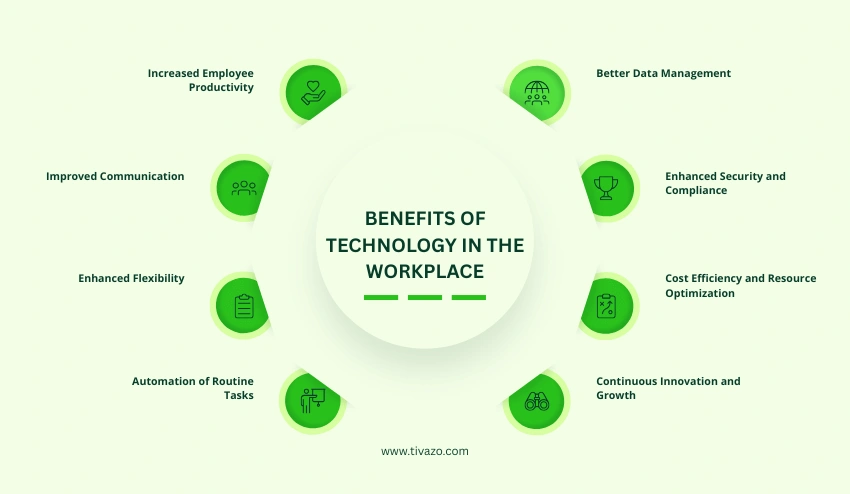
1. Increased Employee Productivity
Increased productivity of employees is one of the greatest advantages of technology in the workplace. Digital tools minimize the workload of manual tasks through automation of repetitive functions like data entry, scheduling, and reporting. This will enable the employees to concentrate on more strategic and creative duties.
In the workplace with digital technology, the work processes are streamlined and uniform. Employee productivity tools also assist the teams to manage their time more efficiently, prioritize, and minimize delays associated with inefficient processes.
Consequently, technology in the work places assist organizations to attain a quicker turnaround time, enhanced quality of output, and continued productivity growth.
2. Improved Communication and Collaboration
Team communication tools at work have altered the way teams relate and work together. Workplace technology is allowing real-time interaction through instant messaging, video conferencing, and shared digital platforms.
Remote and hybrid teams are particularly useful with these tools. Collaboration software has become crucial to technology and the workplace, as it is needed to guarantee transparency, alignment, and cross-departmental and cross-location collaboration.
Better communication will result in quicker problem-solving, better teamwork, and better decision-making within the organization.
3. Enhanced Flexibility and Remote Work
Remote work technology has transformed the place and manner of work for employees. Digital technology at work place enables one to access files, systems, and means of communication from any place safely.
This will help in improving the work-life balance and the satisfaction of employees. Flexible working arrangements can also help organizations to attract and retain talent.
In sum, workplace technology helps companies to stay flexible, receptive, and adaptive to adaptable work models.
📖Read More: Cracking the Productivity Paradox in the Age of Hybrid Work
4. Automation of Routine Tasks
Automation in the workplace has been one of the major sources of efficiency. Workplace technology relies on software and AI to perform robotic tasks and lessen the number of manual tasks and the chance of human error.
Automation enhances the speed of operation and offers uniformity in undertakings. It gives the employees a chance to redirect their attention to innovation and problem-solving as well.
Through adopting technology in the work environment, companies are able to enhance the efficiency with which they carry out their operations, as well as enable employees to contribute more value to the company.
5. Better Data Management and Decision-Making
Business cloud computing has transformed the way data is stored and accessed. At the workplace, technology allows organizations to gather, organize, and process data effectively.
The digital technology at the workplace will allow leaders to have real-time information on the performance, trends, and customer behavior. This enhances smarter and data-driven choices.
With enhanced data management, there will be enhanced forecasting, strategic planning, and general business development.
6. Enhanced Security and Compliance
There is a need to have cybersecurity in the workplace because digital systems are on the rise. Advanced security solutions are required in both technology and the workplace to ensure the safety of sensitive data and systems.
Security tools are used to ensure that organizations are able to prevent cyber threats, data breach and unauthorized access. They also make sure that they are in line with the industry regulations and standards.
Effective cybersecurity helps in the safe and secure use of technology in the workplace, which builds trust among the staff and customers.
7. Cost Efficiency and Resource Optimization
Although there might be a need to invest initially in the implementation of new tools, technology in the workplace will provide cost savings in the long term. Digital workflows and inefficiencies of operation are minimized through automation and labor expenditure.
Physical infrastructure and maintenance are not required in cloud-based platforms, as they are costly. Tech at work also assists companies in scaling resources according to demand.
This leads to the maximization of resources and better future returns on investment.
8. Continuous Innovation and Growth
Constant innovation is promoted by a workforce that is technologically oriented. At the workplace, digital technology allows experimentation, collaboration, and quick adaptation to change.
Modern tools enable organizations to react promptly to trends in the market and customer demands. Creativity and continuous improvement are assisted in the workplace through technology.
Such an innovative culture enables businesses to remain competitive and future-proof in a rapidly changing digital world.
Finally, productivity is hardly the only advantage of technology in the workplace. When there is a good fit between technology and the workplace, organizations are performing better in terms of performance, innovativeness, and long-term sustainability.
Technology in the Workplace Statistics
Technology in the workplace has seen rapid adoption, with 91% of businesses investing in AI and digital workplace tools and 95% of service firms, along with over 90% of healthcare and finance companies, implementing digital-first strategies. About 66% of organizations use cloud-based tools, while 78% prioritize digital transformation as a key business goal. AI usage is surging, with 75% of knowledge workers using generative AI and 92% of Fortune 500 employees leveraging AI tools like ChatGPT; 28% of US workers now use ChatGPT at work.
Productivity benefits are clear: 56% of businesses report higher efficiency, and unified digital workspaces can save employees up to 60 minutes per day, while 74% of employees say technology improves collaboration and remote work efficiency. However, 47% of digital workers still face challenges accessing information, highlighting areas for improvement.

Technology in the Workplace Advantages and Disadvantages
The use of technology in the workplace has changed the way businesses are conducted and has brought many benefits with it, though it has brought some challenges. The introduction of digital technology at the workplace also allows organizations to optimize their operations, communication, and overall productivity. Nevertheless, there are also some weaknesses that may arise as a result of dependence on technology, such as security threats and employee burnout. The key pros and cons are presented in detail below.
Advantages of Technology in the Workplace
- Increased Productivity – Technology in the workplace allows employees to automate repetitive tasks, manage projects efficiently, and collaborate in real time, resulting in higher output.
- Enhanced Communication – Digital technology in the workplace, such as video conferencing, instant messaging, and collaborative tools, improves communication among teams, especially in remote work settings.
- Cost Efficiency – Using technology in work processes can reduce operational costs by minimizing errors, saving time, and decreasing manual labor requirements.
- Access to Real-Time Data – Businesses can leverage workplace technology to access, analyze, and act on data quickly, enabling better decision-making.
- Flexibility and Remote Work – Technology in the workplace supports flexible schedules and remote work, improving work-life balance and employee satisfaction.
Disadvantages of Technology in the Workplace
- Security Risks – Increased use of technology and digital tools can expose organizations to cyberattacks, data breaches, and other security threats.
- Employee Burnout – Constant connectivity and reliance on workplace technology may lead to stress, overwork, and difficulty disconnecting from work.
- High Implementation Costs – Introducing new technology in the workplace often requires significant investment in software, hardware, and training.
- Dependence on Technology – Overreliance on digital technology in work processes may reduce critical thinking, creativity, and problem-solving skills among employees.
- Technical Issues – System failures, software glitches, and network problems can disrupt work, affecting productivity and efficiency.
While technology in the workplace offers numerous advantages such as enhanced productivity, communication, and flexibility, businesses must carefully manage the disadvantages, including security risks, costs, and employee well-being, to maximize its benefits.
Effective Use of Technology in the Workplace
Using technology in the workplace effectively requires a strategic approach to maximize productivity and enhance collaboration. Here are the key points to ensure digital technology in the workplace is used optimally:
- Align Technology with Business Goals – Choose tools and systems that support organizational objectives, such as collaboration platforms, project management software, or AI-powered solutions.
- Provide Comprehensive Training – Ensure employees are trained to use technology in work processes efficiently, reducing errors and resistance to new tools.
- Automate Routine Tasks – Implement digital technology in the workplace to handle repetitive tasks, freeing employees to focus on higher-value work.
- Enhance Communication – Use workplace technology like instant messaging, video conferencing, and collaborative platforms to improve team communication, especially for remote teams.
- Monitor and Measure Impact – Track performance metrics, productivity gains, and employee satisfaction to evaluate the effectiveness of technology in work operations.
- Encourage Flexibility and Innovation – Foster a culture where employees are encouraged to explore new tools and methods that improve workflow and efficiency.
- Regularly Update Tools – Continuously adapt to emerging technologies to maintain a modern, efficient, and competitive workplace.
By following these steps, businesses can ensure that technology in the workplace is used effectively to boost productivity, collaboration, and overall performance.
Conclusion
In conclusion, the importance of technology in the workplace has become a pillar of success in the new business era, which has stimulated productivity, improved collaboration, and more effective work processes. Both digital technology in the workplace, including cloud computing, artificial intelligence, and automation tools, collaboration and remote work tools, technology in the workplace enables employees to work smarter, make data-driven decisions, and quickly adapt to the evolving needs.
Although these problems are present, such factors as security threats and possible staff burnout, long-term planning, continuous education, and efficient use of technology in the working process guarantee long-term advantages. Through the adoption of these innovations, organizations have been able to establish a connected, agile, and technology-driven workforce that provides the organization with growth, innovation, and long-term competitive advantage.