In the contemporary competitive business environment, it has become difficult than ever to develop a high-performing team. That is where a talent assessment strategy will be applied. A decentralized recruitment and employee assessment strategy will make sure that your recruitment and retention strategy is in line with long-term organizational objectives, minimizes turnover, and eventually enhances workforce performance.
Key Highlights:
- What Is a Talent Assessment Strategy
- Why Talent Assessment Strategy Matters
- Key Components of a Successful Talent Assessment Strategy
- Types of Talent Assessments Used in a Strategy
- How to Build an Effective Talent Assessment Strategy
- Candidate Experience in a Talent Assessment Strategy
- Using AI and Technology
- Success Metrics for a Talent Assessment Strategy
- Navigating Legal and Compliance Issues in Talent Assessment
- Common Challenges and How to Avoid Them
What Is a Talent Assessment Strategy?
Talent assessment strategy is an organized method of assessing the abilities, capabilities, and potential of employees or job applicants. It offers evidence-based information to support recruitment, advancements, and training. In contrast to the old-fashioned techniques of hiring, when the resumes are usually considered as the main, and the interview is conducted, talent tests offer measurable and objective information, which may predict the performance in the job and its suitability in your company.
Basically, talent tests are useful in enabling firms to make better decisions on whom to hire, how to train the employees, and where to position them within the organization to have the greatest impact. It is an excellent instrument for enhancing organizational performance and decreasing turnover.
Why Talent Assessment Strategy Matters in 2026
The requirements of the workforce change with the changes in businesses. The emergence of remote work, talent pools across the globe, and constantly changing job descriptions render the talent assessment strategy.
- Data-Driven Decisions: Talent measurements offer empirically-grounded data, which can enable companies to make decisions grounded in facts rather than assumptions.
- Alignment with Organizational Goals: You can make sure that your company’s strategic objectives, culture, and values are congruent with your hiring processes (using a talent assessment strategy).
- Remote & Global Hiring Needs: In the globalized world today, a talent assessment strategy is a sure way to be able to assess people at all locations of the globe.
Key Components of a Successful Talent Assessment Strategy
An effective talent assessment strategy is critical in helping to make the correct choice of candidates and to achieve the growth of employees. It assists in the alignment of your team with the company’s goals and culture, as well as enhances the overall performance. An effective strategy is based on some key components that should be taken into consideration to develop a robust strategy:
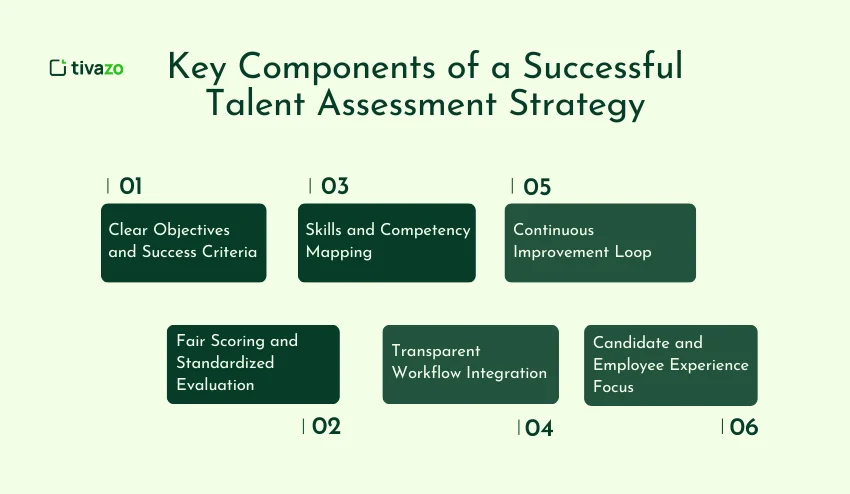
- Clear Objectives and Success Criteria
Determine the definition of success in each job and develop objective standards of assessment for candidates/employees. - Skills and Competency Mapping
Match the assessments to the exact competencies that are necessary in any position. - Fair Scoring and Standardized Evaluation
Make sure that you base your assessment process on unbiased and standardized evaluations to ensure all candidates get equal assessments. - Transparent Workflow Integration
Incorporate assessments in your hiring or development process in a smooth manner so that it is not cumbersome but value-added. - Continuous Improvement Loop
An effective talent assessment strategy is one that will develop with the needs of your company and will see to it that the process will become better with time, depending on the feedback and outcomes. - Candidate and Employee Experience Focus
Put the experience of the candidate and employees first. A good experience will go a long way in the way the employees will view their job and your company.
Types of Talent Assessments Used in a Strategy
Depending on the position, assessments are necessary to have the right candidates as well as to have employees who are constantly developing. Both techniques assist in assessing certain issues of the abilities, behaviors, as well as potentials of a candidate or an employee. The following are some of the most prevalent approaches to talent assessment strategy:
- Hard Skills Tests
Test the technical skills needed for the job. They are especially applicable to jobs that involve expertise (e.g., coding tests for developers). - Job Simulations
These examinations simulate real-life conditions to assess the performance of a candidate under real-life working conditions. - Soft Skills and Personality Assessments
It is important to know how your interpersonal skills, emotional intelligence, and cultural fit of a candidate will work in your organization. - Situational Judgment Tests
Test the candidates on their problem-solving capabilities in situational hypotheses. - Cognitive Aptitude Tests
Test the problem-solving skills, critical thinking, and learning ability. - Performance Reviews & 360 Feedback (for existing employees)
Frequent feedback systems enable you to estimate the growth and development of your existing employees.
How to Build an Effective Talent Assessment Strategy (Step-by-Step)
The creation of a talent assessment plan is to be thought over. The following are the nine steps to develop one:
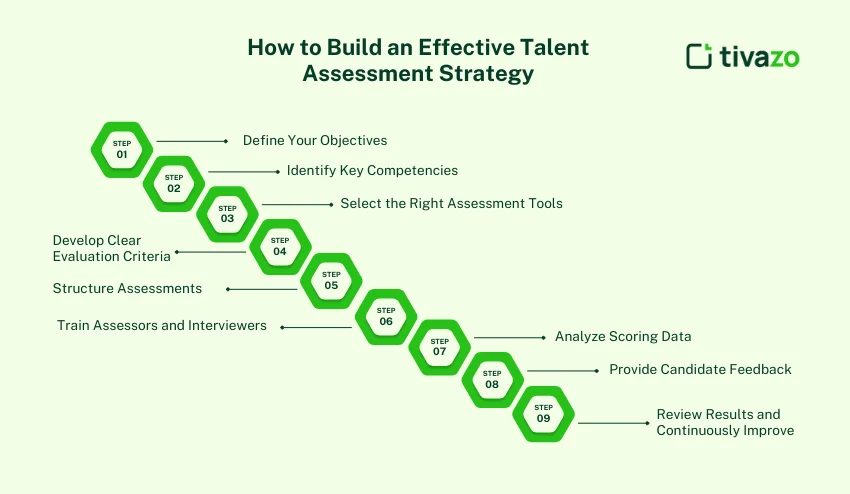
1. Define Your Hiring and Development Objectives
Know what you want to accomplish using your talent assessment strategy. Is the position you are recruiting a high-skill job? Or are you concentrating on long-term employee growth and recognizing future leaders? The rest of the process will be directed by clear objectives.
2. Identify Key Competencies and Role Success Factors
Find out what competencies are necessary to be successful in every position. These can be technical skills, communication ability, leadership capability, or industry knowledge. Being aware of these factors will enable you to evaluate the correct attributes in every candidate.
3. Select the Right Assessment Tools
Select tools that assess competencies identified in the best way. This can be in the form of a job simulation, skills test, personality test, or cognitive aptitude test. The appropriate tools will help to get a full picture of the candidate and their abilities and potential.
4. Develop Clear Evaluation Criteria
Ensure that you select a clear set of success criteria for each assessment tool and role. Clear criteria will provide the uniformity and fairness that should assist the assessors in making objective decisions according to certain performance metrics.
5. Structure Assessments into the Hiring Workflow
Make the evaluations a part of the hiring. Make sure every step of the process is smooth, and it does not strain candidates. An effective workflow plan will make the candidates involved and enhance the efficiency of the recruitment process.
6. Train Assessors and Interviewers
Provide relevant training to the individuals involved in the hiring or evaluation process with the aim of ensuring that they adequately evaluate the candidates without bias. Training will make sure that the assessor is well familiar with the tools to use and assess candidates in an equitable manner.
7. Analyze Scoring Data and Reduce Bias
Make objective and data-driven judgments of candidates. Make sure that scoring is uniform. Concentrating on data, you reduce human bias and provide a more impartial process of evaluation that is more indicative of the actual abilities of the candidate.
8. Provide Candidate Feedback
Always give positive feedback to candidates following appraisals. This assists them in getting better and demonstrates to your company that they are concerned about their development. Actionable and positive feedback can improve your brand as an employer and motivate future candidates.
9. Review Results and Continuously Improve
Conduct a frequent talent appraisal procedure. Evaluate what is working and what is not, and apply the same to improve. Constant review processes will keep your strategy up-to-date, and will also make you stay competitive in terms of attracting the best talent.
Candidate Experience in a Talent Assessment Strategy
The experience of the candidates is very important to attract the best talent and save the reputation of your company. Applicants who feel respected during the evaluation process will accept the offers and refer their friends to your organization. These are the ways to make sure the candidates feel respected during the process:
- Reduce Test Fatigue: Do not subject the candidates to protracted tests.
- Keep Communication Transparent: Open reports on the progress of the evaluation process can be used to ease the minds of the candidates.
- Ensure Accessibility and Inclusivity: Make sure that your examinations are available to everyone (both able and unable to work), even people with disabilities.
Using AI and Technology in Talent Assessment Strategy
The talent assessment process is being transformed by AI and technology. The following are some of the ways through which you can include them in your strategy:
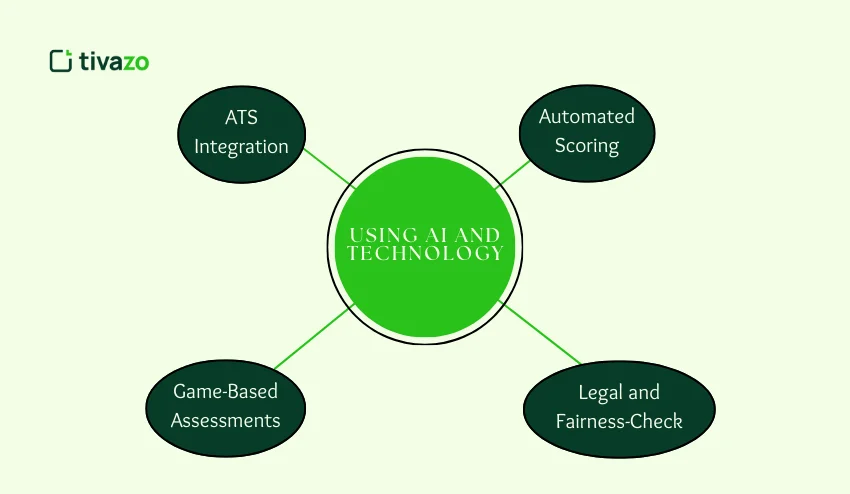
- ATS Integration: Integrate evaluation tools into your Applicant Tracking System (ATS) so that you can manage data easily.
- Automated Scoring & Analytics: With the help of AI-based tools, mark tests and interpret findings more effectively.
- Game-Based Assessments: Gamify assessments by making them interesting and close to the reality of a job scenario.
- Legal and Fairness-Check Tools: Check AI tools to make your assessments legal and fair.
Success Metrics for a Talent Assessment Strategy
To track the effectiveness of your strategy, consider the following main metrics, which will help you to have a clear picture of the effectiveness of your talent assessment. These ratios would allow you to assess the efficiency of your hiring choices as well as the influence on your overall company objectives:
- Quality of Hire: To what extent does your hiring method match job performance?
- Time to Hire: Does your strategy reduce the time to hire?
- Retention Rate: Is there a longer retention of your hires?
- Candidate Satisfaction: Do the candidates have a positive attitude towards their experience?
- Diversity Improvements: Do you have a strategy that assists in diversifying your workforce?
Navigating Legal and Compliance Issues in Talent Assessment
Legal and compliance issues are important; thus, one should always be mindful when developing a talent assessment strategy. Any mishaps in this case may lead to discrimination suits, legal actions, or loss of reputation. The need to comprehend and comply with those laws is extremely important to balance the fairness in the employment decision and ensure that your strategy keeps in line with constantly changing employment regulations.
Key areas to consider include:
- Equal Opportunity Laws: Be sure that you have adhered to Equal Employment Opportunity (EEO) laws on assessment. This involves not being biased based on race, gender, religion, disability, or any other characteristics that are under protection.
- Disability Accommodation: Accommodate candidates with disabilities so that all are able to complete the assessments according to the Americans with Disabilities Act or ADA.
- Data Protection and Privacy: GDPR in Europe and other privacy laws in different countries of the world mean that it is important to safeguard the personal information of the candidates. Make public your methods of storing and using assessment data.
- Consistency and Transparency: Adopt a common procedure with all candidates in order to be fair. Make your scoring and evaluation scheme transparent and available to all stakeholders.
By adhering to these legal standards, not only are your talent assessment strategies adhering to the law, but you are also developing a sense of trust and credibility with the prospective candidates.
Common Challenges and How to Avoid Them
There are several challenges that talent assessment strategies can be challenged with, and thus undermine their effectiveness. The following are some of the common pitfalls to overcome and prevent:
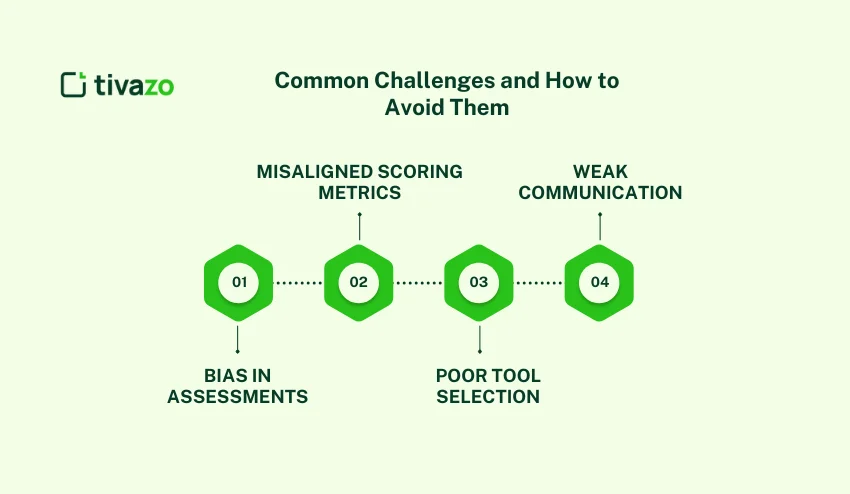
- Bias in Assessments
Prejudice may also be present in judgment when the instrument or assessor is unconsciously prejudiced or biased. To assure fairness, periodically test your assessments on the grounds of bias and educate your evaluators on how their personal biases can be avoided. Equalize assessment standards and use objective information to the greatest extent to make decisions more fair. - Misaligned Scoring Metrics
The scoring measures ought to be directly proportional to the job competencies and performance measures. Poor scoring techniques may give erroneous assessments. To prevent it, make sure your scoring rubrics are standardized and aligned to the skills and attributes that should be present to be successful in the position. - Poor Tool Selection
All the assessment tools fit every role. The inappropriate hires can be caused by the use of irrelevant or generic tools. It is necessary to choose the tools that are specific to the job requirements and can successfully measure the competencies you are attempting to test. Use tested, role-specific measures to enhance the validity and accuracy of the results. - Weak Communication
Poor or non-regular communication would make the candidates doubt their position in the recruitment process or become anxious. As a way of preventing this, make the candidates aware of their progress, establish clear expectations, and offer feedback where necessary. Open communication has the benefit of creating a good candidate experience and enhancing your employer brand.
Conclusion
Developing a proper talent assessment plan is paramount to organizations that seek to recruit the best talent, improve employee growth, and success of the organization. With the appropriate planning of every step, defining the levels of success to the choice of the appropriate tools, your assessments can be helpful in providing useful insights and make well-founded choices of hiring and developing.
It is important to keep in mind that a powerful talent assessment plan is not merely about filling vacancies; it is also about using the process of hiring to meet the objectives of the organization, promote diversity, and enable a lasting employee development. The trick is to change depending on the changing workforce, incorporating technology and remaining legal with all the steps.