The working environment in the digital world is changing more rapidly than ever in the current fast-paced world. WFH abbreviation has likely become the term that you have been bombarded with on email, Slack, or LinkedIn, but what does it actually entail, and why has it become such a big trend? WFH, or Work From Home, is no longer just a luxury but will change the face of the modern workplace, altering the communication, collaboration, and workplace productivity dynamic of a team.
It might be that you are a remote worker, or you are a manager of a remote team, or you are just wondering about the future of work, but whatever the case may be, becoming familiar with the wfh abbreviation is the first step to succeeding within this new realm. Here in this blog, we are going to deconstruct its meaning, discuss its advantages and disadvantages, and provide 7 effective trends and tips to be more productive working at home, including how software like Tivazo can make your working-from-home life smarter, more efficient, and devoid of stress.
What does wfh abbreviation really mean?
Whenever you scroll through work-related chat, Slack, email, or Twitter posts, then chances are that you have encountered the acronym WFH. But what is it – and why has it become so much a commonplace in the modern work environment?
WFH = Work From Home.
In some cases, individuals will say working at home, but in a hurry, typing in the chat or schedule, a short-term WFH abbreviation is less time-consuming but means the same thing.
In general, the term WFH abbreviation means remote work – performing job duties by working at a home office, in a co-working company, a cafe, or any other location other than the conventional venue.
WFH has become a trend in the popular culture of work
Remote work is not a fad or a benefit anymore; it is transforming into an organizational reform.
Here’s why:
Improvements in communication devices and technologies (video-conferencing, cloud storage, collaboration platforms).
- Globalization and distance work teams: Organizations are recruiting talent all over the world.
- Work-life balance: Workers are becoming more flexible, commuting less to work, and have more control over their schedule.
- Economy of money: Good economies are made by the employers and employees – less commuting, less office rent, less overhead.
- Pandemic acceleration: COVID-19 caused many organizations to experiment with (and succeed in) remote work, and many of them found it efficient enough to keep it.
Regardless of whether you are a company owner, team leader, or a remote worker yourself, there are significant gains that can be achieved by welcoming WFH. However, the WFH abbreviation does not work magic: you have to be disciplined, structured, and have appropriate tools to succeed.

WFH: The Pros and Cons What you should know
It would be worthwhile to look at both sides of the coin before plunging into best practices. The following is a table giving a summary of the benefits and the pitfalls of remote work.
| Benefits (Pros) | Challenges (Cons) |
| Flexibility: Work at your own pace and do not have to commute. | Social isolation/lack of social interaction. |
| Superior ways of living and additional family or recreational time. | Such distraction at home (family noise, household chores) |
| Lowered commuting expenses and time | The absence of demarcation between work and personal life. |
| International work opportunities (work in foreign companies) | Challenges in teamwork/communication, and postponements. |
| Prospect of increased productivity (reduced office politics, flexible schedules | Risk of being overworked – “always on” culture. |
| Employers save on overhead and real estate | Security issues: privacy of data, unprotected networks. |
This knowledge can be used to establish achievable expectations and create a successful WFH arrangement.
The 7 WFH Work (and Work WELL) tips
The following are the seven best strategies that remote employees and managers can use to ensure that wfh abbreviation is not only a luxury, but also a high-performance style.
1. Establish a Special Workspace.
It is nice to have a designated workspace at home, even though it could be a corner, to get your brain into work mode.
Tips:
- Select a location that has good light, minimal distractions, and acceptable ergonomics (desk + chair).
- Separate personal and work things – do not work in bed or on the couch.
- Be prepared with basic equipment: nice internet, working laptop/PC, noise-cancelling headphones (in case necessary).
- A special place can be used to replicate the psychological distance between office and home.
2. Define and Stick to a Routine
Since houses are not accompanied by regular routines, a loss of structure is one of the greatest dangers of WFH.
- Establish regular work hours – come to work and leave at approximately the same time.
- Include frequent and brief pauses to prevent burnout (eat, stretch, rest).
- Observing pre-work and post-work rituals – e.g., morning coffee + planning, evening shutdown: log out, clean workspace, turn off notifications.
Discipline comes with routine, and it brings consistency to life, particularly when you do not have a manager breathing down your neck.
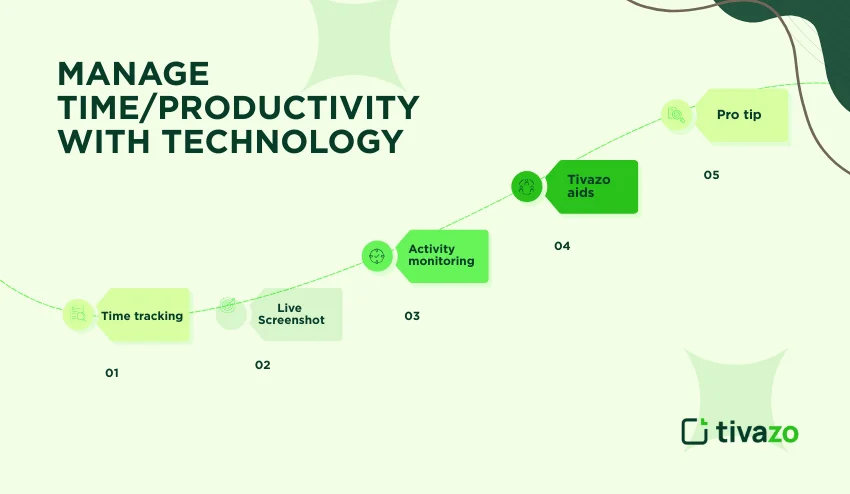
3. Manage Time/Productivity with Technology
Visibility and accountability are one of the main pillars of successful WFH, both individual and managerial. This is where such a tool as Tivazo comes in.
The productivity of the WFH abbreviation is increased by Tivazo
- Time tracking: Keep an account of the time spent at work so as to keep track of yourself (or your team).
- Live screenshots: Get snapshots of your team’s work – helps managers to track the progress without micromanagement.
- Activity monitoring/reporting: Visualize how much time is spent on activity, periods of idle time, and time spent in action – the perfect way to improve productivity based on the data.
- Tivazo aids: Remote workers to be focused, quantify their performance, and prove that they are productive to employers by offering transparent metrics.
- Pro tip: Are you a member of a distributed team? – Make everyone use Tivazo. This streamlines the coordination, accountability, and output tracking.
4. Value Effective Communication
Telecommuting is flourishing on open and aggressive communication. Lack of physical co-location can lead to an accumulation of misunderstandings or delays.
Consider these practices:
- Brainstorming, planning, or complicated discussions can be performed using synchronous tools (video calls, voice chats).
- Send updates, reporting, or feedback using asynchronous tools (messaging apps, shared docs).
- Post status updates / daily briefs- keeps everyone on the same track even in different time zones.
- Communicate too much when uncertain – when there is friction, make things clear.
5. Provide Specific Goals, Deliverables, and Deadlines
Having the right hours on the clock does not ensure production. Productivity is result-oriented.
- Tasks Tracking (e.g., Kanban board, to-do list, weekly sprints).
- Divide large tasks into smaller achievements – smaller to monitor, less intimidating.
- Establish specific deliverables and target dates.
- Periodically (weekly or bi-weekly) review the results of the review and change priorities accordingly.
6. Keep Work-Life Boundaries
We can also mention the flexibility as one of the largest advantages of WFH abbreviation; however, it may be a threat, provided it is not managed properly.
- Establish working schedules and notify relatives or roommates.
- Do not allow just one more email after dinner; have fixed working and non-working timings.
- Work and personal devices should not be used interchangeably.
- Personal time, exercise, and hobbies – make time and be balanced in your everyday routine.
7. Create a remote-friendly Culture and Habit Loop
When you lead a distributed team, it is not just tools and discipline that will make you successful in WFH abbreviation; culture is important.
Remote-friendly culture is characterized by:
- Trust: do not micromanage, trust workers to perform.
- Routine visits: weekly phone calls, team meetings, updates.
- Recognition & feedback: compliment good work, give constructive feedback.
- Shared processes: workflows, documentation, and a body of knowledge.
- Flexibility: honor alternative time zones, personal engagements – allows work-life balance.
When culture, process, and tools all meet, WFH abbreviation is not only workable but thriving.
How Tivazo can solve Common WFH Problems and How
Remote work is challenging, even with all the best intentions. The following are some of the common problems – and how they are solved by tools + habits. List of wfh abbreviation below:
1. Issue: Insufficient Control / Dread of Slacking
Fix: Time-tracking + screenshot option of Tivazo. Managers can check the working hours – not with suspicion. Employees are always motivated because they know that the work they do will be recorded.
2. Issue: Time Management: Never-Finishing, Always-Working
Solution: Have working hours defined, have definite deliverables, and have Tivazo monitor current hours worked. Make comparisons between planned and actual to prevent overwork and detect inefficiencies in wfh abbreviations.
3. Communication Gaps Across Time Zones
Solution: apply structured updates – shared documents, daily/weekly summaries, status dashboards. Keep it up with phone calls; do not leave anything hanging.
4. Issue: Low Motivation, Isolation, or Burnout
Solution: Use routine, frequent breaks, check-ins with social people, and offline periods periodically. Visualise work pattern – identify overwork or low rhythm – with Tivazo reports and change it.

Future of WFH Abbreviation: Trends to Watch
With the remote work steadily changing, the following are some of the trends that are likely to influence the concept of WFH abbreviation in the next few years:
Hybrid Work Models Will Dominate: A great number of businesses will go hybrid, i.e., part-time in the office and part-time at home. Flexibility will be key.
Data-driven productivity monitoring: As the likes of Tivazo continue to emerge, an increasing number of companies will become output-over-input orientated – based on performance and not hours spent.
Well-Being and Work-Life Integration: With remote work breaking down the boundaries, firms will prioritize mental health support and flexible schedules, as well as wellness programs.
Remote Compensation Model, Global Talent and Local Pay: Employers will access universal talent bases; remote compensation plans will change to consider the cost-of-living disparities.
Here you can see why WFH abbreviation can be the change in our near future.
Conclusion
WFH abbreviation is not merely a slogan, but it is a culture, a mentality, and how the 21st century can redefine work. WFH can provide the freedom, flexibility, productivity, and work-life balance when done disciplined, structured, transparent, and with the right tools (such as Tivazo).
As both an individual in an environment as a freelancer, a remote worker, or a manager in a distributed team, being serious with WFH abbreviation, with organization and responsibility, will be worth it. Follow the tips above, install your system, and make remote work work to your benefit.
Are you willing to go a step further with your remote work? Make your visit to Tivazo and find out how time-tracking, monitoring, and productivity information will change your working experience at home.