What is the secret to projects that go off without a hitch while others go into overtime, cost overruns, and burnout? The answer, as always, is one thing: resource allocation.
Resource allocation is what makes or breaks a project. Do it well, and teams meet their deadlines without burning out. Do it poorly, and even the most brilliant teams will struggle to get the job done.
In this guide, we will walk you through the various types of resource allocation and why they are important to project management, efficiency, and business strategy. Whether you are balancing workload, budget, or capacity, you will learn how companies are able to put the right resources in the right place at the right time.
What is Resource Allocation?
Resource allocation refers to a strategic process of allocating the available resources to tasks, projects, or departments in order to realize goals efficiently in terms of people, time, money, equipment, and materials. In project management, it helps in ensuring that the correct resources are allocated to the correct activities at the correct time, eliminating bottlenecks, evenly allocating the workloads, and optimizing productivity.
Project management institute (PMI) indicates that effective allocation of resources extends beyond scheduling, but also allocation of limited resources according to the priorities of the business in order to bring the most value. It implies that organizations will always be in conflict of needs, foresee risks, and rearrange allocations when projects change.
In practice, resource allocation might look like:
- Assigning team members to specific tasks based on skills and availability.
- Planning time allocation to meet strict deadlines.
- Distributing budgets across multiple initiatives.
- Ensuring equipment or materials are available when needed.
Done well, resource allocation improves resource utilization, minimizes waste, and ensures smoother project execution. It is a cornerstone of resource management techniques, helping leaders adapt to changing priorities while keeping projects on track.
Why is Resource Allocation Important?
Resource allocation is what keeps your business running without burning out your team or blowing your budget. When you allocate well, projects move forward. When you don’t, everything slows down.
Make the Most of What You Have
Every business has limits. Limited budget, limited people, limited time. Resource allocation helps you work within those limits smartly. You direct your best people toward your most important work and spend the budget where it creates the most value. That is how efficient businesses stay ahead.
Keep Projects on Track
Without proper allocation, projects stall. Tasks get delayed, budgets run dry, and deadlines get missed. Good allocation ensures the right people are assigned early, timelines are based on actual availability, and tools are ready when needed.
Protect Your Team
Overworked employees lead to errors, missed deadlines, and ultimately, turnover. Allocations ensure that workloads are evenly distributed, making employees feel supported, not overwhelmed. This alone will cut down on burnout and turnover, two of the most costly issues a business can have.
Make Better Decisions
With your resources exactly where they are, decision-making becomes simpler and quicker. You can identify which projects are staffed too heavily, which are struggling, and where resources need to be moved when the project changes. This is true control.
Benefits of Proper Resource Allocation and Consequences of Getting It Wrong
Proper resource allocation does not just help projects succeed. It shapes how your entire business performs. Getting it right brings real, measurable advantages. Getting it wrong creates problems that compound over time.
Benefits of Proper Resource Allocation
When resources are allocated thoughtfully, the results show up fast.
- Projects are delivered on time. Tasks are assigned based on real capacity. Deadlines are realistic. Teams know exactly what they are responsible for.
- Budgets go further. Money flows to initiatives that matter most. There is less waste, fewer surprises, and better return on every dollar spent.
- Teams perform better. When people are working on the right things at the right time, productivity improves. So does the quality of their output.
- Decisions become clearer. You spend less time reacting and more time planning. When you can see where every resource is deployed, you make faster and smarter calls.
- Employee retention improves. Balanced workloads mean fewer burnt-out employees. People stay longer when they feel their time and skills are being used well.
Consequences of Inefficient Resource Allocation
Poor allocation rarely looks like a resource problem at first. It shows up as missed deadlines, budget overruns, low morale, and high turnover. By then, the damage is already done.
Here is what typically goes wrong:
- Top performers get overloaded. The most reliable people get pulled into everything. They burn out. Their work quality drops. Eventually, they leave.
- Budget gets misused. Money flows to the loudest requests, not the most strategic ones. High-impact projects get underfunded.
- Timelines collapse. A delay in one project pushes back everything connected to it. One missed allocation decision creates a chain reaction.
- Teams lose trust in leadership. When people are constantly under-resourced, they stop believing leadership can plan effectively. That is hard to fix.
The cost of poor allocation is not just financial. It is cultural. And culture takes far longer to repair than a budget.
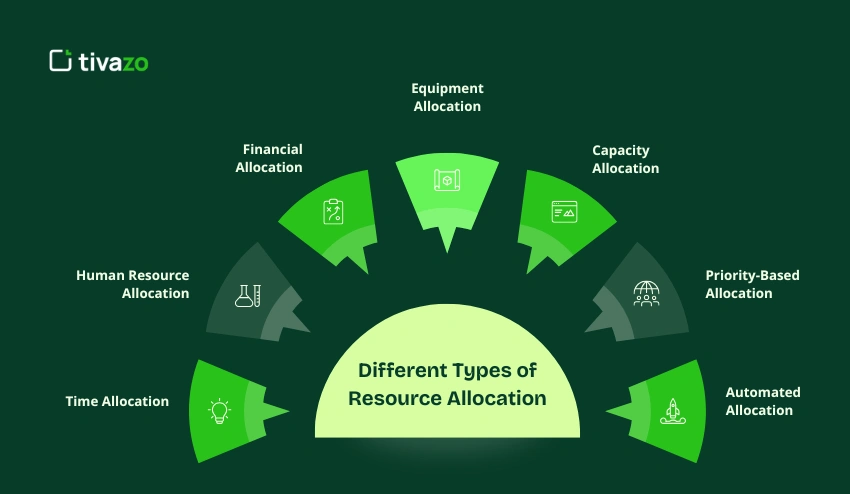
7 Different Types of Resource Allocation
All the project managers and business leaders must be aware of the different types of resource allocation so that their efficiency is fully realized and the wastage is minimized. With the correct allocation approach, be it time, budget, and skills, you could enhance resource usage and result in a higher outcome.
We will discuss the seven major types of resource allocation that organizations employ to allocate their resources in an effective manner.
1. Time Allocation
One of the most common types of resource allocation is time allocation, whereby tasks and times are allocated carefully on hours and time. This approach will make sure that projects run progressively without overwhelming members of the team. Time happens to be one of the most limited resources; thus, time allocation in the projects is effective and helps eliminate bottlenecks and enhance the project scheduling.
Managers in sectors such as IT or marketing usually utilize Gantt charts, timelines, as well as agile sprint planning in order to make proper allocation of time. This can be used to balance the workload and, at the same time, give the appropriate attention to every task. The costly delays, deadlines, and low productivity may be caused by the misallocation of time.
The actual use of time-based resource allocation is that it helps in aligning deadlines with the availability of resources. Managers can also be able to determine what is critical, use the Critical Path Method (CPM), and coordinate the flow of a project with proper planning of time. This strike is invaluable to the satisfaction of teams and clients.
2. Human Resource Allocation
Human resource allocation, as compared to the other types of resource allocation, is most likely to have an effect. It entails allocating team members to the projects according to their skills, experience, and availability. This practice will make sure that workers are not overworked or underworked and thus have better methods of managing their resources.
When properly planned, the human resource allocation strategy involves skill mapping, and the right amount of talent is put in the right position. If there is a need to assign percentages of time to various projects, they can be managed by managers to track availability. This avoids overloading of top performers and allow others to have a chance of being developed, hence resulting in resource optimization.
More so, job satisfaction and low turnover are encouraged through matching jobs with the strengths of the employees. Combining workload balancing and skill development options will not only make the project a better place to be but also enhance employee morale and retention in the long run.
3. Financial Allocation
Finance allocation can be defined as the allocation of budgets to tasks, departments, or projects. It is considered one of the most demanding types of resource allocation since financial resources are what make the difference between successful and failing projects. Projects could also fail to generate ROI because, without having financial resource planning, they could end up without funds halfway through.
Practically, organizations use funds depending on the strategic objectives, strategic goals, or returns. As an example, more urgent projects such as product launches or digital transformation projects usually get a greater portion of the budget. This approach to resource allocation is equal to the distribution of money where it has the most.
A good financial allocation plan also comprises contingency funds to take care of unexpected expenses. Businesses can optimize flows of financial resources by constantly measuring and distributing according to performance to be able to provide capital to drive growth.
4. Equipment Allocation
The process of deploying equipment or machinery, or technology to a task or project is referred to as equipment allocation. It is one of the most important types of resource allocation in the construction, manufacturing, and IT industries, as the unavailability of equipment can stall an entire process.
To illustrate, the placement of specialized machines in the appropriate production line will ensure a smooth-running line and avoid downtime. Using resource distribution systems, the companies are able to plan and monitor the usage of equipment in more than one project to prevent conflicts. This results in an increase in the rate of resource usage and an increase in the efficiency of the production cycles.
The equipment allocation is now less cumbersome with the use of technology, real-time tracking, IoT sensors, and digital asset management platforms. With the help of such tools, organizations can not only save time spent on idle time but also help to save on costs through avoiding the same purchases or needless rentals.
5. Capacity Allocation
Capacity allocation entails the examination of the amount of work that could be done by a team, system, or resource during a specific time. These types of resource allocation prove to be very handy in an organization that has various projects being handled at the same time. It allows leaders to avoid over-committing themselves and assists in making good capacity plans.
Historical data, forecasts, and workload trends are usually used by managers to make realistic expectations. They can match project requirements to team capabilities and therefore make sure that they are not overstretching their resources. This method also aids in the optimization of the resources, wherein no resources go to waste.
Capacity-based allocation enhances sustainability in the long term by balancing between short-term deliverables and long-term growth. It allows the company to be innovative and keep its resources malleable enough to address unforeseen issues.
6. Priority-Based Allocation
Priority-based allocation is done to make sure that the most urgent projects are initially allocated. Among all the forms of resource allocation, this one is the most strategic goal-oriented one since it is more concerned with business value maximization. Priority-based allocation aids in decision-making when there is a shortage of resources, and it is used to select those that are of greatest priority.
The technique is based on the prioritization of tasks or projects in terms of urgency, deadlines, or ROI. As an example, a project that is related to compliance or a client output can be assigned resources at the expense of internal projects. In this manner, resource management techniques directly contribute to the organizational strategy and undertakings for customers.
With priority-based resource allocation, organizations eliminate wastes, and unnecessary activities with low value do not consume scarce resources. It is an active methodology that enhances nimbleness and ensures that investments are geared towards long-term success.
7. Automated Allocation
The latest type of resource allocation is automated allocation, which involves the use of algorithms, AI, and software to allocate resources. Contrary to the manual allocation, automation takes into account a wide range of factors, such as skills, availability, and deadlines, to give optimal distribution.
Through the project management tools, companies are able to monitor the utilization, balance workloads, and project upcoming needs automatically. This not only enhances accuracy but also wastes less time for managers who would have taken long hours to schedule the project. Automated allocation also makes sure that the resources are always in tandem with the current business priorities.
With the increasingly complex businesses, automation will be a critical component of the resource allocation strategies. It reduces the chances of human error, enhances transparency, and enables leaders to respond swiftly to any sudden demand fluctuations.
Learning how to allocate these seven forms of resources will provide you with the knowledge to allocate resources more efficiently, minimize wastage, and become more productive. The trick is that you have to fit each type of allocation to the exact needs of your project, but you always need to track its optimization.
What Are Some Examples of Resource Allocation?
Resource allocation varies based on the type of industry and the context. However, the underlying principle remains the same in every case. It is about allocating what you have to what you need.
Example 1: Human Resource Allocation at a Marketing Agency
There is a marketing agency that is handling three different clients at the same time. The project manager checks the current workload and availability of each team member. The most senior copywriter is allocated to the most valuable client project. The young copywriters are allocated to the smaller clients.
This is an example of human resource allocation.
Example 2: Budget Allocation Across Business Units
A mid-sized company has a fixed annual budget. The executive team reviews performance data and strategic goals. They allocate a larger share of the budget to the product development team because it is tied to a new revenue stream.
The marketing team receives a smaller allocation this quarter. Their campaigns are in a maintenance phase and do not require heavy investment right now.
Budget follows strategy. That is the point of financial allocation.
How these types map to common methods
Knowing the different types of resource allocation is not enough, but the second step is to observe how they relate to the popular project management techniques used. Allocating the different types of allocations to a technique assists teams in the execution of strategies in an efficient manner, enhancing the utilization of resources and also preventing bottlenecks. Various projects involve various strategies, and matching the types of allocation to effective methods is a sure way of achieving the best results.
As an example, time allocation is usually accompanied by the Critical Path Method (CPM), which determines the necessary tasks and steps to complete the deadlines. Likewise, resource leveling and resource smoothing methods are both closely associated with human resource allocation and capacity allocation, which help eliminate over-commitment and distribute the workload across teams. The approaches also incorporate the concepts of project scheduling to make sure that the tasks are performed in the most effective sequence.
Other allocation types map naturally to modern tools and approaches:
- Financial allocation aligns with budgeting frameworks and cost management methods, ensuring resources are directed where they generate the most value.
- Priority-based allocation complements value-driven or portfolio management methods, which prioritize initiatives based on business impact.
- Automated allocation uses algorithms, and AI is integrated into project management software, creating optimized resource distribution with minimal manual intervention.
In knowing such mappings, organizations are able to exploit the kind of resource allocation tactics in a concerted effort to integrate the conventional styles, such as CPM, with the contemporary styles, such as AI-based automation. This is so that resources (human, financial, or physical) are never wasted on the project, aiming to maximize the output, reduce wastage, and improve overall resource optimization.
How to Allocate Resources: Key Processes in Resource Allocation
Resource allocation is not a one-time decision. It is a process you repeat across every project. When you follow a clear process, allocation becomes predictable and far less stressful.
Here is how to do it step by step.
Step 1: Define What the Project Needs
Start by getting specific. Break the project into tasks. Identify what skills each task requires. Estimate how long each task will realistically take.
Vague projects lead to vague allocations. The more specific you are upfront, the fewer surprises you face later.
Step 2: Audit Your Available Resources
Before assigning anyone to anything, check what you actually have available.
Look at:
- Who on your team has capacity, and when
- What does your current budget position look like
- What equipment or tools are already in use
- Which existing commitments are already drawing on resources
Many allocation mistakes happen because leaders assume availability that does not exist. A quick audit prevents double-booking and overpromising.
Step 3: Prioritize Based on Business Impact
Not every project deserves equal resources. Some initiatives directly drive revenue or serve key clients. Others can wait.
Rank your projects by urgency, strategic value, and deadlines. Allocate your strongest resources to your highest-priority work first. Then fill in from there.
This step will almost always surface conflicts. That is a good thing. It is far better to catch them in planning than mid-execution.
Step 4: Assign and Communicate Clearly
Once decisions are made, document them. Make sure every team member knows:
- What they are working on
- For how long and at what capacity
- Who to escalate to if priorities shift
Ambiguity here creates confusion. Clear communication prevents it.
Step 5: Monitor as the Project Runs
Allocation does not end at the planning stage. Projects change. People get sick. Priorities shift.
Build regular check-ins into your process. Review whether resources are being used as planned. Check if anyone is approaching overload. Adjust early rather than waiting for a crisis.
Step 6: Reallocate When Things Change
When monitoring surfaces a problem, act fast. The longer you wait, the more expensive the fix will be.
To stay flexible:
- Build small buffers into your resource plans
- Cross-train team members where possible
- Keep a shortlist of contractors you can call on when internal capacity runs short
The best resource allocators treat it as a living process, not a checkbox. They revisit, adjust, and keep priorities at the center of every decision.
How Software Can Optimize Resource Allocation
Managing resource allocation manually works for small teams. But as your business grows, spreadsheets and calendar blocking are no longer enough. The right software gives you the visibility and accuracy that manual methods cannot match.
Modern resource allocation platforms help you:
- See who is available and when, in real time
- Automatically match tasks to team members based on skills and workload
- Forecast upcoming capacity gaps before they become problems
- Track budget and utilization from one centralized place
- Reassign resources quickly when priorities shift
The result is fewer delays, less guesswork, and faster decisions across every project you run.
Popular tools businesses use include Resource Guru, Float, Monday.com, Smartsheet, and Microsoft Project. The right choice depends on your team size, project complexity, and budget.
Software does not replace good judgment. But it gives you the information you need to make better allocation decisions, faster and with far less manual effort.
Conclusion
To sum up, it is important to know the types of resource allocation, be it time allocation and human resource allocation, financial, equipment, capacity, priority-based, and automated allocation, in order to use the resource management techniques and better use of resources. Knowing the mapping of each type of allocation to the popular techniques such as project scheduling, capacity planning, and workload balancing, the organizations can optimally allocate the resources, decrease the bottlenecks, and match the efforts with the strategic priorities.
Application of these strategies not only maximizes resource optimisation, but also enables projects to be delivered in an efficient way, within time and budget, and eventually leads to improved business results. Are you willing to implement these allocation strategies in the following project?