Most people do not wake up thinking today is the day they will get fired. To the majority of workers, however, it is a surprise when they receive the notice of being fired, not due to their incompetence at work, but because they did not understand what was on the line. Fireable offenses characterize that line.
Fireable offenses are not HR lingo to managers. They are the regulations that ensure that the company does not get into any legal trouble, poisonous behavior, and performance failures. To the employees, they are the unseen line that determines whether an error will result in a warning or the last paycheck.
This guide simplifies fireable offenses in simple language, with actual workplace examples. As a manager, you will be taught to deal with them in a fair and legal manner. As an employee, you will get to know what you can do that will quietly jeopardize your employment and how to prevent it before the ship sinks.
What Are Fireable Offenses?

Fireable offenses refer to acts or conducts that are against the company policy, workplace standards, or employment law and can be used in a legal court to terminate an employee.
These, simply put, are the things that an employee does that an employer has a right to fire them. Other offenses that can cause termination are considered as fireable offenses, and others are first subjected to warnings and corrective actions. This distinction normally relies on company regulations, severity of the act, and local labor legislation.
To illustrate, the theft of company property is nearly always fireable. One time failure to meet deadlines is not generally. Yet, missing deadlines after being warned of it a few times can turn into one. That is why to comprehend the fireable offenses, it is necessary to examine both the action and the tendency to behave in a certain way during a certain period of time.
Why Fireable Offenses Matter for Managers and Employees
Fireable offenses at work affect more than just individual jobs. They influence workplace culture, legal safety, and trust between employers and employees. When both sides understand what qualifies as a fireable offense, problems are addressed earlier and handled more fairly.
Why Managers Need to Understand Fireable Offenses at Work
For managers, understanding fireable offenses at work is essential for consistency and legal protection. Poor handling of termination decisions can lead to lawsuits, employee resentment, and damaged team morale.
Clear knowledge helps managers document misconduct, follow progressive discipline, and align actions with company policy. It also ensures that similar fireable offenses at work are treated the same way across departments, reducing claims of favoritism or discrimination.
Example:
A manager who properly documents repeated policy violations and performance issues is far better protected than one who terminates an employee based on frustration or a single incident.
Common Fireable Offenses in the Workplace
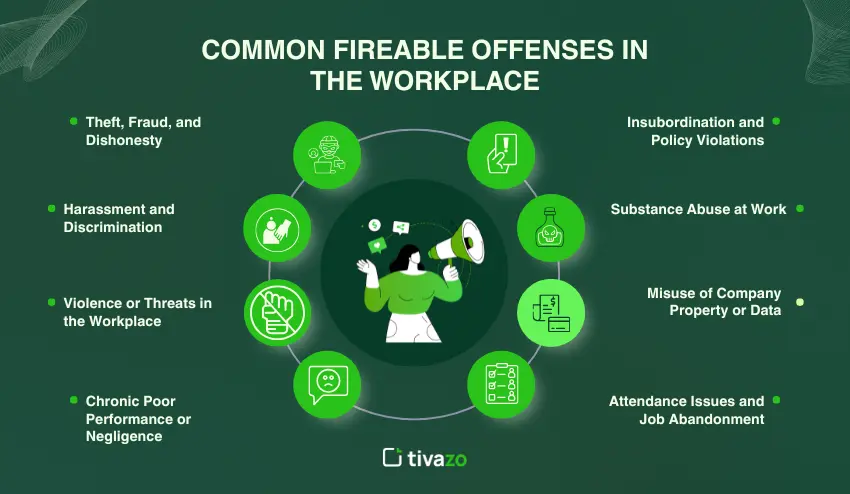
Work related fireable offenses are often categorized under a few broad categories. Some lead to instant firing, whereas others can be fired after a series of violations or warnings. Being aware of these typical fireable offenses enables managers and employees to be aware of severe risks at an early stage.
1. Theft, Fraud, and Dishonesty
The most obvious fireable offenses include theft and dishonesty at work. This involves stealing cash, stationery, information or making up documents like expense reports or timesheets.
Even minor cases of dishonesty are capable of ruining trust. When trust is destroyed, the employers tend to believe that termination is the way to save the organization.
Example:
Even a minimal loss of money may lead to the dismissal of an employee who overstates work hours on a timesheet.
2. Harassment and Discrimination
Discrimination and harassment are grave offenses that can be fired upon leading to litigation against companies. This covers verbal, physical or online conduct that is based on race, gender, religion, age, disability or other covered characteristics.
The majority of companies have zero-tolerance policies towards such fireable offenses in the workplace, particularly when the complaints are backed by evidence or eyewitnesses.
Example:
Constant rude remarks on a colleague may result in instant dismissal upon investigation.
3. Violence or Threats in the Workplace
Violence of any type, threats, or intimidation is virtually a fireable offense. This is in the case of actions towards the colleagues, clients or the management.
Employers do not ignore such fireable offenses at work since they endanger safety and cause a hostile environment.
Example:
Even when there is no physical harm, the threat of a colleague can lead to instant termination of employment.
4. Chronic Poor Performance or Negligence
When the poor performance persists despite coaching and training as well as formal warnings, poor performance becomes a fireable offense. It can also be negligence like failure to perform essential duties.
To prevent conflicts, managers should record the performance problems in a clear manner prior to termination.
Example:
Failure to meet deadlines after performance improvement plans may result in legal termination of an employee who has missed them on several occasions.
5. Insubordination and Policy Violations
Being unwilling to obey reasonable orders or publicly questioning authority may turn into a dismissal offense at the workplace. This also includes policy violations, including the breaking of safety regulations or going through the approval procedures.
Context matters. The first time results in a warning, whereas the second and subsequent instances of insubordination can result in termination.
Example:
Regular refusal to abide by the company procedures even after being warned in writing can be a reason to be dismissed.
6. Substance Abuse at Work
Working under the influence of drugs or alcohol is often cited as a reason to fire an employee, particularly in safety-sensitive positions. It is also common in many companies that substance use is not allowed during working hours or on company premises.
Example:
Coming to the workplace drunk or smoking illegal drugs at the workplace may result in immediate dismissal.
7. Misuse of Company Property or Data
The use of company devices, data, or systems to commit unauthorized activities is an increasing type of fireable offenses in the workplace. This consists of data breaches, transfer of confidential information, or overuse of company tools on personal grounds.
Example:
The disclosure of sensitive client information to third parties may lead to immediate dismissal.
8. Attendance Issues and Job Abandonment
High levels of absenteeism, constant lateness or not reporting at all may be terminated as a fireable offense after some time. Job abandonment normally happens when a worker ceases to appear at all.
Example:
Absence of several days of work with no communication can be considered voluntary resignation/ termination.
Gross Misconduct vs Minor Misconduct
Fireable offenses are not all handled equally. There are acts that result in instant termination and those that need first to be warned and corrective measures. The distinction often lies in the fact that the behavior is treated as either gross misconduct or minor misconduct.
What Counts as Gross Misconduct?
Gross misconduct is the extreme acts that are very harmful to trust, safety, or the legal position of the company. These are the work-related crimes that can easily warrant termination without any prior notice to the employee.
Stolen money, violence, severe harassment, fraud, and intentional data breach are typical instances of gross misconduct. Since the risk is so great, employers do not usually have to go through the steps of progressive discipline before taking action.
Example:
When an employee is found to have stolen confidential client data, he or she can be dismissed on the same day following an investigation.
Examples of Minor Misconduct That Can Become Fireable
Less serious problems that are considered minor misconduct are lateness, minor policy breaches, or unprofessionalism. These actions in themselves do not typically result in termination.
But once the little wrongdoing is repeated and reported, it may become a dismissable offense in the workplace. Progressive discipline is a common approach and it begins with verbal warnings and then moves to written warnings and termination notices.
Example:
When an employee is warned about his/her attendance several times, he/she can be dismissed eventually.
Gross vs Minor Misconduct Comparison
| Factor | Gross Misconduct | Minor Misconduct |
|---|---|---|
| Severity | Very high | Low to moderate |
| Immediate termination | Usually yes | Rare |
| Warnings required | Not always | Usually required |
| Legal risk | High | Lower |
| Examples | Theft, violence, harassment | Lateness, minor policy issues |
Legal Requirements in Fireable Offenses
Workplace rules are not the only fireable offenses at work. They have legal consequences on the employer and employees as well. Mishandling termination may result in lawsuits, fines, and reputation.
The Basics of At-Will Employment
Employment in most areas is at-will. This implies that employers have the right to fire employees on any legal ground, including those that can be termed as fireable offenses provided that the ground is not discriminatory or unlawful.
At-will employment however does not imply that employers can sack employees at will. The decisions made in termination should not be against the company policy and employment laws.
Example:
The employee may be dismissed because of recurring policy breaches but not because he or she reported about workplace harassment.
The Employer risks of Wrongful Termination
Employers are under legal risk where they do not document a fireable offense or do not apply the rules in a consistent manner, even when such an offense exists. It is difficult to fire one employee and overlook the same action in others, which may lead to lawsuits.
Written warnings, clear documentation and involvement of HR minimizes chances of wrongful termination cases.
Example:
Terminating a single worker due to attendance problems and letting others get away with the same act may lead to discrimination issues.
Employee Rights and Due Process
The rights of employees are also applicable in cases where there are fireable offenses at the workplace. These can be the right to reply, seek clarification or appeal a decision as per the company policy or labor laws.
Knowledge of due process assists the employees in defending themselves and also makes investigations impartial.
Example:
A misbehaving employee might be allowed to give his or her side before being terminated.
Common Mistakes Companies Make When Handling Fireable Offenses
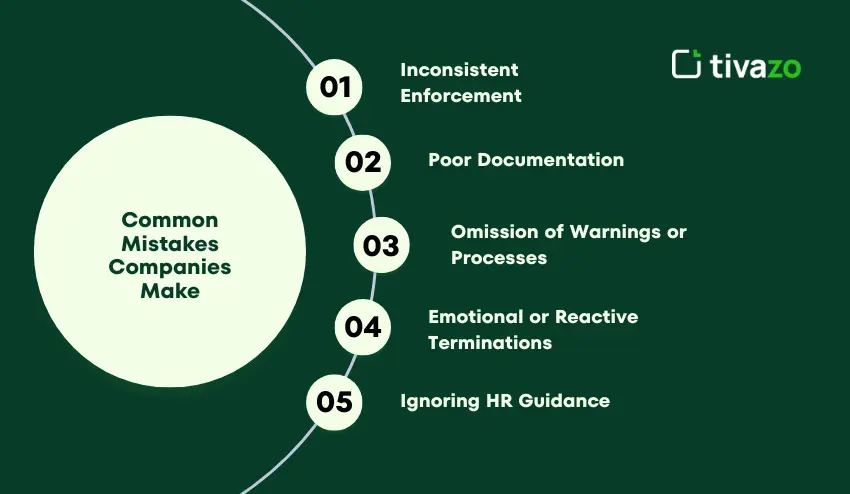
To deal with fireable offenses at work in a fair and effective manner, avoid the following pitfalls:
- Inconsistent Enforcement:
Enforcement of rules on employees in an unequal manner may create the impression of favoritism and legal claims. - Poor Documentation:
It is difficult to prove the termination in case of not keeping the records of the warnings, incidents, or performance issues. - Omission of Warnings or Processes:
Firing employees without adhering to company policies or progressive discipline adds more risk, particularly when it comes to minor misconduct. - Emotional or Reactive Terminations:
Making termination decisions based on anger, frustration, or personal bias can result in wrongful termination claims and low morale. - Ignoring HR Guidance:
Not involving HR in serious issues can lead to mistakes in compliance, documentation, and fairness.
Conclusion
Both managers and employees should know the fireable offences in the workplace. To managers, explicit knowledge gives fair treatment, legality, and a good working culture. To the employees, it secures their jobs, reputation, and future career growth.
Fireable offenses must be prevented by being aware, documented, consistent in policy, and proactive in communication. With both parties responsible, the work environment is safer, more productive, and legally safe.
Knowledge is power and the most effective tool to prevent a shock and to make the work environment respectful, safe, and successful.