What is Modular Organization?
The concept of modular organization is a structural method in which an organization is subdivided into small and autonomous units referred to as modules, which perform certain functions or tasks. These modules work independently and are linked to each other via a central structure that makes sure that they are aligned to the overall objective of the business. This organization enables organizations to coordinate operations in a more effective way since it clearly defines roles, duties, and work processes.
The greatest advantage of modular organization is flexibility and scalability. Businesses can edit, append, outsource, or delete individual modules without affecting the whole system, and thus, businesses can easily adjust to market, technology, or expansion needs. Consequently, modular organization promotes agility, cost-effectiveness, and quicker decision-making in volatile settings.
👉You May Also Like: What is a Dynamic Work Environment, and How to Create it in a Workplace?
Importance of Modular Organizations
Modular organizations are very important in enabling contemporary businesses to remain flexible, scalable, and competitive. Modular organization systems enhance productivity and flexibility in industries by reducing complex operations into manageable units.
1. Enhanced Flexibility and Adaptability
Modular Organization enables a business to react fast to fluctuating market requirements by changing the individual modules without affecting the entire unit. This adaptability facilitates a smoother transition in the time of growth, restructuring, or innovation.
The fact that each of these modules is more or less independent makes it possible to redesign workflows, roles, or processes at relatively low risk. This flexibility renders modular organizational structures suitable in dynamic and rapidly changing environments.
2. Improved Operational Efficiency
The modular organizations break down work into distinct modules and thereby simplify operations and remove bottlenecks. Every unit has its definite duties, enhancing productivity and accountability.
It is a well-organized but adaptable system that provides better coordination and minimizes duplication in work. Consequently, the modular organization systems facilitate a quicker decision-making process and enhanced resource utilization.
📖Related: 4 Best Decision Making Styles
3. Scalability for Business Growth
Scalability is one of the largest benefits of a modular organization. As the operations increase, businesses can easily add or enlarge the modules or increase the size of the already existing modules without necessarily having to redesign the entire organization.
Such scalability makes modular organization design cost-effective and future-oriented. Companies are able to expand in a sustainable manner and retain some control and consistency among teams and departments.
4. Cost Optimization and Resource Management
The cost of modular organizations is low because the companies can outsource or automate certain modules when the need arises. The specific resource allocation strategy reduces unnecessary costs.
Organizations can be financially more efficient by ensuring that they invest in areas where they are doing well or in areas that are a necessity. Modular systems also make sure that resources are put to strategic use as opposed to being dispersed in the organization.
5. Faster Innovation and Competitive Advantage
In the case of a modular organization, innovation is facilitated since separate units are able to experiment and make changes by themselves. This minimizes risk and promotes creativity and constant improvement.
Since the latest ideas are testable within particular modules, the businesses remain agile and competitive. Fast innovation cycles are enabled by modular organizational structures that enable companies to remain ahead of the changing markets.
Modular Organization Characteristics
Modular Organization is characterized by an adaptive and flexible structure that divides work into interdependent but connected modules. All modules are somewhat autonomous and have specific tasks or functions, but these tasks or functions are in line with the overall goals of the organization. This strategy improves efficiency in their operations, increases the optimization of their resources, and facilitates growth that can be scaled. Using modular organization systems and flexible storage of tasks, the businesses can react fast to the changes in the market, simplify the process, and ensure order in the workplace without any clutter.
Key Characteristics of Modular Organization:
- Autonomous Modules: Each unit functions independently but remains aligned with the overall business objectives.
- Flexibility and Adaptability: Modules can be added, removed, or reconfigured without affecting the entire system.
- Clear Division of Work: Roles and responsibilities are well-defined, improving accountability and efficiency.
- Scalability: Organizations can expand or contract modules according to growth needs or market demand.
- Resource Optimization: Enables efficient use of resources by focusing on high-priority or specialized modules.
- Fosters Innovation: Independent modules can experiment and innovate without disrupting other parts of the organization.
- Efficient Decision-Making: Smaller, focused units allow faster and more effective decisions within the system.
What Are the Advantages of Modular Organization?
The advantages of the modular organizations are as follows:
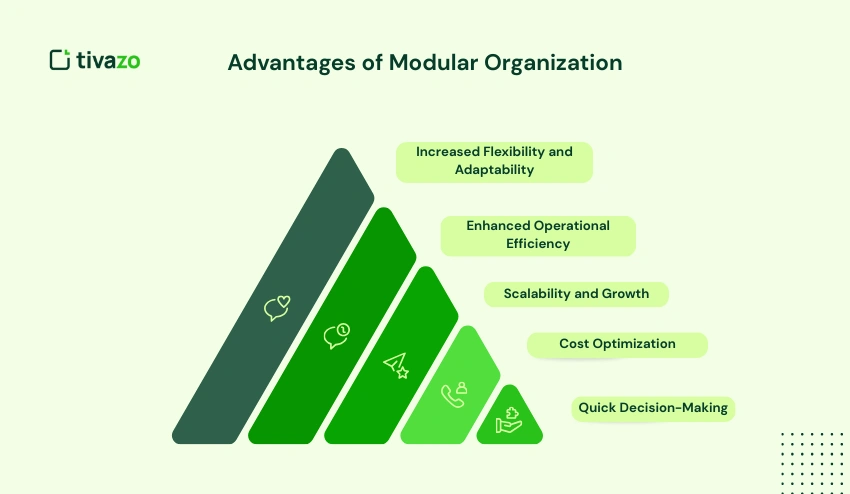
1. Increased Flexibility and Adaptability
Modular organization enables businesses to make alterations to individual modules autonomously, and hence it is simple to act in accordance with the market change or alteration in the business operations. Through modular organization systems, firms are able to reorganize teams, workflows, or processes without interfering with overall productivity so that their management approach is flexible and agile.
2. Enhanced Operational Efficiency
Modular organizations make work simpler by breaking it into precise units, which minimizes redundancies. The modules are specialized in terms of tasks, thus enhancing coordination, accountability, and overall effectiveness, and making the organization more productive and organized.
3. Scalability and Growth
Modular organization systems allow businesses to expand smoothly through the addition, growth, or elimination of modules. This feature enables businesses to expand in a sustainable way, sustain new projects or teams, and ensure a well-organized and effective working process.
4. Cost Optimization and Resource Management
In a modular organization, the business will be in a position to allocate resources appropriately and outsource or even automate certain modules where deemed appropriate. This is a focused strategy that will reduce operational expenses at the expense of ensuring that both human and material resources are utilized effectively.
5. Fosters Innovation and Quick Decision-Making
Free modules promote experimentation and innovation without the interference with other aspects of the organization. With a clearly defined decision-making process inside each module, businesses will be able to implement new ideas much quickly, remain competitive, and maintain an environment that is progressive and agile.
What Are the Disadvantages of a Modular Organization?
The disadvantages of the modular organizations are as follows:
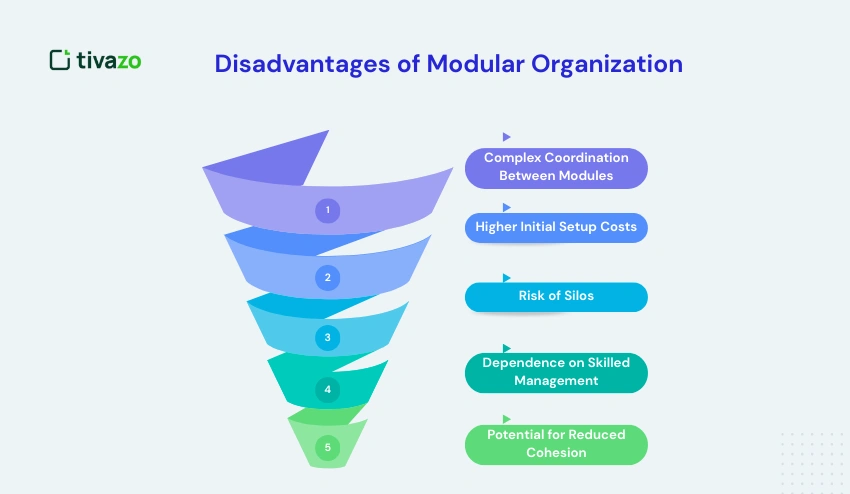
1. Complex Coordination Between Modules
Although modular organization encourages independence, it is difficult to coordinate several modules. Misalignment may have an implication on the general productivity and efficiency of workflow when there is no proper communication and monitoring of the modular organization systems.
2. Higher Initial Setup Costs
A modular organization may demand investment in special systems, technology, and training. Modular organization may enhance efficiency in the long term, but the initial expenses of designing and combining autonomous modules may be quite high for some firms.
3. Risk of Silos
Independent modules may occasionally work in isolation, and this results in information silos. In the absence of appropriate supervision, modular organization can result in disjointed communication and teams concentrating too much on their module and forgetting the overall objectives of the organization.
4. Dependence on Skilled Management
A modular organization needs good leadership and managers who are skilled in organizing different modules. Ineffective leadership may decrease the effectiveness of the system of modular organization and lead to uneven performance of the units.
5. Potential for Reduced Cohesion
Since the modules are semi-independent, employees might not have a sense of belonging to the entire organization. Otherwise, this may affect the culture of the company, teamwork, and involvement of the employees without proper management within a modular organizational structure.
Modular Organization Examples
Modular organizations are also common in any industry where flexibility, scalability, and specialization play an important role. These organizations are able to react to changes swiftly by dividing the operations into semi-autonomous modules and allocating the available resources effectively, as well as ensuring efficiency.
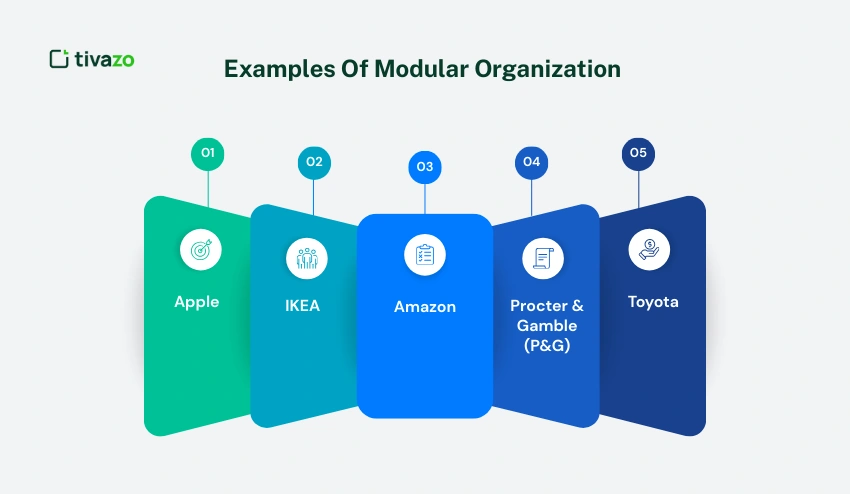
1. Toyota
Toyota adopts a modular organization system in the production system. Various departments, like engine assembly, chassis manufacturing, and quality control, work more or less independently but are combined into the whole manufacturing process. This modular design enables Toyota to scale up production, customize its vehicles, and ensure high efficiency in its world operations.
2. Apple
The product development at Apple is based on a modular organization. The modules separated include hardware, software, and design, which are then brought together to form a unified product. This solution allows quick innovation, efficient workflow, and flexibility to handle complex projects in several teams.
3. IKEA
IKEA implements modular product design as well as supply chain management. Furniture products have been developed in modular form that can be assembled into various forms, and the supply chain has been developed with specialized modules to cater to production, logistics, and managing inventories. This system enables IKEA to be efficient and flexible in the international markets.
4. Amazon
Amazon uses the concept of modular organization in its operations and logistics. Various modules like order processing, inventory management, and delivery services work in a semi-autonomous manner but are integrated to facilitate the running of smooth operations. Such a modular system enables Amazon to grow fast, use resources efficiently, and keep customers satisfied in every corner of the globe.
5. Procter & Gamble (P&G)
P&G uses a modular organization within its product units such that product lines are semi-autonomous units. These modules concern marketing, production, and R&D of individual products, though they do not contradict the overall corporate strategy of the company. Such a structure is effective in ensuring that P&G is efficient in innovation and responsive to market needs.
Modular Organization Framework
A Modular Organization Framework is an established structure that determines the design, relation, and management of modules of an organization to attain the overall business goals. It offers a guideline on how to subdivide work into semi-autonomous units that have certain tasks, functions, or projects, but they are aligned with the strategic objectives of the company.
The framework will usually have a well-defined role, responsibility, and workflow of every module, and communication and coordination systems to facilitate smooth integration. Through a modular organization structure, companies are able to maximize the available resources, improve operational effectiveness, and be flexible to operate in the ever-changing markets. The system allows scalability, quicker decision making, and innovation, and is therefore ideal where companies seek to balance between flexibility and structured control.
Key Components of a Modular Organization Framework:
- Independent Modules: Separate units focusing on specialized functions or projects.
- Central Coordination: A core system or management team ensuring modules align with overall objectives.
- Defined Workflows: Clear processes and responsibilities for each module to maintain efficiency.
- Flexibility Mechanisms: Ability to add, remove, or reconfigure modules as needed.
- Communication Channels: Systems for information sharing and collaboration across modules.
How to Build a Modular Organization?
Building a modular organization involves designing a flexible, scalable structure where independent modules operate in alignment with overall business objectives. By leveraging modular organization systems, companies can create adaptable units that handle specific functions, optimize resources, and respond quickly to market changes.
1. Define Core Functions and Modules
Start by identifying key business functions and dividing them into semi-independent modules. Each module should have a clear purpose, responsibilities, and measurable goals to ensure efficiency and accountability within the modular organization framework.
2. Establish Clear Roles and Responsibilities
Assign specific roles to each module and clarify reporting lines to prevent overlap and confusion. Clear responsibilities within each module improve operational efficiency and streamline workflows, helping the organization stay organized and productive.
3. Implement Communication and Coordination Systems
Effective communication channels are crucial for a modular organization to function smoothly. Use tools and protocols that connect modules while maintaining their independence, ensuring that all teams align with overall strategic goals.
4. Focus on Flexibility and Scalability
Design modules to be adaptable, so they can be added, removed, or restructured as business needs change. A flexible modular organization system allows the company to scale operations efficiently without disrupting overall performance.
5. Monitor, Evaluate, and Optimize
Continuously track the performance of each module and make improvements where needed. By regularly evaluating modular organization systems, businesses can optimize resource use, enhance productivity, and maintain agility in a competitive market.
Conclusion
In summary, modular organization offers businesses a flexible, scalable, and efficient way to manage operations by dividing work into independent, adaptable modules. By implementing these systems, companies can optimize resources, streamline workflows, foster innovation, and respond quickly to market changes. From improved operational efficiency and cost optimization to enhanced decision-making and competitive advantage, modular organizational structures provide the agility and resilience needed in today’s dynamic business environment. Leveraging a modular organization framework ensures that each module operates effectively while contributing to the organization’s overall goals, making it an ideal approach for sustainable growth and long-term success.