A great hiring process cannot just be accomplished by advertising the position. The vast majority of applicants are weeded out way before you send an offer, and a large percentage of them do not even complete the application. A recruitment funnel will help you perceive the entire hiring process. It indicates the areas where applicants lose interest, the speed of their application, and which efforts attract superior talent.
Recruitment funnel allows hiring teams to detect bottlenecks, enhance communication, cut costs, and make decisions more intelligently. It transforms guesswork into information; therefore, you are able to identify the right individuals and occupy roles at a quicker rate.
This guideline covers the definition of a recruitment funnel, the functioning of each of the 7 key stages, and the measurements you need to monitor. You will also know how to construct the funnel, how to measure the conversion rates, how to examine the real-life stories, and use a basic template and go to work today.
Key Highlights:
- What is a Recruitment Funnel
- Why the Recruitment Funnel Matters for Hiring
- Recruitment Funnel Stages
- 4-Stage Hiring Funnel
- How to Build a Recruitment Funnel Step-by-Step
- Key Recruitment Funnel Metrics
- Recruitment Funnel Effectiveness Formula
- Recruitment Funnel Analysis
- Recruitment Funnel vs Candidate Journey
- Common Recruitment Funnel Mistakes to Avoid
- Recruitment Funnel Template
What is a Recruitment Funnel?
A recruitment funnel refers to a process that follows a series of steps to demonstrate how an applicant goes through the process of hearing from the company in the first place to finally accepting an offer. In every phase, there are those candidates who proceed and those who drop out. That drop-off provides you with unambiguous data for powerful recruitment.
How it works
All the stages of hiring are translated into funneling:
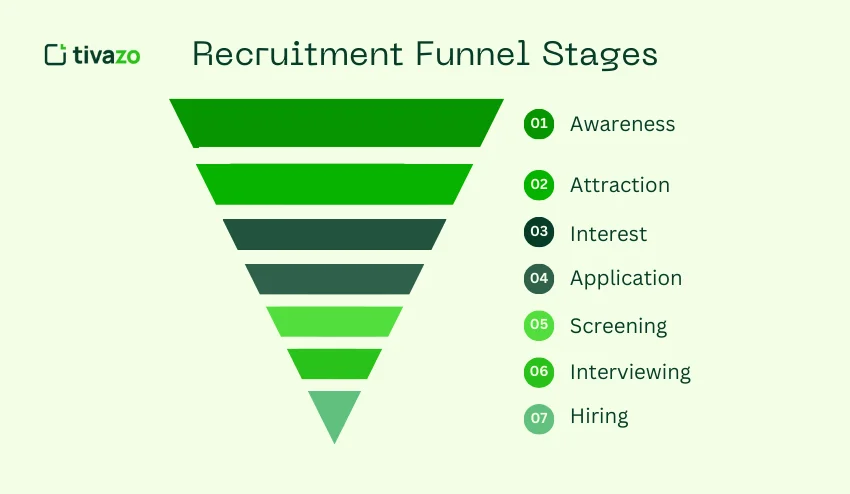
- Awareness
- Attraction
- Interest
- Application
- Screening
- Interview
- Hiring
On the funnel, most of the people are aware of the company. There are not many who take the offer of employment near the bottom. This is used to see where recruitment stagnates or loses track on the part of the candidates.
Why companies use recruitment funnels
- To fill roles faster
- To reduce hiring costs
- To treat candidates fairly
- To achieve a better quality of hires
- To make decisions that are informed rather than made out of a hunch
Why the Recruitment Funnel Matters for Hiring
Any slight alteration of the funnel can have a huge effect. Here are the key benefits:
- Speeds up hiring
- Statistical data is used to indicate the places of delays to enable a prompt response. It also assists you in eliminating processes that slacken everyone. Time-to-hire is lowered, and you get the best of the best before other firms.
- Improves candidate experience
- Answers to everything and minimizing process step owls’ frustrations. Applicants are made to feel that he respects them when information is provided promptly. An enhanced experience also enhances the image of your employee, and it leads to a higher job offer acceptance.
- Brings better-fit candidates
- Applicants remain interested when the funnel is appropriate to the position and the firm. The first thing is that you draw people who know what the job requires. This translates to high performance and reduced post-hiring turnover.
- Helps track results
- You will be able to track the development at every step and correct the dead ends before the failure of hiring. Result tracking also assists HR teams in demonstrating the actual business value of recruitment. They will have confidence in making requests for tools and support with proof.
Recruitment Funnel Stages (7-Stage Model)
A recruitment funnel illustrates how a person enters a company by initially hearing about it and finally ends up taking up an offer. The goal and the conversion rate are measurable at each stage.
1) Awareness – People first learn about you
This is the first place where the candidates are informed about the existence of your company. It contains job advertisements, careers sites, and employer branding. An extended reach will assist in getting more people to learn about your mission and values. The more presence you have, the easier it becomes to fill the future positions.
Examples: Social media posts, employee stories, events of career events.
2) Attraction – Individuals develop an interest in a job
In this case, the candidates determine whether or not to visit your vacant positions. Specific job descriptions and specific channels can enable you to get people who are suitable for what you want. Interest is increased when job advertisements reach the right target audience. An enhanced attraction also provides you with a bigger pool of good candidates.
Examples: Job boards, referrals, talent communities.
3) Interest – People start to consider your company seriously
Applicants desire to learn more about the job and the working environment. Effective communication and valuable information will keep them entertained and minimize turnover. When the questions are responded to promptly, then individuals are sure to proceed. Trust is also obtained through a friendly tone.
Examples: Career newsletters, hiring FAQs, Recruiter outreach.
4) Application – People submit their details
There is an input of candidates where they provide their details and apply to the job. A short version would result in more applications being done. Mobile-compatible pages are also effective. Certain guidelines eliminate confusion and save time among people. In situations where the application is simple, there is less turnover of candidates.
Examples: One-Click apply, uploading a resume, and updates on the status of an application.
5) Screening – You choose who moves forward
Recruiters will go through resumes and skills to determine who progresses. Clarity in terms of criteria makes teams fair and free of bias. Quick decision-making will retain the best talent. Effective screening emphasises the skills that are relevant. It also reduces the wastage of interviews and effort.
Examples: ATS filters, skills tests, phone screens.
6) Interviewing – Team and candidate evaluate each other
The recruitment managers and teams interview job seekers to verify their suitability. Well-structured interviewing is useful in comparing the candidates in a manner that their time is not wasted. Candidates feel appreciated when the interviews are conducted cordially. Firm discussions will also assist the two in making sure decisions.
Examples: structured interviews, assignments, and panel interviews.
7) Hiring – You make the offer
The last process is to offer and assist the candidate to integrate well. An attentive onboarding strategy and swift feedback convert yes to a powerful beginning. The first week is a great week and results in high retention and performance. Understandable expectations make new employees feel prepared and friendly.
Examples: Support first day, reference checks, offer letters.
4-Stage Hiring Funnel
Some companies use a 4-stage hiring funnel:
| 7-Stage Funnel | 4-Stage Funnel |
|---|---|
| Awareness | Attract |
| Attraction | Convert |
| Interest | Assess |
| Application | Hire |
| Screening | |
| Interviewing | |
| Hiring |
Both work. The 7-stage model provides more detailed information.
How to Build a Recruitment Funnel Step-by-Step
Do the following steps in the following order:
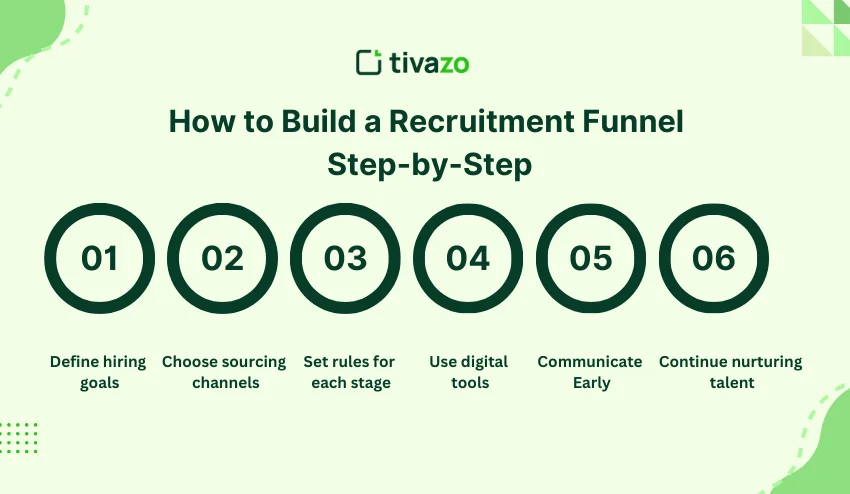
Step 1: Define hiring goals
Choose who you should hire, when, and what skills are important. Goals also make you develop appropriate messages and select the most appropriate channels in your search.
- How many hires are needed?
- What skills are required?
- What timeline is realistic?
Step 2: Choose sourcing channels
Determine the locations of your target applicants on the internet. Bring more qualified individuals into the funnel using such channels as job boards, referrals, social platforms, and talent pools.
Examples:
- Indeed
- Career page
- Employee referrals
- Campus hiring
- Staffing firms
Step 3: Set rules for each stage
Establish clear guidelines on when a candidate has to proceed to the next phase. This ensures that the decisions remain impartial and quicker, and the bias is minimized.
- Who screens?
- How many interviews?
- When do we reject?
- What score counts as a pass?
Clear rules reduce delays.
Step 4: Use digital tools
Applicant Tracking Systems (ATS) allow the team to administer candidates, arrange a meeting, and store information in a single location. This saves manpower and increases the reaction time to the applicants.
Popular ATS platforms:
- BambooHR
- Greenhouse
- Workday
- iCIMS
They assist in monitoring candidate progress and time savings.
Step 5: Communicate early and often
Keep the applicants informed of the next step by updating them on the progress. A fast response demonstrates their respect for time and their interest.
- Auto-emails for next steps
- Pre-interview reminders.
- Feedback after interviews
Fast reactions enhance the acceptance of offers.
Step 6: Continue nurturing talent
Sharing messages on your culture, mission, and benefits. Although one might not be ready today, he or she might be a terrific employee in the future.
- Keep silver-medal candidates engaged
- Send them back to apply in the future.
- Add them to talent pools
This saves on the cost of hiring in the future.
Key Recruitment Funnel Metrics (with Formulas)
Use these to measure success:
| Metric | What it shows | Formula |
|---|---|---|
| Time to hire | Speed | Offer date − Apply date |
| Source of hire | Channel quality | Hires per channel ÷ Total hires |
| Application completion rate | Form friction | Completed applications ÷ Started applications |
| Stage conversion | Funnel health | # progressed ÷ # in current stage |
| Offer acceptance rate | Job attractiveness | Offers accepted ÷ Offers sent |
Quick example
- The application begins with 120 candidates.
- 90 complete it
Application completion rate = 90 / 120 = 75%
In case the conversion is less than 60, then the form should be improved.
Recruitment Funnel Effectiveness Formula
This formula is used to test the funnel conversion:
Effectiveness = Hires ÷ Candidates Entering Funnel
Example:
- 300 candidates enter the funnel
- 6 are hired
Effectiveness = 6 ÷ 300 = 2%
What does 2% mean?
- You can win over scores of people yet the majority drop out.
- One or more of the stages you have to do better.
- Aim for 3–5% in general roles
- Achieve 1-2 percent in very specialized positions.
You are also able to monitor drop-off on a per-step basis:
Drop-off = 1 − Stage Conversion
Example:
- 60 screened from 120 applicants
Conversion = 50% → Drop-off = 50%
This provides the areas where the candidates lose their interest.
Recruitment Funnel Analysis & Optimization
Even a carefully made recruitment funnel may lose candidates in case minor problems are overlooked. Constant analysis will enable you to identify issues, experiment with solutions, and achieve better outcomes in a short period of time. The following is the way to maximize each step:
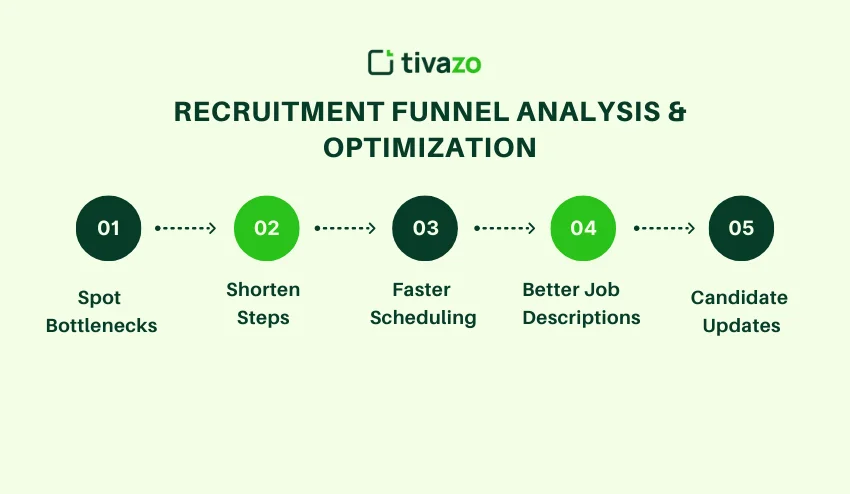
1. Spot bottlenecks
In case a large number of applicants are lost in the screening process, then the issue could be that the resume is being vetted slowly or the job requirements are not clear. Consider every step that people drop out, and do something to correct it.
2. Shorten steps
Candidates are annoyed by lengthy processes. Make application forms brief and to the point. Limit interviews to 2–3 rounds. This will minimize fatigue in the candidates and retain the best talent.
3. Faster scheduling
Stages that are delayed lose the interest of the candidates. Calendar software is used to arrange interviews quickly and minimise no-shows. Professionalism also consists of responding in time.
4. Better job descriptions
There are well-defined job responsibilities, pay scales, and models of work that help in attracting the right people. Avoid vague wording. The best thing is that when a candidate understands what they will do in detail, you will have better-fit applicants and minimal drop-offs.
5. Candidate updates
It is always important to send status emails at the end of every stage. Silence causes candidates to be nervous, and they tend to terminate the process. Basic updates develop faith and ensure they continue moving down the funnel.
Recruitment Funnel vs Candidate Journey
Both are useful, but they focus on different views:
| Recruitment Funnel | Candidate Journey |
|---|---|
| Company view | Candidate view |
| Counts conversions | Tracks emotions |
| Fixes hiring delays | Builds trust |
| Focus on stages | Focus on feelings |
A hiring team that is good employs both in an effort to enhance the experience that people have when joining the company.
Common Recruitment Funnel Mistakes to Avoid
Mistakes in the Recruitment Funnel are:
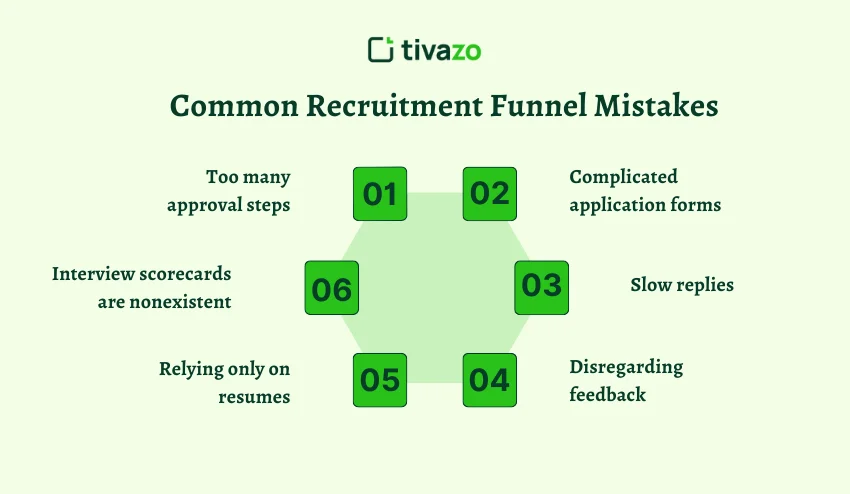
- Too many approval steps
- Complicated application forms
- Slow replies
- Disregarding constructive feedback on candidates.
- Relying only on resumes
- Interview scorecards are nonexistent.
Every mistake increases cost and wastes time.
Future of Recruitment Funnels
Hiring continues to change. We will likely see:
- Skill-first profiles replacing resumes
- Faster matching technology
- Increased pre-application company-candidate discussions.
- Funnels are becoming talent pipelines.
The aim is to have consistent and equitable access to work, not a single hiring.
Recruitment Funnel Template (Copy & Use)
You can paste and fill this for each open role:
Role Name:
Hiring Goal:
Start Date:
Target Hire Date:
| Funnel Stage | Owner | Target Conversion | Actual | Notes |
|---|---|---|---|---|
| Awareness | ||||
| Attraction | ||||
| Interest | ||||
| Application | ||||
| Screening | ||||
| Interviewing | ||||
| Hiring |
Conclusion
A recruitment funnel is not just another hiring tool, but rather a blueprint to attract, engage, and hire the right people in a shorter period of time. Companies can minimize drop-offs and enhance candidate experience, and get a more suitable talent by learning each step, monitoring metrics, and continuing to improve the process. Even minor changes within your funnel can bring great outcomes, and your hiring process will be smarter, quicker, and more efficient.