You feel it the moment projects start creeping across departments. Marketing has one priority. Product has another. Sales pushes for speed. Operations want control. A cross-functional team breaks through that pattern and gets things moving – fast and without everyone stepping on each other’s toes.
That said, putting smart people in one room doesn’t guarantee progress. Structure matters. Clarity matters. Leadership matters. And that is exactly what we are going to sort out. You will see what a cross-functional team is and how you can build one that performs and makes work worth showing up for.
What Is A Cross-Functional Team?
A cross-functional team is a group of people from different departments or areas of expertise working together toward a shared goal. Instead of everyone staying in their own silo, this team brings those different perspectives together. The idea is to deliver projects or comprehensive solutions faster and more effectively by combining different expertise and skills.
Key Characteristics Of A Cross-Functional Team
A cross-functional team has a specific feel when it works right. These traits show you what that looks like in practice.
1. Diverse Expertise
You have people from different backgrounds in the same room. Designers, engineers, marketers – they all add their own flavor, so the team can handle pretty much anything without calling for backup.
2. Shared Organizational Goal
Everyone rallies around one clear company goal. Department targets pause for a moment. The bigger objective takes priority and the team wins together.
3. Collaborative Decision-Making Process
Decisions are made together – not dictated by one department. Input from all areas decides the outcome.
4. Flexible Structure
Hierarchy isn’t rigid. Who leads depends on what needs to be done. And everyone gets a chance to step up.
5. Open Communication Channels
Innovative ideas, questions, problems – everything is shared openly. No hiding issues or assuming what others are thinking.
6. Problem-Solving Focus
The team is meant to solve something specific. Usually something complex – the kind of problem that needs innovative solutions from more than one team.
7. Accountability Across Functions
You own your piece, and you care about the bigger result. Your work connects to everyone else’s. That responsibility is shared.
8. Temporary Or Project-Based Nature
Many cross-functional teams form around a specific initiative. Once it is done, the temporary team wraps up. Though some continue if the work calls for ongoing collaboration.
Pros & Cons Of A Cross-Functional Team
There is a lot to love about an effective cross-functional team, and a few things that can slow it down. Here’s the honest rundown.
| Pros | Cons |
| Combines diverse skills, reducing the need to outsource | Competing priorities can slow progress |
| Increased innovation through diverse perspectives | Communication gaps may arise between diverse departments |
| Fosters collaboration across teams | Decision-making can be slower due to the consensus needs |
| Improves flexibility as members cover multiple roles | Workload imbalance can stretch members |
| Team stays focused on a shared objective | Lack of clear authority may create confusion |
| Speeds up problem-solving for complex projects and increases customer satisfaction | Cultural clashes between departments are possible |
| Supports skill growth for team members | Dependence on key individuals is risky if someone leaves |
How To Make A Cross-Functional Team Perform Well: 8 Strategies For Consistent Results
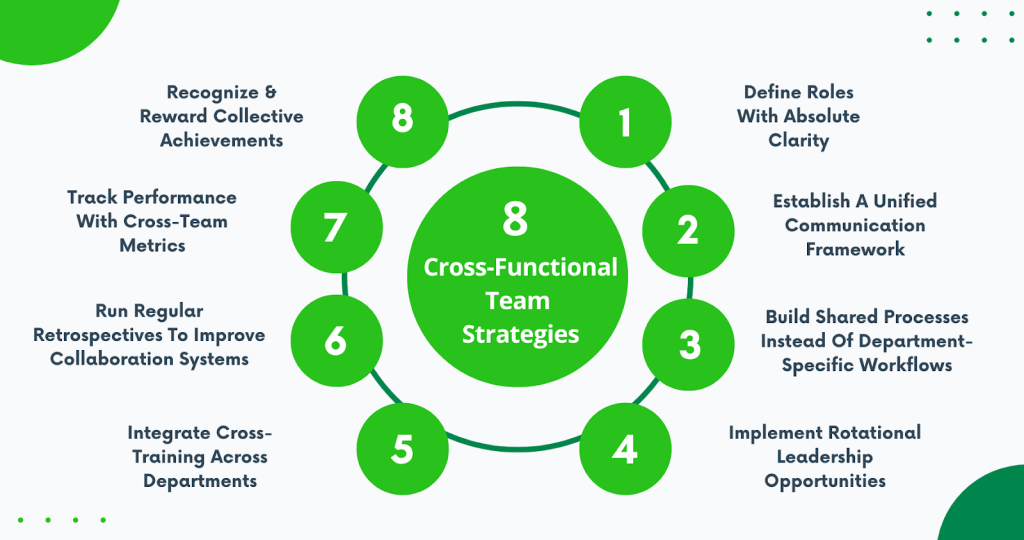
Getting a cross-functional team to perform takes more than good intentions. These eight strategies show how to keep the team delivering every time.
1. Define Roles With Absolute Clarity
Everyone in a cross-functional team brings their own department’s knowledge. That is great, but it is also why things get confusing fast. People know their job title, yet they don’t know which parts of the project they personally own. You want zero ambiguity. Every approval and escalation path must point to a single person.
What To Do:
- Create a RACI chart (Responsible, Accountable, Consulted, Informed) for all major tasks and decisions.
- Document decision rights for budget, scope, timeline, and quality in writing before execution starts.
- Agree on weekly time commitment percentages for each member and get approval from their department head.
- Review and adjust role clarity at the end of each major milestone to prevent silent scope expansion.
2. Establish A Unified Communication Framework
Cross-functional teams talk past each other because each specialized department has its own style and collaboration tools. Marketing team posts in Slack. Engineering uses Jira comments. Finance uses email.
A unified and effective communication framework creates one rhythm and one primary structure. Updates follow the same format. Decisions are recorded in one place. And that enhances communication and removes confusion.
What To Do:
- Choose one primary channel for team communication and define what goes there versus email or project tools. Document this clearly.
- Create fixed communication rituals and ground rules – daily progress check-ins, weekly execution reviews, monthly planning sessions.
- Use structured update formats. Use progress, blockers, decisions needed, and next actions.
- Save all decisions and meeting summaries in a central shared repository. Use tags and dates.
3. Build Shared Processes Instead Of Department-Specific Workflows
Departments bring their own execution habits, which lead to friction at handoffs. Engineering works in sprints. Marketing plans in campaigns. Finance reviews in cycles. Coordination slows down when they are not on the same page.
A cross-functional team needs one operating model. One timeline. One approval flow. One definition of “done.” This removes friction created by competing organizational structures and internal processes.
What To Do:
- Design a team-level project lifecycle with defined stages – planning, execution, review, delivery. And list required outputs for each stage.
- Create handoff checklists. Specify what must be completed before work moves from one function to another.
- Document tool usage rules – where tasks are tracked, where files are saved, how progress is logged.
- Audit the process after the first delivery cycle. Get rid of at least one friction point the team has identified.
4. Implement Rotational Leadership Opportunities
Different project phases require different strengths. Strategy planning may require product depth. Launch execution may require marketing direction. Cost optimization may require financial oversight. Rotational leadership keeps authority aligned with expertise. The person best suited to lead each stage takes the helm.
What To Do:
- Assign a rotating team leader for each sprint or project phase. Document it in the team charter.
- Give the rotating lead authority to reassign tasks and escalate issues without a permanent manager.
- Require the rotating lead to produce a short execution summary. Cover progress and decisions made during their period.
- Track performance metrics for every rotation – cycle time, task completion rate, issue resolution speed.
5. Integrate Cross-Training Across Departments
If your cross-functional team depends on “asking the expert” every time something small comes up, you have built a dependency chain. Cross-training gives every member working knowledge of how the other functions actually operate day to day.
Team building through cross-training also reduces territorial behavior. When someone sees the workload and constraints of another function firsthand, conversations become more practical. But random knowledge-sharing sessions do nothing. You need deliberate skill overlap built into the team’s cadence.
What To Do:
- Block one afternoon every month where each department teaches how they actually work – tools, approvals, timelines, common mistakes. Record it.
- Create one-page “how to get this done” guides for each function. Example: “How to get legal approval in 48 hours” with exact steps and contacts.
- Give each team member one shadow task every quarter, where they assist another function with a real deliverable – not a demo.
- Build a backup capability list. Show who can cover critical tasks if the primary owner is unavailable.
6. Run Regular Retrospectives To Improve Collaboration Systems
Most teams review results. High-performing cross-functional teams review collaboration mechanics. That difference matters. And no, you are not analyzing performance outcomes here. You are examining how the entire team worked together. Retrospectives should produce operational adjustments – not emotional venting. Otherwise, the meeting becomes a ritual.
What To Do:
- Run a 60-minute collaboration retrospective every six weeks, separate from sprint or project reviews. No task updates allowed.
- Bring hard data into the session: handoff delays, approval wait times, missed dependencies, communication breakdowns.
- Force every issue into a system fix, not a people fix. Example: “Approval took 5 days → create a pre-approved decision matrix.”
- Assign one owner per system fix and track it like a project management task with a due date and visible progress.
7. Track Performance With Cross-Team Metrics, Not Department KPIs
Department KPIs push people to optimize their own area – even when it slows the project. Marketing optimizes campaigns. Engineering optimizes releases. Finance optimizes cost. Agile teams need metrics that punish slow handoffs and reward fast delivery as a group.
So for instance, instead of tracking marketing views separately, marketing can define a shared metric like YouTube subscriber growth or video-driven feature adoption. Or engineering can track the activation rate of a new feature within 30 days instead of focusing only on release velocity.
That way, product, marketing, engineering, and sales all work toward the same outcome instead of optimizing silo numbers
What To Do:
- Define 4 shared performance indicators for project delivery and adoption.
- Publish these indicators on a central dashboard. It should be accessible to every team member.
- Assign one rotating team member who can analyze trends and present insights every week.
- Prepare a predefined response plan when any metric drops below an agreed threshold.
8. Recognize & Reward Collective Achievements
Cross-functional teams fracture when rewards focus on individual departments. People optimize for their silo and ignore shared outcomes. Collective recognition shifts attention to joint delivery and shared wins.
What To Do:
- Dedicate five minutes in every milestone meeting to highlight one example of effective cross-team coordination.
- Publish a monthly summary recognizing team-level accomplishments and the collaboration behind them.
- Tie a portion of performance evaluations to documented cross-functional contributions.
- Offer one shared reward every quarter for achieving a major team milestone.
5 Common Mistakes To Avoid When Building A Cross-Functional Team
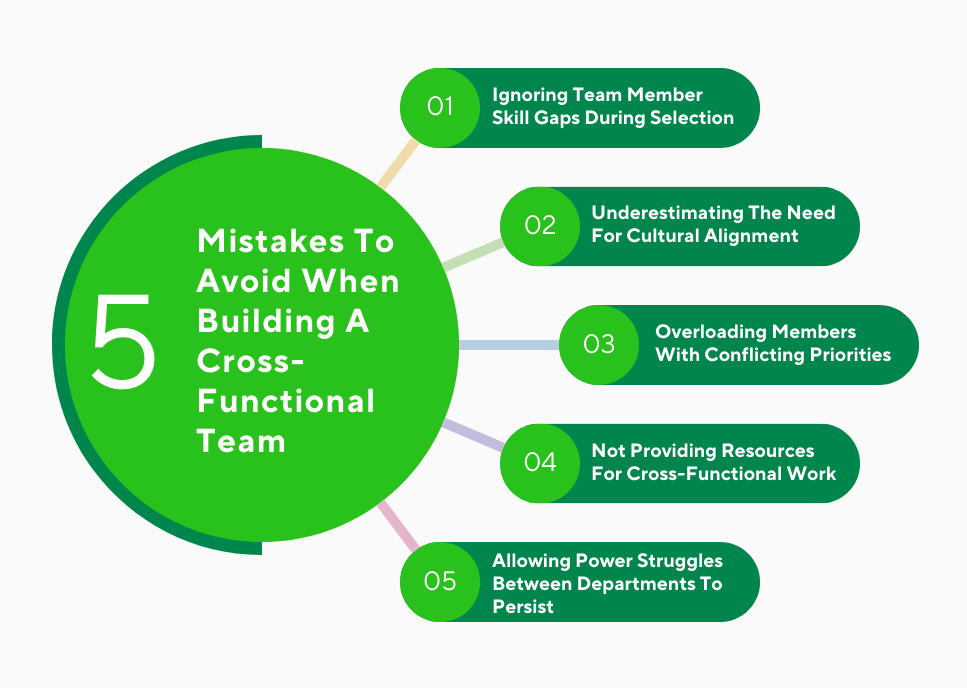
Teams rarely crash because of one big mistake. These are the five small but costly errors to watch for, along with what to do instead.
1. Ignoring Team Member Skill Gaps During Selection
Leadership says, “We need someone from Product, someone from Sales, someone from Marketing.” And managers nominate whoever is available or senior enough to represent the department. On paper, the team looks balanced. In reality, you may have just assembled people who are brilliant individually but can’t work cross-functionally.
How To Fix: Before you pick people, list the exact capabilities the project needs, not job titles. Then compare candidates against that list and bring in the missing skill set through temporary advisors or internal mentors instead of assuming the team will “figure it out.”
2. Underestimating The Need For Cultural Or Departmental Alignment
Departments operate with different internal rules. And when they collide, friction starts quietly and builds fast.
You will see it in subtle reactions. Someone gets frustrated because a decision took too long. Someone else pushes back because the documentation was too light. Neither side is wrong. They are operating from different internal standards. Cross-functional teams require a reset. Without it, the team defaults back to departmental habits.
How To Fix: Hold a short alignment session before work starts, where each department explains how they work and how they make decisions. Then write down shared rules for the cross-functional team so people stop defaulting to departmental habits during conflicts.
3. Overloading Members With Conflicting Priorities
Cross-functional team members usually keep their day jobs. Their manager still assigns tasks, and their department still has targets. Deadlines slip because someone “had something urgent come up.” This creates silent prioritization battles where people delay cross-functional tasks because their primary team pressures them.
How To Fix: Create a formal priority agreement with functional managers. Document how much time each member dedicates to the cross-functional project and what work can be deprioritized. Review this agreement each month and adjust workload when project intensity changes.
4. Not Providing Tools Or Resources For Cross-Functional Work
You can’t run cross-functional collaboration on spreadsheets and long email chains. When various departments bring their own version of tracking, no one can see what is actually going on. That is when people start double-checking everything. Updates get repeated. Docs get recreated. Decisions get questioned again and again.
How To Fix: Use a dedicated project management software just for the cross-functional team with a single task tracker and a simple reporting view. Assign one person to maintain access and structure for enhanced collaboration.
5. Allowing Power Struggles Between Departments To Persist
Power dynamics rarely show up openly at first. They surface in who speaks the most during meetings. Whose priorities get implemented first. Whose objections carry more weight. If one department consistently dominates discussions, others disengage quietly. And ignoring power struggles doesn’t make them disappear. It allows them to solidify.
How To Fix: Appoint a neutral decision authority for the specific project. Make it clear that project decisions override departmental preferences. Record final decisions in a shared log so people can’t reopen the same debates.
4 Real-World Examples Of High-Performing Cross-Functional Teams
Successful cross-functional teams exist, and they deliver. These examples show how they operate on the ground.
1. Uproas

Uproas TikTok agency account partner sits at the intersection of creator growth, platform compliance, ad account structure, and monetization rules. That environment changes fast. A single platform update can impact client campaigns overnight.
Their high-performing cross-functional team is built around platform velocity. You have TikTok account managers, ad strategists, policy compliance specialists, and performance analysts working together in real time.
When a client account faces a restriction or an ad disapproval, it doesn’t bounce between departments. The compliance specialist reviews the violation code. The strategist adjusts the creative angle. The analyst checks how the change affects conversion tracking – all inside the same operational window.
What makes this cross-functional team work is response sequencing. A flagged ad triggers a compliance review first. A performance dip triggers an analyst review first. A creator account limitation triggers account management escalation first. That structure prevents internal bottlenecks when platform rules change.
2. IceCartel
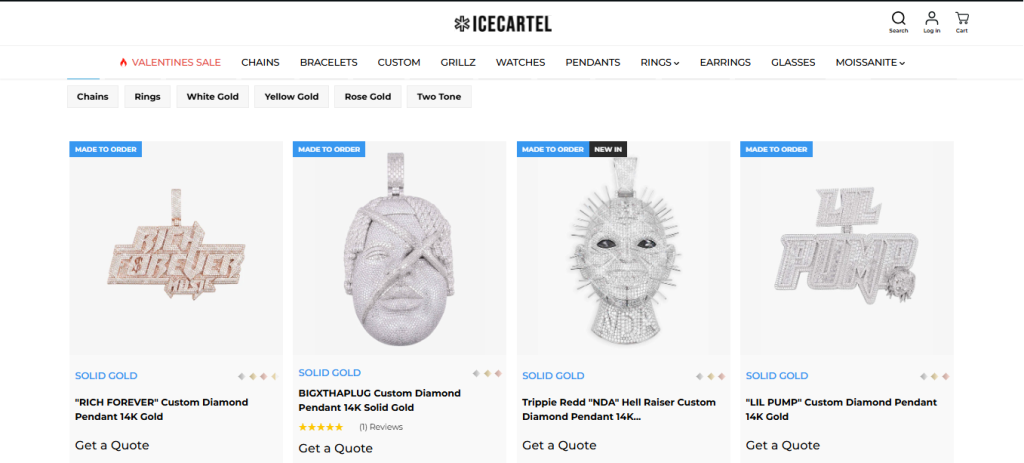
IceCartel’s custom jewelry moves through design approval, stone sourcing, manufacturing, quality inspection, and shipping. If one step misaligns, delivery timelines break, and customer trust drops.
Their cross-functional team centers around order lifecycle ownership. Instead of handing custom orders from sales to design to production in isolation, they build micro-teams around high-value custom pieces. A sales advisor, CAD designer, production supervisor, and fulfillment coordinator stay aligned from the first design mockup to the final shipping confirmation.
The strength of this cross-functional structure is milestone visibility. When a CAD render is approved, production already has sourcing options prepared. When stones arrive, quality control pre-books inspection slots.
The fulfillment coordinator tracks shipping carrier availability before the item reaches packaging. That parallel coordination compresses turnaround time without sacrificing craftsmanship.
This cross-functional team structure reduces revision cycles and last-minute supplier issues. It keeps high-margin custom work predictable, even when client requests shift mid-production. In industries where customization generates revenue, operational continuity inside a cross-functional team protects both timelines and brand reputation.
3. Freeburg Law

Freeburg Law’s criminal defense attorneys handle complex Wyoming criminal defense cases where courtroom strategy and client preparation must move in sync.
Their cross-functional team model focuses on case synchronization. They assign a case unit that includes a lead attorney, a paralegal responsible for procedural deadlines, an investigator managing evidence and witness coordination, and a client liaison handling updates and document intake.
The key difference here is information control. Court deadlines can’t slip. Evidence can’t be mishandled. Client expectations can’t drift. So the cross-functional team meets around case phase transitions – arraignment, pretrial motions, plea negotiation, trial prep. At each stage, every function confirms readiness before moving forward.
This structure prevents last-minute filing errors and inconsistent courtroom narratives. And in a high-stakes legal setting, this cross-functional team model reduces procedural risk and keeps case execution disciplined from start to finish.
4. Re Cost Seg
Re Cost Seg specializes in cost segregation studies for real estate investors. And this requires precision because IRS classification errors can create serious consequences.
Their cross-functional team is built around technical accuracy. A tax strategist interprets depreciation categories while an engineering analyst reviews building components and construction documents. On the other hand, a financial reporting specialist translates the results into investor-ready summaries and audit-support documentation.
The performance edge here is documentation layering. Before any final report goes to a client, engineering classifications are reviewed through a tax lens. Then tax assumptions are validated against investor reporting standards. Each function checks the other’s output using a predefined validation checklist.
This reduces audit exposure and protects clients from misclassification risks. It also speeds up delivery because technical review happens during the drafting phase, not after finalization.
In a compliance-heavy financial environment, this type of cross-functional team protects credibility. It aligns technical detail with financial clarity and regulatory standards at the same time.
Conclusion
The advice is simple yet demanding. A cross-functional team has to become a priority. If members are half in and half out, results will mirror that split. So mix the right people who solve problems and give them space to think and act beyond their department bubble. Kill status theater. Focus on outcomes. Make progress visible.
And that is exactly what we built Tivazo for. Our platform automatically tracks work hours, shows real-time activity, highlights idle time, and gives you clear reports on how projects and people are moving.
We also help you manage cross-functional teams in one place – create teams, assign roles, monitor progress, and generate timesheets that keep payroll and billing clean and accurate. You get live dashboards, productivity insights, screenshots for proof of work, and detailed reports that show where time goes and where bottlenecks show up.
Try Tivazo free or view the demo to see how it helps your team deliver real results.