You open your laptop.
Your task list is full.
But you are sitting there and staring at the screen.
You know the work matters. You know the deadline is real. Nevertheless, it is impossible to start. Not due to laziness, distraction, or poor performance at work, but because your brain has reached a dead end.
This is referred to as task paralysis, and it is a phenomenon that occurs among employees at all levels. At the entry level and the top management level, most individuals find it difficult to be psychologically stagnated when they are overwhelmed, confused, or emotionally burdened at work.
The positive aspect is that there is no individual failure in task paralysis. It is a work habit issue that can be solved. When you know why it occurs and how to dissect it, then you can move up again.
What Is Task Paralysis?

Task paralysis is a psychological state where employees are not able to begin or finish tasks, yet they are aware of what needs to be done.
It often shows up as freezing. You are at your desk, you open the task, and get paralyzed. The work seems too large, too serious or too ambiguous to start.
Task paralysis is not about the decision to postpone work, as is the case with procrastination. The employees who are paralyzed with tasks typically desire to begin. Their brain just fails to make up their minds on what to do first.
Task paralysis may be a problem at work in daily duties. It is easy to get lost in writing emails, beginning reports, prioritizing tasks, or making decisions.
As soon as you realize that you are experiencing task paralysis, you can cease the habit of self-blame and begin to work on the actual issue.
Why Task Paralysis Happens at Work
Task paralysis seldom arises due to a deficiency in ability or effort. In the majority of cases, it is brought about by the structure of work and the response of the brain to pressure.

These are the most prevalent causes of task paralysis in employees.
1. Too Many Tasks, Not Enough Clarity
In a time when everything is urgent, nothing seems manageable. Employees have to work with emails, meetings, messages, and deadlines simultaneously.
The brain cannot make a decision without clear priorities on where to begin. Such psychological burden may lead to a total paralysis.
2. Fear of Doing It Wrong
Some tasks feel risky. Performance reviews or team results may be affected by a presentation, report, or decision.
This stress instills the fear of errors. Employees do not begin at all, but wait to begin.
3. Perfectionism and High Expectations
It is not the problem to desire to do great work. It is not possible to expect perfection of the first draft.
It is daunting to begin when employees feel that the task should be perfect. Their minds enlarge the task more than it is.
4. Decision Fatigue and Cognitive Overload
Decisions are made in every working day. What to answer first, what to give priority to, and what to delay.
Employees lose their mental energy by the time they come to critical chores. Exhaustion is the natural response to task paralysis.
Task Paralysis vs Procrastination: What’s the Difference?
Task paralysis and procrastination are not similar terms. The difference will assist employees in selecting the appropriate solution.
Task paralysis occurs when the brain is overwhelmed and cannot focus on anything to begin. Procrastination is a deliberate postponement, despite the fact that you might start.
In task paralysis, there is the intent to work. In procrastination, the task is deliberately evaded.
Task Paralysis vs Procrastination Comparison
| Aspect | Task Paralysis | Procrastination |
|---|---|---|
| Intent | Wants to start | Chooses to delay |
| Cause | Overwhelm, fear, mental overload | Avoidance or low motivation |
| Feeling | Stuck or frozen | Distracted or disengaged |
| Solution | Clarify, reduce, simplify | Improve motivation or discipline |
For employees, this distinction matters. Treating task paralysis like procrastination often leads to guilt and burnout instead of progress.
Once you identify task paralysis, the focus shifts from forcing motivation to reducing mental friction.
Why Task Paralysis Is a Serious Problem for Employees
Task paralysis is not only a problem of productivity. It may have an impact on performance, wellbeing and long-term career development when it occurs frequently.
1. Reduced Productivity and Missed Deadlines
Employees get stagnated and the work becomes slow. What should have taken minutes takes hours or days.
Deadlines get pushed. Small tasks pile up. This puts additional pressure, and task paralysis is even more exacerbated.
2. Increased Stress and Burnout
It is tiring to be psychologically stagnant. Employees tend to criticize themselves for not starting, even when trying.
This is a continuous stress that results in burnout over time. Work becomes heavier, and the motivation decreases throughout the board.
3. Influence on Performance Appraisals and Career Development
Other people may not see task paralysis. Managers can only observe missed deadlines or slow output.
This may influence performance reviews, promotions, and trust without context. That makes it crucial to learn how to deal with task paralysis in employees who are interested in expanding their roles.
Common Types of Task Paralysis Employees Experience
Task paralysis does not appear the same to all people. Different types are usually experienced by employees based on workload, role and mindset.
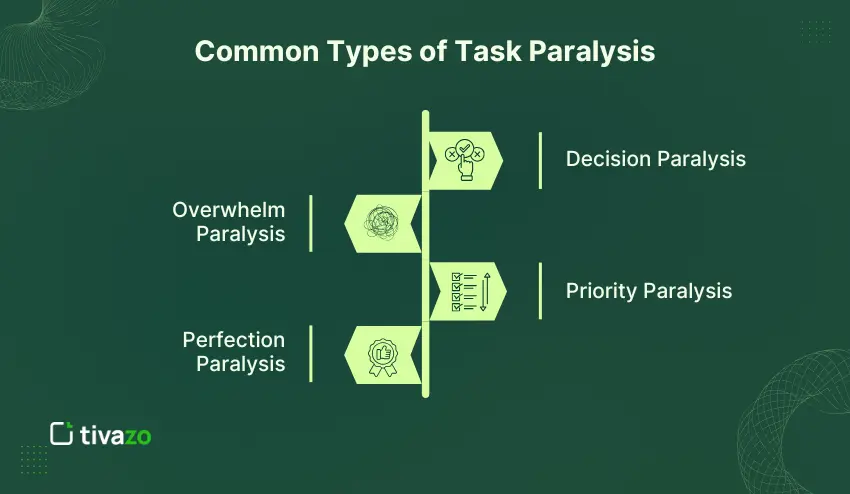
It is easier to repair what you know what kind of type you are dealing with.
1. Overwhelm Paralysis
This occurs when the task list seems to be never-ending. There is competition between messages, deadlines, and emails.
Employees close down instead of beginning due to the fact that everything seems to be urgent and significant.
2. Decision Paralysis
Some tasks require choices. What to do, what to focus on or what to do.
In the case of a large number of choices, the employees take time before making the wrong choice.
3. Perfection Paralysis
This kind of type appears when employees are under pressure to perform perfect work. It is intimidating to draft, revise, or present.
The task is too large to start without the right conditions.
4. Priority Paralysis
Employees hesitate when they do not know what is important. Their concern is working on the wrong thing.
This indecision holds tasks back, even where time is not a problem.
9 Proven Strategies to Overcome Task Paralysis at Work
Motivation does not eliminate task paralysis. It disappears as tasks become smaller, clearer and safer to begin.
These plans are realistic and can be implemented in actual working day.
1. Break Tasks Into Ridiculously Small Steps
Overwhelm is triggered by large tasks. Minor things generate motion.
Rather than finish report, open the document or write the title. Having completed the first step, the second one becomes easier.
Example:
When a presentation is too heavy, then you may start by opening the slide deck. That’s it.
2. Use the 5-Minute Rule
Remind yourself that you just have to work five minutes. Nothing more.
Starting is the hardest part. When you start, it is easy to get a momentum and move on.
Checklist item:
Use a timer and set it at five minutes and stop. Most people don’t.
3. Clarify the Next Physical Action
Unclear activities result in stagnation. Friction is eliminated by clear actions.
Question yourself on what is the next action that is visible. Not the ultimate aim, but the next little step.
Example:
In place of plan meeting, draft meeting agenda is to be used.
4. Limit Choices and Decisions
Excessive choices are paralyzing the brain. Task paralysis is a result of decision fatigue.
Minimize decisions by pre-setting tools, formats or time blocks. A smaller number of decisions implies quicker action.
Tip:
Select one tool and one way of similar tasks.
5. Time-Block Instead of Using Long To-Do Lists
Long to-do lists feel endless. Time blocks feel contained.
Allot tasks to brief calendar intervals. This brings order and reduces stress to complete everything immediately.
6. Lower the Bar for Starting
One does not have to be good at work. It only needs to exist.
Allow yourself to make a crude copy. It is better to edit than create something.
Mindset shift:
Draft first. Improve later.
7. Externalize Tasks by Writing Them Down
Stress is caused by holding things in your mind. Their written downness liberates mental space.
Use a notebook, an application, or a sticky note. When you see things in your mind, they seem to be manageable.
8. Create Gentle Accountability
Responsibility does not require coercion. It just needs visibility.
Share with a colleague what you are going to work on or make a quick visit with a manager. The awareness that another person knows assists in action.
Example:
Even a short message, such as I will send the draft by 3 PM will suffice.
9. Reflect and Reset Weekly
Task paralysis frequently recurs in cases of unnoticed patterns.
Spend some time weekly to contemplate. Determine what led to the freeze and what assisted you in getting past it.
Minor modifications thwart subsequent blocks.
Common Mistakes Employees Make When Dealing With Task Paralysis
Despite the good intentions, employees may still get into habits that worsen task paralysis. Being aware of these errors will allow avoiding setbacks:
- Waiting for motivation
- Attempting to do it all simultaneously.
- Ignoring mental fatigue
- Tips: Take micro-breaks and focus on mental relaxation; five minutes of a break can refresh your action capacity.
Conclusion
Employees are prone to task paralysis. It does not imply that you are lazy or incompetent; it just means that your brain requires a less complicated route to begin.
The above strategies, which include breaking tasks into small steps, clarification of actions, use of tools, and creating accountability, are all proven methods of making progress.
Start small today. Choose one activity, reduce it, and make the first move. Once you cross the freeze, momentum picks up.
Remember: progress, not perfection, is what matters. You can beat task paralysis and regain control of your workday.