In the modern digitalized high-paced workplace, the failure of teams is not due to a lack of talent but rather due to the failure of the workflows. The symptoms of the lack of workflow tracking are missed deadlines, unclear duties, duplication of work, low visibility, etc.
Manual coordination and guesswork do not work anymore as organizations grow. Teams require formalized information-based systems to trace the flow of work, start to finish. This is where workflow tracking is needed.
This guide will describe the nature of workflow, its importance, the difference between workflow and task management, and the role of software such as Tivazo in simplifying the process of workflow tracking.
What Does Workflow Mean?
A workflow is a systematic flow of actions that establishes the flow of work between the beginning and the end. It specifies who does what, when, and in which order, and thus the tasks are done consistently and efficiently. Workflows can ensure the elimination of confusion, delays, and standardization among teams. Be it onboarding a new worker, initiating a marketing campaign, or even paying invoices, workflows offer a roadmap on how work should flow through to the end and reduce mistakes and miscommunications.
Major Aspects of a Workflow
- Tasks and activities
- Roles and responsibilities
- Dependencies between steps
- Tools and systems involved
- Defined outcomes
A workflow provides an answer to one simple question:
“How does work get done?”
What is the meaning of workflow tracking?
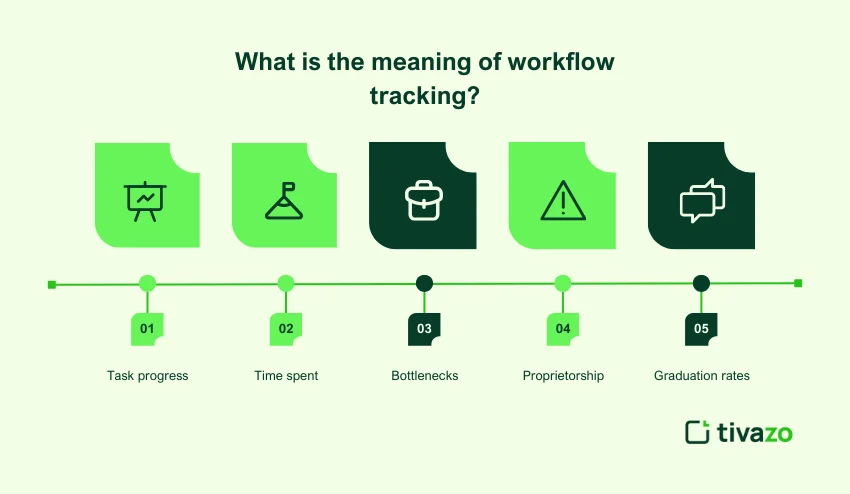
Workflow tracking is the process of tracking, gauging, and analyzing the movement of tasks and processes of a workflow in real time. It enables the organizations to have a constant view of the working process so that processes remain on track with objectives and timelines. Through monitoring of workflows, teams can understand inefficiencies promptly and enhance coordination as well as data-driven decisions that will improve productivity and consistency in various departments.
Covers of Workflow Tracking
- Task progress at each stage
- Time spent on each activity
- Bottlenecks and delays
- Proprietorship and responsibility.
- Graduation rates and effectiveness.
Workflow offers real-time operational visibility, unlike the traditional type of planning, which allows the teams to make changes before things go out of control.
Do Workflow Tracking and Task Management Equate?
No, they are related but are not the same.
Workflow Tracking vs Task Management
| Aspect | Task Management | Workflow Tracking |
| Focus | Personal assignments | Workflow Tracking |
| Scope | To-do lists | Process chain |
| Visibility | Task status | Process flow & bottlenecks |
| Measurements | Time | efficiency, delays |
| Use case | Individual/team performance | Operation optimization |
Workflow tracking is not a task in itself, but it links tasks together into a system.
Why should workflow tracking be needed?
Organizations run blindly without workflow. Teams are based on assumptions rather than on facts, and one cannot even guess where time is consumed or why the time is delayed. Workflow brings transparency to day-to-day activities, allowing leaders to make quality decisions, enhance cooperation, and keep the performance steady when teams are enlarged or working remotely.
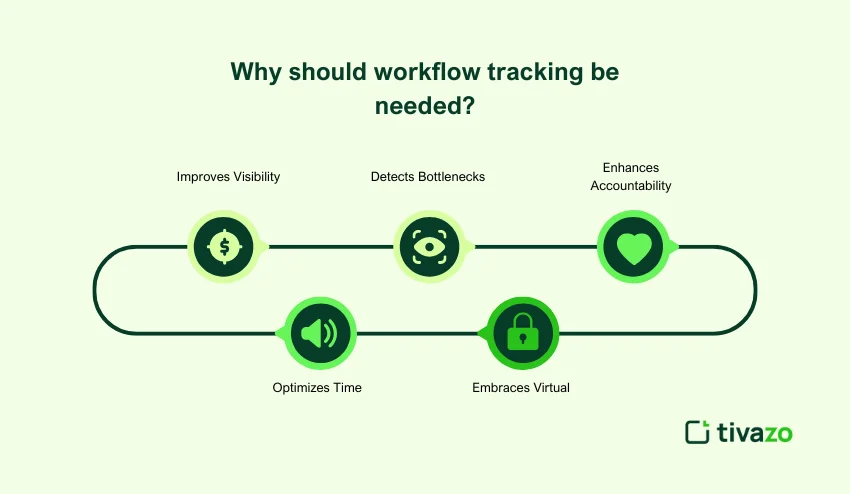
Important Reasons Why Workflow Tracking Is Necessary
- Improves Visibility: The teams are aware of what, where, and why.
- Detects Bottlenecks in Advance: Delays are observed, and they affect delivery.
- Enhances Accountability: The ownership of all workflow stages.
- Optimizes Time & Resources: Statistics indicate ineffectiveness and the wastage of energy.
- Embraces Virtual and Hybrid Teams: Assures alignment but not micromanagement.
Best Practices Workflow Tracking
Workflow tracking is to be applied strategically to obtain real value
1. Establish clarity of workflow stages
- Avoid vague steps. Every stage should have:
- A clear purpose
2. Apportion Responsibility at Every Level.
- There must be someone to own each step of the workflow.
3. Track Time Automatically
- The manual tracking is associated with inaccuracies. Data is reliable because of automation.
4. Use Data, Not Assumptions
- Make decisions based on performance monitored, not on gut feeling.
5. Continuously Optimize
- Workflow tracking is a process of iteration. Optimize processes by insight.
Workflow Tracker: How to Build One (Step-by-Step).
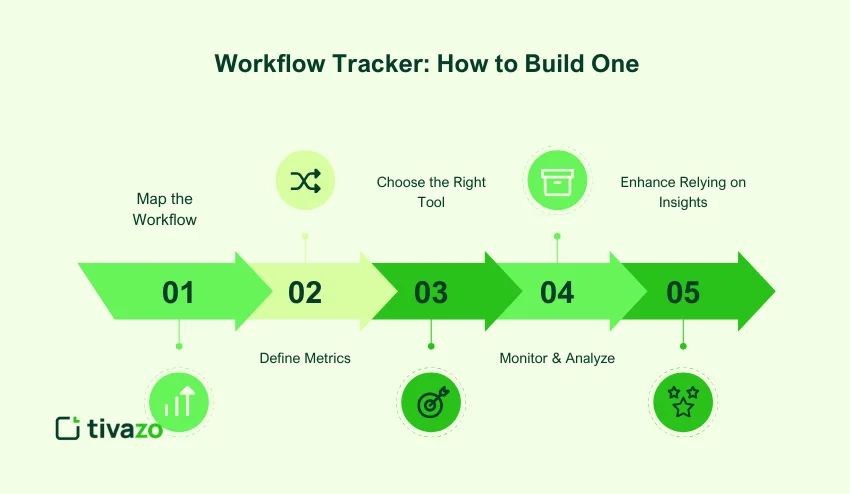
Step 1 – Map the Workflow
Record all the steps from beginning to end, with clear inputs, outputs, and dependencies. This makes sure that all people are aware of the flow of work and the location of handoffs.
Step 2 – Define Metrics
Track:
- Time per task
- Completion rate
- Idle time
- Rework frequency
These metrics assist in measuring efficiency and revealing delays in the shadow.
Step 3 – Choose the Right Tool
Choose those software products that enhance automation, analytics, and scalability to prevent errors in manual tracking.
Step 4 – Monitor & Analyze
Review reports and dashboards on a regular basis to identify trends and performance gaps.
Step 5 – Enhance Relying on Insights
Eliminate the bottlenecks and streamline the flows by continuous improvement.
Workflow Tracking and Workflow Management
These terms are used interchangeably, but they are not used in the same way.
Key Differences
| Aspect | Workflow Tracking | Workflow Management |
| Purpose | Observing workflows | Design and control workflows |
| Goal | Measurement and visibility | Governance and execution |
| Output | Information and knowledge | Process control |
| Tools | Software BPM | Automation tools |
Workflow Tracking Software: What to Expect
Workflow software must not be simply a task monitoring tool but must provide end-to-end insight into the actual workflow between teams and processes. The appropriate tool can enable organizations to shift the paradigm of reactive management to active optimization through the transformation of everyday work into workable data.
Besides essential functionality, effective workflow tracking software must be compatible with the existing tools, need minimal manual intervention, and be adopted by the team. An easy-to-use interface means a user uses it regularly, whereas the accuracy of the data they get implies that the insights can be relied on to make decisions and improve performance.
The important aspects to note include:
- Real-time tracking
- Automated time capture
- Clear dashboards
- Workflow visibility
- Performance analytics
- Growth team scalability.
The Support of Tivazo to Workflow Tracking
Tivazo is a current workforce productivity and workflow tracking platform that is developed to bring clarity, control, and insights without interfering with work.
- Major Workflow Attributes in Tivazo: Plots, automatic work operation
- Workflow Visibility: Managers observe the working process of teams and phases.
- Performance Analytics: Know time allocation, delays, and efficiency trends.
- Responsibility With No Micromanagement: Promotes proprietorship and transparency.
- Remote-Ready Architecture: Perfect in hybrid and distributed teams.
The manner in which Tivazo simplifies the workflow tracking
Tivazo makes workflow monitoring easier by:
- Recording live work information.
- Mapping tasks to workflows
- Underlining bottlenecks immediately.
- Giving practical productivity feedback.
- Allowing ongoing streamlining of the workflow.
The teams can view, quantify, and remedy time instead of making assumptions about its location and wastage.
Workflow Tracking Case Studies in Cross-Industrial
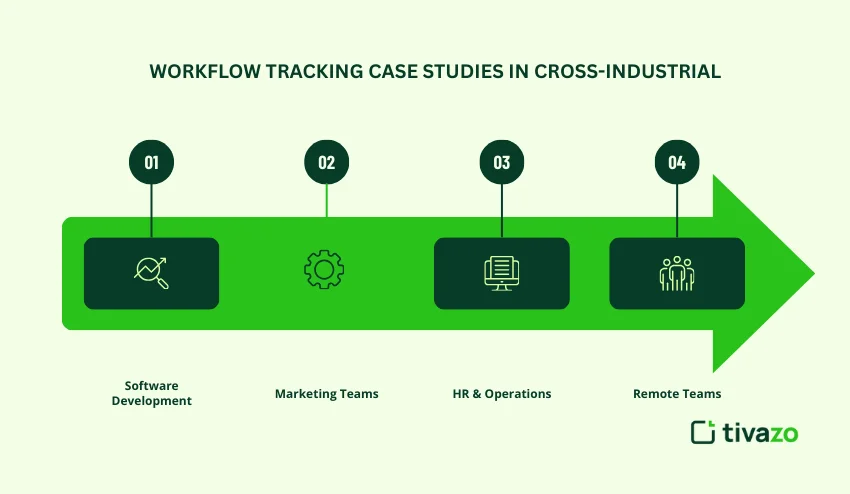
1. Software Development
- Sprint workflow tracking
- Bottleneck detection
2. Marketing Teams
- Visibility of campaign workflow.
- Deadline optimization
3. HR & Operations
- Onboarding and recruitment processes.
- Tracking process efficiency.
4. Remote Teams
- Unmonitored productivity.
- Performance insights based on time.
Workflow Tracking Fallacies to Beware of
- Tracking too many metrics
- Lack of ownership
- Manual data collection
- Ignoring insights
- Considering tracking to be surveillance.
Teams must be empowered and not controlled through workflow tracking.
Conclusion
Efficiency is now a choice in the modern organization. Workflow helps to make invisible work measurable performance, which allows teams to work smarter, faster, and in a more aligned manner.
Through the adoption of best practices and the utilization of technologies such as Tivazo, organizations will be able to transition to reactive management instead of active optimization.
Workflow tracking is not all about monitoring work but about making work better.