
One of the issues that is the most neglected and also expensive at the workplace currently is work hour fraud. Most organizations are concerned with significant financial fraud or cybersecurity threats; however, wrongly recorded or falsified time is silently stealing productivity, payroll budgets, and trust between employees.
Work hour fraud can impact businesses of all scales, but remote and hybrid teams are particularly vulnerable to it because of padding hours and buddy punching, as well as ghost employees. The fact that it is so easily unnoticed until afterwards, when it is too late, is what makes it dangerous.
This is a comprehensive guide where you will know what work hour fraud is, its practical use and its legal consequences, the types of fraud, and most importantly, how to detect and avoid work hour fraud with the help of intelligent systems such as Tivazo.
What Is Work Hour Fraud?
Timesheet fraud means timesheet fraud is a deliberate action by the employee to document inaccurate, overstated, or deceptive work hours to get an undeserved payment or benefit.
This may include:
- Making claims for hours that are not worked.
- Control of clock-in or clock-out times.
- Recording personal time as working time.
- Get another person to clock them in.
In contrast to the mere errors in time sheets, timesheet fraud presupposes deliberate misstatements.
Why Work Hour Fraud Happens
- Lack of monitoring
- Manual work hour systems
- Weak workplace policies
- Visibility-free remote work.
- Inadequate culture of accountability.
What Is the Cost of Work Hour Fraud?
Over one month:
22 workdays x 40 min/day = 14.6 hours stolen.
At $20/hour = $292/month
Per employee, per month
Take that per team or department, and exponential losses are realized. This action also affects team morale and fairness, in addition to direct payroll loss. Poor time reporting practices that remain untreated may encourage other cases of poor accountability, decrease the level of trust between workmates, and subtly decrease the overall productivity within an organization.
Is timesheet fraud a crime?
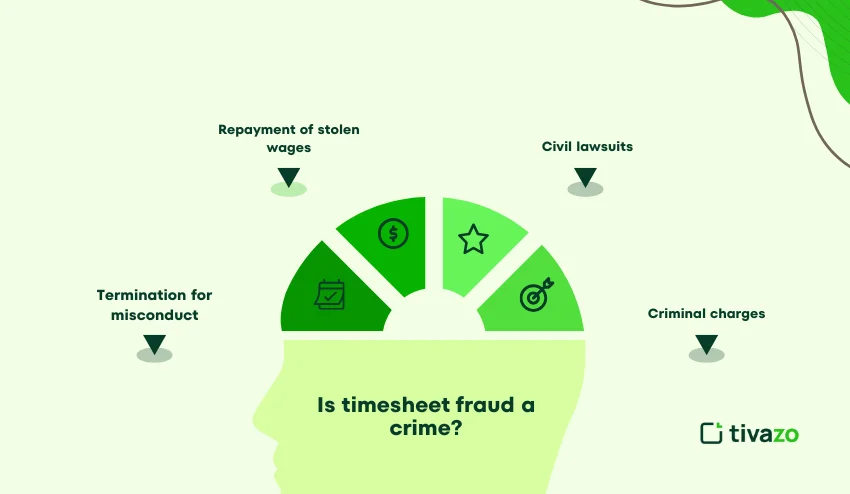
Depending on the jurisdiction and the severity of the offense, timesheet fraud can be considered a crime.
Legal Implications Could Be:
- Termination for misconduct
- Repayment of stolen wages
- Civil lawsuits
- Criminal charges (in extreme instances)
The term “wage theft” or “payroll fraud” is used in most nations to define falsification of work hours. Recurring or excessive crimes can trigger investigations, penalties, or prosecution. In addition to the individual employees, the employer also stands at risk of legal liability where he/she do not supervise time records adequately and deliberately permit false reporting. Governmental organizations can impose sanctions on inadequate payroll compliance processes, particularly those organizations with stringent labor laws. This implies that both legal safeguarding and ethical management in the workplace are very critical in proactive time tracking and proper documentation.
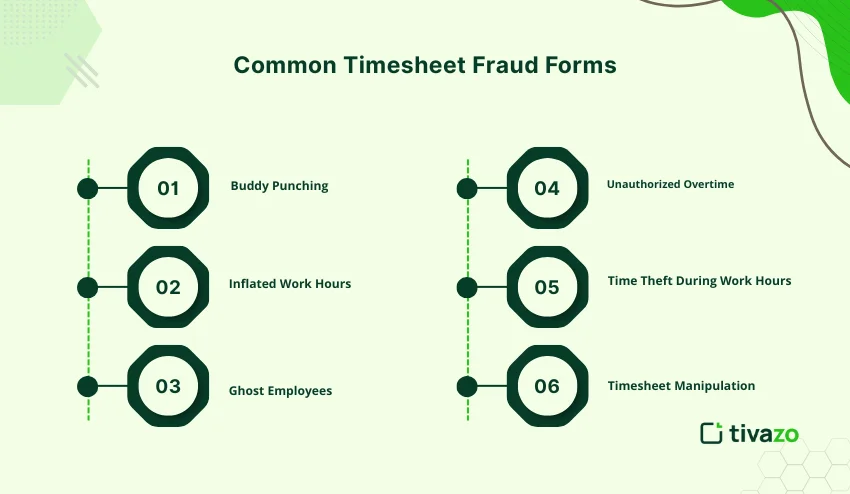
6 Common Timesheet Fraud Forms
1. Buddy Punching
Buddy punching takes place when a worker records the in or out time of another worker who is absent, late, or leaving early. The fraud is prevalent in workplaces where work is done on shared work systems or where manual system management is involved, and thus, individual attendance cannot be confirmed.
2. Inflated Work Hours
The employees deliberately register more hours than they are working, usually by either increasing the starting time, watching clock-outs, or overstating the project hours. With time, these little exaggerations grow, leading to a huge loss in payroll and distorted productivity reporting.
3. Ghost Employees
Ghost employee fraud is the addition of nonexistent workers to payrolls or the recording of hours of previous or retired workers. This is normally a result of inadequate internal controls and may result in both huge financial and compliance risks to organizations.
| Risk Factor | Risk Factor |
| Weak payroll audits | Undetected leakage of salaries. |
| Inadequate access control | Counterfeit or faked entries |
| Absence of control | Financial loss in the long term |
4. Unauthorized Overtime
Unauthorized overtime occurs when workers mark additional hours without permission or even without working. It is mostly prevalent in unsupervised or remote settings where overtime policies are either ambiguous or lack enforcement.
5. Time Theft During Work Hours
Time theft is when employees get involved in other personal activities like social media, errands, and long breaks and record these activities as productive work by the employees. This will decrease real production and impose disproportionate working loads on the team members.
| Services Uses | Unrecognised Cost |
| Social media surfing | Time wastage |
| Personal calls | Lower efficiency. |
| Long hiatuses | Reduced team performance |
6. Timesheet Manipulation (Manual)
Manual timesheet manipulation is a practice where time entries are modified by the end of the workday or by submitting modified records to overcharge hours. Manual systems are not verifiable, and hence, it is easier to commit fraud by modifying them without frequent audits or automated monitoring.
The Tivazo way of preventing Work Hour fraud
Tivazo is not a micromanagement tool but an ethical, accurate, and transparent time tracking tool. It also takes actual information on work hours instead of the self-reported hours, and this decreases the chances of manipulation, as well as retains the confidence of the employees.
Fraud Prevention Capabilities
| Feature | Benefit |
| Automated tracking | Removes spurious entries |
| Idle alarm | Stops bogus hours |
| Live reports | Indicate anomalies in time |
| Quality reports | Enhances the accuracy of payroll |
| User transparency | Gathers trust and accountability |
Tivazo eliminates the loopholes that fraud relies on by eliminating manual intervention. Moreover, the managers have regular insight into the work patterns without the need to supervise them. The unfair and inaccurate records will also be avoided, which will decrease conflicts and misunderstandings among the staff. This moderated method assists organizations in avoiding work hour fraud and creating a culture of accountability, transparency, and trust among teams.
Fraud vs. Honest Mistakes
Fraud is not all about time-tracking errors. Real mistakes committed by employees in most instances are because of forgetfulness, system fault, or ambiguity. The major distinction is in intention and action in the long run.
| Honest Fraud | Work Hour Fraud |
| Unintentional missed clock | Intentional padding |
| Single mistake | Repetitive action |
| Fixed in haste | Covered or rejected |
Mistakes and misconduct are distinguished with the help of such tools as Tivazo, which can offer objective and time-related data. Automated tracking eliminates the need for memory and record keeping and gives the employees an opportunity to study and make corrections to errors early. This will be fair and will also safeguard organizations against abuse.

The importance of Informational Awareness
Most corporations are oblivious to timesheet fraud and let it run simply because:
- Calculate time more precisely.
- Rely on outdated systems
- Suppose that trust = no tracking.
This is because of the lack of awareness that usually causes organizations to undervalue the frequency of time-related problems. Unless understood effectively, minimal inconsistencies are discredited as a harmless factor, albeit one that builds up to quantifiable losses in the long run. The awareness of information assists the leaders in identifying trends, creating attainable expectations, and solving issues before they get out of control.
With moral technology, awareness is encouraged to foster transparency and not surveillance. It also guarantees the employees that they have time tracking just in case of fairness, accuracy, and accountability, hence safeguarding both the employer and employees and enhancing trust in the workplace.
Conclusion
Work hour fraud is not only a matter of money; it makes a difference in terms of trust, equity, and output.
By understanding:
- What Work Hour fraud is
- How it happens
- What it costs
- How to prevent it
Organizations are able to develop a clear, responsible, and high-performing workplace. Active policies and proper timekeeping minimize conflict, boost morale, and aid in making better decisions. Tools such as Tivazo do not track time alone; they ensure integrity and fairness, and they make teams concentrate on meaningful work, which in reality spurs business growth.