One of the best methods of building a work group into becoming productive and motivated and involving themselves at their workplace is rewarding and recognizing one’s top workers. The employees feel valued when appreciated; this, to some point enhances the performance, efforts, as well as loyalty in realizing the set goals through the company. Worker appreciation can be done through “Employee of the Week”. This simple, efficient recognition methodology will go a long way in ensuring productivity, improving morale, and building up a positive work culture.
Has your team’s morale and productivity lagged? Sometimes, all that is needed is the simplest of rewards every week. Regular recognition for efforts and contribution motivates not only employees but also their teams to achieve great heights of excellence.
Why Employee Recognition Matters?
Recognizing employees is one of the surefire ways to enhance morale and productivity. Here are some reasons why it is so important to recognize your Employee of the Week:
- Motivates Them: They will feel appreciated and thus have the urge to work harder to achieve more as Employees of the Week.
- Positive Boost on Employee Engagement: According to Gallup research, employees with much work appreciation are 2.7 times more likely to engage at work.
- Gain in Productivity: Where an Employee of the Week was named and pursued consistently, higher productivity has been achieved by about 14 percent; this regular engagement will keep up motivation and best outputs in the employees’ delivery at their workplaces.
- Fosters Positive Culture: A consistent “Employee of the Week” program sets a standard of excellence that encourages others to do their best.
5 Tips to Reward Your Employee of the Week
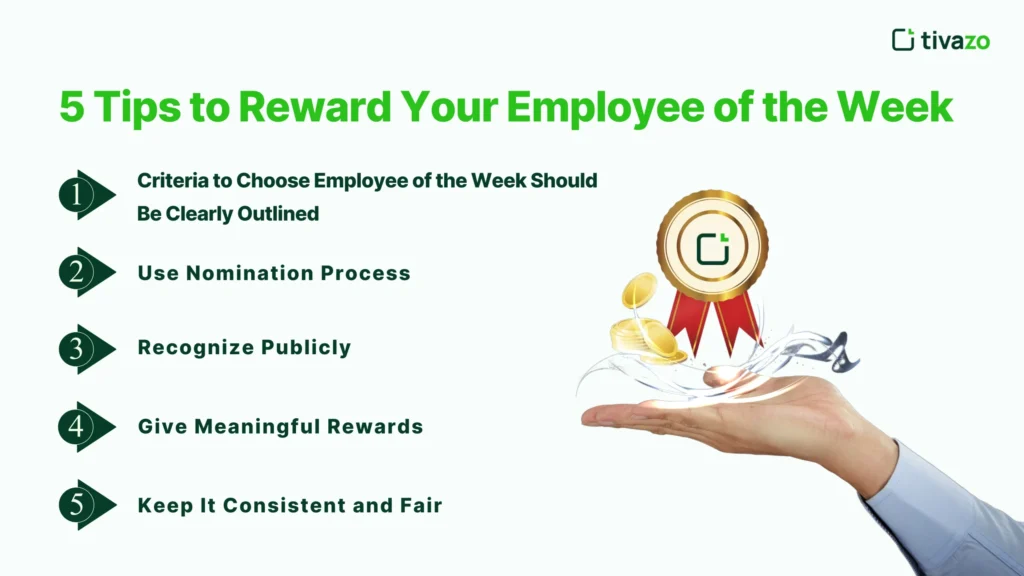
Tip 1: Criteria to Choose Employee of the Week Should Be Clearly Outlined
Choosing your Employee of the Week requires a great deal of fairness and transparency. If employees know what the criteria are, then it instills a sense of trust and makes the process objective. By setting expectations, everyone will work toward the same goals; hence, this would create a more productive and engaged team.
Here are some potential criteria to base your choice for Employee of the Week:
- Performance: Meets or exceeds work expectations consistently.
- Attitude: Maintains a positive, proactive attitude toward work.
- Teamwork: Willing to collaborate and support colleagues.
- Initiative: Exceeds job expectations without supervision.
- Punctuality: Always on time, meeting deadlines as required.
This means you communicate what being called Employee of the Week entails and helps the employee understand where his efforts stand relative to the objectives of the corporation. This will make them do their best, hence boosting morale within the team.
Tip 2: Use Nomination Process
Taking a nomination process to choose your Employee of the Week can help achieve the following:
- Increases Authenticity: Having nominations from other colleagues or team leaders makes the recognition more legitimate. A selection done by peers naturally will make an employee happy, which in turn improves morale and teamwork.
- Encourages Inclusiveness: A nomination system makes people feel included, and it lets everybody get the opportunity to value and appreciate each other’s efforts; an Employee of the Week award becomes somewhat communal.
- Garners Recognition to Certain Achievements: Employees provide a clear elaboration through a nomination letter so that management shows recognition highlighting major contributions of each action performed towards the Employee of the Week award.
- Encourages Appreciation: It encourages an appreciative culture that motivates every person to support and acknowledge their colleagues by nominating them for the Employee of the Week on active consideration.
Pro Tip: Provide a medium or platform for employees where they can place their nominations, stating reasons why the employee deserves the title of “Employee of the Week.” These make the recognitions more personalized and meaningful.
Tip 3: Recognize Publicly
Public recognition extends the efficiency of Employee of the Week awards in that one can celebrate achievement and success among the colleagues present. Here’s how public recognition may create a world of difference, quite literally:
- Increased Visibility: Calling out the name of the winner during team meetings, via e-mail shoutouts, and even on social media relays the recognition to make the whole organization informed.
- Inspires Pride: Public recognition instills pride in the Employee of the Week. By letting all be informed of his contribution, he would feel attached to the company and appreciated.
- Encourages Excellence: The rest of the staff members get motivated enough to put on an excellent display of work by watching their coworkers be publicly acknowledged. This points precisely to what was exemplary work, so, therefore, urges one and all to excel.
Example of a Great Public Recognition Message
“We are pleased to announce that this week’s Employee of the Week is >> First Name Last Name! >> First Name Last Name always beats about the bush in their role by showing great teamwork, dedication, and initiative. Thanks for your hard work and commitment >> First Name Last Name! Let us draw inspiration from his/her outstanding contributions!“
By giving public recognition to the Employee of the Week, you are recognizing not only his or her achievement but building an enabling culture of work excellence and recognition in your workplace.
Tip 4: Give Meaningful Rewards
Giving meaningful rewards is another important way to give recognition to your Employee of the Week. Instead of giving some monetary reward, which may well be spent right away and then forgotten, a meaningful reward could last longer and make employees feel valued. Here are some meaningful reward ideas:
- Time Off: Extra time off or flexible hours give staff time to rejuvenate; it shows their effort has been noticed and valued.
- Certificates or Trophies: A personalized certificate or small trophy is a long-lasting reminder of achievement and recognition.
- Personalized Gifts: Thoughtful, personalized gifts — such as a customized mug, an insulated tumbler designed for superior heat retention, quality apparel, gift cards to a favorite store, or even a luxury item like a Tissot watch — will surely make employees feel special and show that you put real thought into your choice.
- Professional Development Opportunities: Offering an in-service training course or conference is considered a sure-shot sign that one values an employee’s continued growth and future success.
Thoughtful rewards suggest that the employees are valued on an entirely different level. Many times, it’s not what the actual tangible item is, but the gesture that means so much more and impacts morale and further best-effort output. Implementing an employee reward system can aid in this process.
Example of Meaningful Reward
“This week’s Employee of the Week, [Employee Name], has earned an extra day off to relax and recharge! We’re also excited to gift [Employee Name] a personalized certificate and a gift card for their favorite coffee shop to show our appreciation for their outstanding work.”
By offering rewards beyond money, you help build a workplace culture where employees feel genuinely appreciated for the effort they invest; hence, they are better motivated to keep on delivering brilliant results.
Tip 5: Keep It Consistent and Fair
The consistency and fairness of the Employee of the Week program usually shine through. In case the choice is not consistent and the procedure is not quite transparent, workers may think favoritism takes place, and that consequently lowers morale in the teams. Here’s how to make sure fairness is maintained:
- Don’t Play Favorites: The selection should be done openly and non-discriminatorily. Provide specific criteria regarding what the Employee of the Week awarding should be based on so that all employees will have a fair chance of winning based on their work performance and putting in effort.
- Rotate between teams or departments: So as not to leave anybody behind, and to make sure that all employees take part in the process, it would be great to have some kind of Employee of the Week rotation between teams or departments. This way, everybody gets their turn in the limelight, and the program seems to be much fairer throughout the company.
- Let It Be Fun and Entertaining: Choices have to be entertaining and engaging in the spirit of friendly competition. Maybe an entertaining system for selecting nominees, or some sort of lighthearted, playful challenge in selection could be appropriate. Your workers should feel great about the possibility of getting the title of Employee of the Week.
The Positive Impact on Morale and Productivity

Such recognition of employees, especially through the Employee of the Week program, directly influences productivity, job satisfaction, and retention rates. Here’s how:
- Improved productivity: Appreciated employees work harder. The feeling of achievement that may follow such events as naming an Employee of the Week spurs them to further put in more effort. Recognized employees usually are focused on work and are generally productive.
- Higher Job Satisfaction: Recognition for the effort put in by the employees raises their self-esteem and makes them feel valued. Assured of such an environment that positively reinforces them, employees are satisfied with their jobs. A satisfied staff is willing to show loyalty to the company and give their best to ensure its success.
- Improved Retention Rate: Other forms of employee retention include recognition programs such as the Employee of the Week program; the less one feels underappreciated, the less a person will go looking elsewhere, and it installs some trust in hard work while creating a great, nontoxic environment that leads to lower-valued employee turnover to improve retention.
Case Studies of Successful Programs
- Tivazo: facilitated the continuous change of the week amongst its teams by developing practices in a year and having results work rate increased by 20 percent; 15 percent are more motivated to stay behind because there is more encouragement toward the people than in earlier times, and make them bond with employees, which again is a positive influence for staying on in organizations.
- KrispCall: Job satisfaction scores for staff increased 30 percent after the induction of the Employee of the Week program every week. In general, the workforce became far more forthcoming with comments and suggestions, willing to support other departments, and even taking part in further training.
It builds an environment that not only complements productivity but also job satisfaction, and finally retention if the employees are recognized through different employee-of-the-week programs. The bottom line is simple: employee recognition offers a committed and productive workforce.
How to Create a Fair and Transparent Worker of the Week System
Building a just and open Worker of the Week program begins with clear and quantifiable standards and regular assessment. Explain performance measures like employee collaboration, time-keeping, output, and customer service to the employees to know how exactly the Employee of the Week is chosen. To minimize bias in manager reviews, integrate peer nominations, and maintain transparency of the process by using simple tracking tools. Lastly, publicly announce the winner and give them a brief explanation as to why they deserve this honor. This will help build trust and motivate them, as well as enhance your overall employee recognition strategy.
In short:
- Set clear and measurable selection criteria.
- Communicate the rules and expectations to all employees.
- Use both manager evaluations and peer nominations.
- Track performance using simple tools or software.
- Announce the winner with clear reasons for their selection.
Common Mistakes to Avoid When Choosing a Staff Member of the Week
Rewarding an employee and making them a staff member of the week is an effective method of boosting morale, celebrating employee accomplishments, and motivating your team. Your employee of the week system can be a motivating factor to your employees when done in the right way and can be an important element to your workplace culture. However, once the process is not fair or clear, then the recognition becomes worthless and may even give rise to frustration among the team members.
In order to make your worker of the week or employee of the week award believable, you should not make the same mistakes that undermine the program. Knowing about these pitfalls, you may create a more transparent and involving recognition system, one that conforms to your tip of the week to work, motivates continuously, and points out the actual wins of the week at work.
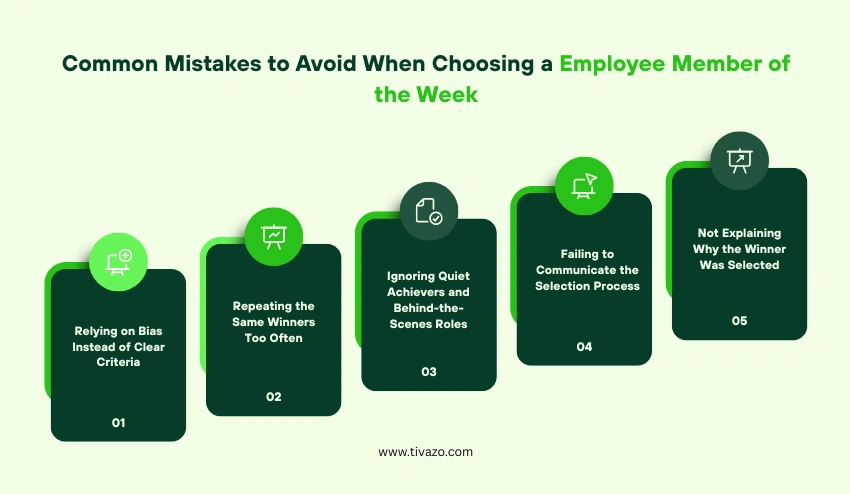
1. Relying on Bias Instead of Clear Criteria
Among the greatest errors that companies can commit during the process of choosing a staff member of the week is to allow personal bias to have a role in the decision process. Employees will lose trust in the program very fast when they believe that the employee of the week is not selected on merit but on favoritism. This may demoralize those who have been making regular contributions but are not in the limelight.
To prevent this, develop measurable and clear criteria. The employee of the week template should be used, which should spell out the expectations that include teamwork, reliability, customer service, problem-solving, and innovation. This will make your worker of the week system more open, equal, and consistent with your tip of the week to the employees.
2. Repeating the Same Winners Too Often
The other similar problem is choosing the same star employees again and again. Although these individuals might deliver the best they can, they should never reward the same people so that others feel that they are neglected. This undermines the effectiveness of your employee of the week award and restricts motivation in the larger team.
To remedy this, make sure that recognition is rotated and emphasizes different kinds of contributions. Disseminate the limelight between teams and positions to indicate that anyone can be granted an opportunity to be the worker of the week by making significant wins of the week at work.
3. Ignoring Quiet Achievers and Behind-the-Scenes Roles
Most workplaces do not recognize quiet achievers accidentally, i.e., the ones who work steadily and perform well without any publicity. When such team members are not included in the employee of the week recognition, they might feel underrated. This may demotivate and decrease interest.
Consider every position in the staff member of the week evaluation: frontline, remote, administrative, or behind-the-scenes. By identifying silent performers, not only will it inspire them, but it will also help strengthen your resolve to a culture of recognition that is fair and inclusive.
4. Failing to Communicate the Selection Process
Insufficient communication about the process of selecting the employee of the week may lead to confusion and distrust. Employees should know what you want, the nature of nominations, and what should be considered as a win worth recognition.
Share your process openly. Get a basic employee of the week template or checklist to steer your team. It is this openness that makes all realize how they can get the award of employee of the week, and also makes the process go hand in hand with your bigger tip of the week to direct your employees on work.
5. Not Explaining Why the Winner Was Selected
Telling someone that he was the winner without any explanation lowers the worth of the recognition. Employees desire specific feedback that is meaningful and that gives insight into what the winner did in order to be awarded the worker of the week. In isolation, the award comes across as a mechanized statement and not a prize for hard work.
It is best to always have a short explanation that links the winning behavior to what you were looking for. Compliment them on their weekly victories in the workplace and emphasize that they are needed to make the team a success. This builds confidence and encourages others to strive for the following staff of the week award.
Enhance Employee Recognition with the Right Tools
You could simplify this Employee of the Week program for yourself through online tools such as Tivazo. It helps in tracking and managing rewards for performance, and transparency in general. You maintain one centralized platform for performance data insights to find your top performers quickly without any biased opinions, and make your reward system quick, effective, and fair. Such tools increase participation and allow consistent rewarding of efforts put in by staff.
Conclusion
In a nutshell, creating an Employee of the Week program requires consistency, clear-cut criteria for selection, public acknowledgment of those being nominated, and a form of decent reward. If the selection of these workers is somewhat fair and value-based, and rotation among other teams is performed with appreciation of real reward, then appreciation will be developed among workers. Likewise, public acknowledgments raise the morale of staff. The meaningful ones, in particular, make the people valued and therefore ultimately create a capable workforce with an attitude toward successful work.
You create a very encouraging environment in which people feel great about coming to work, are productive, and stay with you longer. Feeling appreciated, employees will work harder and show greater dedication.
Now it’s your turn! Establish the Employee of the Week program in your workplace today and watch the difference it makes in morale and productivity. Please share your results and let us know how this affects your team!