
You glance at your phone and see “7:00.” But wait, is that morning or evening? If you’ve ever had that split-second moment of confusion, you’re not alone. The 12 hour vs 24 hour clock difference can trip anyone up, especially when switching between systems.
There are two main ways the world reads time. The 12-hour clock divides the day into two cycles, AM and PM. The 24-hour clock, also called military time, runs straight from 00:00 to 23:59 without repeating.
Both systems tell you the same thing. They just do it differently. And knowing the difference can save you from a missed meeting, a wrong flight, or a very awkward moment.
If you’ve ever struggled to convert between formats, this guide breaks it all down simply with examples, a comparison table, and easy conversion rules.
What Is the 12 Hour Clock?
The 12-hour clock divides the day into two halves, each 12 hours long. The first half runs from midnight to noon and is labeled AM (from the Latin ante meridiem, meaning “before midday”). The second half runs from noon to midnight and is labeled PM (post meridiem, meaning “after midday”).
So when someone says 7:00 AM, they mean early morning. When they say 7:00 PM, they mean early evening: same number, completely different time.
This system is most commonly used in the United States, Canada, Australia, and parts of South Asia for everyday conversation and casual scheduling.
The downside? You always need that AM or PM tag to make the time clear. Drop it, and suddenly “meet me at 8” means nothing on its own. That small dependency is where most confusion creeps in.
What Is the 24 Hour Clock (Military Time)?
The 24-hour clock runs continuously from 00:00 (midnight) to 23:59 (one minute before the next midnight), no repeats and no AM or PM needed.
Noon is still 12:00. But instead of cycling back after that, the hours keep climbing 13:00, 14:00, 15:00, all the way to 23:59.
| Standard Time | 24-Hour Time |
| 12:00 AM (midnight) | 00:00 |
| 12:00 PM (noon) | 12:00 |
| 2:00 PM | 14:00 |
| 6:30 PM | 18:30 |
The system is standard in the military, aviation, hospitals, and most international locations because it leaves zero room for misreading.
This is exactly why many people use a military time converter: they know they can quickly and accurately make the switch.
12 Hour vs 24 Hour Clock: Key Differences
Here’s a side-by-side look at how the two systems compare:
| Feature | 12-Hour Clock | 24-Hour Clock |
| Format | Uses AM/PM | Runs from 00 to 23 |
| Clarity | Can cause confusion | Clear and precise |
| Hour repetition | Hours repeat twice daily | Each hour is unique |
| Common usage | Daily casual life | Military, medical, global |
| Example | 7:00 PM | 19:00 |
| Error potential | Higher (missing AM/PM) | Lower |
The biggest practical difference is repetition. In the 12-hour system, 7:00 happens twice a day. In the 24-hour system, 07:00 and 19:00 are two completely different, unmistakable times. In environments where precision matters, like scheduling a surgery or clearing a flight for takeoff, that distinction isn’t just convenient. It’s critical.
How to Convert 12-Hour to 24-Hour Time
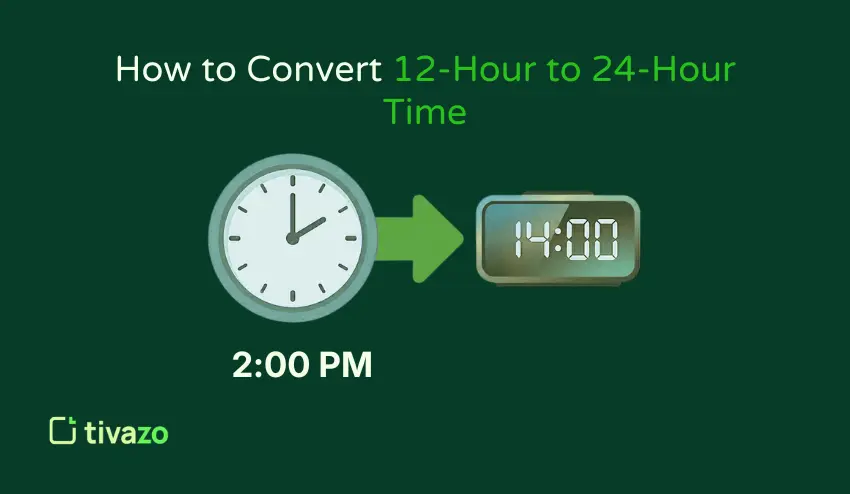
The conversion is easy once you know that there are two main rules:
For AM times:
- The hour remains the same
- One exception: 12:00 AM converts to 00:00
For PM times:
- Add 12 to the hour
- One exception: 12:00 PM remains the same
Examples:
| 12-Hour Time | 24-Hour Time |
| 9:00 AM | 09:00 |
| 12:00 AM | 00:00 |
| 12:00 PM | 12:00 |
| 2:00 PM | 14:00 |
| 11:45 PM | 23:45 |
Once you practice these two rules, the conversion becomes second nature. You can also use an online military time converter for instant, error-free results, especially useful when you’re dealing with multiple time entries.
How to Convert 24-Hour to 12-Hour Time
Going the other direction is just as simple:
- 00:00 to 11:59 → These are AM times. Keep the hour as-is (00:00 becomes 12:00 AM)
- 12:00 to 23:59 → These are PM times. Subtract 12 from the hour.
Examples:
| 24-Hour Time | 12-Hour Time |
| 08:30 | 8:30 AM |
| 12:00 | 12:00 PM |
| 16:00 | 4:00 PM |
| 21:15 | 9:15 PM |
| 00:00 | 12:00 AM |
Manual entry is easy, but it’s not completely error-free when using tools, especially when you’re tired, in a hurry, or working across multiple time zones.
Advantages of the 24-Hour Clock
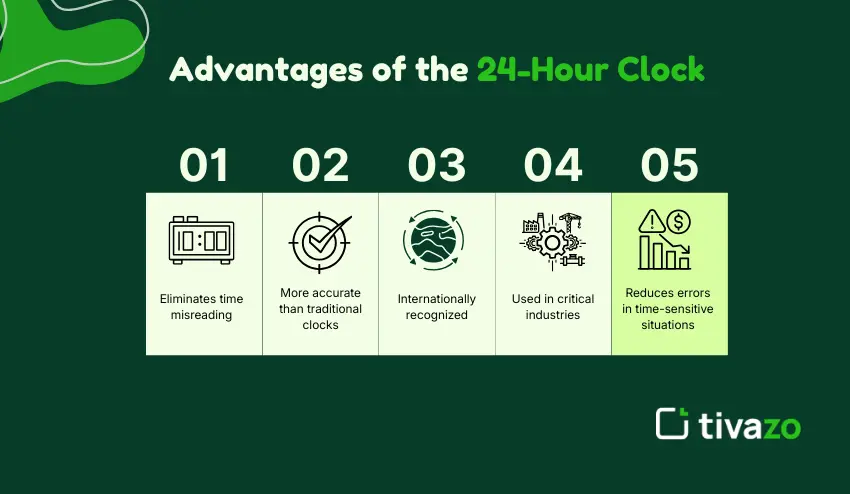
The 24-hour clock has some advantages, and they’re mostly associated with the workplace:
- Eliminates the possibility of misreading the time: Each hour of the day is represented by a unique number
- More accurate than the traditional clock: Schedules and appointments are accurately logged without the possibility of misreading
- Internationally recognized for communication: Most countries outside the USA use the 24-hour clock
- Used in critical industries: It’s the standard in hospitals, airlines, emergency services, and the military
- Reduces the possibility of errors in time-sensitive situations: A misread clock can have serious consequences in healthcare and aviation. Using the 24-hour clock eliminates the possibility of errors.
Common Mistakes People Make
Even once you understand the system, a few errors tend to come up repeatedly:
- Confusing 12 AM and 12 PM: This is the most common one. Midnight is 12 AM (00:00), and noon is 12 PM (12:00). They feel counterintuitive to many people
- Forgetting to add or subtract 12: Writing 3:00 PM as 3:00 instead of 15:00, is an easy slip
- Misreading 00:00: Some people read this as the end of the day rather than the very start
- Skipping leading zeros: 9:00 AM in 24-hour format is written as 09:00, not 9:00. The leading zero matters in formal and technical use
- Mixing formats in the same document: Switching between “2 PM” and “14:00” in a single schedule creates unnecessary confusion.
Double-check your entries or use a military time converter to avoid these errors altogether.
When Should You Use Each Format?
Neither system is universally “better.” It really depends on the context.
Stick with the 12-hour clock when:
- When you’re having casual conversations with people you know, like friends or family
- When you’re creating personal reminders or local appointments
- When your audience is mostly from places like the US, Canada, or similar regions
Switch to the 24-hour clock when:
- You’re working with international teams or clients
- You’re scheduling in healthcare, aviation, or military environments
- You’re creating formal schedules, logs, or shift plans
- You need to ensure there is zero room for AM/PM ambiguity
Conclusion
While the 12-hour and 24-hour clocks serve the same function, the 24-hour clock does so more clearly, with no room for confusion, making it suitable for use in places such as hospitals, the armed forces, and even international air travel.
After learning the conversion rules, it is easy to go back and forth between the two clocks. In addition, with a bit of practice, the 24-hour clock looks like second nature.
If you wish to quickly and effectively convert between the two clocks, you may want to try the military time converter, which will do the math for you in a snap, leaving you free to concentrate on what matters most.