
It’s super important to know what the average wage in Australia if you’re thinking about moving there, landing a job, or just checking how your money stacks up In a place where life’s pretty good, jobs are all over the place, and the work rules are solid, knowing what you’re earning compared to others is key for smart money moves and career choices. No matter if you’re a local worker figuring out your worth, a pro looking to move, or a boss trying to lure in the best, the average pay in Australia is a solid benchmark to help make those decisions.
For job seekers, knowing the average wage in Australia can help you ask for a fair wage and set realistic salary goals based on your field, experience, and where you live.
If you’re thinking about moving, figuring out what kind of income you need can help you plan your life, your money, and what you want to achieve in the long run.
Let’s dive into the nitty-gritty of what you’re earning in Australia, see how it stacks up in different places and jobs, and figure out what it’s worth when you’re trying to get by in
Key Highlights:
- How Does Australia’s Wage Compare Globally?
- In Australia, is $70,000 a good salary?
- In Australia, is AUD 6,500 a decent wage?
- In Australia, is $50 an hour a good wage?
Let’s explore all you need to know about Australia’s average salary and how it impacts your standard of living.
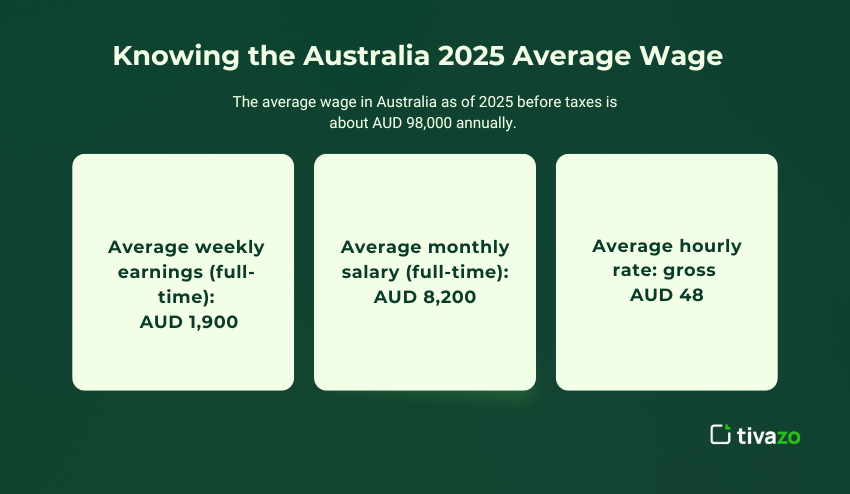
Knowing the Australia 2026 Average Wage
According to the Australian Bureau of Statistics, the average wage in Australia as of 2026 before taxes is about AUD 98,000 annually. Full-time, part-time, and casual employees in all industries are counted in this figure. It should be seen with caution, though, since it’s based on a mean average and can be inflated by high-income earners; it reflects the total income levels in the nation.
- Average weekly earnings (full-time): AUD 1,900
- Average monthly salary (full-time): AUD 8,200
- Average hourly rate: gross AUD 48
The average wage in Australia does not, however, provide the whole story. It is much affected by affluent sectors, including mining, technology, banking, and medicine, where senior executives may make well over $150,000 yearly. Conversely, industries like retail, hospitality, and government sometimes pay much less than the national average.
For this reason, one should also take into account the median income, which provides a more accurate picture of what most Australians make. The median income in Australia in 2026 is closer to AUD 75,000 per year, which indicates that half of the workforce makes under this amount. Assessing overall affordability and cost of living, this median number is particularly helpful and provides a more realistic picture of the median Australian employee’s compensation.
How Does Australia’s Wage Compare Globally?
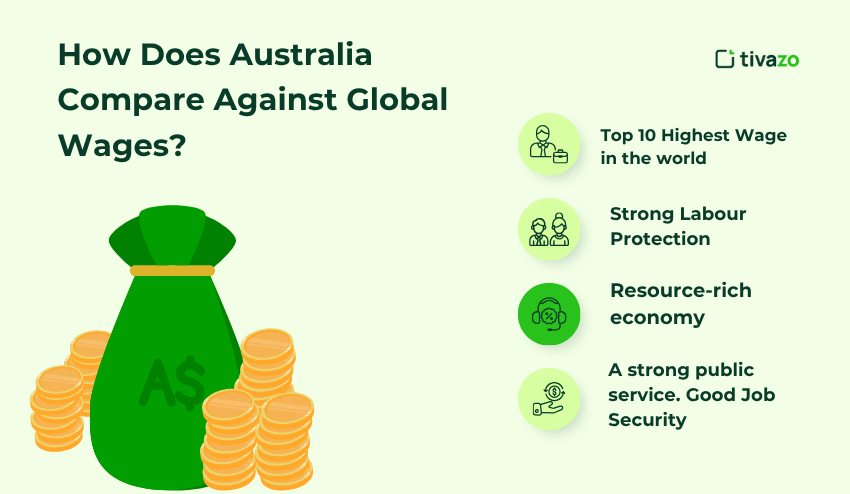
With regard to developed nations, the average wage in Australia is considered high. Australia ranks among the top 10 countries in terms of the highest average earnings, above the United Kingdom, France, Canada, and New Zealand, thus attracting skilled workers, international students making a transition into the workforce, and professionals seeking better jobs and pay.
Factors governing the better-than-average wage in Australia are largely structural and economic:
- One of the highest minimum wages in the world (AUD 24.10 per hour in 2026)
- Labor protections that ensure workers have fair wages and working conditions
- Resource-rich economy, especially in the mining and energy sectors, thereby requiring jobs that pay well
- Good size for public sector support to pay well enough to be attractive, with benefits
This is intertwined with modern healthcare, universal education, and strong infrastructure that complement these wage levels so that a balanced quality of life can be offered to the people of this country. Adjusted for PPP, the average wage in Australia still holds much better value per dollar than many developed economies.
Higher wages are a strong incentive for any international professional to consider relocating, especially when considered against a relatively high but still manageable cost of living.
How Does Australia Compare Against Global Wages?
Australia is higher than other developed nations when we talk of the average wage. In reality, it is consistently ranked among the top 10 average income-level countries, with countries in the UK’s position, France, Canada, and New Zealand falling behind. On the global scale, this places Australia as one of the best places to live for all those skilled and international professionals looking for a better lifestyle and appropriate remuneration.
The wage in Australia is high due to several reasons:
- Very high minimum wages (in 2026, it will be $24.10/hr, which will rank among the highest in the world)
- Strong labor protections, including fair work rules, occupational health, and safety standards
- Resource-rich economy (mining, energy, agriculture), where the middle range of high-end professions usually gets good wages
- A strong public service pays well and offers job security
At least equal pay laws, union strength, and the right to collective bargaining in Australia maintain comparable pay rates throughout most industries. Average wages in Australia are also reflective of the strong economy that resists pressures to maintain wage growth during global recessions.
On a larger scale, the average wage in Australia is adjusted for purchasing power parity (PPP), displays real purchasing power in Australia. One can procure proper health, housing, education, and leisure with the help of such purchasing power, which makes Australia more attractive than many countries where pay may be more on paper but is more than significantly compensated for by the higher cost of living.
Salary Growth & Increment Trends in Australia (2026)
Australian salaries are like stair climbing – incremental instead of the exponential trajectory of an elevator ride.
Recent trends
- Wage growth has been averaging 4–6% per year
- Stronger increments in high-demand sectors:
- Tech
- Healthcare
- Construction
What to expect in 2026
- On average, most employees are expected to see increments in the 3-5% range annually.
- Those in high-performing positions or those changing jobs can expect the following:
- 10–20% salary jumps
It is likely that the biggest bumps will come in cases of job switching rather than continued employment.
Industry impact
Not all sectors grow equally:
- Tech positions can be expected to exhibit relatively quick salary growth.
- Traditional industries may still present lower increment percentages.
The inflation factor
Here’s the twist:
Even though salaries are increasing, cost of living is rising at a similar pace
Meaning:
- Your salary may increase
- But your actual purchasing power may not
Smart takeaway
To truly grow your income in 2026:
- Upskill in high-demand areas
- Negotiate actively
- Consider strategic job changes
Because in today’s market, income growth favors the proactive
What is Average vs. Median salary in Australia (2026)?
When people look up salary, the numbers they often see are average incomes. However, average income numbers may not be an accurate representation.
Average income encompasses salaries across all employee types, from beginner to top management, as opposed to the median income, which is exactly in the middle, with 50% of incomes above it, and 50% below it.
Based on Australia’s estimated income data in 2026:
Average income: AU $85K-95K
Median income: AU $70K-75K
The reason that average income is not often the most effective way of assessing income is due to highly compensated earners, usually in the financial and tech industries, who can inflate this average. As this does not portray the typical earning rate, many feel the median income provides the most appropriate depiction.
To get a better understanding of average income, try to think about this situation: imagine 9 people earn AU $70K, while the 10th person in the room earns AU $500K. The median will be AU $70K, while the average income will spike considerably high.
Takeaway:
When attempting to find and compare earning figures or plan an income-relevant migration, the most practical metric of comparison will be the median income.
Is $70,000 Considered a Good Salary in Australia?
This is a question that applies to both residents and newcomers. The short answer? Yes, but that depends on your lifestyle and where you live.
A salary of $70,000 a year puts you just below the average wage in Australia, but it is still well above the average income in Australia. Here’s what you need to know:
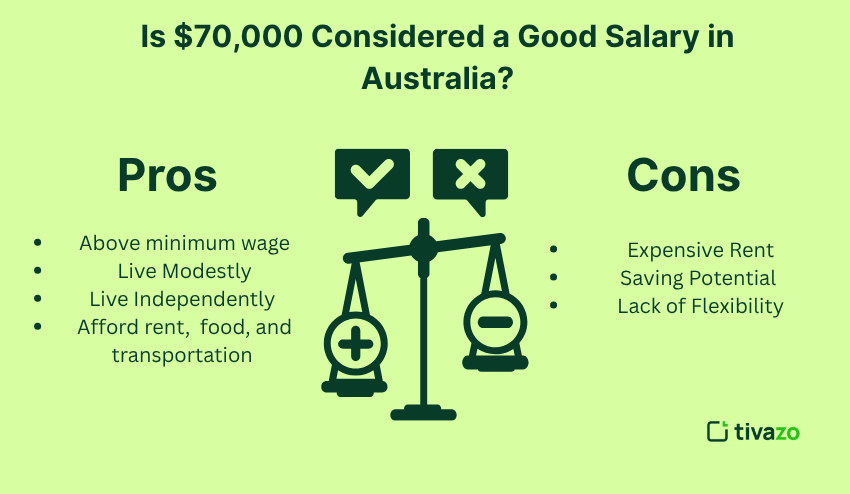
Pros :
- Above minimum wage
- You will be able to live modestly in most cities
- You can live independently without a roommate
- Will afford rent, food, transport, and entertainment
Cons:
- You may feel it’s tight in Sydney or Melbourne because the rent will be expensive
- You may not have much savings potential if you are supporting a family
- You may not have much flexibility for travel or investment
While $70,000 may not meet the wage that the average working person in Australia earns, it may still provide a decent and unscripted lifestyle, especially if you are living in small cities or rural towns. Those without families or just couples will generally be able to take care of the essentials, and with some budgeting, you will be able to save a percentage of that money as well. However, if you are raising a family or have one of those large urban rents (and similar expenses for child care), you are likely going to feel like it’s tight, particularly in this environment.
Is AUD 6,500 a Reasonable Salary in Australia?
$6,500 per month, a sum amounting to $78,000 yearly, is beyond the average wage in Australia, yet on the contrary, is somewhat below the average wage in Australia, standing at $98,000 in 2026. Meanwhile, this salary would result in a very comfortable and sustainable income for most people individually and/or small families, especially while living outside high-cost city centers.
Having AUD 6,500 as monthly income will offer you the following:
- Accommodation in suburban areas or shared accommodation in inner cities, comfortably
- Dine out a few times on the weekends without any financial problems
- Good healthcare, transport, and the necessities of life to live an untroubled existence
- Create emergency funds, save, or coordinate superannuation
- Traveling costs for entertainment or family holidays
In standard-paying terms, $6,500 per month makes an average middle-class income in Australia. These earnings are enough to meet day-to-day expenses with a decent level of living and to realize savings for the future, but would not have placed you in the upper income group.
This is substantially more than what many consider the average wage in Australia, particularly in the service industry, education sectors, or early career jobs, although barely below the average wage in Australia. With good money management, you could land on safe ground, attain financial goals, deposit toward owning a house, or invest.
Going at $50 per hour, is it good money in Australia?
Let us tell you:
- Weekly (38 hours): $1,900
- Monthly (4.3 weeks avg.): $8,170
- Annual: $98,000
This is right on the average wage in Australia. Remember that $50 per hour is above the accepted base rate for many award jobs. Positions for professionals in the IT, engineering, finance, and health sectors are usually in this pay range.
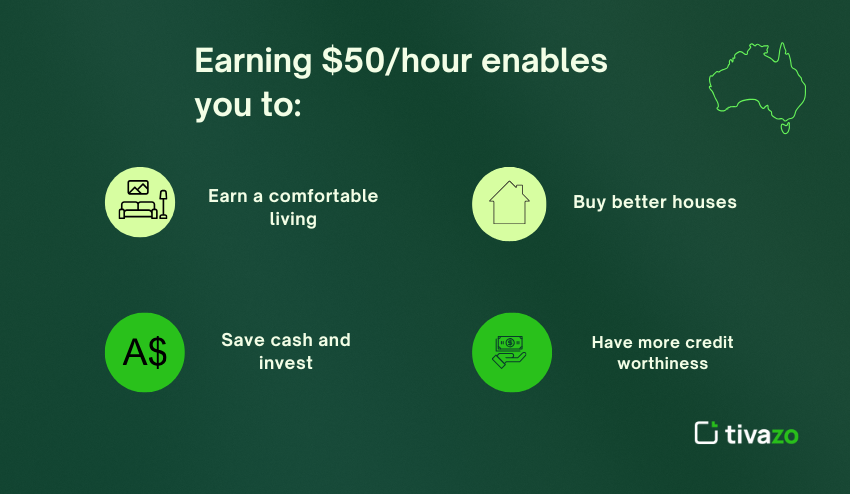
Earning $50/hour enables you to:
- Earn a comfortable living
- Save cash and invest
- Buy better houses
- Have more creditworthiness
Yes, it’s certainly a good wage in Australia at $50 an hour; in fact, it is an average pay.
Is it possible to live comfortably in Australia in 2026?
Yes, but comfort in Australia does not come without a hefty price tag, and that price varies according to where you place yourself.
What does “comfortable” actually mean
A comfortable life would also be expected to involve:
- Having a decent place to live (not having to plan time to the penny for rent, but sharing directly with someone in a stable situation)
- Personal savings
- Eating out every now and then
- Handling Unexpected Expenses Stress-Free
Income situation from the point of view of the year 2026.
- $60K Less flexible, enough to cover the essentials
- $70K-$85K average lifestyle, some savings
- $90K-$110K, Can live comfortably
- 120K+ Making everyday financial comfort, mainly out of town.
The largest contributor is the location.
The big city kings, such as Sydney and Melbourne, can silently suck the lifeblood out of you:
- Renting by yourself can get 30-50% of your income.
- Daily outgoings are far greater than in smaller cities.
A single person in a major city typically needs:
80K-100K+ to comfortably live in the city
The truth in hiding.
Despite the fact that salaries are increasing, there are a lot of people who can’t make ends meet because
- Growing rent
- What is Inflation
- Cost of living
In simple terms:
You can live comfortably in Australia, but you will need to earn more than your lifestyle, not just keep up with it.
You can live comfortably in Australia, but your salary needs to outpace your lifestyle, not just match it.
Wage Differences by Industry in Australia
The average wage in Australia varies drastically by industry. Here’s a quick snapshot:
| Industry Average | Annual Salary (AUD) |
| Mining and Resources | 150,000 – 165,000+ |
| IT and Software | 115,000 – 130,000 |
| Finance and Insurance | 110,000 – 125,000 |
| Healthcare and Social Work | 95,000 – 110,000 |
| Education and Training | 85,000 – 100,000 |
| Retail and Hospitality | 60,000 – 70,000 |
| Construction and Trades | 90,000 – 110,000 |
| Government/Public Services | 100,000 – 115,000 |
Note : Salaries vary based on experience, location, and role seniority, with senior positions in industries like IT and mining earning significantly above the averages listed above.
So industries such as mining, IT, and finance tend to raise the average wage, whereas retail, hospitality, and tourism stand below that average.
Regional Differences: Where You Do Work Matters
Going by the average wages in Australia, the location was a significant factor in earnings. Not every state in Australia pays the same wages.
| State/Territory | Average Annual Wage (AUD) |
| Australian Capital Territory (ACT) | $113,000 – 118,000 |
| Western Australia | $115,000 – 120,000 |
| New South Wales | $108,000 – 112,000 |
| Victoria | $105,000 – 110,000 |
| Queensland | $100,000 – 105,000 |
| South Australia | $95,000 – 100,000 |
| Tasmania | $90,000 – 95,000 |
| Northern Territory | $102,000 – 108,000 |
The stronger the economy of a region or the more it has government, mining, or tech jobs, the higher the average wage Australia tends to offer there.
Living Costs vs. Average Wage in Australia
You have to consider the cost of living when evaluating any wage. Here is what your money potentially goes into each month:
| Expenses Estimated | Monthly Costs (in AUD) |
| Rent (1-Bedroom city) | 2,200 – 2,800 |
| Utilities and Internet | 300 – 400 |
| Groceries | 600 – 800 |
| Transportation | 200 – 300 |
| Eating Out/Leisure | 300 – 500 |
| Health Insurance | 150 – 300 |
| Miscellaneous | 200 – 300 |
| Total | 4,050 – 5,400 |
Given you are drawing an average wage in Australia $8200 per month, the approximate monthly post-tax income stands at $6200, leaving an extra $2000 for discretionary expenses or savings. Not bad at all.
The Gender Pay Gap and Australia’s Average Wage.
It is one of the very important points of discussion: indeed, by the year 2026, the average wage in Australia will still reflect a split between male and female earnings. On average, men earn about 10 to 12% more than women per annum.
- Average male wage: AUD 111,700
- Average female wage: AUD 98,900
This wage differential carries the utmost importance in leadership positions, in male-dominated sectors such as mining, finance, and construction. Although being in such positions within sectors such as the health or education sector-women out outnumber men-men tend to be paid more for their services.
Concurrently, over time, the gender pay gap has been reduced, with increased pressure from the public, policy reform from the governmental side, along with changes in gender pay transparency laws, and has become part of the corporate agenda with diversity initiatives and corporate policies. Efforts to achieve equal pay will, therefore, look towards ensuring that the average wage in Australia represents equal opportunity regardless of gender. Nonetheless, the complete closing of the wage gap needs to be coupled with sustained work on areas such as equitable parental leave entitlements, flexible working arrangements, and the fair treatment of hiring and promoting contractors and employees across all sectors.
Conclusion
The average wage in Australia in 2026 will surely allow for a comfortable life, especially for full-time employees and skilled personnel. However, one’s experience can vary greatly with location, profession, lifestyle, and family situation. So, understanding the average wage in Australia is beyond numbers and must be about the objective and the way one intends to live. Being aware helps make better decisions regarding career and finances, whether working in Australia or contemplating moving there.