
Knowing how to hourly to salary calculator is a crucial part of assessing job offers, making financial plans, negotiating salaries, and predicting future income.
Understanding the calculator of hourly wage to annual salary can assist you in making better financial decisions, whether you are an employee, freelancer, contractor, Human Resources (HR) professional, or job seeker.
People make only hourly rate decisions and take no other factors into account. A $25 per hour job might be appealing, but how much is that per year? Similarly, it might be hard to compare two positions that have different pay structures unless you calculate them to annual basis.
That’s where an Hourly to Salary calculator comes in handy. You can estimate your weekly, monthly, and annual salary in seconds using the hourly to salary calculator with your hourly wage and working schedule.
Have you ever wondered:
- 20 hours a year is how much?
- How to calculate an hourly wage from an annual salary?
- Does an hourly job offer a better salary position?
- Given my current hourly wage, how much money will I make a year?
In this guide, you’ll learn:
- What is the Hourly to Salary Calculator?
- Why Use an Hourly to Salary Calculator?
- The formula used to calculate annual income
- Hourly to Salary Calculator Examples
- Common salary examples range from $15 to $100 per hour
- How overtime affects yearly earnings
- Factors that impact your actual take-home pay
- Why accurate time tracking improves salary estimates
At the end of this guide, you will know how much you can expect to earn and how to work out your annual salary.
What is the Hourly to Salary Calculator?

What is an hourly to salary calculator? It is a calculator available on the internet that converts your hourly rates to an approximated yearly salary, considering the hours you work each week and the number of weeks you work in a year. The formula does the math and calculates your earnings.
This tool can be essential for employees, independent contractors, job candidates, and business owners who want an accurate hourly-to-salary calculator. If you are looking at a few job offers, preparing a salary negotiation, or doing household budget planning, having an hourly-to-salary calculator can be very effective.
Most handheld calculators can also allow you to tailor your work schedule to reflect part-time hours, overtime, or fewer working weeks to give you a more detailed prediction. Turning this hourly rate into a yearly one gives you a much better indication of your future earnings to assist you with your savings, taxation, and career goals.
Why it’s important in 2026:
- Job postings have become more hybrid and remote, with hourly pay combined with a salary, particularly.
- The U.S. Bureau of Labor Statistics reported that, on average, workers in the private industry earned $32.23 per hour in April 2026, up 3.6% from the previous year. Not to mention how crucial it is to know your earning potential.
- From an annual number, it is much easier to budget for rent, savings, and monthly expenses than it is from an hourly number.
- To secure a raise or freelance rate, knowing your annual market value is essential, rather than an hourly rate.
If you are looking to become an employee, freelancer, or HR manager, comparing the compensation packages and understanding how to calculate hourly wages into a salary is a basic financial skill.
Why Use an Hourly to Salary Calculator?
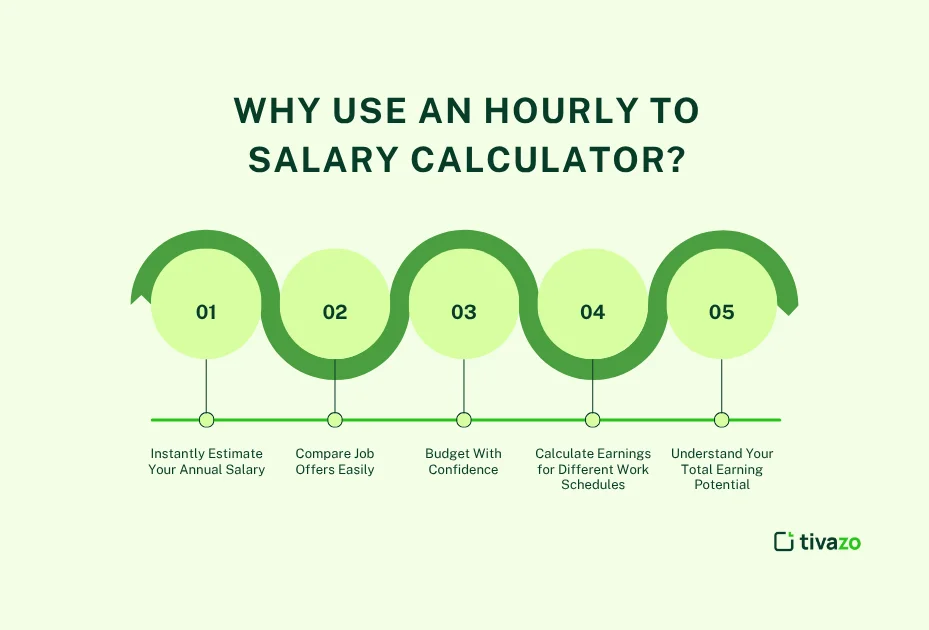
An hourly-to-salary calculator allows you to figure out what a yearly salary is using a pay rate. Instead of working the job calculation all out for yourself, put in your pay rate, hours in a week, then weeks a year.
When it comes to comparing job offers, negotiating salaries, budgeting, or estimating income, an hourly-to-salary calculator can do the work for you efficiently and reliably.
1. Instantly Estimate Your Annual Salary
The calculator does in seconds what you would otherwise do by multiplying your hourly salary by the number of hours you worked throughout the year.
It helps you quickly answer questions like:
- How much is $20 an hour per year?
- What annual salary equals $35 per hour?
- What is my salary if I go part-time, for example, working 30 hours per week?
2. Compare Job Offers Easily
Somecompaniesdisemmination in pay schemes. For example, one company may pay $28 per hour and advertise another pay between $58,000,
Using an hourly-to-salary calculator gets you a result in the same unit, which makes the comparison far easier and helps in picking the best deal.
3. Budget With Confidence
Having an idea of what your yearly salary is expected to be will surely give you an edge in whatever decision you are about to make.
The calculator can help you plan:
- Monthly housing expenses
- Savings goals
- Debt repayments
- Emergency funds
- Retirement contributions
- Annual spending budgets
Annual income estimates are way more informative for financial planning over the long-term than an hourly wage.
4. Calculate Earnings for Different Work Schedules
Yours truly doesn’t abide by a normal 40-hour work week.
An hourly-to-salary calculator lets you customize:
- Hours worked per week
- Weeks worked per year
- Part-time or full-time schedules
- Seasonal employment
This is a more realistic estimate because of the hours you really work.
5. Understand Your Total Earning Potential
Your yearly income may vary depending on several factors, including:
- Overtime hours
- Paid vacation
- Paid holidays
- Bonuses
- Time off
- Reduced work weeks
The hourly to salary calculator provides you with an accurate baseline estimate of your overall salary.
How an Hourly to Salary Calculator Works
The use of an hourly-to-salary calculator involves an equation that requires the user to determine.
Your annual salary can be calculated by multiplying the number of hours you work each week by the number of weeks per year you work. This will give you the number of hours you work in a year. Then divide this number by your hourly rate.
- United States full-time employees: For most of the country, the basic formula is 3
- 40 hours/week 52 weeks/year = 2, 080 working hours a year.
- So you can shortcutly work out: Much easier than working out, so I have.
- Hour Rate 2,080 = Estimated Yearly Salary
If you are employed part-time, work overtime, or work fewer weeks per year, then the calculator will auto-calculate the outcome depending on the values that you have submitted.
Hourly to Salary Calculator Examples
| Hourly Rate | Estimated Annual Salary (40 hrs/week, 52 weeks/year) |
| $15/hour | $31,200 |
| $20/hour | $41,600 |
| $25/hour | $52,000 |
| $30/hour | $62,400 |
| $40/hour | $83,200 |
Note: These calculations assume a full-time load of 2,080 hours per year. If your normal working hours are not this amount, utilize the hourly to salary calculator to receive a custom estimate.
Hourly Wage to Annual Salary Chart (2026)
The table below assumes:
- 40 hours per week
- 52 weeks per year
- 2,080 total annual work hours
| Hourly Rate | Weekly Pay | Monthly Pay | Annual Salary |
| $15 | $600 | $2,600 | $31,200 |
| $20 | $800 | $3,467 | $41,600 |
| $25 | $1,000 | $4,333 | $52,000 |
| $30 | $1,200 | $5,200 | $62,400 |
| $35 | $1,400 | $6,067 | $72,800 |
| $40 | $1,600 | $6,933 | $83,200 |
| $50 | $2,000 | $8,667 | $104,000 |
| $60 | $2,400 | $10,400 | $124,800 |
| $75 | $3,000 | $13,000 | $156,000 |
| $100 | $4,000 | $17,333 | $208,000 |
$15 an Hour Is How Much a Year?
Many entry-level and service-sector jobs pay around $15 per hour.
Using the standard formula:
$15 × 2,080 = $31,200
Income Breakdown
| Time Period | Earnings |
| Hourly | $15 |
| Weekly | $600 |
| Monthly | $2,600 |
| Yearly | $31,200 |
A worker earning $15 per hour can expect approximately $31,200 annually before taxes and deductions.
$20 an Hour Is How Much a Year?
One of the most searched salary questions online is:
“$20 an hour is how much a year?”
Using the standard formula:
$20 × 2,080 = $41,600
Income Breakdown
| Time Period | Earnings |
| Hourly | $20 |
| Weekly | $800 |
| Monthly | $3,467 |
| Yearly | $41,600 |
What About Overtime?
When an employee works overtime regularly, they can make a lot more than the base annual salary.
For example:
Overtime pay is a great way to make significant extra money each year. If you work 5 hours of overtime a week and get time-and-a-half for those hours, you’ll bring home a lot of extra cash annually.
To estimate additional earnings, you can use the overtime calculator to accurately calculate overtime hours and understand how overtime affects your annual salary.
$25 an Hour Is How Much a Year?
At $25 per hour:
$25 × 2,080 = $52,000
Income Breakdown
| Time Period | Earnings |
| Hourly | $25 |
| Weekly | $1,000 |
| Monthly | $4,333 |
| Annual | $52,000 |
$30 an Hour Is How Much a Year?
At $30 per hour:
$30 × 2,080 = $62,400
Income Breakdown
| Time Period | Earnings |
| Hourly | $30 |
| Weekly | $1,200 |
| Monthly | $5,200 |
| Annual | $62,400 |
$40 an Hour Is How Much a Year?
At $40 per hour:
$40 × 2,080 = $83,200
Income Breakdown
| Time Period | Earnings |
| Hourly | $40 |
| Weekly | $1,600 |
| Monthly | $6,933 |
| Annual | $83,200 |
Many mid-level managers, consultants, engineers, and specialized professionals earn compensation in this range.
$50 an Hour Is How Much a Year?
A common question among experienced professionals is:
“$50 an hour is how much a year?”
Using the standard annual salary formula:
$50 × 2,080 = $104,000
Income Breakdown
| Time Period | Earnings |
| Hourly | $50 |
| Weekly | $2,000 |
| Monthly | $8,667 |
| Annual | $104,000 |
What Does a $50/Hour Salary Mean?
A typical weekly wage of $50 is a good income. This rate is earned by many professionals who work in the following fields:
- Technology
- Engineering
- Healthcare
- Finance
- Project management
- Consulting
If an employee earns $104,000, he or she can enjoy greater financial flexibility and:
Increase retirement contributions
Build emergency savings
Make extra payments on debt to pay it off sooner.
Wisely invest for a long-term gain.
Potential Earnings With Overtime
If the employee works overtime regularly, he or she may find that the annual income goes up significantly if the job pays $50/hour.
For example:
- Standard annual salary: $104,000
- Overtime could bring in more than six figures in earnings.
When calculating compensation for the calendar year, it’s extremely important to keep accurate records of working hours, particularly in cases where workers are paid on a variable schedule or based on opportunities for overtime.
Hourly Pay vs Salary Pay

When evaluating a job opportunity, one of the biggest decisions is whether to choose an hourly position or a salaried role.
While both compensation models provide income, they differ significantly in flexibility, benefits, overtime eligibility, and earning potential.
Understanding these differences can help you make a more informed career decision.
| Factor | Hourly Pay | Salary Pay |
| Payment Method | Paid for each hour worked | Fixed annual compensation |
| Overtime Eligibility | Usually eligible | Often exempt from overtime |
| Income Stability | Can vary weekly | Consistent paycheck |
| Schedule Flexibility | Often more flexible | Usually fixed work expectations |
| Benefits | May be limited | Often includes more benefits |
| Earnings Potential | Increased over time | Usually fixed unless bonuses apply |
| Paid Time Off | Depends on the employer | Commonly included |
Advantages of Hourly Pay
Some of the advantages of hourly jobs include:
- Overtime opportunities
- Flexible schedules
- You receive compensation for the additional hours: hour
- Easier income tracking
However, for those who work overtime regularly, their hourly wages may lead to higher annual salaries than a similar job with a standard work schedule.
Advantages of Salary Pay
Wages paid are typically given to salaried employees:
- Consistent income
- Paid vacation time
- Paid holidays
- Health insurance
- Retirement benefits
- Professional development opportunities
Salary jobs can provide a more stable and predictable income stream for many professionals, as well as a potential for growth and career advancement.
5 Factors That Affect Annual Income
The amount you earn can vary from the calculation, even if you have performed an hourly-to-salary calculator.
There are several factors that determine your annual income.
1. Overtime Pay
Over time can make a big difference to the annual income.
Most employers in the United States are required to offer overtime pay to anyone who is qualified to work overtime in accordance with rules set by the Department of Labor on the overtime pay rates.
For example:
- Hourly Rate: $25
- Overtime Rate: $37.50
- Overtime Hours: 5 per week
The additional hours can contribute thousands of dollars to a year’s wages.
If you have a routine with overtime, you need to use the Overtime Calculator to determine how much you will earn with overtime.
2. Paid Time Off
Annual income is impacted by Paid Time Off (PTO).
Examples include:
- Vacation days
- Sick leave
- Personal leave
- Paid holidays
If a worker takes PTO, he or she is still getting paid while on leave.
This can make a compensation package more valuable than jobs that just give you unpaid leave.
3. Bonuses and Commissions
A lot of employees receive extra income above the basic wage.
Examples include:
- Performance bonuses
- Annual bonuses
- Sales commissions
- Profit-sharing programs
- Referral incentives
These payoffs are not part of the typical calculation of earnings from an hourly rate but can significantly boost overall compensation.
4. Taxes and Deductions
Gross income is not equal to take-home pay.
Common deductions include:
- Federal income taxes
- State income taxes
- Social Security contributions
- Medicare contributions
- Retirement plan contributions
- Insurance premiums
Two employees who receive the same amount of pay annually can end up with different net take-home pay, depending on deductions and tax rates.
5. Benefits Packages
Higher benefits can boost the worth of compensation.
Common benefits include:
Health Insurance
Saving employees thousands of dollars every year is the value of having a health program that their employer pays for.
Retirement Matching
Some employers will match employees’ contributions to a retirement plan like a 401(k) program.
Tuition Reimbursement
Some employers may offer to pay for education and certification costs, which not only cuts expenses but can also help promote advancement within the job.
Remember to take salary and benefits into account when considering compensation.
How Taxes Affect the Hourly to Salary Calculator?
One of the most common mistakes people make is assuming their annual salary estimate equals their take-home pay.
In reality, salary calculations usually represent gross income, not net income.
Gross Pay
Gross pay is the amount of pay received before deductions.
Example:
- Hourly Rate: $30
- Annual Salary Estimate: $62,400
The total of $62,400 is gross income per year.
Net Pay
Net pay is pay after deductions have been taken out.
Deductions may include:
- Income taxes
- Social Security
- Medicare
- Retirement contributions
- Health insurance premiums
This is commonly known as “take-home pay.
Take-Home Income Example
Suppose that one of the workers makes:
Gross Salary: $62,400
Once all deductions are made, their real earnings or take-home after deductions may be lower than this if they:
- Location
- Tax bracket
- Benefits elections
- Retirement contributions
Tax situations are also very varied and should not be used for tax planning but only for tax estimation using the salary calculator tools.
Important Note
This article is for informational purposes only and is not meant to be tax, legal, or financial advice. Seek professional advice on your individual circumstances.
The Internal Revenue Service (IRS) and the Social Security Administration (SSA) provide that tax obligations are based on the tax regulations, income, and individual circumstances.
How Accurate Time Tracking Improves Salary Calculations?
Inaccurate work hour data is one of the most common issues with converting to Hourly to a salary calculator.
Even the most accurate salary formula will not yield accurate results if the number of hours recorded is wrong.
Thus, effective time tracking is crucial for salary estimation. The importance of tracking the time.
Why Time Tracking Matters
Good records enable employees to know:
- Actual hours worked
- Overtime hours
- Productivity patterns
- Project profitability
- Income trends
If not done properly, annual salary estimates can be very high or low.
Better Payroll Accuracy
Time tracking systems are used to enhance:
- Payroll processing
- Compensation accuracy
- Labor cost analysis
- Compliance reporting
Consistent hours tracking means that employees receive accurate pay for all hours worked.
The Role of Timesheets and Reports
Detailed Timesheets and Reports provide valuable insights into:
- Daily work hours
- Weekly trends
- Attendance records
- Overtime totals
These reports create a reliable foundation for annual income forecasting.
Verifying Work Hours
A Time Card Calculator is also used by many professionals to check work hours to see if there are any discrepancies before payroll is processed.
The more accurate the records, the more accurate the salary calculator estimates will be.
Better Financial Planning
With regular work-hour reporting, employees can:
- Make more realistic future income forecasts
- Create realistic budgets
- Set savings goals
- Monitor income growth
Using Employee Monitoring to Understand Productivity and Labor Costs
When it comes to salary calculations for businesses, it’s not just about compensation for employees. They also play a critical role in comprehending the costs of labor and the productivity of labor.
Today’s tools and applications make it possible to gain insights that enable organizations to make informed decisions.
1. Understanding Labor Expenses
Labor is typically one of a company’s highest operating costs.
Having accurate workforce data assists businesses with the following:
- Estimate payroll costs
- Forecast staffing needs
- Improve scheduling
- Control labor spending
This information can be used to improve budgeting and resource allocation.
2. Employee Monitoring and Productivity
The best Employee Monitoring (employee-monitoring) will give you insight into employee time.
Organizations can identify:
- Productivity trends
- Workflow bottlenecks
- Attendance patterns
- Resource utilization
The idea isn’t just to be in charge, it’s to be more efficient.
3. Visual Accountability through Live Screenshots.
To get a better picture of work activity during office hours, some businesses are using Live Screenshots.
These are the kinds of tools that can aid:
- Check if the working time is ongoing.
- Improve accountability
- Support project management
Used correctly, they can help to make more accurate labor-cost calculations.
4. Measuring Performance More Effectively
When using Data-driven Performance Insights, organizations can assess:
- Productivity levels
- Team efficiency
- Project completion rates
- Workload distribution
The information is useful for leaders to inform decisions on staffing and compensation planning.
5. Supporting Growing Teams
Effective Team Management becomes more crucial as organizations grow in size.
Workforce Analytics can help managers:
- Balance workloads
- Improve scheduling
- Forecast labor expenses
- Optimize staffing levels
When you add accurate time tracking with productivity data, you get a better picture of employee performance and overall labor costs.
5 Common Mistakes When Calculating Annual Salary
While the Hourly to Salary Convertor formula is simple, many people make mistakes that can lead to inaccurate salary estimates.
Knowing what these typical mistakes are can help you to make a more accurate estimate of your annual income.
1. Ignoring Unpaid Leave
Many salary calculations utilize working 52 weeks a year. But if you go on unpaid leave, you may see a lower income per year.
Examples include:
- Extended personal leave
- Unpaid vacation days
- Seasonal work gaps
- Family leave
If you are employed for less than 52 weeks a year, make the proper adjustments.
Example
$25/hour × 40 hours/week × 48 weeks
= $48,000 annually
This is far greater than the usual $52,000 with 52 working weeks.
2. Forgetting Overtime
Annual income can be greatly enhanced by overtime.
Overtime workers with a regular overtime history may not realize that they are earning overtime until they only consider their base hourly rate.
For example:
- Base wage: $20/hour
- Overtime hours: 5/week
- Overtime rate: $30/hour
Those additional hours could cost thousands of dollars in wages over a year’s time.
An Overtime Calculator can be helpful to make sure overtime income is counted in annual salary estimates.
3. Miscalculating Weekly Hours
Most people don’t accurately track their hours.
Common mistakes include:
- Forgetting short shifts
- Excluding meetings
- Ignoring travel time
- Miscounting overtime
A small mistake can make a huge difference in calculating the annual salary over 52 weeks.
4. Ignoring Taxes
A gross salary differs from take-home pay. Paper salary estimates can seem to be a good deal, but it’s not always the case when the deductions are taken into account.
When working on any problems, remember to think:
- Federal income taxes
- State taxes
- Social Security contributions
- Retirement deductions
- Health insurance premiums
5. Not Tracking Work Hours Properly
Accurate time records are essential for making accurate salary calculations.
Many employees use their memory instead of the real data.
A Time Card Calculator is available to check work hours and to give more accurate salary estimates.
The better your time records are, the better your annual income estimates will be.
Conclusion
Understanding the hourly to salary calculator is essential for making informed career and financial decisions.
Whether you are:
- Comparing job offers
- Negotiating pay
- Planning your budget
- Switching careers
- Freelancing full-time
Knowing your annual earning potential gives you a much clearer financial picture.
Instead of guessing your yearly income, use accurate salary calculator formulas and online tools to make smarter decisions.
In any field or job, anybody who has to budget his/her financial affairs or make career changes needs to know how to turn hourly wages into salary estimates. Remember all the other suggestions that we underlined to ensure you get the highest possible salary and are in charge of your financial life.
An hourly-to-salary calculator is available online nowadays to remove the potential uncertainties while providing data for salary comparisons and starting to think about a financially secure future.