Starting a new business is exciting, but without a clear roadmap, even the best ideas can fail. That’s where a business plan for a startup becomes essential. A properly developed startup business plan is a step towards success in the long term, whether you are pitching to an investor, applying for a loan, or even trying to explain the vision.
This step-by-step tutorial will explain how to make a business plan for a startup, what information to cover, pitfalls to avoid, and how you can use a business plan for a startup to save time. At the end, you will possess all the information that you can trust in writing a business plan for a startup company.
👉Related: How to Write a Business Plan in 2026: 9 Key Steps to Success
What Is a Business Plan for a Startup?
A business plan for a startup business is a formal document that outlines your company’s goals, strategy, target market, operations, and financial projections. It explains what your business does, how it will make money, and why it will succeed.
Startups are uncertain as opposed to established companies. That is why a startup business plan is not only about execution but also validation, demonstration of the idea that you have a real problem, and the market will demand.
In simple terms, a business startup plan helps you:
- Turn an idea into a structured strategy
- Test assumptions before investing heavily
- Communicate your vision clearly to stakeholders
Why Every Startup Needs a Business Startup Plan (Benefits)
Most founders do not plan since they desire to move fast. Speed is important, but rushing without a proper strategy is likely to result in time and resource wastage. Established entrepreneurs know that the business startup plan is not to slow down the pace; it is to build deliberately and clearly.
The following are the major reasons why it is necessary to write a business plan for a startup in order to succeed in the long run.
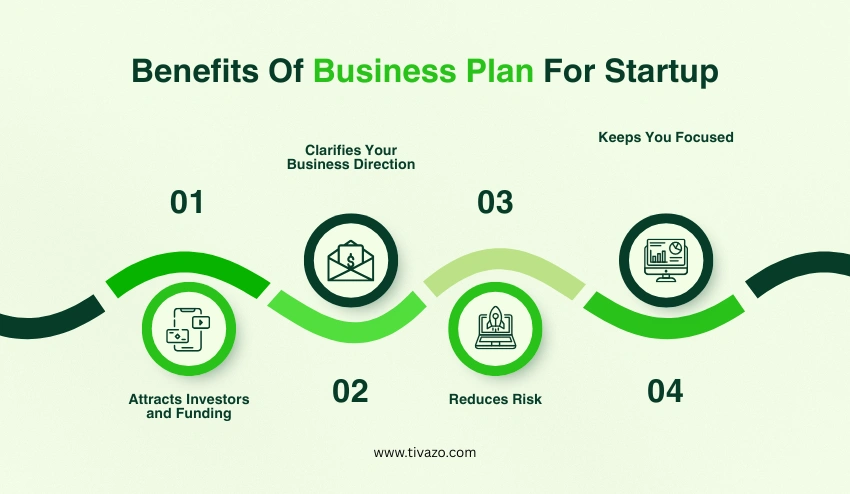
1. Attracts Investors and Funding
Investors will hardly ever finance ideas and will invest in businesses that are structured, foresighted, and have growth potential. Having a good business plan in a startup business indicates that you have an idea of your market, revenue model, and how far you can go. It demonstrates to the investors that you have conducted the required research and are ready to make your idea work with a plan.
An effective business plan of startup also offers a financial forecast and risk analysis, which is essential in developing investor confidence. Even good startups might not be able to fund or get a partner without a proper business plan in a startup business.
2. Clarifies Your Business Direction
A startup company’s business plan compels the founders to establish their mission, target audience, pricing plan, and competitive edge. Most of the startups that fail use vague positioning and not bad ideas. By writing down these elements, it becomes possible to turn an abstract idea into a clear and practical strategy.
Writing a business plan for a startup helps you understand more about your goals and ways to accomplish them. This transparency simplifies the prioritization of tasks and resource allocation and the informed decision-making process as the business grows.
3. Reduces Risk
All startups are uncertain, but a business plan that discusses start up business in detail will help in identifying risks that may be encountered by a startup before they get out of control. Through the analysis of the market demand, competition, and financial needs, founders are able to devise solutions and contingency plans early on.
An entrepreneurial business plan that is well researched promotes the use of data in making decisions, as opposed to relying on guesses. Although no plan will take all risks out, planning will greatly decrease the number of mistakes that can be avoided and will have a higher probability of sustainable growth.
👉You May Also Like: Business Process Planning in Workplace: 7 Powerful Steps
4. Keeps You Focused
As a startup, there are several ways you can be distracted, and this can be a result of competitors offering alternatives and new opportunities that can draw you in different directions. A startup business plan is like a roadmap; it enables you to test the viability of new ideas with respect to your long term vision and goals.
The business startup plan is also a good way of monitoring the progress by determining specific milestones and performance indicators. It makes sure that day-to-day operations do not deviate when the environment alters and are in tandem with the long-term objectives of the business.
At the beginning of any entrepreneurship, being focused and clear can be the key to success and growth or failure. A properly developed business plan of a startup helps not only in the process of decision-making but also in enhancing the credibility of the business among investors, partners, and stakeholders. Investing time in the development of a careful and realistic strategy, founders prepare their startups for success in the long-run and flexibility.
Types of Startup Business Plans
You need to select an appropriate format before you start writing. Startups do not all require the same kind of plan, and choosing the one that fits you will save some time and help you achieve your objectives. These are the most widespread formats when developing a business plan for a startup business.
1. Traditional Business Plan
A conventional business plan is elaborate, organized, and thorough. Such a format is generally applied when requesting bank loans or pitching to investors who require in-depth analysis, clear financial projections, and long-term planning. It is detailed and encompasses all the aspects of the business, hence suitable in the case of an established business or startup that is already funded.
Key Points:
- Detailed and structured
- Ideal for investors and banks
- Typically 15–30 pages
2. Lean Startup Plan
The lean startup plan is a more flexible plan that is also shorter than a traditional plan. It is concerned with assumptions of the core, major metrics, and rapid validation as opposed to long descriptions. This is the ideal format in cases where founders would wish to go at a fast pace and also be clear at the same time.
In learning to develop a business plan to start a business, most of the early-stage founders start with a lean version and improve it as time goes on.
Key Points:
- Short and flexible (1–3 pages)
- Focuses on key assumptions and metrics
- Best for early-stage founders
3. One-Page Business Plan
A one-page business plan gives you a general overview of your business. It is handy in internal alignment, brainstorming, and fast pitches. Although not generally adequate as a tool to be given to investors, it is a good planning tool or summary.
This format may be applied together with a business plan template of startup to outline ideas in a quick mode, then proceed to elaborate into a comprehensive plan.
Key Points:
- High-level overview
- Useful for internal clarity and quick pitches
When founders begin seeking funds or expanding operations, most of them start with a lean version and gradually develop it into a full business plan of startup. The correct format will make sure that your plan is aligned with your stage and objectives.
Step-by-Step Guide to Create a Business Plan for a Startup
A good business plan for a startup does not need to be daunting to create. In the event that it is divided into manageable parts, the process becomes manageable and very effective. Every part of your startup business plan has its purpose, as it allows the investors and stakeholders to know your vision and implementation plan.
The following is a step-by-step analysis of each critical section that you require when learning how to create a business plan to start-up.
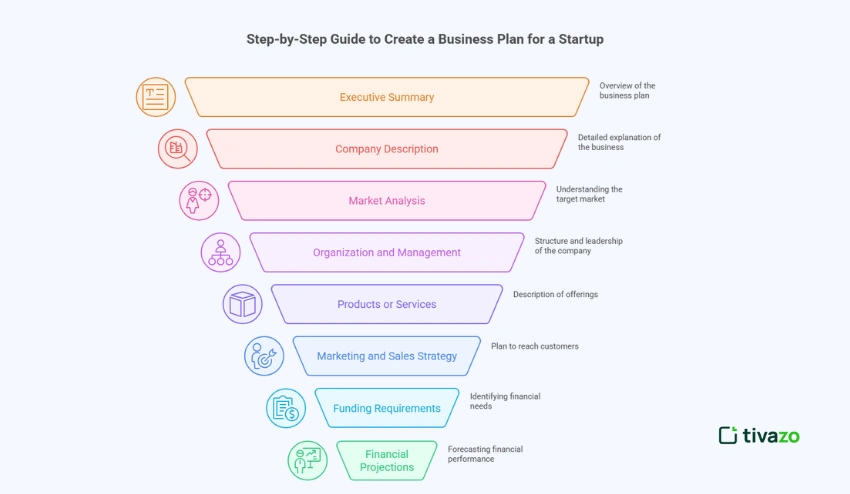
1. Executive Summary
The most important section of your business plan as a startup is the executive summary since it gives a description of your entire business. It is usually the first part that is read by the investors and in many instances the only part, hence it has to be clear, concise, and compelling.
The executive summary must come at the very end, although it is stated in the very beginning. This makes it reflect well on the specifics of your business plan concerning your startup business and your goals, strategy, and financial perspective.
Include:
- Business name and location
- Mission statement
- Product or service overview
- Target market
- Revenue model
- High-level financial projections
👉 Tip: Write this section last, even though it appears first.
2. Company Description
A company description describes who you are, what you do, and why you are starting a company. This section of a business plan of a startup company establishes the groundwork of all that comes after it since it clearly outlines your purpose and vision.
The section, which makes the readers know what problem you are solving and where your solution fits in the market. Having a well-written description of your company is a strength of your business startup plan because there is intent, direction, and long-term potential present.
Cover:
- Business structure (LLC, sole proprietorship, corporation)
- The problem you’re solving
- Your solution
- Short- and long-term goals
A strong company description shows why your business plan for a startup company exists and why it matters.
👉Related: 15 Profitable Remote Business Ideas for Quick Success
3. Market Analysis
Your startup idea is verified by market analysis, which demonstrates that there is demand. Investors would like to know that there are customers who are ready to buy your product or services. This part is necessary when preparing a business plan for a startup that is to scale.
With the help of data and research, you will show that you know your industry and rivals well. An excellent market analysis renders your startup business plan more plausible and reduces perceived risk.
Include:
- Target customer demographics
- Market size and growth trends
- Customer pain points
- Competitor analysis
Use data wherever possible. A data-driven market analysis strengthens your startup business plan and builds credibility.
4. Organization and Management
The section brings to focus the individuals behind the business. Investors do not simply put money in ideas; they put money in teams. The startup business plan must clearly state the people in charge of the strategy implementation.
Confidence is created by presenting clear roles and responsibilities even in a small startup. It demonstrates that the correct skills and leadership support your business start-up plan.
Include:
- Founders and key team members
- Roles and responsibilities
- Advisors or board members
- Organizational structure
Even if you’re a solo founder, explain how your skills support the business startup plan.
5. Products or Services
In this case, you tell people precisely what you are selling and why they need it. This part relates your solution to the problem that you have identified in your business plan for a startup.
You need to consider benefits, differentiation, and value as opposed to features. This is to aid the reader in knowing how your product or service fits in the market and aids your business plan for starting up.
Answer:
- What problem does your product solve?
- What makes it unique?
- What is your pricing strategy?
- What’s the product lifecycle?
This section connects your solution directly to customer needs, critical when writing a business plan for a startup.
6. Marketing and Sales Strategy
Having a great product is not sufficient; you need to demonstrate how customers are going to find out about it and purchase it. This part will render your business plan of a startup business viable, as it describes how revenue is to be obtained.
For instance, teaming up with a Demo Video Production Company can bring your product to life and give potential customers a clear reason to engage.
Your marketing and sales strategy must be in line with your target audience and budget. For instance, allocating a portion of that budget to a specialized media buying service can often yield a higher ROI than attempting to manage complex ad platforms in-house without prior experience. A clear plan demonstrates to the investors that your business startup plan is viable and implementable.
Include:
- Marketing channels (SEO, social media, ads, partnerships)
- Sales process
- Customer acquisition cost
- Retention strategy
This is where your business plan for a startup business becomes practical and actionable.
7. Funding Requirements
Transparency is important in case your startup needs external funding. Here is where you justify and clarify in your business plan of a startup company the amount of money you require and the reason.
Well-defined funding requirements give an indication to the investors that you know your financial requirements and how to use the capital in a responsible manner. This enhances confidence in your startup business plan.
Explain:
- How much funding do you need
- How the money will be used
- Timeline for funding
- Expected return for investors
Clear funding details increase trust and improve the success of your business plan for a startup company.
8. Financial Projections
Financial forecasts indicate the financial feasibility of your startup. Although your business is not old, based on research, it is better to make estimates rather than leave this section blank in your business plan when starting up.
Good financials reflect organization, discipline, and growth potential. This is one of the most scrutinized sections of any startup business plan.
Include:
- Revenue forecasts
- Profit and loss statement
- Cash flow projections
- Break-even analysis
Even estimates are better than nothing. Solid financials strengthen your startup business plan significantly.
9. Appendix
Additional information is provided in the appendix that will not clutter your main information. It assists in maintaining your business plan to start up clean, professional, and easy to read.
In this section, evidence and details that you use to support your claims should be presented throughout the plan. The appendix that is well structured boosts the viability of your business plan when starting a business.
Use the appendix for supporting documents:
- Charts and graphs
- Legal documents
- Resumes
- Product images
This keeps your main business plan for a startup clean and readable.
👉Read More: Business Growth: 7 Essential Strategies for Success
How to Create a Business Plan for a Startup: Best Practices
Follow these tips to improve quality and SEO performance:
- Keep language simple and clear
- Avoid exaggerated claims
- Use headings and bullet points
- Update your plan regularly
- Use a business plan for a startup template to stay organized
Remember, your business plan is a living document, not a one-time task.
Business Plan for Startup Template (Simple Example)
Here’s a basic structure you can copy:
- Executive Summary
- Company Description
- Market Analysis
- Organization & Management
- Products or Services
- Marketing & Sales Strategy
- Funding Request
- Financial Projections
- Appendix
Using a business plan for a startup template saves time and ensures you don’t miss critical sections.
Common Mistakes To Avoid When Writing a Startup Business Plan
1. Skipping Market Research
Another error in developing a business plan for a startup is neglecting market research. Your startup business plan can be premised on assumptions and not facts without knowing your target audience, competitors, and market trends.
Market data as part of your business start-up plan will demonstrate to investors that your approach is not a fantasy. This enhances your business plan in a startup company and minimizes risks in the course of expansion.
2. Unrealistic Financial Projections
Exaggerating income or minimizing expenses may render your startup business plan untrustworthy. To have confidence in your startup business plan, investors require realistic figures.
Included: detailed revenue projections, cash projections, and break-even analysis. Professionalism and confidence are created through accurate financials in your business startup plan.
3. Writing Too Much Without Clarity
Investors can be overwhelmed by a long and vague business plan of a startup. Pay attention to the short and systematic text to emphasize your plan and objectives.
Make your startup business plan readable using headings, bullet points, and visuals. An effective business start-up plan will assist the investors in grasping your vision within a short time.
4. Ignoring Competition
The inability to analyze the competitors undermines your business plan of startup company. Shareholders would like to know the uniqueness of your product in the market.
Enhance competitor profiles, market share, and differentiators in your business startup plan. This is evidence of a strategy and foresight, which makes your startup business plan better.
5. Not Tailoring the Plan to Investors
Not all investors will be attracted to a generic business plan of a startup. Fine-tune your business startup plan to bring to the fore aspects that are most important, such as the size of the market, growth prospects, or more novel features.
Customization of your business plan to a startup company makes it more meaningful and enhances the likelihood of raising funds.
These mistakes are to be avoided to make your business plan for a startup more efficient and professional. Having detailed research, realistic financials, short writing, competitor knowledge, and investor-specific customization make your business startup plan a powerful guide to success.
Conclusion
A startup business plan is not just a paper; it is a success guide. It makes you know your market, what your strategy is, and articulate your vision to investors and partners.
With this guide and a structured business plan template for startups, you are sure to transition to the implementation phase. Begin small, remain adaptable, and keep on improving your plan as your startup evolves.