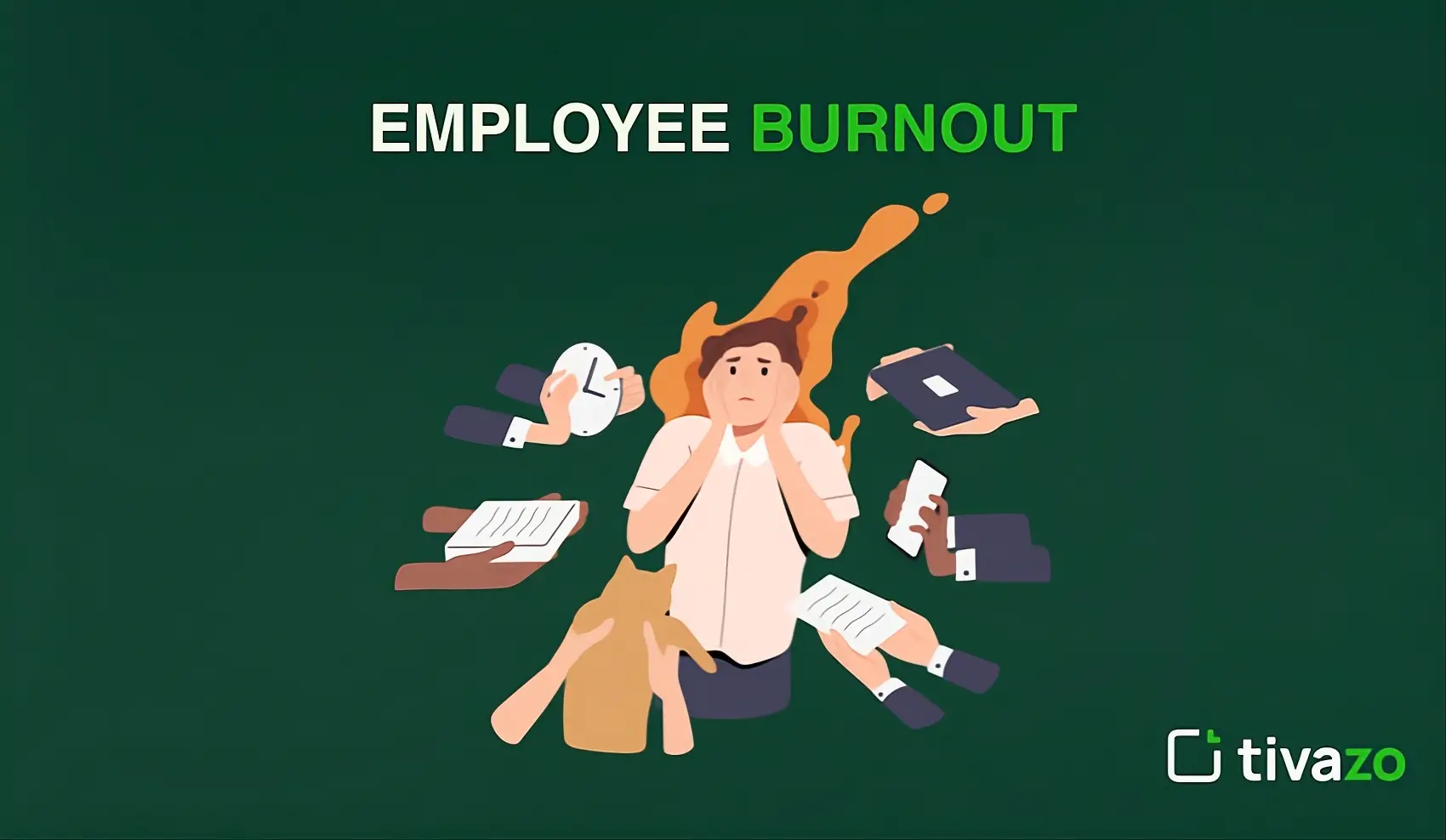
Ever feel like there’s too much to do and not enough time?
You try to stay on track, but things keep popping up, and suddenly, the deadline is tomorrow. Yikes. Sounds familiar? Don’t worry. You’re not the only one.
Life gets busy. Work gets crazy. And somehow, the deadlines just keep coming.
I think we’ve all been there a million times, struggling to get our work done on time, regardless. No matter how many time management classes we take, good deadline management is always just a bit out of reach.
Deadlines are never late enough. We do the hours, but the tasks just never seem to end. They mount up, we lose focus, and the next thing we know, we’re racing against time. It is stressful and frustrating, right?
But with some tried-and-tested deadline management techniques, not only can you do your work efficiently, but even have some free time to spare. Whether you’re a stressed-out boss, a freelancer, or simply someone who’s doing way too much, these techniques will have you plan better, work faster, and feel better. Let’s make deadlines your friend, not your enemy.
In this blog, we’ll walk you through 7 easy deadline management tips that work, even when your schedule is full.
Ready to stop rushing and start crushing deadlines? Let’s do this.
What Is Deadline Management?
Deadline management is the process of planning, organizing, and controlling tasks to ensure they are completed within a specified timeframe. For professionals, deadline management is an essential skill that combines time and task management with personal control into a single process that directly impacts your productivity and professional reputation.

Why Is It Important to Manage Deadlines?
Being time-conscious is one of the best habits that a professional can develop. That is why it is so significant, as it seems to be to most people.
- It develops trust and credibility. Meeting deadlines will make you a trustworthy person to others, and this will open up greater duties and prospects.
- It helps in alleviating stress. Being aware of what should be done and when will eliminate the stress of always being behind schedule.
- It enhances the quality of your work. The more time you have, the more time you have to think, revise, and polish your work so it represents your best work, not a quick fix.
- It helps enhance coordination between the teams. The failure to meet your deadline may bring an entire project to a halt, an entire project whereas doing it well will keep the rest of the team in line.
- It drives career growth. It is professionals with reputations for meeting deadlines who get promoted, recommended, and assigned high-stakes work.

Helpful Tips For Deadline Management
- Set SMART goals – Break tasks into Specific, Measurable, Achievable, Relevant, and Time-bound goals.
- Prioritize with the Eisenhower Matrix – Focus on urgent and important tasks first.
- Use time blocking – Schedule specific time slots for each task to stay focused.
- Leverage technology – Use time-tracking apps or project management tools to monitor progress.
- Reward small wins – Celebrate milestones to stay motivated and on track.
The Impact of Poor Deadline Management
Late submission is only the tip of the iceberg when timelines are not met or managed. The impacts affect all aspects of your life, both in the workplace and in your personal life.
Lost career: Missing deadlines sends a message to others that you are untrustworthy or unorganized, even if that isn’t the whole story. Over time, this perception becomes hard to shake, and it will also close doors you never even thought were open.
Heightened stress and burnout: Working in crisis mode at all times, to complete the overdue assignments, apologize for the delays, and work on the backlogs is exhausting both mentally and physically. Mismanagement of a deadline has been found to be one of the major causes of professional burnout.
Poor-quality production: In the end, compromises are made. Reviews are overlooked, information is missed, and the end result is compromised. What might have been a good job just becomes good because there isn’t enough time to make it better.
Monetary implications: Deadlines that are not met are directly punished financially in most of these industries. Client contracts can include clauses on late deliveries; projects might exceed budget due to stretched timelines, and a missed business opportunity due to a frustrated client may have a long-lasting revenue impact.
Bad working relationships: The kind of working relationships that coworkers and supervisors, who depend on your output, will lose are the ones that are affected by failed deadlines. This can cause friction in the workplace, lack of collaboration, and a harder working environment.
Inability to trust yourself: Eventually, the inability to trust yourself in meeting deadlines will cause you to view yourself in a different light. It has the potential to create a cycle of self-doubt, procrastination, and avoidance that will make it even more difficult to manage deadlines.
The Most Common Challenges Leading to Missed Deadlines
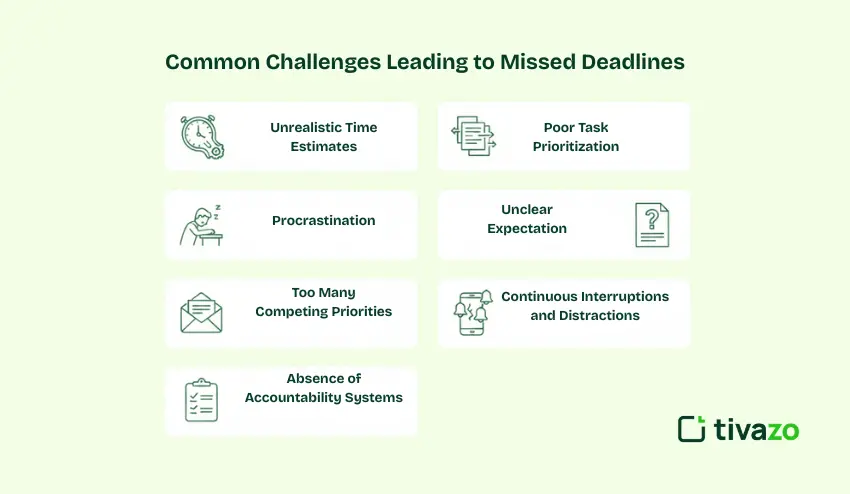
The first step in addressing the issue is to identify the reasons for missed deadlines. These are the most common problems faced by specialists across all industries.
Unrealistic Time Estimates
Among these problems, underestimating task timeframes is one of the most common. When you make plans on an ideal basis rather than a realistic one, any minor setback can throw you off schedule.
Poor Task Prioritization
Nothing gets the attention it needs when everything is urgent. The lack of a clear way to identify what really matters most can lead to an urgent situation when one spends time on low-priority tasks, only to realize that high-stakes deadlines are right around the corner.
Procrastination
Postponing the start of a task, particularly one that is complex or uncomfortable, is among the greatest causes of missed deadlines. The longer a job goes unattended, the less time there is to address any issues that may arise during the job.
Unclear Expectation
Lack of a clear definition of a deadline or scope of a task at its inception will result in wastage of time, rework, and scrambling at the end. Unclear guidelines and non-communicated schedules are the ingredients for delays.
Too Many Competing Priorities.
Ambitions that exceed your capacity are the quickest road to the failure of deadlines. Having no power to say no or to resist unreasonable demands, your workload becomes more than any system can handle effectively.
Continuous Interruptions and Distractions.
Constant alerts and interruptions, shared offices, and internet distractions are dividing your concentration and undermining your productivity. Even small breakages count a lot during working time.
Absence of Accountability Systems.
It is very simple to lose track of the work in place quickly, as there is no means of tracking the progress and keeping an eye on how things are going. Unmonitored deadlines are known to creep up on you before it is too late to rectify.
7 Deadline Management Tips and Techniques That Work
With these few tips and tricks, deadline management may be easy, even during the busy life. The following 7 tips and techniques are the real ones that work:
1. Set Clear Goals and Priorities

The first and most important thing to do when it comes to managing a deadline is to have a good idea of what your work involves. Begin by formulating specific attainable objectives and dividing your work into small and manageable steps. This strategy can be used to ease the burden of handling big undertakings that one knows but does not know where to start. When the work is small, you are well aware of what the finish line will be; it is not far away, and you can remain focused and avoid procrastination, which easily results in deadlines being missed.
A to-do list is one of the most effective methods of spending time and staying on time. Everything in your list must state what should be done, the purpose of it, and the time you expect to take to accomplish it. This will make you keep within your time frame and make sure that none of the tasks will be carried out beyond the required time.
Have priorities on the tasks you want to do, with those that are urgent being first. By doing so, you would be prioritizing the tasks that have high priority and directly work towards the achievement of the deadlines, whereas those having low priority, such as small corrections, can be allocated at a later date. This is the best way of managing your time and ensuring that you complete your work successfully.
2. Remove Distractions

You may have heard of the phrase: Out of Sight, Out of Mind
You will be distracted if you have something like your phone with you while you are working. A notification pings, and you pick up your phone, the next thing you know, you have spent most of the day procrastinating. So, try not to keep it in your sight.
The best solution: when doing your task, remove all devices that may distract you, like your smartphones or iPads. Put them away in a different room and focus on doing your tasks. This way, random pinging of notifications won’t distract you from your work.
For some, distractions come from devices, while for others, it’s their environment, especially when working from home. Family members, though well-meaning, can unintentionally divert your attention from work, whether by starting conversations or creating noise. If you often find your focus divided, consider removing yourself from the distracting environment.
An alternative for this is you can go to a quiet, peaceful place, like a café or your local library, where you can concentrate and improve your time management, helping you meet deadlines more effectively.
3. Utilize Time Management Techniques

You can also utilize different time management techniques to plan and organize your goals properly, which is essential for successful deadline management. Time management techniques help to identify your priorities, allocate time to activities based on their importance, and also use different strategies to optimize efficiency.
This can reduce the stress of finishing a job and make the most of the available time before your deadline.
You may like the Pomodoro Techniqueor the Pickle Jar Theory for time management. The Pomodoro Technique involves doing tasks in intervals that are separated by short breaks, and the Pickle Jar Theory suggests putting your “bigger pickles”, i.e., your top priority tasks, in the jar first, and then the smaller priority tasks, or “smaller pickles or pickles juice”. The “jar” in the Pickle Jar Theory represents your workload.
Many other time management techniques can work for you if these two don’t seem to do the job.
4. Delegate Tasks When Possible

You can find yourself completing work faster when you work alone. When the work is too much, however, delegation is useful in managing deadlines efficiently. It’s not a bad idea to enlist the help of co-workers, friends, or underlings; this keeps you in line and helps with deadline management overall.
In this way, you get to focus on priority tasks that demand your total concentration, while others do the less demanding tasks that you simply need to illustrate. This kind of cooperation saves time and allows better management of deadlines.
You can also assign work based on your team’s strengths. Let your assistants handle the tasks that they are best suited for, while you handle segments that need your skills. While delegating, always remain open and share task goals, deadlines, and significant steps. Thus, your team understands what to produce and what is needed to reach success. Transparency is a key element of good deadline management.
Daily check-ins work too. Brief meetings to track progress and solve problems early on can enhance your team’s rhythm and keep everyone moving in the same direction. Smart delegation not only reduces stress, but it also builds stronger collaboration, and that’s the essence of smart deadline management.
5. Use Tools and Apps

In the digital world, one will not run out of available tools that can assist specialists in managing time deadlines better. Whether it is a basic task tracker or a complete project management system, the appropriate tool can provide you with a clear overview of all your plates, prioritize them, and remind you before it is too late.
The trick here is to get tools that fit into your workflow and do not make your process too complicated. A one-man professional will be satisfied with a bare-bones task application, whereas a team manager can use a shared one. One tool, acquire it properl,y and build on it.
6. Learn to Say No

When we do our best to commit ourselves to the work, it is easy to overwork ourselves, which results in failure to meet the deadlines, poor work performance, and burnout. In order to manage your deadlines better, you need to be strict in drawing lines related to the type of jobs that you are ready to do in regard to your competence, workload as well as time.
Be direct and direct about what you are looking at. And saying no, do kindly say why you are not accepting the task.
You would be told to know how to stand up when one is pressured to do more work. You can not only refer them to resources that can help them or to individuals who may be able to undertake the task, instead of trying to help them immediately.
Provided you have no other choice but to do the new thing, you can suggest a later date when you may be able to give them assistance. In case the work is not aligned with your priorities, you can refuse it.
Saying no does not mean evading duties; it is all about knowing what you can handle so that you can produce good work on time. This way, you will be in a better position to achieve all your deadlines, and a healthy balance between work and life.
7. Review and Reflect

As you implement the strategies mentioned above, take time to review your progress at regular intervals. This step can help you reflect on what you can improve to meet your deadlines more efficiently.
Reviewing and reflecting on your timeline can not only help you assess how you spent your time, but you can also reflect on your past accomplishments and milestones reached. This helps boost your morale.
You can find out what worked and what did not work for your productivity if you reflect on it. Then, adjust your strategies based on your assessment of what challenges you encountered during your work and experiment with different productivity approaches until you find what works best for you.
This step can help empower you to consistently meet deadlines.
Deadline Management Templates
With the right template on hand, there will be no guesswork in the planning, and your work will be well organized throughout. These are the most feasible deadline management templates that professionals use to stay on schedule.
1. Basic Task Deadline Manager.
It is a simple spreadsheet or table where one lists all the tasks, the person who performs each task, the due time, the status, and any notes. It is good for individuals and small teams that require a no-frills method to keep track of what is due and when. One can be constructed simply in Google Sheets or Notion.
2. Gantt-Style Project Timeline Template.
A Gantt chart is a graph that shows every milestone or task on a linear timeline and how they relate to one another. It is particularly handy when activities are connected, allowing you to identify potential bottlenecks and prevent them before they become a headache. Gantt views are provided in tools such as Trello, Asana, and ClickUp.
3. Weekly Priority Planner
This template will guide you in planning your week around your most important deadlines. It usually includes a top-3 priority list, a day-to-day task breakdown, deep-work time blocks, and a last-minute end-of-week review. It suits best those workers who are in charge of various running projects simultaneously.
4. Deadline Countdown Checklist.
This template moves backward from a final deadline to establish a sequence of mini-deadlines and milestones. As an illustration, when a report is due within three weeks, the checklist can be compiled using the writing of the research, completing the first draft, and the final revisions within one, ten, and sixteen days, respectively. Large projects become much less daunting when broken into smaller milestones with deadlines.
5. Team Deadline Dashboard
For team managers, a deadline dashboard is a collaborative tool that gives all team members visibility into what each person is responsible for and the status of each. It will usually include the task name, the assigned team member, the deadline, the completion percentage, and any blockers. This eliminates the need for endless status meetings.
By using any of these templates, even a basic one, you will give your deadline management system the framework it needs to become a positive habit instead of a panicked reaction.
Best Time Management Tools and Apps
Here are some recommended time management tools and apps to help you meet deadlines and optimize your efficiency:
a) Tivazo
Tivazo is a time-tracking software that aims to enhance deadline management by capturing regular screenshots of your work. This feature offers you a nice insight into how you spend time on various tasks and allows you to analyze the trends of productivity, track time-consuming tasks, and stay on schedule to meet deadlines. If you notice that you take a lot of time on secondary tasks, you can re-prioritize them accordingly.
Tivazo can even be used for tracking remote and in-office employees, i.e. if you are outsourcing the work to other people, then you can also track their activities on their projects.
For team managers or managers, Tivazo offers a business solution to track work hours and manage payrolls based on comprehensive work hour reports.
b) Trello
Trello is such a great deadline management tool to use, especially when you’re working on projects together. It sorts everything out in the optimal way by using boards, lists, and cards. You can create a board for your project, and add lists for different tasks, and cards inside those lists to represent what needs to be done. It is fun and simple to use!
With Trello, you can task team members, so they all know what to do. You can also define specific deadlines for every task. This makes deadline management simple because you will know when things have to be completed. Furthermore, Trello provides you with progress updates, so you always have an idea of where you are.
The best part is that Trello lets you know everything. You can look at your board and instantly know all the deadlines and where you stand. This puts the whole team in check and makes it easier and less stressful to manage deadlines.
c) Rescue Time
RescueTime is a very helpful utility that tracks how much time you spend on different apps and websites automatically, with no input on your part required. It does all the work for you, giving you a full report of where your time is going. This can be a wake-up call, especially when you want to improve your work habits.
Likewise, Tivazo helps you keep one step ahead of your work, whereas RescueTime helps in deadline management. RescueTime paints for you a picture of just how you’re spending your time and helps you to find the minuscule time-wasting habits that are bringing you down. You then make better choices based on this and remain more focused.
Using RescueTime, you can set intelligent objectives for yourself and therefore keep track. You can use this to monitor your performance day by day to better manage your time and ensure that you never miss a deadline. This simplifies and reduces the stress of meeting deadlines.
d) Forest
Forest is a productivity application that is based on a game to construct focus habits. In this case, you plant trees that are virtual and which grow as long as you are on the app. When you leave the app, your trees die virtually.
Therefore, you cannot use other apps to ensure that your mind is focused on your work (and keep your trees alive). This app will make your time management related to deadlines better, because it promotes continuous work periods, and allows developing concentration habits that will eventually contribute to deadlines being better managed.
Conclusion
Meeting deadlines is not a simple matter of time management; it also includes skills of how one can have strategies that best suit him or her, their job, and the productivity of their team.
With clear goals and the elimination of distractions, you can work through your work at a faster rate than previously. In addition to this, you can adopt a number of proven time management tips.
It is important to remember that meeting deadlines is not just about being able to finish your work on time, but also having a healthy balance of what you are able to commit to and what you are able to accomplish. Therefore, it is necessary to refuse any new tasks that can impair your productivity or to assign them to other people to protect your productivity and health.
Similarly, you can make use of productivity tools such as Tivazo and Trello, among others, to automate your workflow and hold yourself accountable to get your work done, which will enable you to regain control over your work and meet deadlines with confidence.
These strategies will help you to succeed in a prolific working setting, and will leave you with some spare time to meet your deadlines as well.