More sales don’t automatically mean a profitable small business. It’s one of the more frustrating realities of running a small business. Revenue climbs, the workload increases, and yet the margins somehow stay flat or get worse. The culprit is usually the same: systems that haven’t kept pace with growth.
Whether you’re running a small electrical firm, a creative agency, or a services business with a handful of staff, the processes keeping you operational have a direct impact on what you actually take home. Get them wrong and growth becomes expensive. Get them right and the business starts to compound.
Why Profitability Breaks Down as Businesses Grow
Early-stage businesses survive on improvisation. A spreadsheet here, a WhatsApp thread there, invoices sent when someone remembers. It works until it doesn’t.
The breaking point tends to hit somewhere between five and fifteen employees, when the volume of tasks, clients, and decisions exceeds what any one person can hold in their head. At that stage, informal systems don’t just become inconvenient, they become costly. Jobs get misquoted. Invoices go out late. Staff time gets allocated badly. None of these are catastrophic on their own, but together they quietly erode profitability in ways that are hard to see until the damage is done.
The fix isn’t necessarily hiring more people. Often it’s replacing manual processes with ones that run themselves.
The Core Systems Every Profitable Small Business Needs
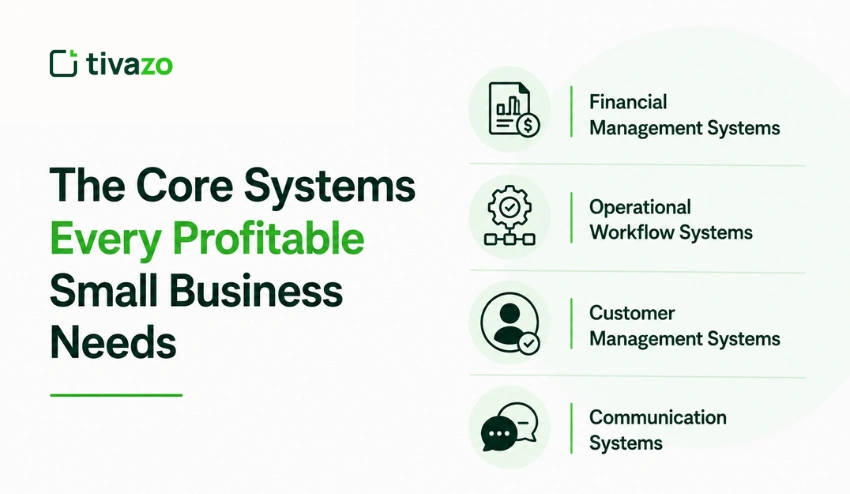
Financial Management Systems
Poor financial visibility is probably the single biggest drag on small business profitability. When you can’t see your cash position clearly, you make conservative decisions: turning down work you could actually afford to take on, or taking on work without properly understanding the margins.
Accounting software solves this by centralising everything: cash flow, expenses, income by client or job type, outstanding invoices. The difference between looking at a spreadsheet you updated last Tuesday and a live dashboard showing today’s position is significant. For trade businesses in particular, where job costing and timing of payments can vary wildly, purpose-built electrical contractor accounting software handles the complexity that generic tools often miss.
The broader principle applies across every business type: when your financial picture is accurate and current, you make better decisions.
Operational Workflow Systems
Workflow tools aren’t glamorous, but they’re where a lot of operational leakage gets stopped. When tasks live in people’s heads or inboxes, things get dropped. When they live in a shared system with clear ownership and sequencing, they don’t.
These tools become more useful when they start automating handoffs: a new enquiry triggers an onboarding sequence, a completed job triggers an invoice, a missed deadline triggers a notification. The work still happens; you just stop relying on someone remembering to do it. Project management software is widely used for exactly this, giving small teams a shared view of work in progress without requiring much setup.
Customer Management Systems
A CRM is often sold as a sales tool, but its real value for small businesses is in retention and consistency. When every customer interaction is logged, calls, emails, site visits, complaints, renewals, you stop relying on whoever has the longest memory and start building institutional knowledge that survives staff turnover.
A free CRM is a popular starting point for small businesses, handling contact management, deal tracking, and basic automation without an upfront cost. Lead tracking is the other side of this: good CRM software scores and prioritises incoming leads automatically, so your team spends time on the enquiries most likely to convert rather than working through them in the order they arrived.
Communication Systems
Internal communication might seem like a soft issue, but fragmented communication is a real operational cost. When updates live across email threads, text messages, and verbal conversations, context gets lost constantly and recovering it takes time.
A central platform brings messaging, file sharing, and notifications into one place, which reduces that friction considerably. It also creates a searchable record of decisions, which matters more than people realise until something goes wrong and no one can remember what was agreed.
Common Mistakes Small Businesses Make
A few patterns come up repeatedly when businesses struggle to improve profitability despite growing revenue.
Leaning too heavily on spreadsheets is the most common. They’re familiar and flexible, but manual data entry introduces errors and, more importantly, creates a time lag between reality and what you’re looking at. Decisions made on last week’s numbers aren’t always the same as decisions made on today’s.
Using too many disconnected tools is the second. When your CRM doesn’t talk to your accounting software, which doesn’t connect to your project management tool, you end up maintaining the same information in multiple places, or not maintaining it at all. Integration matters because it’s what makes automation possible.
The third is treating operational investment as something that can wait. Backend inefficiency tends to be invisible until it causes a client-facing problem, at which point the cost is higher than it would have been to fix it earlier.
Tools That Actually Improve Profitability
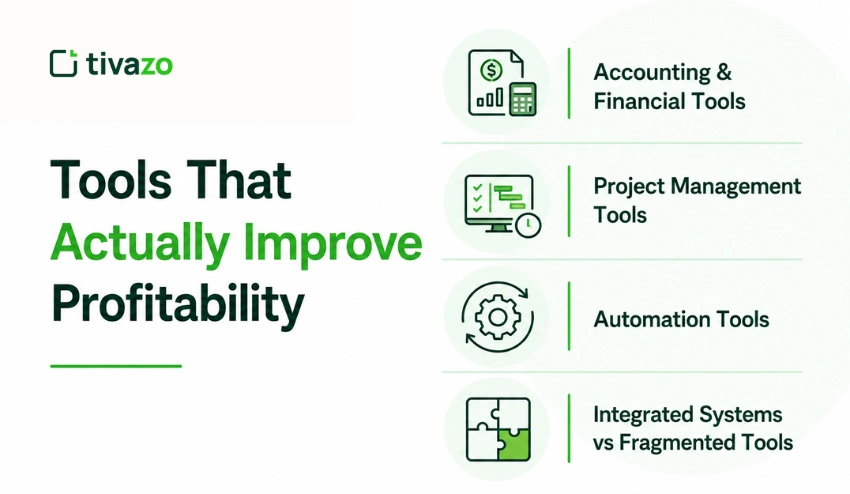
Accounting & Financial Tools
The value here is not just accuracy, it’s time. Automated bookkeeping, real-time reporting, and integrated invoicing collectively remove hours of admin per week. For small teams, that’s meaningful. For owner-operated businesses, it can be the difference between working in the business and working on it. Connecting your accounting software to timesheets and reporting tools closes the loop further, giving you a clearer picture of where staff time is actually going relative to what you’re billing.
Project Management Tools
The ability to see all active work in one place, with time tracking against each task, is how you move from estimating profitability to actually measuring it. Most businesses have a rough sense of which jobs or clients are their best. The data tends to be more precise, and often more surprising, than people expect when they first start recording it properly.
Automation Tools
The business case for automation has become much clearer in recent years. A Deloitte study found that organisations that have moved beyond piloting intelligent automation achieved an average cost reduction of 32%. That figure reflects the cumulative effect of removing repetitive work across finance, operations, and customer management simultaneously.
Invoicing is an obvious example: generating, sending, and chasing invoices can all be automated. But the same logic applies to onboarding, reporting, scheduling, and most other rule-based processes.
Integrated Systems vs Fragmented Tools
Individually useful tools become significantly more powerful when they share data. Integration is what turns a collection of software into an actual operating system for the business, one where information flows automatically, decisions are based on current data, and the team spends less time moving information between places manually. Performance insights become genuinely useful at this stage, because the underlying data feeding them is complete rather than partial.
Turning Systems Into Sustainable Profit
The businesses that sustain profitability as they grow tend to share one characteristic: they treat their operational infrastructure as seriously as their sales pipeline. Revenue is easier to grow than margins, and margins are protected by systems.
Small improvements in how work is tracked, invoiced, communicated, and managed compound over time. The businesses that build these foundations early are the ones that grow without the inefficiency tax that catches most others out.
How to Implement New Business Systems Without Disrupting Operations
Businesses often delay improving their systems because they assume the process will be expensive, time-consuming, or disruptive. In reality, the most successful implementations happen gradually rather than all at once.
Start by identifying the biggest operational bottleneck. If invoicing is slowing cash flow, improve your financial systems first. If projects regularly miss deadlines, focus on workflow management. Solving one high-impact problem at a time allows your team to adapt without overwhelming daily operations.
It’s also important to involve employees early in the process. The people using these tools every day often know where inefficiencies exist and can provide valuable feedback on what would actually improve productivity. Providing basic training and documenting new workflows help ensure adoption across the business.
Finally, measure results after implementation. Track metrics such as time spent on administrative tasks, invoice turnaround time, project completion rates, customer response times, and profit margins. Reviewing these numbers regularly helps determine whether your new systems are delivering measurable improvements or whether further adjustments are needed.
The goal isn’t simply to add more software. It’s to create processes that reduce manual work, improve visibility, and free your team to focus on activities that generate revenue and long-term growth.