
Salary inflation is a vital principle of financial planning in today’s dynamic economic scene. As an employer, employee, or investor, you must track the impact of inflation on salaries so that you make informed choices. The salary inflation calculator is an effective tool that allows one to calculate old salaries compared to current figures, as well as forecast future salaries based on the trend of inflation.
This guide will inform you of everything you must know regarding how to use a salary inflation calculator effectively. It covers everything from understanding inflation to step-by-step instructions on how to utilize the tool.
Salary Inflation Calculator at a Glance
A salary inflation calculator can help you understand the real value of your income over time, by adjusting salaries to inflation. If you’re asking for a raise, comparing job offers, or planning for retirement, it shows how much your salary is worth in today’s dollars.
Here’s what you’ll learn in this guide:
- Calculate the inflation-adjusted value of your salary
- Understand nominal vs. real wages
- See if your pay has kept up with inflation
- Learn how inflation affects purchasing power
- Use salary data to negotiate better compensation
- Discover how employers use inflation data for salary planning
What Is a Salary Inflation Calculator?
A salary inflation calculator is a computer application that enables users to determine the effect of inflation on their income over time. Inflation reduces the purchasing power of money, and therefore, salaries in the past may be significantly less valuable today. A salary inflation calculator enables you to translate previous salaries into present-day values or forecast future income based on inflation rates.
The salary inflation calculator makes adjustments to salaries using historical inflation. It takes into account the average annual inflation rate, which can be derived from the Consumer Price Index (CPI) or other financial metrics, and applies it to salary values over a given period.
Who Should Use a Salary Inflation Calculator?
A salary inflation calculator isn’t just for economists. It’s useful for anyone who wants to understand the real value of their income.
Employees
Compare salary increases with inflation to determine whether your purchasing power has improved.
Job Seekers
Compare job offers from different years using inflation-adjusted salary values.
Freelancers and Contractors
Adjust hourly or project rates to keep pace with rising living costs.
HR Professionals
Use inflation data when planning salary reviews and compensation strategies.
Business Owners
Create competitive compensation packages that help attract and retain employees.
Quick Example: Is Your Raise Really a Raise?
Imagine you earned $60,000 in 2023.
Your employer gave you a 3% raise in 2024.
Your new salary became $61,800.
However, if inflation was 4%, your purchasing power actually declined.
Although your paycheck increased, your salary didn’t keep pace with rising prices. This means you experienced a real wage decrease, even though your nominal salary went up.
This is exactly why a salary inflation calculator is useful—it reveals the true value of your earnings.
Why Use a Salary Inflation Calculator?
There are several reasons why one should use a salary inflation calculator:
- Personal Planning: Understanding the effects of inflation on salaries can help you set valid financial goals and keep your revenues in line with living costs.
- Negotiation of salaries: Employees may use a calculator for salary inflation to justify payment hikes by delineating how purchasing power declined over time due to inflation.
- Retirement Planning: Helps to forecast future expenses based on inflation and determine if adequate money is being saved for retirement.
- Job Comparison Tool: Helps job hunters compare salaries for years and determine the competitiveness of an offer.
- Business Decisions: An employer may forecast reasonable salary increases for employees to provide competitive and understandable salaries.
Is My Salary Actually Keeping Up With Inflation?

When it comes to looking up a salary inflation calculator, this is the query that everyone is asking. So the truthful response is… probably not.
The inflation rate in the U.S. was the highest since the early 1980s, between 2021 and 2023. In 2021, the annual inflation rate reached 7%, and for the most part, it was around 8% in 2022. Wage growth averaged about 4-5 percent over the same period. The difference between the price and wage rises, for most people who worked, is a loss of purchasing power, despite annual increases in wages.
Now let’s read what you need to do:
- Even if your wage has been 2 to 3 percent a year and the inflation rate has averaged 4 to 8 percent over the past three years, your real wage has fallen each year you’ve received a paycheck.
- If raises have equaled or surpassed inflation, you are holding your own or making a little more.
- Even if you’ve experienced no raise for two years or more, the loss of purchasing power is equivalent; whatever the rate of inflation has been, at 3 percent inflation, your real standard of living has fallen about 6 percent over two years.
- You can’t tell from the number on your paycheck whether or not you are on a high or low income. The salary calculator does.
What Is a “Good” Raise? Real Benchmarks Against Inflation
The first thing to do is to determine real costs against inflation.
The advice that is given on this question is generally murky.
Here are some actual numbers.
| Raise Amount | Inflation Rate | What it Actually Means |
| 2% raise | 3.5% inflation | Real pay cut — you lost 1.5% purchasing power |
| 3.5% raise | 3.5% inflation | Break-even — same purchasing power, no real gain |
| 5% raise | 3.5% inflation | Modest real gain of about 1.5% |
| Any positive inflation |
How to Use a Salary Inflation Calculator
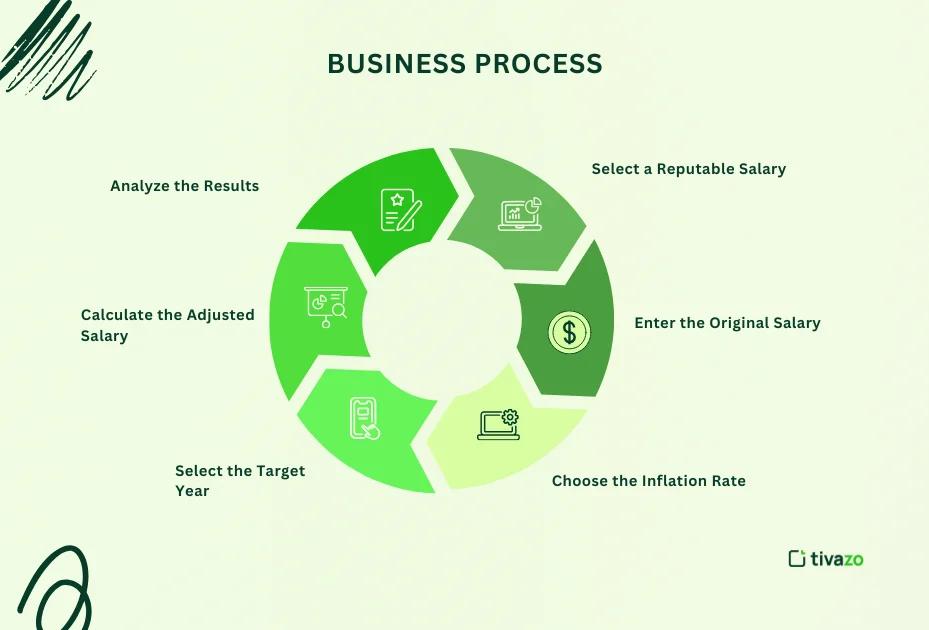
The use of a salary inflation calculator is easy and can be done with a few clicks.
Here are the steps to do it:
Step 1: Select a Reputable Salary Inflation Calculator
Various free online calculators of salary inflation exist. Some well-known ones are
- U.S. Bureau of Labor Statistics (BLS) Inflation Calculator
- Bank Rate Inflation Calculator
- SmartAsset Salary Inflation Tool
- Various financial websites have salary adjustment calculators
- Ensure that you use a calculator that uses accurate and up-to-date inflation data to provide precise calculations.
Step 2: Enter the Original Salary and Year
To use a salary inflation calculator, you must initially enter
- Your original salary
- The year you earned your salary
- For example, if you had earned $50,000 in 2010, type “$50,000” and select the year “2010.”
Step 3: Choose the Inflation Rate or Index
The majority of salary inflation calculators use official Consumer Price Index (CPI) figures as a basis for their calculations to compute salary adjustments. In case the calculator allows manual input, you may have to:
- Select an inflation index (e.g., CPI, Core Inflation, or national rate)
- Input an average annual inflation percentage (typically 2-3% in stable economies)
Step 4: Select the Target Year
Choose the year you want to reduce your salary back to. If you want to find out how much $50,000 in 2010 would be worth in 2024, select “2024” as the target year.
Step 5: Calculate the Adjusted Salary
After filling in all the necessary details, click on the “Calculate” button. The salary inflation calculator will give you the adjusted salary after taking inflation into account.
For example, using the assumption that inflation is 2.5% annually, your $50,000 salary in 2010 would be worth $67,000 in 2024.
Step 6: Analyze the Results
When you get results from the salary inflation calculator, use them to suit your needs:
- If you are in a situation where you need to negotiate a salary increase, demonstrate to your employer how inflation has affected salaries over time.
- If you are retired or retiring, adjust your expected expenses accordingly.
- If you’re comparing job offers, ensure the salaries reflect today’s value.
Nominal Wage vs. Real Wage: The Difference That Changes Everything
Most people keep their salary in nominal money the dollar amount they see on their offer letter or paycheck. It’s a feeling of progress when that number is increasing. That is only half the truth, however.
Your nominal wage is the amount of money you make without any deductions. That amount is your real wage, which equals the amount of those things you can purchase for that wage. Your nominal wages can increase while your real wages decrease.
This is no longer a speculation. This didn’t happen to just a handful of workers in 2021-2023; it was experienced by millions of workers as the average pay increase of 3 to 4 percent compared with a 7 to 8 percent increase in prices. The outcome was the biggest decline in real wages in more than 10 years, despite the fact that workers were being paid a bit more.
A salary inflation calculator is a tool that helps you find out the real value of your salary history in terms of inflated wages. It’s useful because of that conversion. If not, your financial gains are measured by a shrinking measure.
How to Use the Results to Negotiate a Raise

The first step is to run the calculator. It’s what you do with the outcome that gets you the money in your pockets.
Enter the salary increase from the previous year into the calculator before your next review. Obtain the “real” value for the current time period. If it is more than your current salary, then you can present a number, not an opinion, your current number, not a request; it is a calculation.
Translate this conversation: “My salary was $55,000 in 2020, but BLS CPI data shows that in today’s dollars, that is equivalent to about $67,000, so I’m requesting a raise to catch up to that.
Several factors bolster the argument:
Be sure to display the math, not just the number. A calculation from the U.S. Bureau of Labor Statistics takes the discussion out of opinion and into the realm of fact. Very few managers have ever had an employee do this. It lands differently.
Don’t lump inflation adjustment into a performance raise. It’s two different arguments. An inflation adjustment restores your position to the real levels. Your performance, you go forward. Separately frame them and request both.
Know your floor. If you cannot adjust completely, inquire what a partial adjustment is. Even a little step gets the discussion started and provides a focal point for the next review.
What HR Managers and Remote Team Leads Need to Know
This is the part of the salary inflation calculator tutorials that most people miss. They write to the employee. But it’s also as significant a discussion on the employer side, and one that’s frequently overlooked.
HR managers who manage annual reviews without taking inflation into account are not conducting accurate reviews. They’re defining nominal pay increases as real ones, and they’re working on building a work population that perceives it’s being undercompensated despite the fact that its income is increasing annually.
The best way for HR managers

Take a person’s base salary from the year he or she got his or her last substantial raise, plug it into the calculator, and then compare the inflation-adjusted amount to what he or she is paid now. Even if the nominal amount of the raise has been below the inflation-adjusted baseline, if the employee’s wages are below the inflation-adjusted baseline, they are still experiencing a real wage cut. The period of over 10 percent over three years is when flight risk becomes serious, particularly in remote-first teams where a competitor may be able to pull a teammate in via a Slack message.
Remote Leads

Averages of national CPI can fool remote team leads. If an employee made a certain salary three years ago in San Francisco, he has a different cost of living experience than an employee who made the same salary three years ago in Tulsa. BLS releases CPI information for employees in the United States by region and by metro area.
If you have members on an international team, you can use data from the inflation statistics office in each country – the World Bank has inflation rates available at the country level and is in the public domain. If this is the case, a uniform 3% raise probably left some behind and may have provided a real raise for others, depending fully on location.
Understanding the Impact of Inflation on Salaries
How Inflation Affects Purchasing Power

Inflation causes the price of goods and services to rise, reducing the purchasing power of a given salary. For instance, $50,000 in 1990 could afford much more than $50,000 in 2024.
A salary inflation calculator helps illustrate this change by adjusting wages for inflation, providing a more accurate financial picture.
Historical Salary Trends
The value of money fluctuates over time due to inflation. Here’s a rough example of how salaries have been adjusted:
- A $30,000 salary in 2000 is equivalent to around $53,000 in 2024.
- A $40,000 salary in 2010 is worth about $56,000 today.
- A $60,000 salary in 2020 may be worth $65,000 in 2024 if we apply inflation.
Using a salary inflation calculator, you can easily compute such an amount for a specific year.
How to Effectively Use a Salary Inflation Calculator
- Use Official Inflation Rates: Always use calculators based on official data like the U.S. Bureau of Labor Statistics (BLS) or the World Bank.
- Look for Other Feature: A few of these calculators allow customization, i.e., varying inflation rates or regionalization.
- Compare Multiple Years: Instead of one year, compare salary changes over multiple years to see long-term trends.
- Use for Retirement: Adjust your projected retirement income through a salary inflation calculator to determine financial security.
- Look at Inflation Rates: Inflation rates change every year, so make an educated guess based on previous experience.
Other Means of Estimating Salary Adjustments
While the most convenient and precise method is a salary inflation calculator, you can also estimate salary adjustments manually:
1. Use the formula:
Adjusted Salary = Initial Salary × (1 + Inflation Rate)^Years.
For example, if inflation is 3% and you’re adjusting a 2015 salary of $40,000 to 2024: $40,000 × (1.03)^9 = $52,000
2. Check government reports on wage growth trends.
3. Compare salaries in job postings from different years.
Conclusion
A salary inflation calculator is an essential money tool that enables individuals and businesses to make wages inflation-adjusted. Whether you are negotiating a raise, planning for retirement, or comparing past wages with today’s values, a salary inflation calculator ensures you have the most up-to-date and precise financial data.
By going through these steps in this guide, you can maximize the use of a salary inflation calculator and use it to finance a brighter, economically more secure future. Always have inflation trends at the back of your mind and keep recalculating for the best approximations.
“Want to stay productive and organized effortlessly? Subscribe to our newsletter for expert time-tracking tips and exclusive insights!”