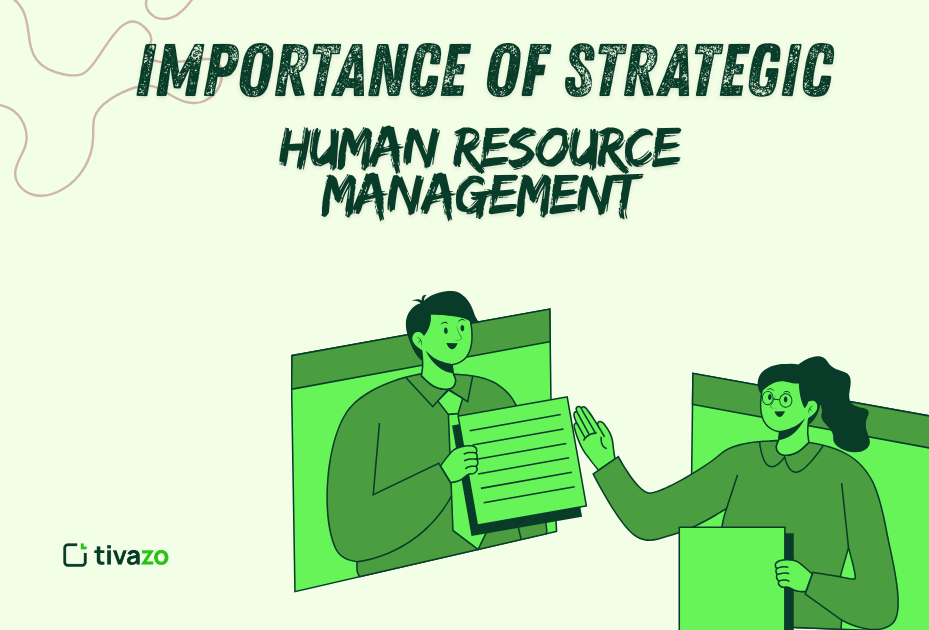
In the current competitive business world, organizations cannot afford to consider human resources as a back-office operation. The strategic human resource management has become one of the most vital business drivers of long-term success – linking people, processes, and purpose to a single engine of growth.
Firms that invest in strategic human resource management do not hire individuals but develop winning workforces. Both tech giants and startups around the world have one thing in common: strategic human resource management is the driving power behind successful and sustainable organizational performance and culture.
This detailed manual will answer all your questions about strategic human resource management, such as what it is, why it is important, how it functions, and what makes it different from traditional human resource management.
Strategic Human Resource Management (SHRM): What Is It?
Strategic human resource management refers to the proactive approach of ensuring that the human resource policies, practices, and programs of an organization are in line with its long-term business goals. Instead of reacting to the requirements of the workforce as they come, strategic human resource management predicts future talent requirements and develops the human capital to satisfy them.
Fundamentally, strategic human resource management does not consider employees as costs that are to be limited but strategic assets that are to be grown and maximized. It connects talent management strategy, workforce planning, human capital management, employee engagement, and HR analytics into one consistent framework that is aimed at driving organizational performance.
Whereas traditional human resource management poses questions such as, how do we manage our people today, strategic human resource management poses, how do we build the workforce we need to win tomorrow?
Why is Human Resource Strategy Important?
Strategic human resource management is of great significance. In the age of talent as the major competitive advantage, the organisations that consider strategic human resource management always perform better in comparison with those that do not.
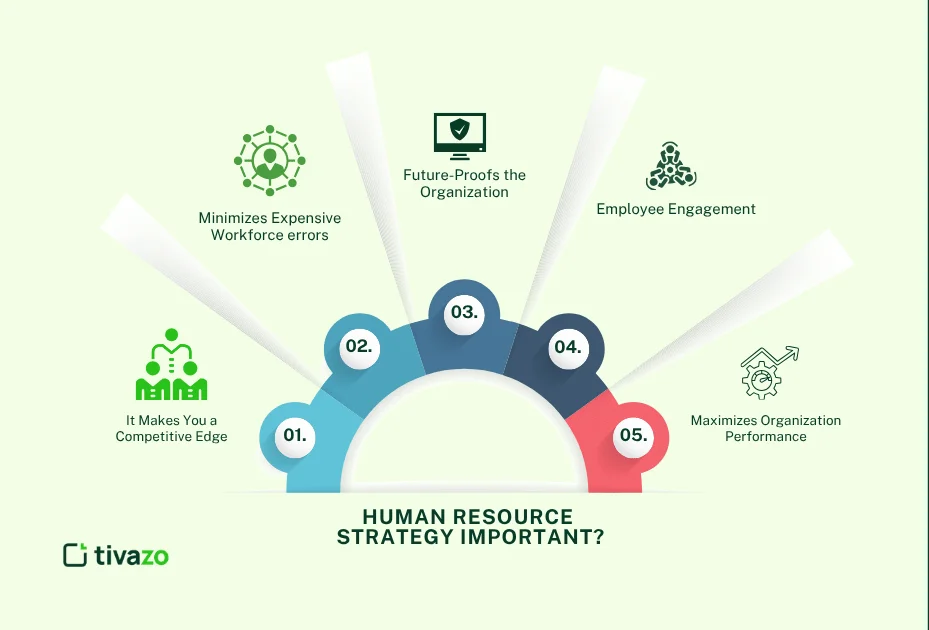
This is why strategic human resource management is crucial to all organizations today:
1. It Makes You a Competitive Edge
Strategic human resource management changes the manner in which organizations perceive their workforce. With a planned talent management strategy and human capital management, companies are creating employees who are not only competent but also exceptional. This forms a sustainable competitive advantage that other competitors will find hard to imitate.
2. It minimizes Expensive Workforce errors
Ineffective recruitment, turnover, and skill gaps cost organizations millions annually. Workforce planning and HR analytics help strategic human resource management to make evidence-based decision-making, which minimizes the chances of making costly mistakes in hiring and makes sure the right individuals are in the right jobs at all times.
3. It Future-Proofs the Organization
Markets change. Technologies evolve. Customer needs shift. Strategic HRM(human resource management) makes sure that the human capital in the organization is constantly evolving to suit the future needs of the organization, not struggling to keep pace with what has already happened.
4. It enhances employee engagement
Strategic human resource management helps to develop work environments where employees see how their roles relate to the larger picture. This sense of purpose is a tremendous motivator of employee motivation – and engaged employees are more productive, more loyal, and more inventive.
5. It Maximizes Organization Performance
All the components of strategic human resource management, such as workforce planning and talent management strategy through to HR analytics, are geared towards achieving one end objective: ensuring the maximization of organizational performance at all levels of the business.
What is the Relationship between Strategic HRM and Business Goals?
The feature of strategic human resource management is business strategy alignment. In the absence of the same, even the best HR programs will be out of place, activities that eat resources without adding strategic value to the organization.
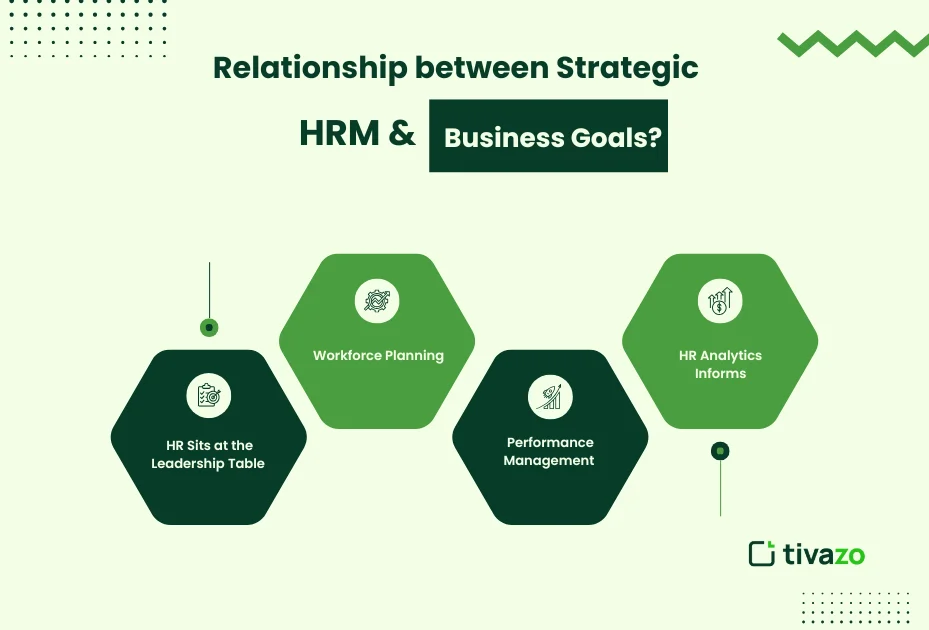
Strategic human resource management realizes alignment of business strategy in several ways:
- HR Sits at the Leadership Table – In companies that engage in strategic human resource management, the Chief Human Resources Officer (CHRO) is a strategic collaborator with the CEO, CFO, and COO. HR is engaged in business planning at the very beginning, not introduced at the end to implement decisions that have already been made.
- Workforce Planning Is Business Roadmap Driven– Strategy human resource management is less reactive, but more proactive, to planning the business strategy, which will forecast the skills, roles, and leadership capabilities that will be needed in 1, 3, and 5 years. This proactive workforce planning makes sure that the organization will never lack the human capital it requires – when it requires it.
- Performance Management is a subset of Strategic Objectives – Within strategic human resource management, individual performance goals are cascaded directly out of strategic company-level objectives. All employees can observe a direct connection between their day-to-day work and the overall organizational objectives – a scheme that drastically enhances the alignment of business strategy and employee involvement at the same time.
- HR Analytics Informs Strategic Decisions – Strategic human resource management leverages HR analytics as a tool to understand the fit of the workforce to support achievement of business objectives – metrics such as skills gap analysis, bench strength, workforce productivity, and talent pipeline health.
The 5 Steps of Strategic HR Management?
Strategic human resource management is a disciplined, repeatable process that has to be put into effect successfully.
The five steps that follow are the universally accepted process of implementing strategic human resource management:
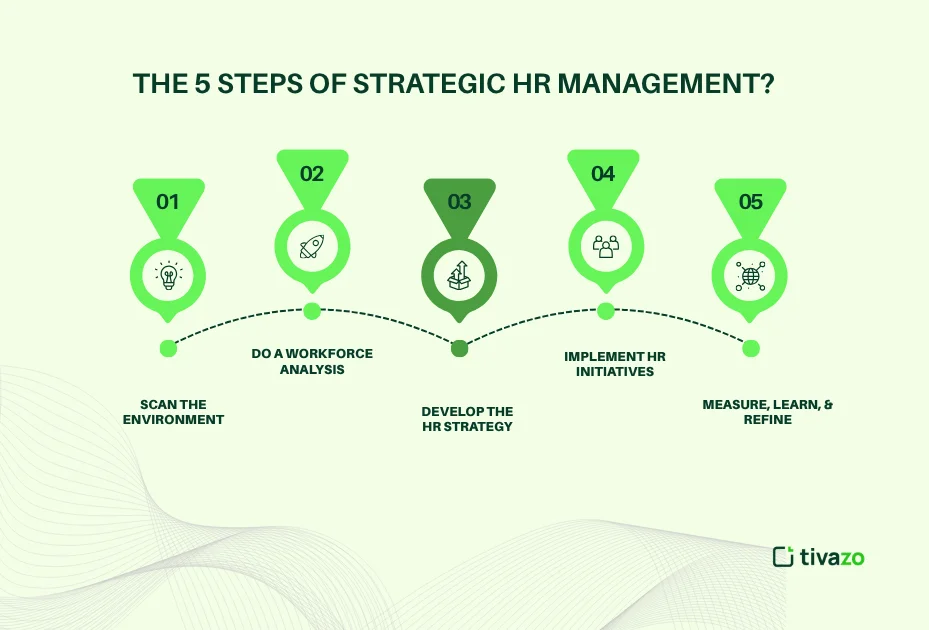
Step 1: Scan the Environment
Strategic human resource management entails an in-depth investigation of the internal and external environment before formulating any HR strategy. This involves an analysis of the business strategy, evaluation of market trends, benchmarking of competitor talent practices, and regulatory changes that may influence the workforce. Such tools as PESTLE analysis and SWOT analysis are typical of this stage.
Step 2: Do a Workforce Analysis
Strategic human resource management based on HR analytics also necessitates an in-depth evaluation of the existing workforce, such as skills inventories, succession gaps, attrition rates, engagement levels, and demographic data. This workforce planning exercise determines the difference between the current position of the human capital of an organization and where it should be tomorrow.
Step 3: Develop the HR Strategy
Having a clear vision of the business direction and the reality of the workforce, strategic human resource management is connected with the creation of the overall HR strategy. This incorporates talent management strategy plans of acquisition, development, and retention, compensation and benefits structures, learning and development road maps, and employee engagement programs, all based on business strategy alignment.
Step 4: Implement HR Initiatives
Here, strategic human resource management is seen throughout the organization. Development courses in leadership are initiated. Succession plans are initiated. New performance management systems are implemented. Workforce planning efforts are shifted out of the spreadsheet to action. Recruitment campaigns are focused on the specific skills required by the business strategy.
Step 5: Measure, Learn, and Refine
SHRM is not a project but a cycle that should run continuously. HR analytics will be applied to quantify the effectiveness of each initiative – gauging organizational performance indicators, employee engagement rates, training ROI, and human capital management performance in comparison with strategic objectives. The lessons learnt during this assessment are directly incorporated into the subsequent planning cycle.
What are the 4 Strategic Management?
Strategic human resource management is not a one-man show. It resides within the organization in terms of scope and should be in tandem with the larger strategic management system. Knowledge of the four kinds of strategic management will enable the HR leaders to locate strategic human resource management at the appropriate level of the business.
| Strategic Level | Focus | How SHRM Aligns |
| Corporate Strategy | Overall company direction, portfolio management, and growth model | Strategic human resource management addresses human capital management and talent management strategy to growth ambitions, organic, acquisitive, or transformational. |
| Business Strategy | The way every business unit competes in its market | Strategic human resource management aligns the workforce planning and recruitment with the competitive positioning of each business unit. |
| Functional Strategy | Department-level plans and priorities of Strategies and functions | Strategic human resource management aligns HR analytics and organizational performance measures with those of finance, marketing, operations, and technology functions. |
| Operational Strategy | Daily implementation and efficiency | Strategic human resource management ensures employee engagement, performance management, and human resource management practices support frontline delivery |
The approach of strategically aligning the four levels of human resource management would result in the organization attaining real business strategy alignment, where all business layers are pulling in the same direction.
What are the most important advantages of Strategic Human Resource Management?
The strategic human resource management benefits far beyond the HR department. Strategic human resource management can bring tangible benefits to the whole organization when done well:
- Greater Talent Pipelines – Strategy human resource management creates internal leadership pipelines in such a way that key positions can be filled immediately in-house – eliminating reliance on costly external recruitment and speeding up the time-to-productivity of new leadership.
- Improved Employee Retention – Strategic human resource management lowers voluntary turnover by providing employees with clear career paths, meaningful development opportunities, and high engagement, thus saving the organization the huge expenses incurred in replacing employees.
- Improved Organizational Performance – Studies have continually indicated that organizations that incorporate strategic human resource management perform better than others on important financial and operational indicators. The connection between effective human capital management and the performance of the organization is not new.
- Enhanced Agility – Organizations that have established strategic human resource management can react more quickly to changes in the marketplace since the workforce planning processes enable them to detect the changes ahead of their competitors.
- Data-Driven HR Decisions – The adoption of HR analytics in strategic human resource management will move the gut-feel HR decision-making processes to evidence-based approaches that enhance the accuracy and confidence of all critical workforce decisions.
Examples of Strategic Human Resource Management in Practice?
The practical examples of strategic human resource management help to make the notion concrete and show what can be achieved when organizations are really serious about this strategy.
1. Google- Strategic Intelligence, People Analytics
People Operations is the HR department of Google, which is arguably the best-known strategic human resource management business across the globe. Instead of being guided by intuition, Google incorporated HR analytics into the core of all decisions that it made about its workforce. Its popular Project Oxygen relied on information to find out what actions produced great managers and then constructed the actions into all of its leadership development programs. Google has no HR program for strategic human resource management; it is a fundamental business capability that directly contributes to the performance of the organization at scale.
2. Microsoft- Culture Transformation with SHRM
In 2014, Satya Nadella was appointed as the CEO of Microsoft, and it was facing internal competition, poor employee engagement, and decreased innovation. Nadella employed strategic human resource management as the key change tool. Microsoft restructured its culture both internally and externally by replacing the forced ranking model of performance management with a growth mindset model. The talent management approach was re-invented with an emphasis on rewarding teamwork, as opposed to rivalry – a change which is directly credited with bringing Microsoft back to the top of the world technology market.
3. Netflix- Radical Talent Management Strategy
The strategic human resource management at Netflix is strategically unconventional. Their well-known Keeper Test, which poses the question of whether managers would give their lives to retain each employee, is a talent management plan that is aimed at ensuring that a large workforce is retained in the company, which is performing exceptionally well. Netflix commits a great deal of resources to employee engagement via market-leading pay, radical transparency, and authentic autonomy.
What it has produced is an organizational standard of performance that has seen Netflix become one of the most influential companies of the 21 st century. Their HR philosophy, which was presented in the Netflix Culture Deck, was one of the most viral ones in Silicon Valley – evidence that strategic human resource management can even be a competitive brand asset itself.
What Are the Problems With Strategic HRM?

Although it is a definite advantage, there are challenges associated with the implementation of strategic human resource management. Being aware of these challenges assists organizations in being more anticipatory and overcoming them.
Challenge 1: Senior Leadership Resistance
Another issue that is usually cited as an obstacle to strategic human resource management is the fact that some executives believe that HR is an administrative task and not a strategic task. To conquer this, there is a need to have HR leaders who are able to speak the business language, show ROI in using HR analytics, and be credible as true strategic partners and not policy enforcers.
Challenge 2 – Inability of HR Analytics
Data plays an important role in strategic human resource management. Most organizations do not have the infrastructure of HR analytics – or the analytical capabilities of the HR department – to collect, analyze, and respond to insights about the workforce. This ability will have to be developed through investment in technology and talent within the HR itself.
Challenge 3 -Hard to Find Business Strategy Alignment
It is really hard to transform an abstract business strategy into actual workforce planning activities. The HR leaders should become thoroughly fluent in business strategy – competitive dynamics, financial drivers, and operational priorities – before they can design strategic human resource management programs, which actually bring about business strategy alignment.
Final Thoughts
Strategic human resource management is where HR has been developed as a support role to a strategic force. Whenever organizations align their talent management strategy, workforce planning, human capital management, employee engagement practices, and HR analytics with their long-term business objectives, it yields transformative outcomes in terms of greater organizational performance, enhanced competitive positioning, and a workforce that is truly built to win.
Whether strategic human resource management is important or not is no longer a question. The fact that it does is overwhelming. The actual issue is whether your organization is prepared to jump out of the world of operational management of people to strategic management of people.
The ones that will be defining their industries in the next decade are the ones that say yes and invest in strategic human resource management.