What if you could pinpoint your top performers without depending on subjective annual reviews or simply counting the hours they put in?
Traditionally, many organizations have gauged employee performance by having managers monitor employees, maintain attendance records, or conduct periodic performance reviews.
These approaches provide useful context, but they don’t always tell the whole story. They may be biased by recency, personal opinions, or a lack of a good feel for what employees do on a day-to-day basis. The challenges are even more pronounced in today’s remote and hybrid workplaces.
Thus, businesses are increasingly using time data as a more objective way to evaluate employee performance.
The best organizations don’t time-track their employees with questions like “How many hours did they work?” They ask a better question: “How well was that time spent to meet business objectives?”
Used responsibly, employee time data is more than just clock-in and clock-out times. It allows managers to spot productivity trends, identify workflow bottlenecks, balance workloads, and help employees with data-driven coaching instead of assumptions.
For example, let’s take two employees:
| Employee | Hours Worked | Productive Hours | Productive Hours | Quality Score |
| Employee A | 40 | 34 | 10 | 98% |
| Employee B | 55 | 30 | 8 | 90% |
Employee B appears to be more committed on the surface since they put in more hours. But when you look closer at their time data, you’ll see that Employee A actually completed more projects, spent more time doing productive work, and delivered higher-quality results—and did it all in fewer hours.
This example demonstrates an important fact:
Performance isn’t about how much time is on the clock, it is about the value created in the time on the clock.
Time Tracking solutions today allow organizations to see how employees spend their day, so leaders can make informed decisions based on real productivity trends, not assumptions.
Ethical Employee Monitoring is about optimizing workflows, reducing burnout, and supporting employees—not watching every click or keystroke.
Businesses that Track Employee Performance using reliable time data can:
- Make fairer and more objective performance evaluations.
- Identify productivity trends before they become problems.
- Improve workload distribution across teams.
- Detect early signs of employee burnout.
- Increase operational efficiency and profitability.
- Support continuous employee development through coaching and feedback.
The trick is to use time data as part of the performance puzzle, not as the sole measure of success.
Combining time data with quality of work, goal achievement, collaboration, and employee feedback is a powerful tool for building high-performing teams.
In this guide, you’ll learn:
- What employee performance time data is and why it matters.
- The most important time-based performance metrics to track.
- Why hours worked don’t always equal productivity.
- How to measure employee performance without micromanaging.
- A practical framework for using time data to improve performance.
- Best practices for creating a transparent and ethical performance management process.
What Is Employee Performance Time Data?
Employee performance time data involves the collection and analysis of work-related time data in order to assess utilization of employee time for work, completion of work, and contribution to organizational goals.
Rather than just measuring attendance or total hours worked, it looks at the relationship between time, productivity, efficiency, and performance outcomes.
In layman’s terms, the employee performance time data is answering questions like
- How much time is spent on productive work?
- Which tasks take longer than expected?
- How efficiently are projects completed?
- Are employees overloaded or underutilized?
- Where are workflow bottlenecks occurring?
- How can managers support employees based on real data?
Performance reviews are largely subjective, based on what managers observe, whereas time data offers objective information about day-to-day work patterns.
This allows organizations to better understand performance, resource allocation, and employee development decisions.
Employee Performance Time Data vs. Hours Worked
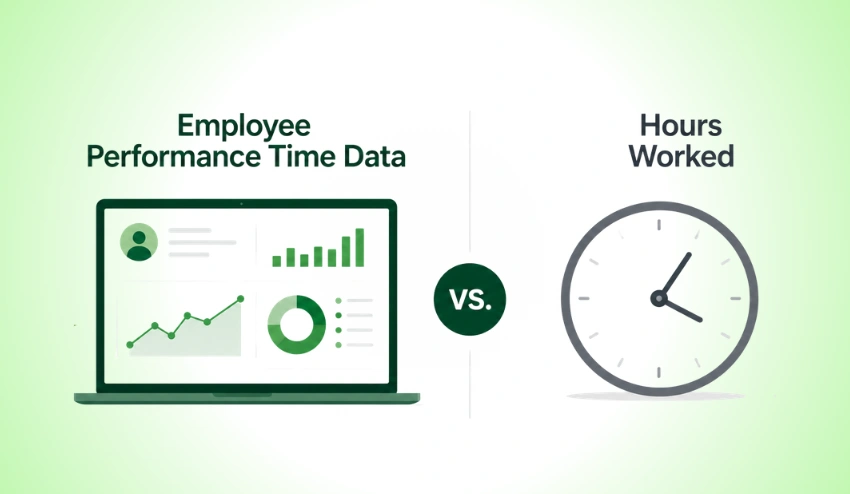
One of the worst misconceptions in performance management is that more hours worked means better performance. The fact is, hours worked are only part of the story.
Consider the following comparison:
| Hours Worked | Performance Time Data |
| Measures attendance | Measures productivity and efficiency |
| Focuses on quantity | Focuses on quality and outcomes |
| Doesn’t reveal workflow issues | Identifies bottlenecks and improvement opportunities |
| Limited insight into employee performance | Provides actionable performance analytics |
| Often used for payroll | Used for coaching, planning, and decision-making |
This shift from measuring time to analyzing time allows organizations to evaluate their employees more fairly while encouraging healthier work habits.
Types of Employee Performance Time Data
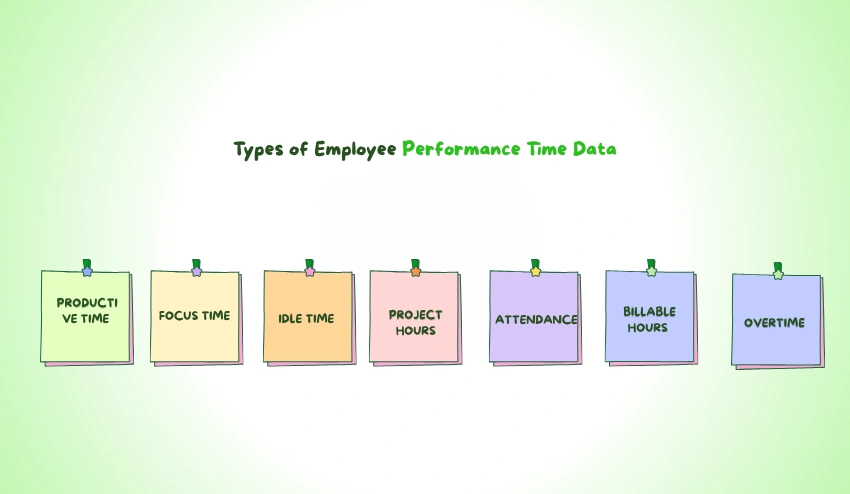
To get a real sense of performance, organizations need to collect time data across many categories, not just one metric.
1. Productive Time
Productive time is time employees spend doing meaningful, value-adding work that directly supports the business’s objectives.
Examples include:
- Developing software
- Designing marketing campaigns
- Writing reports
- Meeting with clients
- Solving customer issues
The manual way of clocking in to tasks or projects becomes redundant when you use automatic time tracking software. It simply helps you log all your time spent working in the background without having to mark anything yourself.
2. Focus Time
What is Focus Time? A block of time with no interruptions for deep work. Some employees work their best during times with the proper, long stretches of time for challenging tasks.
Organizations that prioritize focus time often find themselves
- Faster project completion
- Fewer mistakes
- Higher creativity
- Better problem-solving
3. Idle Time
Idle time refers to time you spend while not actively getting work done during scheduled working hours.
- Waiting for client approvals
- System outages
- Team dependencies
- Scheduled breaks
- Training sessions
The goal isn’t to eliminate idle time but to identify avoidable inefficiencies that impact productivity.
4. Project Hours
Employee time tracking records the amount of time a team member spends working on each individual project, client, or endeavor.
It’s valuable data for project owners looking to get a better idea of project profitability, optimize resource scheduling, and more accurately predict project time requirements.
With precise Timesheet and Report information, you have a better picture of your time spent across the various projects your teams are engaged on and can identify when delays, scope changes, or resource limitations arise.
5. Attendance
Attendance is simply monitoring to ensure that your employees are physically present during their designated work shifts.
Attendance will still be necessary to manage your workforce effectively and maintain compliance, but attendance will not and should not be your sole measure of performance.
Even though most businesses track employee hours, there are several key questions you can’t answer through attendance alone.
- Was the employee productive?
- Were deadlines met?
- Was the work completed accurately?
- Did the employee spend time on high-value activities?
Attendance should always be analyzed alongside productivity and performance metrics.
6. Billable Hours
In the world of agencies, consultants, freelancers, and professional service companies, billable hours are time you can invoice to your customers.
Measuring billable hours helps companies:
- Measure profitability
- Improve client billing accuracy
- Optimize resource utilization
- Increase revenue per employee
7. Overtime
Overtime work is the work that is done outside of regular working hours.
Excessive overtime can be a sign of:
- Poor workload planning
- Staffing shortages
- Unrealistic deadlines
- Increased burnout risk
Rather than punishing for overworking, organizations should look into why these overtime hours are being worked and workload distribution methods.
Why Time Data Matters More Than Hours Worked?
For decades, organizations equated long working hours with high performance. Employees who stayed late or logged extra hours were often viewed as the most dedicated and productive members of the team.
However, today’s workplace tells a different story.
In knowledge-based industries, success is rarely determined by the number of hours worked. Instead, it depends on how effectively employees use their time to produce meaningful outcomes. Someone who completes high-impact work in six focused hours can contribute more value than someone who spends ten hours switching between meetings, emails, and low-priority tasks.
This is why organizations are moving beyond attendance-based evaluations and embracing time data as a more reliable indicator of employee performance.
Instead of asking:
- How many hours did an employee work?
Modern organizations ask:
- How much productive work was completed?
- How much uninterrupted focus time did the employee have?
- Were projects delivered on time?
- Was overtime necessary or avoidable?
- How efficiently was time allocated across priorities?
- Did work quality improve or decline over time?
These questions provide a much clearer picture of performance than hours worked alone.
Hours Worked ≠ Employee Performance
Working longer doesn’t automatically mean working better.
Consider the following example.
| Performance Metric | Employee A | Employee B |
| Hours Worked | 40 | 60 |
| Productive Hours | 34 | 29 |
| Deep Work Sessions | 22 | 10 |
| Projects Completed | 10 | 8 |
| Error Rate | Low | High |
| Customer Satisfaction | 98% | 89% |
But despite working 20 hours extra, Employee A still delivered much better results.
Which brings me to an essential truth:
Focus on outcomes supported by time tracking. Not hours spent at the desk.
Accurate Performance Insights empower managers to spot those who are adding value. Regardless of the time they invest.
Time Data Reveals Hidden Productivity Patterns
This temporal aspect of data gives you insights into team members’ work behaviors in a way that conventional employee reviews simply cannot.
For instance, managers can observe:
- Employees who consistently complete projects ahead of schedule.
- Teams spending too much time in meetings.
- Departments with excessive overtime.
- Workflows that create unnecessary delays.
- Employees who need additional support or training.
- High-performing employees at risk of burnout.
These insights help leaders improve processes rather than making assumptions based on appearances.
Improve Decision-Making with Data
Objective performance data leads to better business decisions.
Managers can use time analytics to:
- Allocate workloads more fairly.
- Estimate project timelines more accurately.
- Identify opportunities for automation.
- Recognize top performers based on measurable outcomes.
- Support employees through coaching instead of criticism.
When an organization opts for a transparent time tracking system your staff can believe in, it fosters an environment ripe for improvement and increased accountability.
Time Data Supports Employee Well-Being
Most people think that time tracking is meant for the purpose of monitoring employees.
In practice, the use of such a tool, carried out ethically, contributes to the safety of employees from excessive workloads.
For instance, managers can easily determine:
- Employees are regularly working 12-hour days.
- Teams experiencing continuous overtime.
- Individuals with little uninterrupted focus time.
- Departments facing staffing shortages.
Leaders can help avoid burnout by redistributing workloads, changing deadlines, and not over-rewarding over-workers.
That’s part of the reason why many companies are using the best employee tracking methods and replacing the outdated evaluation methods.
Benefits of Measuring Employee Performance Using Time Data
Organizations that use meaningful time data to measure performance make better decisions than those using intuition or yearly reviews.
Instead of being measured by visibility or the number of hours worked, managers can get an objective view of productivity and efficiency, how much they are helping each other out, and how much they are spreading their work out.
This creates an environment where staff are fairly assessed, managers make effective decisions, and teams continually evolve and develop.
1. Increases Employee Productivity
When employees receive regular performance feedback, they become more aware of how they are spending their workday, which leads to improved awareness.
When employees receive regular performance feedback based on time data, awareness is improved.
Instead of simply working longer hours, they learn to:
- Prioritize high-impact work.
- Reduce unnecessary meetings.
- Eliminate distractions.
- Improve focus.
- Complete tasks more efficiently.
Focusing on small improvements in daily work habits can yield big productivity gains over time.
2. Creates Fairer Performance Evaluations
Traditional appraisals tend to be subjective and/or recent.
Time data gives more objectivity because managers can assess employees based on certain common parameters like
- Productive time
- Task completion
- Focus sessions
- Project delivery
- Utilization
- Attendance trends
These measures, when applied to business outcomes, make for more balanced and transparent evaluations.
3. Improves Workload Planning
There are some who are overburdened and others who are underutilized.
If the managers don’t know, they won’t know, and projects may only be discovered as they get behind schedule.
Organizations can use time analytics to:
- Equally distribute workloads among teams.
- Forecast staffing requirements.
- Improve resource allocation.
- Reduce project delays.
- Increase overall team efficiency.
4. Reduce Employee Burnout
Often, symptoms of burnout are early signs of reduced productivity, reduced focus time, and overtime.
By tracking these trends, managers can take action before the performance is negatively affected.
Preventative actions include:
- Adjusting workloads.
- Hiring additional staff.
- Prioritizing projects.
- Encouraging regular breaks.
- Improving workflow efficiency.
Good employee health relates to employee productivity over time.
5. Enables Better Coaching
Objective data can make performance conversations much more productive.
Instead of saying,
You don’t seem to be as productive these days.
a manager can say,
You have been focusing less and meeting more over the last month. What are the things that are causing those meetings?
This helps to facilitate cooperative problem-solving instead of confrontational dialogue.
6. Improves Profitability
Each hour spent by employees on low-value work is an hour lost to the business.
Time analysis can be used by businesses:
- Reduce wasted effort.
- Increase billable utilization.
- Improve project pricing.
- Optimize staffing.
- Eliminate inefficient processes.
These enhancements have a positive impact on increased profitability.
7. Enhances Forecasting Accuracy
Historical time data helps us to see into the future.
Managers can estimate:
- Project duration.
- Resource requirements.
- Budget needs.
- Delivery timelines.
- Capacity planning.
Actual performance data is much more reliable for forecasting than is based on assumptions.
8. Increases Visibility Across Remote Teams
Performance management is more difficult in the remote environment.
With today’s technology, managers are no longer able to gauge how work is going simply by being there.
Rather, they require information that is objective on:
- Work completed.
- Productivity trends.
- Project progress.
- Workload distribution.
- Team collaboration.
This visibility can be achieved by the use of time data in a responsible way and without fostering a culture of micromanagement.
The Society for Human Resource Management (SHRM) states that employers with clear performance expectations and frequent feedback, coupled with measurable goals, are more likely to engender engaged workers and better organizational performance.
Time Data can be used to help managers make objective assessments and make better use of their coaching conversations.
Employee Performance Metrics That Actually Matter
The collection of employee time data is just the first step. The true value lies in converting this data into actionable employee performance metrics, which can aid managers in assessing productivity, efficiency, and the broader impact on the business.
Organizations can make informed, objective, and equitable performance decisions without making assumptions or relying on personal observations but instead using measurable KPIs.
Today’s Time Tracking solutions do more than just capture working hours. They give informative Performance Insights on time spent by employees, opportunities to enhance productivity patterns, and insights into workflow improvements.
Businesses that Embrace Objective Measures of Employee Performance and, not just attendance, foster a culture of continual improvement, not micromanagement.
The best companies don’t rely on just one data point to evaluate employees. Rather, they assess productivity, work quality, efficiency, teamwork, and business results.
This equitable strategy is used to acknowledge high achievers, pinpoint coaching needs, and fairly assess staff wherever and whenever.
Why Do Performance Metrics Matter
Where traditional performance reviews fail to provide answers to key business questions, employee performance metrics can.
For example:
- What are the characteristics of those employees who routinely deliver quality work?
- Which student finishes work quickly and accurately?
- Which teams are burdened with too much work?
- What are the areas of delay or stumbling blocks on projects?
- Who needs extra coaching/training?
- What are some ways that managers can distribute load?
Managers can use measurable KPIs to enhance performance management, workforce planning, and employee development, rather than relying on perception.
Accurate time-tracking details also enable managers to discover long-term trends as opposed to just recent performance. This helps to minimize bias and ensures a clear employee evaluation process.
1. Productivity Score
Productivity Score is the percentage of productive working time that employees spend on activities that create value. It is one of the most critical measures of employee productivity since it relies on tasks that are work-related and not just attendance.
Formula
Productivity Score (%): Productive Time/Total Working Time × 100.
Example
An employee has a total of 40 hours per week.
- Productive Time = 32 hours
- Total Working Time = 40 hours
Productivity Score:
(32 ÷ 40) × 100 = 80%
80% would suggest that the employee is engaged in 80% of their workday that is directly focused on business objectives.
But productivity always needs to be judged in conjunction with quality. An employee who works quickly but produces poor-quality work isn’t necessarily performing well.
By using automatic time tracking, organizations can gain a more accurate picture of productivity because they are eliminating the possibility of timesheet errors and also the time that is recorded as being productive throughout the day.
Why It Matters
A productivity score aids organizations in:
- Identify highly productive employees.
- Detect workflow inefficiencies.
- Improve workload planning.
- Minimize time spent on low-value activities.
- Support conversations about coaching using data.
2. Efficiency Rate
Efficiency is the ratio of the work done by the employee to the amount of time that is expected to be needed to do the work.
Productivity deals with the use of time, efficiency deals with the use of time by the employees.
Formula
Efficiency (Rate %): (Expected Completion Time / Actual Completion Time) × 100
Example
The estimated time required to complete a project is 10 hours.
It takes the employee 8 hours to finish.
Efficiency Rate:
**(10 ÷ 8) × 100 = 125%**
This equates to 25% faster than expected work by the employee.
However, faster isn’t always better. Managers should ensure the work is of good quality and not reward high efficiency scores.
Why It Matters
The efficiency rate is useful for organizations to:
- Compare predicted and actual project time.
- Enhance future planning of projects.
- Identify workflow improvements.
- Acknowledge staff for being efficient in their work consistently.
- Reduce unnecessary delays.
Efficiency metrics and the ability to link to Performance Insights enables managers to gain insights into whether higher performance equals higher business results.
3. Task Completion Rate
Task Completion Rate is a measurement of the consistency of staff task completion within a given time frame.
It is especially helpful for project team members, customer support, marketers, software developers, and operations teams in which work is defined by the delivery of work products.
Formula
Task Completion Rate (in %) = (Completed Tasks/Assigned Tasks) × 100
Example
An employee gets 40 tasks during the month.
They complete a total of 38 tasks.
Task Completion Rate:
(38 ÷ 40) × 100 = 95%
The high completion rate suggests reliability and good time management.
But this should always be considered in conjunction with the quality of the work and the results of the work for the customer.
Why It Matters
Organizations can use tracking to help them:
- Measure employee reliability.
- Improve project visibility.
- Monitor team capacity.
- Identify missed deadlines.
- Facilitate more precise workforce planning.
Organizations that use task completion rates to track employee performance are able to take a quick read of the task completion report to see where more resources or coaching may be required.
4. Average Time to Completion
Average Time to Completion is the time that employees take to complete individual tasks or projects.
Tracking this KPI over time can enable organizations to pinpoint trends in productivity, identify inefficiencies in their processes, and automate those processes.
Formula
Average Completion Time = Total Time Spent / Number of Completed Tasks
Example
During one week:
- Total Time Spent = 60 hours
- Completed Tasks = 12
Average Completion Time:
60 ÷ 12 = 5 hours per task
This efficiency boost could mean that they are more skilled at the job, have better workflows, or improved team collaboration.
On the other hand, if completion times start to grow, managers should look into the cause of the delay, which can be confused requirements, too many meetings, or resource issues.
Correctly filled-out Timesheets and Report data make it easier to analyze the trends of completed timesheets across projects and departments and to better estimate future workloads.
Why It Matters
Average completion time can be of benefit to organizations.
- Improve project estimation.
- Identify workflow bottlenecks.
- Evaluate process improvements.
- Reduce project delays.
- Increase operational efficiency.
But before you can track advanced KPIs, you’ll need to learn how to Track Employee Time Effectively.
All of the productivity metrics detailed below rely on an accurate and complete set of time tracking data. Without this, you can never expect any performance measure to be accurate.
5. Utilization Rate
Utilization Rate is the percentage of an employee’s work time that is billable or productive. It assists organizations in identifying if their employees are underutilized, working to capacity, or working too hard.
Whereas productivity is about the efficiency of the use of time, utilization is about using up capacity.
Formula
The formula for calculating Utilization Rate (%) is as follows: Productive Hours / Available Working Hours × 100
Example
An employee is available to work 40 hours in a week.
- Productive Hours = 32
- Available Hours = 40
Utilization Rate = (32 ÷ 40) × 100 = 80%
A utilization of 70% to 85% is deemed healthy for many knowledge-based jobs. A low utilization could mean that the service is underutilized, and a very high utilization could lead to higher stress and burnout.
Why It Matters
Utilization rate benefits organizations:
- Improve resource allocation.
- Forecast staffing requirements.
- Distribute workload evenly amongst teams.
- Identify underutilized employees.
- Don’t overwork yourself, or you’ll burn out.
6. Billable Percentage
With consulting firms, agencies, law firms, and accounting practices, the impact of billable utilization is a direct impact on profitability.
This KPI is the proportion of employee working time that contributes to the business’s revenue.
Formula
Billable Percentage (%) = (Billable Hours / Total Hours Worked) * 100
Example
- Billable Hours = 34
- Total Hours Worked = 40
Billable Percentage = 85%
A well-balanced billable percentage will help companies boost their profits and allow the staff to collaborate, train, and manage administrative tasks.
7. Focus Time Percentage
Focus Time is the percentage of the total time spent on meaningful, high-value work.
Those who have extended sessions of work regularly will make:
- Better quality work
- Faster project completion
- Higher creativity
- Fewer mistakes
Formula
Focus Time (%) = (Focus Hours / Total Working Hours) x 100
Example
- Focus Hours = 24
- Working Hours = 40
Focus Time = 60%
Those who are software developers, software designers, software analysts, software engineers, software writers, and other knowledge workers, in particular, should pay attention to protecting their focus time.
8. Revenue Per Hour
Revenue Per Hour (RPH) is the amount of money earned per hour of work.
Formula
Revenue Per Hour = Total Revenue Generated / Total Hours Worked.
Example
- Revenue Generated = $12,000
- Hours Worked = 240
Revenue Per Hour = $50
This KPI assists the business leaders to assess the profitability and find opportunities to make the business more efficient.
9. Quality Score
If staff regularly produce mistakes, or need lots of corrections, then there’s not much point in having high productivity.
Always consider time measures in conjunction with quality measures.
A quality score can consist of:
- Customer satisfaction
- Error rates
- Manager evaluations
- Peer reviews
- Compliance standards
- Rework percentage
When coupled with quality metrics, understanding employee strengths examples can help managers identify individual talents and tailor coaching for growth.
10. Deadline Success Rate
Meeting deadlines reflects good planning, prioritizing, and doing.
Formula
Deadline Success Rate (%) = (Projects Completed On Time ÷ Total Projects) × 100
Example
- Projects that were completed on time = 18.
- Total Projects = 20
Deadline Success Rate = 90%
A company that has a very high rate of meeting deadlines typically has more satisfied customers, better profitability, and better teamwork.
11. Attendance Rate
Attendance indicates the reliability of employees and participation in scheduled work.
Formula
Attendance Rate (%) = (Days Present ÷ Scheduled Working Days) × 100
Example
- Days Present = 21
- Scheduled Days = 22
Attendance Rate = 95.5%
Attendance is a valuable aid to workforce planning but should never be the only indicator of employee performance. Attendance should always be assessed in conjunction with productivity, quality, and business results.
12. Overtime Percentage
While it may be necessary to work overtime during high-traffic projects, too much overtime can indicate other issues.
Formula
Overtime Percentage (%) = (Overtime Hours ÷ Total Hours Worked) × 100
Example
- Hours = 8
- Total Hours Worked = 48
Overtime Percentage = 16.7%
More often than not, overtime is not a sign of commitment; it is a sign that work may be getting done at the last minute, due to unrealistic deadlines, workers being understaffed, or time management inefficiencies. Overtime is not a sign of commitment, managers should seek to understand why it is occurring and whether the cause of the overtime is deadlines that are too short, too few workers, or time management inefficiencies.
Overtime tracking, in turn, assists companies in minimizing the time theft that can occur due to inaccurate records, poor scheduling, or business-overloaded workloads, as well as establishing fair and objective performance measurement.
13. Learning and Development Time
Great companies realize employee development directly helps them succeed in the long term.
Learning time consists of:
- Professional certifications
- Online training courses
- Internal workshops
- Mentoring sessions
- Cross-functional learning
- Leadership development
Monitoring learning time fosters ongoing enhancement and enables the development of future-proof teams in organizations.
14. Context Switching Frequency
Context switching is the number of times an employee switches from one task, project, meeting, or software application to another throughout the workday.
If this is done regularly, it can result in:
- Reduced concentration
- Lower productivity
- Increased stress
- More mistakes
- Longer completion times
Managers need to minimize the amount of unnecessary interruptions by putting in place and utilizing the best employee tracking methods available: not tracking individual actions, but instead optimizing workflow.
| KPI | Measures | Primary Business Benefit |
| Productivity Score | Productive Work Time | Improves productivity |
| Efficiency rate | Speed of Work | Optimizes workflows |
| Task Completion Rate | Work Completion | Measures reliability |
| Average Completion Time | Time Per Task | Improves project planning |
| Utilization Rate | Productive Capacity | Better resource allocation |
| Billable Percentage | Revenue-Generating Work | Increases profitability |
| Focus Time | Deep Work | Improves work quality |
| Revenue Per Hour | Financial Performance | Measures business value |
| Quality Score | Accuracy | Reduces costly errors |
| Deadline Success Rate | One-time Delivery | Improves customer satisfaction |
| Attendance rate | Reliability | Supports workforce planning |
| Overtime Percentage | Extra Work Hours | Prevents burnout |
| Learning Time | Employee Development | Builds future skills |
| Context Switching | Workflow interruptions | Improves efficiency |
Measuring Performance Beyond the Numbers
KPIs are great tools for getting an understanding, but they need to be read in the context of the whole picture. Best practices in performance management incorporate a mix of quantitative and qualitative data to provide a holistic view of employee achievement.
It is also important for managers to understand what employee monitoring software is and how a new generation of monitoring tools is different from the intrusive ones.
Today’s solutions focus on productivity analytics, workload optimization, and the support of employees instead of constant observation.
Likewise, knowing the difference between Employee Monitoring vs Employee Surveillance lets businesses establish trust whilst keeping accountability.
Ethical monitoring focuses on transparency, employee participation, and business improvement rather than intrusive monitoring.
When organizations adopt a transparent time tracking system employees trust, they create a culture where time data becomes a coaching tool instead of a control mechanism.
Data-driven performance analysis is more likely to be adopted by employees when they know it is not about watching them and knowing where they are all the time but about enhancing their processes, celebrating their successes, and advancing their careers.
If you’re interested in understanding more about ethical productivity tracking, our Best Employee Productivity Tracking Guide examines the best practices for measuring productivity while maintaining employee satisfaction and the long-term health of your business.
A 7-Step Framework for Measuring Employee Performance Using Time Data
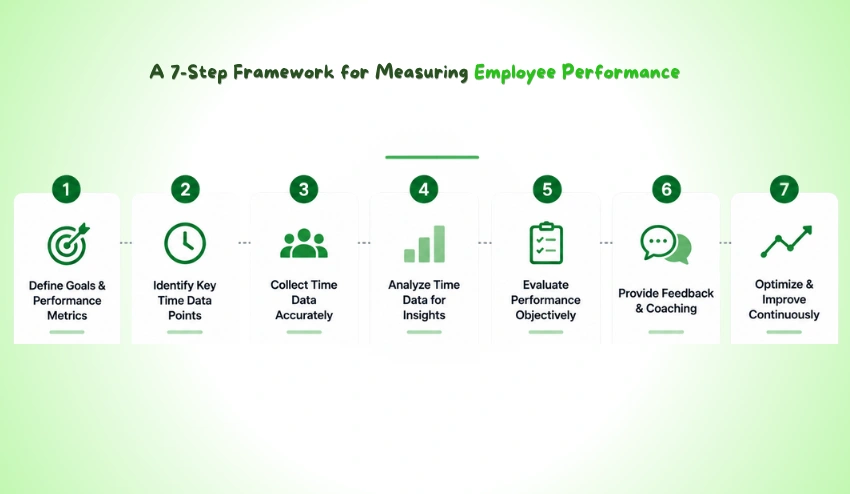
Unless time data is used to make better decisions, it is of little value. Organizations spend time on time-tracking software but without being able to convert data into performance improvement. Either they work too many hours or they follow too many metrics without correlating them with business outcomes.
The best way to do this is to implement a formal structure that integrates employee objectives, time tracking, productivity metrics, and frequent coaching. This means that it is used to measure performance without putting undue pressure on the employee.
Here is a simple 7-step process that an organization of any size can follow to fairly and consistently measure employee performance.
Step 1: Set SMART Performance Goals
All performance measurement procedures should start with clearly defined goals. Before making an evaluation, employees must know what success is.
To develop goals using the SMART goal framework that are:
- Specific
- Measurable
- Achievable
- Relevant
- Time-bound
- Example
Instead of saying
“Improve customer support.”
Set down a measurable objective, such as
Improve customer satisfaction from 88% to 93% in the next 3 months with an average First Response time of less than 2 hours.
Having clear goals assists employees in focusing their effort and making more objective performance assessments.
Best Practice
Ensure every specific goal aligns with the team and business goals. Familiarity with how the work of employees is helping the organization succeed helps to boost their engagement.
Step 2: Define the Right KPIs
After goals are set, identify the most appropriate Key Performance Indicators (KPIs) that will track progress.
Each job comes with its own set of performance measures. For instance, a software developer’s KPIs shouldn’t be the same as those of a sales or customer support representative.
Some role-specific KPIs are:
| Department | Recommended KPIs |
| Sales | Revenue, conversion rate, follow-up time |
| Marketing | Campaign ROI, content production, lead generation |
| Customer Support | Resolution time, CSAT, first-response time |
| Software Development | Sprint completion, bug rate, code quality |
| Finance | Report accuracy, processing time, compliance |
| Human Resources | Hiring time, employee retention, onboarding completion |
Step 3: Collect Accurate Time Data
Accurate data is crucial for reliable performance measurement.
A lack of or incomplete information results in poor KPIs and poor evaluations.
To gather data, include:
Productive hours
Focus time
Billable hours
Non-billable work
Project time
Overtime
Attendance
Task completion time
Idle time
Utilization rate
Focus should always be on work patterns and not on the monitoring of all activities.
Good time data can help managers understand trends, rather than reacting to individual events.
Step 4: Analyze Trends Instead of Individual Days
There is always one major mistake made by the managers: they take the benchmark from a single busy day or an unusually slow week.
All performance should be assessed over time.
Look for patterns such as:
- Boosting productivity over a period of several months.
- Declining focus time.
- Consistent overtime.
- Increasing task completion rates.
- Seasonal workload changes.
- Recurring project delays.
Trend analysis is much more accurate than one-off observations.
Example
An employee might show up as not as productive in one week, as he or she has spent most of that time introducing a new worker to the team. An unfair evaluation could be made if one only took data from that one week.
To better inform decisions, review monthly or quarterly trends.
Step 5: Combine Time Data with Business Outcomes
Time data should not be used alone to assess data.
An employee can work for 8 hours on a project, but the critical question is, what did he get done?
Effective performance measurement is the blending of time-based measurements with outcome-based measurements, including
- Work quality
- Customer satisfaction
- Revenue generated
- Project success
- Innovation
- Collaboration
- Goal completion
- Error rates
For example:
| Time Data | Business Outcome |
| High productivity | High customer satisfaction |
| Strong focus time | Better work quality |
| Reduced overtime | Lower employee burnout |
| Improved utilization | Higher profitability |
When organizations combine both perspectives, they gain a complete understanding of employee performance instead of relying on a single metric.
Step 6: Coach Employees Using Data
Performance measurement should aid in employee development and not just in assessing past performance.
To support managers in using the information about performance in the regular one-on-one meeting, they should:
Celebrate achievements.
Identify strengths.
Discuss challenges.
Remove workflow obstacles.
Set improvement goals.
Provide additional resources.
Instead of saying,
You aren’t very productive.
Use data to create constructive conversations:
Over the last month, you’ve had 20% fewer focus hours and more hours spent in meetings, let’s find ways to protect more focus hours.
This helps to foster a sense of cooperative teamwork rather than defensiveness.
An ongoing training process creates trust and helps employees improve their skills continuously over time.
Step 7: Review Performance Regularly
Performance management is not a one-off activity—it’s a continuous process.
Successful organizations conduct the following:
- Weekly team reviews
- Monthly KPI evaluations
- Quarterly performance discussions
- Annual strategic development reviews
Regular reviews aid managers:
- Identify trends early.
- Use goal setting to adjust when priorities change.
- Recognize employee achievements.
- Provide timely coaching.
- Prevent performance issues from becoming long-term problems.
Staff also receive regular feedback, as they know how they are doing and how to improve.
Time Data vs. Employee Surveillance
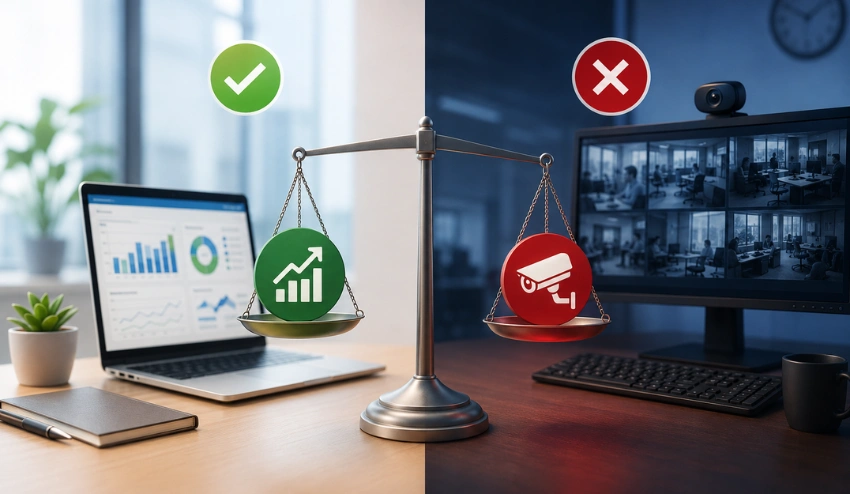
The biggest misconception about employee time tracking is that it equates to employee surveillance.
Time data and employee surveillance have very different purposes, in reality.
Companies that leverage time data responsibly pay attention to productivity, support the employee, and optimize the workflow. With surveillance, though, the focus is on watching more rather than showing performance improvement.
Time Data Supports Better Work
Ethical time tracking can assist companies in addressing questions such as:
- Is the workload evened out among team members?
- What are the most time-consuming projects?
- Do employees have adequate time to work on high-value tasks?
- What are the points of delay in the process?
- Who are the teams that are at risk of burnout?
These insights enable managers to enhance processes rather than to observe individual behavior.
Employee Surveillance Focuses on Observation
Surveillance tends to focus on the monitoring of activities like:
- Continuous screen recording
- Webcam monitoring
- Keystroke logging
- Mouse movement tracking
- Constant activity monitoring
These approaches may yield visibility, but they do not necessarily have a positive impact on productivity alone and can erode employee trust if they are not done transparently.
Ethical principles of using time data
There are several best practices to consider when using time data to measure employee performance:
- Be clear about the information that is gathered.
- Describe the reasons for collecting the data.
- Take the time to streamline processes rather than track people.
- Provide feedback to staff.
- Protect employee privacy.
- Gather only information needed for business purposes.
- Apply data to coach, not punish.
If staff know time data is being used for staff development, they are more likely to trust the process and want to be involved in staff development initiatives.
Building a Culture of Trust
The measure of performance is not to control people; it’s to help them succeed.
When management is transparent, ethical data practices are followed, and managers provide regular coaching, working time tracking is not a source of anxiety but a facilitator of collaboration.
The purpose, of course, is not to observe employees’ work. The aim is to grasp how work operates, eliminate productivity challenges, and establish a work setting where every employee and business can flourish.
Employee Performance Dashboard
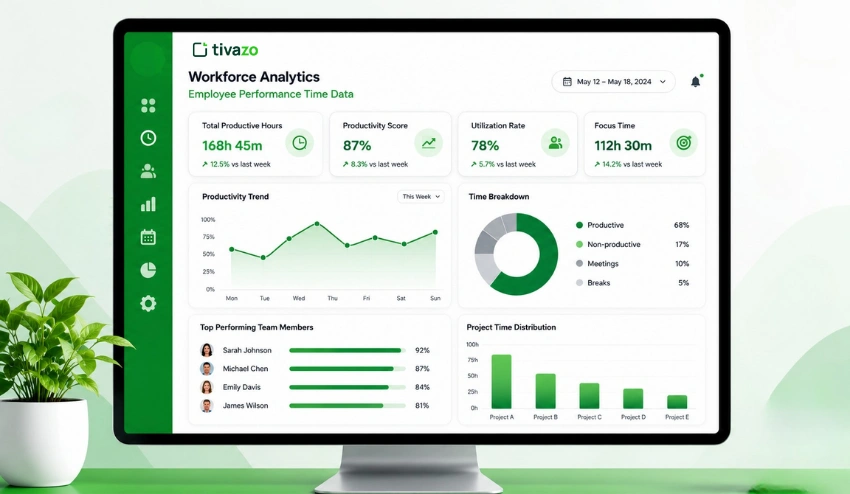
Data about employee time turns into action with an Employee Performance Dashboard that provides a comprehensive view of productivity, workload, and team performance. Leaders can make informed decisions without having to go through spreadsheets.
The following elements should be included in a well-designed dashboard:
- Daily productive hours
- Weekly productivity trends
- Monthly KPI summaries
- Utilization rate
- Focus time
- Billable vs. non-billable hours
- Overtime analysis
- Attendance trends
- Project progress
- Team performance comparison
The objective is not to keep track of every minute that an employee works but to ensure that opportunities exist to coach, balance workload, and continuously improve.
Organizations should also ensure that employee performance data is collected responsibly. Following internationally recognized standards such as ISO 27001 for information security helps businesses protect employee data, improve transparency, and maintain trust while using time-based performance analytics.
Common Mistakes Companies Make
If time data isn’t accurate, then organizations can make poor decisions regarding performance even if it’s on the right measures.
Common mistakes include:
- Measuring only hours worked instead of outcomes.
- Ignoring work quality and customer satisfaction.
- Tracking too many KPIs without clear objectives.
- Comparing employees in different roles using the same metrics.
- Using time data to punish employees instead of coaching them.
- Ignoring employee feedback when evaluating performance.
- Failing to review performance trends regularly.
These errors prevent the implementation of a fair, transparent, and employee-centric performance management process.
Best Practices for Measuring Employee Performance
There are some time-tested best practices that organizations can follow to gain the most value from employee time data.
- Set clear goals and measurable KPIs.
- Measure productivity alongside work quality.
- Review performance trends monthly instead of focusing on daily fluctuations.
- Share performance data with employees to encourage transparency.
- Use time data for coaching, recognition, and development—not micromanagement.
- Continuously refine KPIs as business priorities evolve.
- Combine time data with qualitative feedback for a complete performance evaluation.
These practices can help organizations increase productivity, foster trust and a culture of continuous improvement, and ensure that employees feel supported and not monitored.
How Company A Improved Employee Performance with Time Data
An agency, not necessarily massive but in the middle tier, had a recurring issue with missed deadlines, imbalanced task distribution, and lots of overtime.
Management relied on hand-written reports and educated guesses, so pinpointing the sources of low productivity was a real challenge.
Implementing a transparent time-tracking system revealed a lot. Instead of merely tracking who attended and when, the company started looking at such figures as, for example, productive hours, focus time, utilization rates, and project completion.
Within half a year of adopting new methods, the company has shown some promising results:
| Before | After |
| 25% overtime | 10% overtime |
| 78% on-time project delivery | 94% on-time project delivery |
| Uneven workload distribution | Balanced team workloads |
| Limited performance visibility | Data-driven performance reviews |
How Tivazo Helps
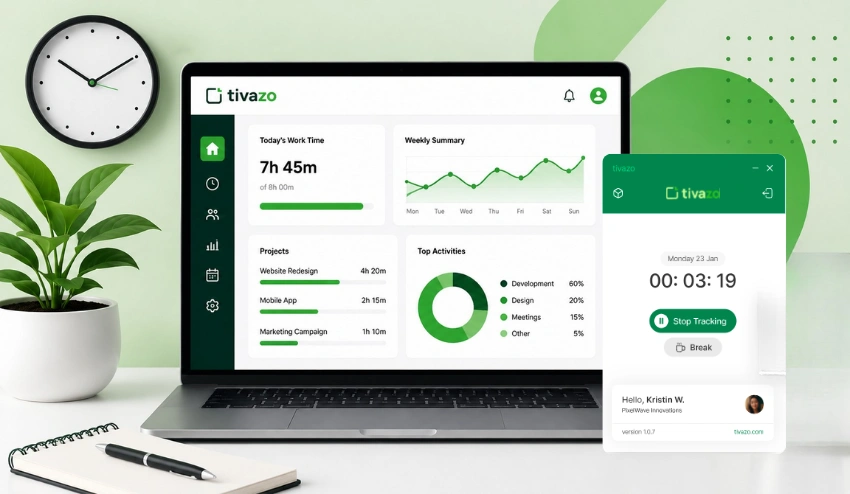
Tivazo enables businesses to gauge employee productivity with meaningful, not intrusive, data. With features like Time Tracking, Performance Insights, and comprehensive Timesheets and Reports, managers can monitor productivity trends, analyze project progress, and make informed workforce decisions.
The platform also streamlines workload management, logs productive and non-billable time, detects overtime trends, and offers comprehensive productivity insights with clear dashboards. Tivazo transparency and accuracy in time tracking help businesses streamline, enhance employee growth, and build a more balanced and efficient work environment.
Comparison Table
| Feature | Traditional Reviews | Time Data | AI Performance Analytics |
| Review Frequency | Annual or Quarterly | Continuous | Real-time |
| Data Source | Manager Opinion | Time & Work Data | Predictive Analytics |
| Objectivity | Low | High | Very High |
| Coaching Opportunities | Limited | Regular | Proactive |
| Burnout Detection | Difficult | Moderate | Advanced |
| Decision-Making | Subjective | Data-Driven | Predictive & Automated |
20 Expert Tips
- Measure outcomes, not just hours worked.
- Set SMART performance goals.
- Review KPIs every month.
- Protect employees’ focus time.
- Balance workloads across teams.
- Reward quality over speed.
- Monitor overtime regularly.
- Use data for coaching, not punishment.
- Track trends instead of isolated events.
- Align KPIs with business goals.
- Encourage employee feedback.
- Automate repetitive reporting tasks.
- Reduce unnecessary meetings.
- Support continuous learning.
- Use role-specific performance metrics.
- Review utilization rates frequently.
- Recognize top performers consistently.
- Improve workflows before increasing workloads.
- Share performance dashboards transparently.
- Continuously refine your performance measurement strategy.
Conclusion
Measuring employee performance is no longer about who works the longest, it’s about how to use time to achieve positive business results. Time data, along with productivity, quality, and goal-driven KPIs, can be used to make better hiring decisions, enhance employee efficiency, and enable growth.
The focus is on using time data appropriately. Instead of just looking out for the usual suspects, it is far better to use performance insights to see what is creating bottlenecks, rebalance workloads, prevent burnout, and allow employees to celebrate their successes.
Employees will be more willing to accept time tracking when they see the value in the system and how it will enhance workflows and the ability to coach them.
From managing a small team to a global workforce, having a clear, data-informed performance approach will help create a more productive, engaged, and high-performing work environment.
Using the right tools and time-based performance reviews, organizations can make time data a competitive asset.
As the workplace continues to evolve, organizations must move beyond measuring attendance alone. The World Economic Forum emphasizes that data-driven decision-making, digital skills, and continuous performance improvement will remain essential for building resilient and future-ready workforces. By combining time data with meaningful performance metrics, businesses can create a culture of accountability, transparency, and continuous growth.